



Contemporaneous, fact-based patient care reports, with clear timestamps and documented reasoning, stand as an EMS provider’s primary legal defense in court. We write this for every clinician who has wondered whether a chart written in the middle of the night will hold up months later in a deposition. It will, if it separates observed facts from interpretation, captures why a patient refused care, and keeps an honest audit trail with any later edits logged as amendments.
TL;DR:
- For high risk refusals, document understanding, appreciation, reasoning, and a clear choice, then record the patient’s exact words, risks and benefits discussed, barriers, and alternatives.
- A modified Delphi panel of 19 physicians reached an 80% consensus threshold on 16 standardized steps for assessing capacity to refuse transport.
- Record dispatch, arrival, assessments, interventions, reassessments, and handoff times; explain delays and changes in the care plan with brief factual notes.
- Correct submitted reports only through separately timestamped amendments that explain the reason; never overwrite the original, because electronic audit trails preserve edit history.
Table of Contents
- How Courts and Regulators Use PCRs and ePCRs as Evidence
- What Reviewers Look for in Facts, Timelines, and Clinical Reasoning
- High-Risk Refusals and Capacity Documentation: A Checklist Approach
- ePCR, NEMSIS Elements, Audit Trails, and Late Edits
- Preparing to Testify About What You Wrote
- Common Charting Pitfalls That Undermine Legal Defense
- How PSCG Supports Defensible Documentation and Testimony
- Charting Is Care, Not Paperwork
- Strengthen Your Agency’s Documentation Before You Need It in Court
- FAQ
- Sources
How Courts and Regulators Use PCRs and ePCRs as Evidence
A patient care report lets a reviewer who was never on scene reconstruct what happened: the dispatch, the assessment, the interventions, and the handoff. EMS documentation serves patient handoff, billing, quality improvement, and legal review all at once, and an incomplete report can expose a provider to disciplinary action long after the call ends.
Courts and regulatory boards both weigh the same qualities: completeness, internal consistency, and whether the record was written close to the time of care rather than reconstructed later. Baan v. Columbia County shows how central a single EMS report can become when a patient’s condition and the applicable protocol are in dispute. The chart is often the only neutral witness left once memories fade.
Recent coverage from JEMS makes the stakes plain: documentation is frequently a provider’s strongest legal shield, but legal immunity is not automatic when a deviation from protocol goes unrecorded or unexplained.
What Reviewers Look for in Facts, Timelines, and Clinical Reasoning
A defensible chart keeps three things visibly separate: what you observed, what the patient or a witness said, and what you concluded from it. Blending them into one sentence invites a cross-examining attorney to ask which part was fact and which was your opinion.
Reviewers also look hard at timing. Dispatch, arrival, assessment, each intervention, and handoff should carry precise times, and any delay deserves a short, factual reason rather than silence. A gap in the timeline reads as a gap in the care.
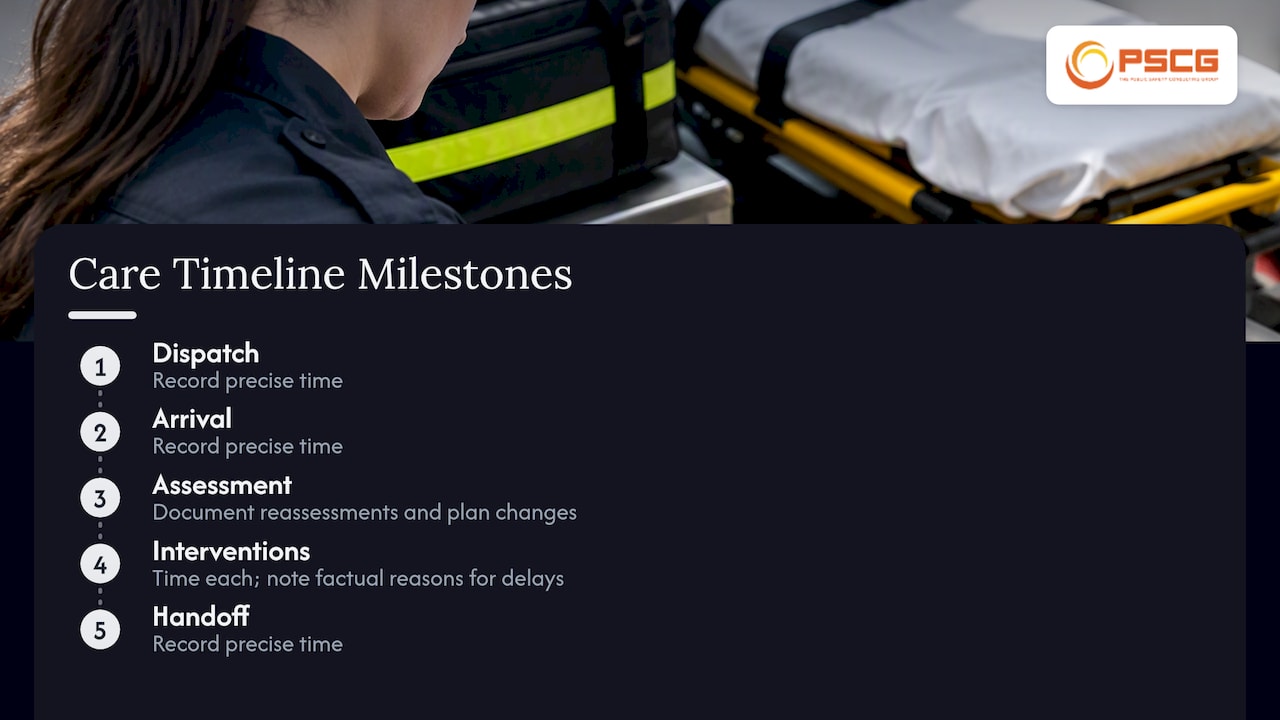
Finally, document every reassessment and explain why your plan changed. If a patient’s mental status improved after glucose, say so and note the follow-up vitals. A chart that only shows one snapshot in time leaves a reviewer guessing about everything that happened between arrival and transport, and guessing is exactly what a courtroom exists to resolve.
High-Risk Refusals and Capacity Documentation: A Checklist Approach
Refusals carry the heaviest legal weight of any call type, and the charting has to match that weight. A modified Delphi panel of 19 physician experts reached an 80% consensus threshold on 16 standardized steps for evaluating capacity to refuse EMS transport, giving crews a structured way to show their reasoning rather than just their conclusion.
On scene, that consensus translates into several things worth charting every time:
- Understanding: the patient can restate, in their own words, what you told them about their condition.
- Appreciation: the patient connects that condition to their own situation, not an abstract risk.
- Reasoning: the patient can explain, however simply, why they are choosing to refuse.
- Expression of choice: the patient states a clear, consistent decision.
Record the risks and benefits you discussed, the patient’s exact responses, any interpreter or communication barrier, and the name and time of any online medical control physician consulted. Note which structured refusal checklist your agency uses and list any alternative care or transport options you offered.
Pro Tip: Quote the patient directly when documenting refusal reasoning. “I understand I could have a heart attack, but I’m not going to the hospital” does more legal work than “patient refused against advice.”
ePCR, NEMSIS Elements, Audit Trails, and Late Edits
Most states now require electronic patient care reports built on the NEMSIS v3 EMSDataSet, which assigns each record a unique identifier and structures required fields like times, scene details, and disposition so they can be aggregated nationally. That structure matters in court: a UUID and a creation timestamp prove when a record was first generated and whether it was touched afterward.
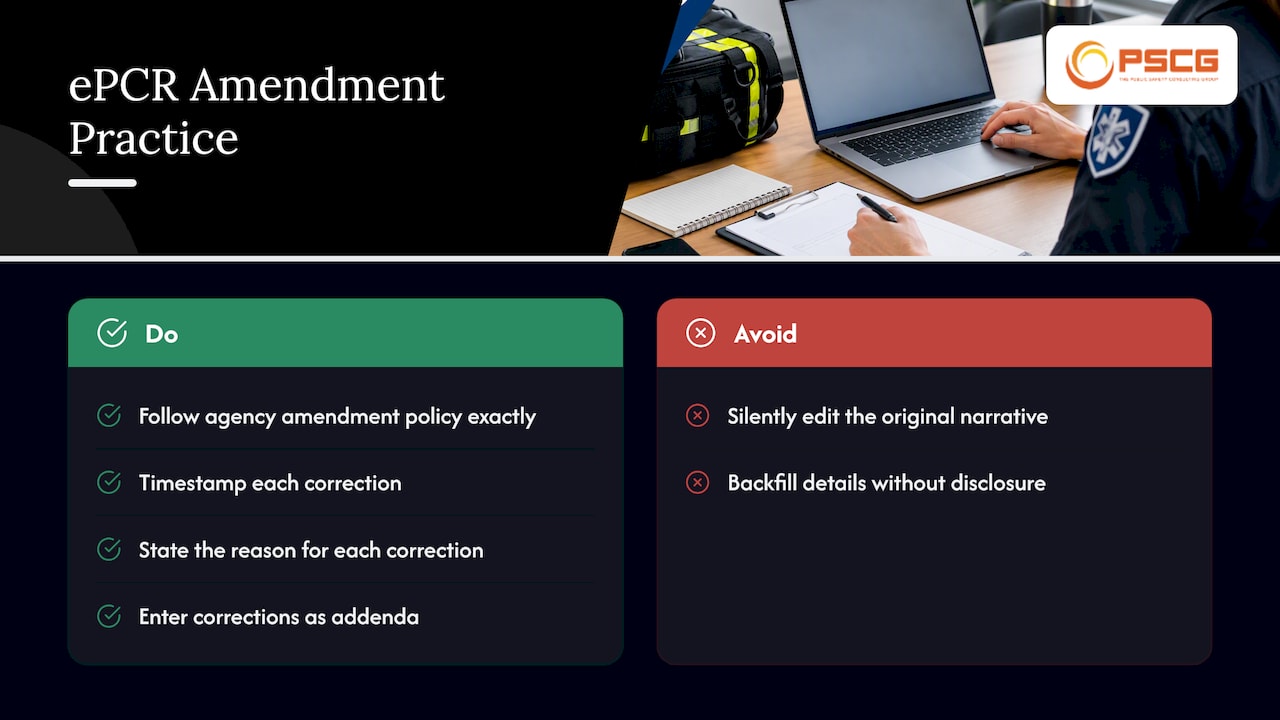
That audit trail cuts both ways. It protects a provider whose contemporaneous note holds up under scrutiny, and it exposes one who tried to backfill details days later without saying so. Follow your agency’s amendment policy exactly: any correction needs its own timestamp and a stated reason, entered as an addendum rather than a silent edit to the original narrative. Agencies evaluating ePCR platforms or integration projects can find useful context in CorLab’s overview of digital transformation in healthcare, which covers how modern clinical software handles exactly this kind of record integrity.
Preparing to Testify About What You Wrote
Testimony goes smoothly when it mirrors the written record instead of relying on memory of a call from months or years ago.
- Bring the originals. Request the contemporaneous ePCR or PCR, CAD logs, and any online medical control notes before the hearing, not the morning of.
- Rehearse short answers. Practice walking through your own entries in plain, concise language rather than narrating the whole call from scratch.
- Point to the chart, not your memory. When an attorney asks about a detail, answer from what you documented; speculation beyond the record creates openings you do not need.
Practical courtroom preparation built around these habits keeps testimony tight and keeps the written record, not your recall, doing the heavy lifting.
Common Charting Pitfalls That Undermine Legal Defense
Most documentation problems in court trace back to a short list of habits, and each one is fixable before it costs you.
- Backfilling entries: never add observations after the fact without labeling them as a dated, timed amendment.
- Vague language: “patient seemed fine” tells a jury nothing; “alert and oriented, denies pain, vital signs stable” tells them everything.
- Missing signatures or witness names: every crew member present and every bystander who spoke should appear by name.
- Loose record handling: keep patient records private and traceable, with a clear chain of custody from the call to the agency file.
How PSCG Supports Defensible Documentation and Testimony
We work with agencies to review documentation policies and train crews on documentation practices. Aligning policy and training this way narrows both regulatory exposure and legal risk before a single call ever gets questioned. When a case does go to court, an experienced EMS expert witness can walk a judge or jury through why a contemporaneous chart matters under applicable expert testimony standards.
Charting Is Care, Not Paperwork
We think of good documentation as an extension of patient care, not a chore tacked onto the end of a call. A record written clearly, in the moment, gives the next clinician a true picture of what happened and gives you peace of mind if that call is ever questioned months later. Treating every chart with that same discipline is a professional habit that pays off long before anyone mentions a courtroom.
— Mike
Strengthen Your Agency’s Documentation Before You Need It in Court
We built our consulting and training around one goal: helping your agency strengthen its documentation practices. Agencies can learn more about our operational risk reduction services.

When litigation is already underway, our EMS expert witness services provide support. Here is what that support looks like in practice:
- Operational risk reduction consulting.
- Professional education and training services.
- Expert witness support for legal cases.
Visit Thepscgroup to start a conversation about where your current documentation stands and what a focused review could change.
This article is general information, not a substitute for advice from a qualified lawyer. Consult a qualified legal professional about your own circumstances before acting on anything here.
FAQ
What makes a PCR admissible as evidence in court?
A patient care report generally becomes admissible when it was created contemporaneously with the care given and can be authenticated as a business record kept in the ordinary course of EMS operations. Courts weigh completeness, consistency, and whether any later changes were properly logged as amendments rather than silent edits.
How should EMS document a high-risk refusal of care?
Document the components of capacity, including understanding, appreciation, reasoning, and expression of choice, along with the specific risks and benefits discussed and the patient’s exact words. A 16-item consensus checklist from a 2025 physician Delphi panel offers a structured way to capture this reasoning in the chart.
What happens if I need to correct my PCR after submission?
Follow your agency’s amendment policy: add a new, separately timestamped entry explaining what changed and why, rather than altering the original narrative. NEMSIS-based ePCR systems typically log this activity through audit trails tied to the record’s unique identifier, so an undisclosed edit is usually visible to anyone reviewing the file.
Can an EMS expert witness help interpret my documentation in court?
Yes, an experienced EMS expert witness can explain to a judge or jury why specific charting choices, like timing, reassessment notes, or refusal language, matter clinically and legally. This kind of testimony is evaluated under applicable standards for expert qualification.
Do criminal and civil EMS cases require different documentation?
The underlying charting standards stay the same, but criminal cases tend to scrutinize chain of custody and record integrity more closely, while civil cases often focus more on whether care met the applicable protocol. In both settings, a complete, contemporaneous record gives you the strongest footing regardless of which court you end up in.
Sources
- Critical Steps for Determining Capacity to Refuse Emergency Medical Services Transport: A Modified D
- EMS Documentation – StatPearls – NCBI Bookshelf
- NEMSIS v3 EMSDataSet Guide
- BAAN v. COLUMBIA COUNTY (2015) | FindLaw
- Criminal Liability and Legal Challenges for EMS Providers