



Use a transparent, pre-published weighted rubric that places operational reliability and payer-compliance risk above lowest bid. The three items that matter most are operational performance (response times, staffing, fleet readiness), clinical quality, and reimbursement risk tied to Medicare denial patterns. Anchor your scoring to CMS rules and document every step so the award survives a protest. A specialized EMS consulting firm supports municipalities through exactly this kind of procurement review.
TL;DR:
- An ambulance RFP evaluation should prioritize operational performance, clinical quality, and reimbursement risk, with scoring weights favoring these aspects over price.
- Verifying proposer data such as response time data, staffing plans, fleet maintenance, and Medicare enrollment is critical before detailed scoring begins.
- Focus on assessing denial-management capabilities and total cost of ownership, including reimbursement risks, instead of relying solely on the lowest bid.
- Use the published CMS rules to shape contract terms around Medicare coverage, documentation, and appeals, and ensure evaluation timelines include response, scoring, and reference checks.
- Payments should be based on a weighted rubric, with independent scoring, conflict-of-interest declarations, and thorough documentation to protect the municipality from protests and challenges.
Table of Contents
- What Should an Ambulance RFP Evaluation Checklist Include?
- Building a Defensible Scoring Rubric and Weighting System
- Which Technical and Operational Criteria Deserve the Closest Look?
- How Do You Evaluate Price and Total Cost of Ownership?
- What CMS Compliance Rules Should Shape Your Contract Terms?
- What Does a Fair Evaluation Timeline Look Like?
- What Red Flags Should Concern a Procurement Team?
- An Editorial Take on Getting This Right
- How Thepscgroup Supports Your Procurement Process
- Sources
- FAQ
What Should an Ambulance RFP Evaluation Checklist Include?
Before you score a single point, run every proposal through a responsiveness and substance screen. This first pass catches disqualifying gaps before your evaluators invest hours in detailed scoring.
- Confirm minimum qualifications. Verify state ambulance licenses, Medicare supplier enrollment, certificates of insurance, and audited financial statements for the past two to three years.
- Cross-check operational commitments. Compare the proposed System Status Plan, unit-hour totals, and peak staffing levels against the call-volume data the proposer submitted.
- Demand clinical quality evidence. Look for a documented quality improvement program, a chart-review methodology, and named medical oversight.
- Test data and technology claims. Confirm ePCR compatibility with your dispatch and hospital systems, plus a defined reporting cadence and dashboard access.
- Review fleet and maintenance commitments. Check vehicle age, preventive maintenance schedules, and loaner-unit availability during breakdowns.
- Scrutinize billing and reimbursement plans. Identify the billing provider of record, the denial-management workflow, and collections practices.
A few gaps here should end a proposal’s run before it reaches full scoring:
- Missing or lapsed state ambulance licensure
- No proof of Medicare supplier enrollment
- Audited financials more than three years old or unavailable
- Insurance coverage below the RFP’s stated minimums
Building a Defensible Scoring Rubric and Weighting System
Publish your weights before proposals arrive. Procurement guidance on staged evaluation consistently points to this as the single biggest factor in defensible vendor selection, and it protects your team if a losing bidder challenges the outcome.
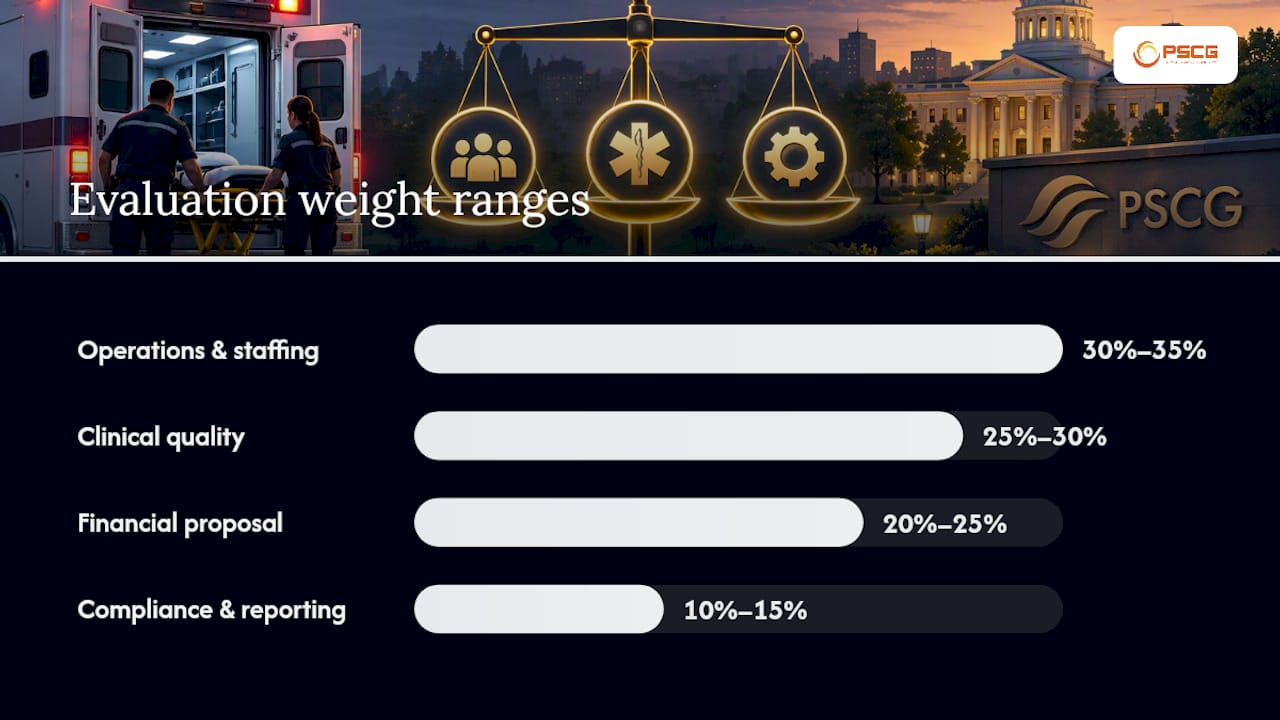
A workable weight distribution looks like this:
- Operations and staffing readiness: 30% to 35%
- Clinical quality and medical oversight: 25% to 30%
- Financial proposal and price: 20% to 25%
- Compliance, reporting, and documentation: 10% to 15%
For price, avoid scoring the lowest number as an automatic winner. The ratio method normalizes the lowest compliant cost against every other bid, scoring proposals proportionally rather than rewarding a number that may not reflect real delivery cost. Academic work on multi-criteria EMS contractor selection backs this up, noting that managerial and staffing readiness often predicts long-term reliability better than price alone.
Require every evaluator to sign a conflict-of-interest declaration and score independently before any group discussion. Consolidate scores in a moderated session, not a vote, then move your top scorers into interviews, reference checks, and final negotiation.
Which Technical and Operational Criteria Deserve the Closest Look?
Response-time claims deserve real scrutiny, not a passing glance at a headline number. Ask for the raw unit-hour data and time-on-task figures behind any 90th-percentile claim, not just the summary statistic. Consulting firms typically request three to six months of anonymized run data specifically to pressure-test System Status Plan assumptions against actual call volumes.
Verify these operational elements directly against submitted documentation:
- Peak-hour unit deployment and surge-capacity plans for mass-casualty events
- Mutual aid agreements and backup coverage commitments
- Emergency takeover language defining trigger events and transition obligations
- Vehicle compliance with NFPA and NHTSA standards, plus maintenance turnaround times
- Crew credential verification, fatigue policies, and shift-length limits
Sample municipal RFPs, including Ventura County’s emergency ambulance solicitation, model strong performance-standard language you can adapt directly.
Pro Tip: Ask proposers for a written disaster-surge plan showing exactly how many additional units they can field within two hours of a declared emergency, and require them to name the source of that surge capacity.
How Do You Evaluate Price and Total Cost of Ownership?
Price scoring has to go beyond the bottom-line number on page one. Compare base rates, mileage charges, rural adjustments, annual escalation language, and payment schedules line by line, since Medicare’s own fee-schedule structure treats these as separate, geographically adjusted components.
Build total cost of ownership across the full contract term, not just year one:
- Base rate and mileage charges over the contract’s full term, including any escalation clauses
- Demo-unit allowances and standby coverage costs for special events
- Contingency reserves for service guarantee shortfalls
- Projected reimbursement losses from historical denial rates
Denial risk is a financial risk, not just a compliance issue. A proposer with a weak appeals workflow effectively bids one price and delivers another once denied claims start eating into net revenue. Score denial-management capability explicitly in your financial category, and request evidence of the contractor’s historical denial rate alongside its corrective action process.
What CMS Compliance Rules Should Shape Your Contract Terms?
Two regulatory anchors matter most here: 42 CFR §410.40, which governs ambulance coverage requirements, and the Medicare Benefit Policy Manual, Chapter 10, which distinguishes coverage denials from medical-necessity denials.
CMS’s own reason-code documentation points to the same handful of denial drivers showing up again and again: incomplete documentation, transport to a non-covered destination, mismatched ALS versus BLS coding, and provider eligibility gaps.
Your contract should require:
- Proof of active Medicare supplier enrollment before award
- ePCR delivery within a fixed timeline (24 to 48 hours is common)
- Clear language on who absorbs denied claims and who manages appeals
- Municipal audit rights over billing records and denial logs
What Does a Fair Evaluation Timeline Look Like?
A defensible process moves through four distinct stages, each with its own gatekeeping function.
- Responsiveness screen. Reject incomplete submissions before scoring begins.
- Independent scoring. Trained evaluators score against the published rubric, each having signed a conflict-of-interest declaration.
- Moderated consolidation. Scores are reconciled in a facilitated session, followed by shortlisting and standardized interviews or equipment demonstrations.
- Reference checks and negotiation. Site visits where applicable, followed by a Notice of Intent to Award.
Keep a written debrief and protest procedure ready before you announce a winner. It costs little to prepare and saves weeks if a losing bidder challenges the process.
What Red Flags Should Concern a Procurement Team?
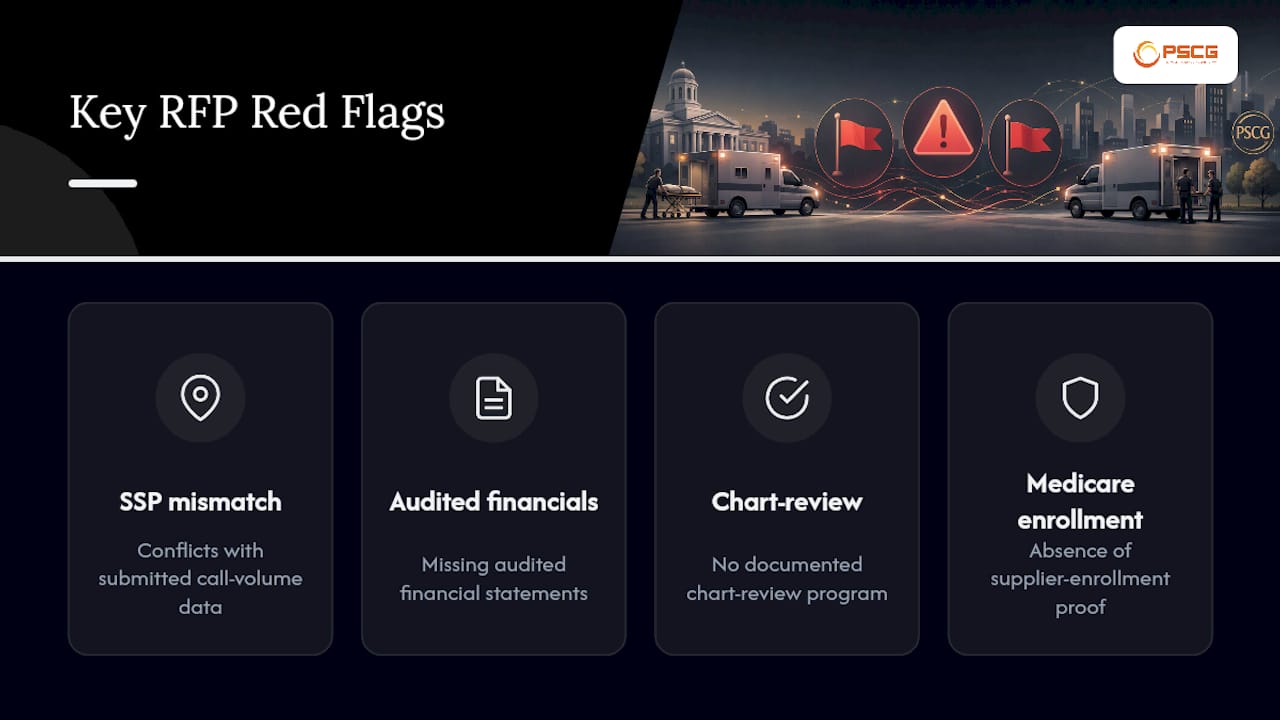
Watch for System Status Plan assumptions that don’t match submitted call-volume data, missing audited financials, no documented chart-review program, or the absence of proof of Medicare supplier enrollment. Any one of these should slow down an otherwise attractive bid.
A thorough approach to these verifications includes document requests, sample-data audits, and site visits when a contract’s scale warrants it. In one municipal engagement, this kind of review surfaced a mismatch between a proposer’s claimed peak staffing and its actual scheduled shifts, a gap the municipality corrected before signing.
Pro Tip: Request the proposer’s actual shift schedule for a representative two-week period, not a staffing summary. Summaries smooth over the gaps that shift schedules reveal.
An Editorial Take on Getting This Right
Here’s what the research and the contract language both point to: municipalities lose more often to reimbursement risk than to operational failure. A contractor can hit every response-time target and still leave a city holding the bag on denied Medicare claims if nobody scored denial-management capability going in.
The conventional advice, score price heavily and operations lightly, has this backwards. Price is the easiest number to game with escalation clauses buried in year three. Denial exposure and staffing readiness are harder to fake and matter more over a five-year contract term.
If you take one thing from this piece, prioritize the raw data request. Any proposer confident in its numbers will hand over unit-hour production data and historical denial rates without hesitation. Hesitation itself is information. Municipalities that build this into their evaluation steps early tend to avoid the expensive surprises that show up two years into a contract.
— Mike
How Thepscgroup Supports Your Procurement Process
Thepscgroup is the direct alternative to guessing your way through an ambulance RFP evaluation: instead of building a rubric from scratch or leaning on a proposer’s own marketing claims, you get a procurement partner with more than 32 years of field experience in EMS system design and municipal contracting.

Our services for municipalities running an ambulance procurement include Municipal EMS Strategy support, Financial Improvement Analysis for total-cost-of-ownership modeling, Response Time Improvement Analysis to pressure-test proposer claims, and Reimbursement Optimization to score denial risk correctly before you sign anything. A typical engagement starts with a scope call, moves into document and data review alongside your evaluation committee, and ends with a scored recommendation and contract-language markup, timed to fit your procurement calendar rather than slow it down.
If your team is building or refining an ambulance service RFP, visit Thepscgroup to schedule a procurement consultation before your evaluation window opens.
Sources
- esMD Ambulance transport reason codes and statements
- Ventura County Emergency Ambulance RFP (sample)
- Proposal Evaluation Tips & Tricks: How to Select the Best Vendor for the Job
FAQ
What Are the Standard Evaluation Criteria for an RFP?
Most public-sector RFPs score proposals across four categories: technical and operational capability, price, past performance, and compliance with mandatory requirements. For ambulance contracts specifically, weighting typically favors operations and clinical quality over price to reduce long-term reimbursement and liability risk.
What Is the Most Common Denial Reason for Ambulance Claims?
CMS documentation identifies incomplete or inconsistent trip documentation as one of the most frequent denial drivers, often alongside destination-eligibility issues and mismatched ALS/BLS coding. Requiring a proposer’s denial-management plan in your RFP helps surface this risk before award.
Which Federal Guidance Helps States Develop and Evaluate EMS Systems?
The National Highway Traffic Safety Administration, through its NHTSA Office of EMS, publishes model system guidance that many states adapt for EMS planning and evaluation. Municipalities often pair this with CMS billing and coverage rules when building their own local evaluation standards.
What Does “Category 3” Mean for an Ambulance Response?
Response categories vary by jurisdiction and dispatch protocol, so there’s no single national definition. Most systems that use tiered categories reserve the higher-numbered tiers for lower-acuity, non-emergency transports, while Category 1 typically covers life-threatening calls; check your local EMS authority’s protocol for the exact definition used in your area.
How Does Thepscgroup Help With Ambulance RFP Evaluation?
Thepscgroup works directly with municipalities to build weighted scoring rubrics, verify proposer data against operational claims, and structure contract language around performance guarantees and denial-risk mitigation. Pricing for these engagements is available by request through Thepscgroup.