



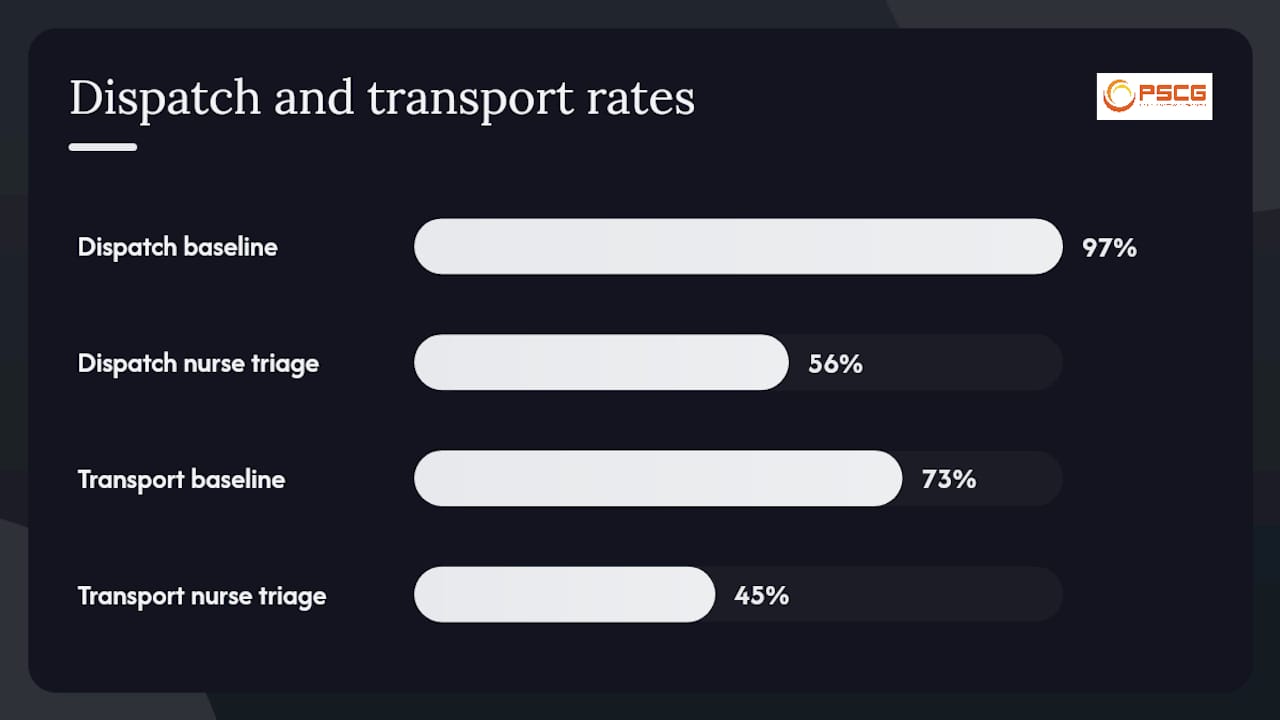
The evidence is clear: integrating registered nurses into 911 call center operations reduces unnecessary ambulance dispatches, connects low-acuity callers to appropriate care, and does so safely when proper protocols and escalation safeguards are in place. A randomized controlled trial of thousands of callers found that ambulance dispatches dropped from 97% to 56% and transports fell from 73% to 45% for calls routed to nurse triage. Washington, DC’s Right Care, Right Now pilot routes roughly a quarter of medical calls to nurses, with documented reductions in ambulance use and increased primary care linkage.
Two important caveats belong in any honest briefing. First, the same randomized trial found no detectable six-month differences in overall utilization or expenditures, meaning short-term operational gains are well-documented but long-term system cost effects remain an open question. Second, every program reviewed relies on structured escalation criteria and ongoing quality assurance to keep high-acuity callers from being undertriaged. With those guardrails in place, the weight of evidence supports moving forward with a structured pilot.
Key Takeaways
Nurse triage in 911 call centers produces well-documented short-term reductions in ambulance dispatches and transports, but long-term cost effects remain unproven, making rigorous pilot design and pre-specified outcomes essential for any new program.
| Point | Details |
|---|---|
| Trial evidence is strong but bounded | Dispatches fell from 97% to 56% and transports from 73% to 45%; six-month cost effects were not detected. |
| 15–20% of calls are eligible | Industry estimates indicate this share of medical calls are low-acuity and appropriate for nurse triage redirection. |
| Protocol and QA infrastructure are non-negotiable | ECNS uses over 200 symptom-based protocols; AQUA QA integration and IAED ACE accreditation are standard prerequisites. |
| Legal and payer groundwork takes time | Scope-of-practice confirmation, medical direction, and Medicaid engagement must begin in parallel with operational planning. |
| Thepscgroup supports the full design cycle | From pilot methodology and baseline data governance to stakeholder engagement and formal evaluation, PSCG works alongside your team. |
This article is general information, not a substitute for advice from a qualified doctor. Consult a qualified healthcare professional about your own circumstances before acting on anything here.
Table of Contents
- What does the peer-reviewed evidence actually show?
- What nurse-triage models work inside 911 systems?
- Which outcomes should your agency measure?
- Operational checklist: what does your agency need before launch?
- How should you design a pilot and evaluate its impact?
- What legal, regulatory, and payer issues must you resolve first?
- What do real US programs tell us?
- What does the evidence not yet prove, and what are the risks?
- A practical perspective on what actually moves the needle
- How Thepscgroup supports nurse-triage program design and evaluation
- Sources
What does the peer-reviewed evidence actually show?
The strongest evidence comes from a randomized controlled trial published on PubMed, conducted within Washington, DC’s 911 system. Researchers randomized 6,053 callers and measured dispatch, transport, and downstream utilization outcomes. The results were striking at the operational level.
Among Medicaid beneficiaries, short-term shifts in emergency department and primary care visits were observed. At six months, however, the trial found no statistically detectable differences in overall utilization or expenditures between the nurse-triage and standard-dispatch groups. That finding does not undermine the operational case, but it does mean administrators should not promise long-term cost savings without additional evidence from their own system.
The Lab @ DC’s program documentation adds operational context. Lab @ DC researchers frame the program as a regional health strategy rather than a standalone cost-cutting measure, which is the framing that holds up best against the trial’s mixed six-month findings.
Industry estimates suggest 15–20% of medical calls to emergency communication centers are low-acuity and appropriate for secondary nurse triage, with potential redirection to urgent care, telehealth, behavioral health, or home self-care. That range gives planners a reasonable baseline for sizing a pilot and projecting call volumes before launch.
What nurse-triage models work inside 911 systems?
Three primary models appear in US programs, each with distinct workflow implications for staffing, IT integration, and dispatch throughput.
Co-located Emergency Communication Nurse (ECN) model. A registered nurse sits inside the dispatch center and receives warm transfers from Emergency Medical Dispatchers after initial MPDS screening. The nurse conducts a structured telephone assessment using symptom-based protocols, recommends a disposition (urgent care, telehealth, primary care, or self-care), and arranges transport or follow-up when needed. CONFIRE’s ECNS program operates on this model, with RNs credentialed in emergency care and protocol-driven assessments that can arrange transport when the caller’s condition warrants it.
- Pros: Real-time escalation to dispatch is immediate; nurse has direct access to CAD data; quality assurance loop is tight.
- Cons: Requires dedicated FTE within the dispatch center; space and scheduling constraints in smaller PSAPs.
Transfer-to-nurse line model. The EMD completes initial screening and transfers eligible callers to a nurse staffed at a separate but connected call center, sometimes operated by a health system or managed care partner. Santa Clara County’s 911 Nurse Navigation program uses EMD-based screening and transfer criteria to route callers to nurse navigators who use evidence-based protocols to direct callers to appropriate care settings.
- Pros: Scalable; can share nursing staff across multiple PSAPs; lower physical footprint inside dispatch.
- Cons: Transfer handoff introduces a brief gap in situational awareness; requires robust IT integration to share call data across systems.
Off-site nurse navigation and telehealth integration model. Nurses operate from a health system or telehealth platform and receive referrals from dispatch via secure messaging or integrated CAD. This model works well for lower-acuity behavioral health and chronic-condition calls where video assessment adds clinical value.
- Pros: Leverages existing health system infrastructure; expands scope to video assessment.
- Cons: Highest IT complexity; requires formal data-sharing agreements; escalation path back to dispatch must be explicitly defined.
Hybrid approaches combining co-location during peak hours with off-site coverage overnight are increasingly common and may offer the best balance of cost and clinical oversight for mid-sized agencies.
Which outcomes should your agency measure?
Tracking the right metrics from day one separates programs that can demonstrate value from those that cannot. The table below organizes the primary outcome categories with evidence-based context where available.
| Outcome Category | Metric | Evidence Context |
|---|---|---|
| Operational | Ambulance dispatch rate | Trial baseline: 97%; nurse-triage arm: 56% |
| Operational | Ambulance transport rate | Trial baseline: 73%; nurse-triage arm: 45% |
| Operational | Call-to-disposition time | Track against pre-pilot baseline; no universal benchmark |
| Clinical | Same-day ED visit for non-emergent complaint | Short-term reductions observed in Medicaid subgroup |
| Clinical | PCP follow-up within 24 hours | Short-term increases observed in Medicaid subgroup |
| Safety | Adverse events flagged for QA review | Zero-tolerance threshold; any undertriage triggers protocol review |
| Financial | Estimated cost per redirected call | Derive from local transport cost data; no universal figure |
| System | Avoidable ED visits | Benchmark against AHRQ/MEPS national ED utilization data |
Pro Tip: Pre-specify your primary outcome before launch. Programs that define “success” after seeing results invite credibility challenges from payers, unions, and oversight bodies. Commit to one primary operational metric and two secondary clinical metrics in your pilot protocol document.
Data governance matters as much as data collection. Call-level dispatch records, transport logs, and ED visit data require formal data-sharing agreements with hospitals and health plans before a pilot begins. Medicaid encounter data, in particular, requires state agency coordination and may take months to arrange.
Operational checklist: what does your agency need before launch?
Getting the operational foundation right before the first nurse takes a call is what separates programs that sustain themselves from those that quietly close after 18 months.
Confirm RN qualifications and scope. Nurses should hold active RN licensure in the state of operation and have verifiable emergency or critical care experience. Telephone triage is a distinct clinical skill; prior dispatch or EMS experience is a meaningful advantage.
Achieve or target IAED ACE accreditation. IAED Center of Excellence (ACE) accreditation for Emergency Medical Dispatch is a recognized governance benchmark and a practical prerequisite for layering nurse triage onto a dispatch center. Treat it as an organizational target during planning if your center has not yet achieved it.
Select and configure a protocol library. The Emergency Communication Nurse System (ECNS) uses more than 200 symptom-based protocols and requires MPDS ProQA and AQUA QA software integration. Confirm your CAD vendor supports the required integration before signing any protocol licensing agreement.
Build the escalation criteria document. Define, in writing, every condition that triggers an immediate return to emergency dispatch. This document is your primary liability management tool and your QA team’s reference standard.
Establish a QA review cycle. Budget for sustained QA reviews using AQUA or an equivalent platform, with retraining cycles tied directly to QA findings. Telephone triage protocol fidelity degrades without regular case review.
Draft call transfer scripts and consent language. Callers must understand they are being transferred to a nurse, not being denied emergency services. Plain-language consent phrasing, reviewed by legal counsel, protects both the caller and the agency.
Confirm 24/7 staffing coverage. Low-acuity calls arrive at all hours. A program that operates only 8 AM to 8 PM creates a two-tier system and complicates public communication.
Map local points of care. The nurse’s referral options are only as good as the community resource inventory behind them. Urgent care hours, behavioral health warm lines, telehealth platforms, and transportation options must be current and verified.
Pro Tip: Run a tabletop exercise with your dispatch team, nursing staff, and medical director before go-live. Walk through three to five realistic call scenarios, including one that requires immediate re-escalation to emergency dispatch. Gaps in the escalation workflow almost always surface during tabletop exercises rather than during live calls.
How should you design a pilot and evaluate its impact?
A well-designed pilot produces evidence your stakeholders will trust. A poorly designed one produces data no one can act on.
Where feasible, randomized assignment of eligible calls to nurse triage versus standard dispatch is the strongest design, as demonstrated by the Washington, DC trial. When randomization is not operationally or politically feasible, a stepped-wedge rollout, phasing nurse triage in across shifts or geographic zones over time, provides a credible comparison period and limits the risk of contamination between groups.
Essential data elements to collect from day one:
- Call-level dispatch records with timestamps, chief complaint codes, and assigned disposition
- Transport logs linked to call records by incident number
- ED visit data matched to triaged callers via name, date of birth, and date of service
- Payer flags, particularly Medicaid, to enable subgroup analysis
- Nurse assessment documentation including protocol used, disposition recommended, and any escalation events
Suggested pilot timeline:
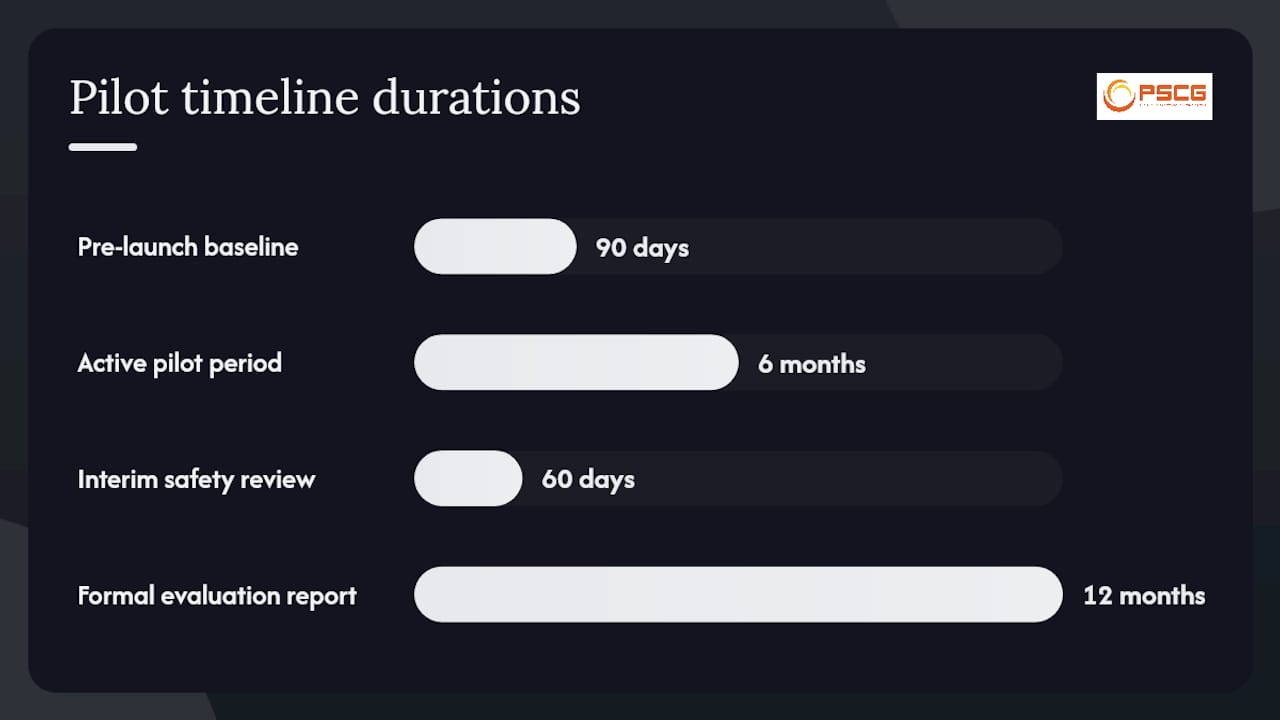
A 90-day pre-launch baseline period establishes your comparison data. A six-month active pilot period captures enough call volume for meaningful analysis. An interim safety review at 60 days post-launch catches protocol gaps before they accumulate. A formal evaluation report at 12 months gives you the full picture, including any early signals on downstream utilization.
Pro Tip: Designate a data governance lead before the pilot begins, not after. This person owns the data-sharing agreements, manages the ED match process, and coordinates with your state Medicaid agency. Without a named owner, data collection stalls and your evaluation timeline slips.
Pre-specify your safety monitoring plan in writing. Define what constitutes an adverse event, who reviews it, within what timeframe, and what threshold triggers a program pause. Public reporting of safety data, even when the numbers are favorable, builds the community trust that sustains programs through political transitions.
What legal, regulatory, and payer issues must you resolve first?
Regulatory and payer questions are the most common reasons nurse-triage programs stall before launch. Address them in parallel with operational planning, not after.
- Scope of practice: Telephone triage by RNs is permitted in all US states, but the specific protocols, supervision requirements, and documentation standards vary. Confirm with your state board of nursing and your agency’s legal counsel before finalizing protocol selection.
- Medical direction: Most programs require a physician medical director to approve protocols, review adverse events, and provide clinical oversight. Confirm this role is defined and funded in your program budget.
- Liability and documentation: Every nurse assessment must be documented in a format that supports retrospective QA review. Incomplete documentation is the primary liability exposure in telephone triage programs. ASPR TRACIE’s documentation of DC’s program notes that documentation standards and escalation triggers were central to the program’s governance design.
- Medicaid and payer engagement: Short-term ED visit reductions among Medicaid beneficiaries were observed in the DC trial. Engage your state Medicaid agency early to discuss whether nurse-triage dispositions affect transportation coverage, whether referrals to telehealth or urgent care are covered benefits, and whether the program qualifies for any value-based payment arrangements.
- Transportation coverage for non-emergent referrals: If a nurse recommends urgent care transport rather than emergency ambulance transport, confirm that the recommended transport mode is a covered benefit for the caller’s payer before the program goes live.
- Grant and funding sources: HRSA rural health grants, state EMS improvement funds, and Medicaid 1115 waiver authorities have all been used to fund nurse-triage pilots. Identify applicable funding streams during the planning phase, not after the budget is set.
What do real US programs tell us?
Washington, DC: Right Care, Right Now
The DC program is the most rigorously evaluated nurse-triage initiative in the United States. The trial results showed a 41-percentage-point drop in ambulance dispatches for triaged callers. Becker’s Healthcare reported the program-level dispatch reduction and tracked tens of thousands of triaged calls across the pilot period.
Reno, Nevada
Reno’s program is frequently cited in practitioner summaries as an early US example of co-located nurse triage in a mid-sized PSAP. The program demonstrated that the model is operationally viable outside major urban centers, with staffing structured around peak call hours and a defined escalation path back to emergency dispatch.
New Hyde Park, Nassau County, New York
The Nassau County example is notable for its integration with a health system partner, which provided nursing staff and clinical oversight infrastructure. This model illustrates how agencies without the internal capacity to hire and credential nurses directly can partner with regional health systems to staff the function, reducing the organizational burden on the PSAP while maintaining clinical governance.
Across all three programs, common early monitoring metrics include call transfer completion rates, nurse assessment duration, escalation frequency, and caller satisfaction. Programs that tracked these metrics weekly during the first 90 days caught workflow problems early enough to correct them before they affected outcomes.
What does the evidence not yet prove, and what are the risks?
Honest program planning requires naming what the evidence does not support as clearly as what it does.
Evidence gaps:
- Long-term system cost effects are not yet established. The DC trial found no detectable six-month differences in utilization or expenditures, meaning cost-savings projections beyond the operational level should be treated as hypotheses, not guarantees.
- Generalizability across jurisdictions is uncertain. DC’s urban payer mix, health system density, and community resource availability may not replicate in rural or suburban systems with fewer referral options.
- Effects on caller populations with limited English proficiency, cognitive impairment, or complex social needs are not well-characterized in published evaluations.
Operational risks:
- Undertriage is the primary safety risk. A nurse who recommends urgent care for a caller who subsequently deteriorates creates significant liability exposure. Conservative disposition thresholds and a robust escalation safety net are non-negotiable.
- Staffing and burnout. Telephone triage is cognitively demanding. Nurses who handle high call volumes without adequate QA support and peer review are at elevated risk of protocol drift and burnout.
- Community perception. Some callers and advocacy groups interpret nurse triage as denial of emergency services. Proactive public communication, clear consent language, and transparent safety data reporting are the most effective mitigations.
Mitigation strategies:
- Set disposition thresholds conservatively at launch and loosen them only after QA data supports doing so.
- Build a mandatory escalation review into every adverse event, with findings reported to the medical director within 24 hours.
- Publish a plain-language program summary for the public before launch, and update it quarterly with safety and outcome data.
A practical perspective on what actually moves the needle
The evidence on 911 nurse triage is more nuanced than either its advocates or its skeptics typically acknowledge. The operational gains are real and well-documented. The long-term cost story is not yet written. What I find most instructive about the DC trial is not the dispatch reduction numbers, impressive as they are, but the finding that short-term clinical shifts were concentrated among Medicaid beneficiaries. That tells you something important: the callers who benefit most from nurse triage are often those with the fewest alternatives, people who call 911 not because they need an ambulance but because they have no other reliable path to care.
That reframes the program design question. The goal is not simply to reduce ambulance dispatches. It is to build a system where every caller, regardless of acuity, reaches the right level of care. That requires community resource mapping, payer engagement, and a staffing model that treats nurses as clinical partners in the dispatch workflow, not as a filter in front of it. Programs that approach nurse triage as a cost-cutting mechanism tend to underinvest in the community resource infrastructure that makes referrals meaningful. Programs that approach it as a care coordination function tend to produce better outcomes for callers and more durable political support from stakeholders.
The agencies that get this right will be the ones that invest as much in the “where do we send them” question as in the “how do we screen them” question. That is where the real work is.
How Thepscgroup supports nurse-triage program design and evaluation
Thepscgroup works alongside EMS agencies, municipal leaders, and 911 system administrators to design, evaluate, and sustain nurse-triage programs grounded in the evidence reviewed here. Our EMS system design consulting covers the full scope of what a nurse-triage integration requires: pilot design and randomization methodology, baseline data collection and governance, IAED/ACE readiness assessment, IT and dispatch workflow integration advisory, stakeholder engagement with hospitals and payer partners, and formal program evaluation with pre-specified outcomes.
We do not approach these projects as one-size-fits-all implementations. A mid-sized suburban PSAP has different staffing constraints, payer mixes, and community resource inventories than an urban system like DC’s. We work alongside your team to build a model that fits your jurisdiction. Our municipal EMS strategy services include reimbursement optimization and payer engagement, which are often the most time-consuming elements of a nurse-triage launch.
To discuss a scoping engagement or request a program readiness assessment, contact us at Thepscgroup.
Sources
- Randomized controlled trial of nurse-led triage of 911 calls — PubMed
- Can nurses at the 911 call center improve care? — The Lab @ DC
- 911 Nurse Navigation | Emergency Medical Services Agency — Santa Clara County