



TL;DR:
- Dispatch plays a critical role in EMS by accurately triaging calls, deploying resources, and guiding pre-arrival care. Its decisions directly influence patient survival and system efficiency through structured protocols like MPDS and advanced technology. Proper training and system design are essential to balance response accuracy, resource allocation, and operational readiness.
Dispatch is the first and most consequential link in the emergency medical services chain, determining how quickly and accurately the right resources reach a patient in crisis. The role of dispatch in EMS extends far beyond answering a 911 call. Dispatchers assess severity, assign priority levels, deploy Basic Life Support (BLS) or Advanced Life Support (ALS) units, and deliver pre-arrival instructions that can sustain life before any crew arrives on scene. Structured protocols like the Medical Priority Dispatch System (MPDS) govern every step. A 2026 international Delphi study finalized 227 essential components for Emergency Medical Dispatch Systems, confirming that dispatch is a system-level discipline, not a single task.
What is the role of dispatch in EMS operations?
Dispatch is the first of four interdependent EMS system components, alongside first response, advanced care, and facility integration. That position matters because dispatch shapes every clinical and logistical decision that follows. A miscategorized call at the dispatch level can delay ALS to a cardiac arrest or send a critical unit to a low-acuity fall. The downstream effect on patient outcomes is direct and measurable.

The MPDS is the gold standard used in approximately 71% of major U.S. cities for emergency medical dispatch. It categorizes calls into five acuity levels, from Echo (immediately life-threatening) down to Alpha (non-urgent), guiding which unit type and response mode are appropriate. That structure removes guesswork and replaces it with a repeatable, physician-validated process. Consistency at the dispatch level is what makes the rest of the EMS system predictable.
Dispatchers also serve as real-time coordinators across multiple agencies. When a mass casualty incident unfolds, the dispatcher manages communication between fire, EMS, law enforcement, and hospital receiving teams simultaneously. That coordination function is as operationally significant as the initial call triage.
How does EMS dispatch operate from call receipt to resource deployment?
The dispatch workflow follows a defined sequence that leaves little room for improvisation. Each step builds on the last, and the speed of execution directly affects patient survival.
- Call receipt and verification. The dispatcher answers the 911 call, confirms the location, and begins caller interrogation using MPDS scripted questions. Address verification is the first priority because a unit cannot respond to an unknown location.
- Structured caller interrogation. The dispatcher works through a decision tree of standardized questions covering the patient’s chief complaint, level of consciousness, and breathing status. These questions are not improvised. They follow physician-approved algorithms that define the clinical boundaries of the dispatcher’s role.
- Determinant code assignment. Based on interrogation responses, the dispatcher assigns a determinant code. Echo-level calls (cardiac arrest, airway obstruction) trigger an ALS response with lights and sirens. Alpha-level calls (minor injuries, routine transfers) may receive a BLS unit without emergency driving. The code drives the entire resource decision.
- Resource deployment. The dispatcher selects the closest appropriate unit using Computer-Aided Dispatch (CAD) mapping and fleet status data. Unit selection accounts for unit type, location, current workload, and traffic conditions.
- Pre-arrival instructions. While the unit is en route, the dispatcher guides the caller through life-sustaining actions. CPR instruction, hemorrhage control, and airway positioning are all delivered over the phone. Pre-arrival instructions like CPR guidance and hemorrhage control are standard dispatcher functions, not optional add-ons.
- Ongoing incident communication. The dispatcher maintains radio contact with the responding crew, relays updated patient information, and coordinates any additional resources needed as the incident evolves.
This sequence repeats simultaneously across multiple active calls in a busy dispatch center. The dispatcher’s ability to manage concurrent incidents without losing accuracy on any single case is the operational core of the role.
What are the key responsibilities and functions of dispatchers in EMS systems?
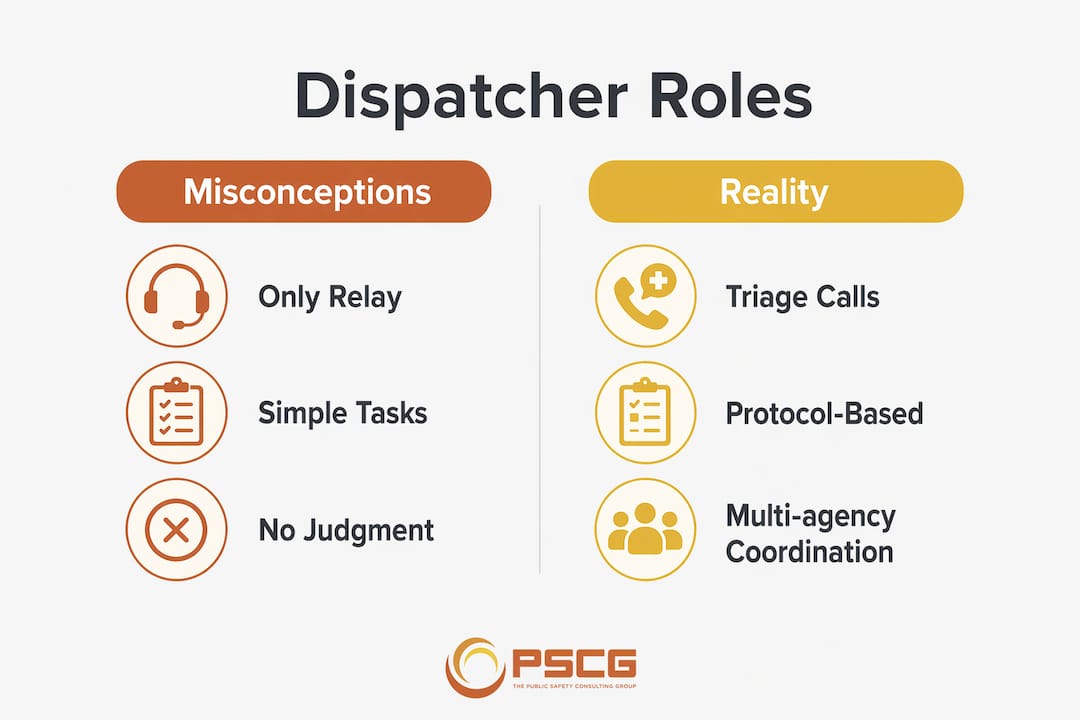
EMS dispatchers carry responsibilities that span clinical triage, resource management, communication, and data compliance. The common misconception is that dispatchers simply answer phones and relay addresses. The actual function is far more complex.
Core dispatcher responsibilities include:
- Answering calls within established response time benchmarks and confirming caller location before any other action
- Applying MPDS or equivalent triage protocols to classify call acuity accurately
- Selecting and deploying the appropriate unit type (BLS vs. ALS) based on determinant code
- Delivering pre-arrival instructions to callers, including CPR, bleeding control, and childbirth guidance
- Managing multi-agency coordination during complex or multi-casualty incidents
- Monitoring active units and repositioning resources to maintain geographic coverage
- Documenting call data accurately to support medical oversight, quality review, and compliance audits
- Escalating cases when patient condition changes during the call
The table below separates what dispatchers actually do from what is commonly assumed.
| Common misconception | Operational reality |
|---|---|
| Dispatchers only relay addresses to crews | Dispatchers triage calls, assign acuity codes, and select unit types |
| Dispatchers work independently | Dispatchers operate within physician-approved, scripted protocols |
| Dispatch ends when the unit is deployed | Dispatchers maintain communication throughout the incident lifecycle |
| Any staff member can handle dispatch | Dispatch requires specialized training in MPDS, CAD systems, and medical triage |
| Dispatch has no clinical function | Dispatchers deliver pre-arrival instructions that directly affect patient survival |
Dispatchers operate using physician-approved protocols that restrict independent diagnosis and maintain consistent clinical boundaries. That structure protects both the patient and the dispatcher. It also means that dispatcher performance is measurable and subject to medical director oversight, the same accountability framework applied to field providers.
How is technology transforming EMS dispatch operations?
Computer-Aided Dispatch systems integrate call-taking with dispatch, providing map-based fleet visibility, real-time traffic data, and incident monitoring to support resource deployment decisions. CAD platforms have shifted dispatch from a reactive, phone-based function to a data-driven operation with live situational awareness. A dispatcher using a modern CAD system sees unit locations, response times, hospital diversion status, and incident clusters on a single screen.
Automation tools now allow proactive resource management by monitoring fleet location, traffic, and incident patterns in real time. This represents a fundamental shift from static posting models, where units sat at fixed stations, to dynamic repositioning based on demand forecasting. A system that moves units before calls come in maintains coverage more effectively than one that reacts after the fact.
Cloud-based CAD platforms also enable remote dispatch operations, reducing the dependency on single physical dispatch centers. That capability matters for continuity of operations during infrastructure failures, severe weather events, or staffing shortfalls. Agencies exploring high-performance dispatch center design are increasingly treating CAD as a live ecosystem rather than a static software tool.
Non-emergent trip scheduling modules represent another area of growth. These tools allow dispatchers to manage scheduled medical transport alongside emergency calls without manual cross-referencing, reducing administrative burden and error potential.
Pro Tip: Treat your CAD system as a planning tool, not just a dispatch log. Agencies that review CAD data weekly to identify demand patterns and coverage gaps reduce response time variance without adding units.
What challenges shape EMS dispatch decision-making?
Dispatch decision-making operates under constant tension between two failure modes: over-triage and under-triage. Neither is acceptable, and both carry real consequences.
- Over-triage sends ALS units to low-acuity calls. This depletes high-capability resources and leaves critical patients waiting longer for advanced care. In high-volume systems, repeated over-triage degrades overall system readiness.
- Under-triage sends BLS units or delays response to calls that require ALS intervention. The patient safety risk is direct. A cardiac arrest receiving a BLS-only response in a system with available ALS is a preventable failure.
- Dispatcher-led triage identifies low-acuity cases to reduce futile responses and preserve ALS assets for critical emergencies. That function is not just about efficiency. It is about keeping the system capable of responding to its most serious calls.
- Protocol adherence is the primary safeguard against both failure modes. Dispatchers who follow MPDS algorithms consistently produce more accurate triage outcomes than those who rely on experience alone.
- Experienced judgment within protocol constraints remains essential. A dispatcher recognizing that a caller’s description does not match the assigned determinant code, and escalating accordingly, is exercising exactly the kind of informed discretion that training and oversight are designed to produce.
The tension between over-triage and under-triage is a system-level challenge, not just an individual dispatcher problem. Agencies that treat it as a training issue alone miss the structural factors: call volume, unit availability, geographic coverage, and protocol design all contribute. Effective EMS system design addresses dispatch triage as part of the broader operational architecture, not as an isolated function.
Key takeaways
Dispatch is the foundational EMS function that determines clinical outcomes before any crew reaches the patient, making protocol adherence, technology integration, and triage accuracy the three pillars of an effective dispatch system.
| Point | Details |
|---|---|
| Dispatch drives clinical outcomes | Accurate triage and fast deployment directly affect patient survival before EMS arrives. |
| MPDS structures every decision | Physician-approved algorithms replace guesswork with consistent, auditable triage. |
| Technology shifts dispatch from reactive to proactive | CAD systems and automation enable real-time fleet repositioning and demand forecasting. |
| Over-triage and under-triage both carry real costs | Strategic tier assignment preserves ALS availability without compromising patient safety. |
| Pre-arrival instructions are a clinical function | Dispatcher-guided CPR and hemorrhage control extend care before any unit arrives on scene. |
Dispatch is more than a phone call: what I’ve learned from the field
Working alongside EMS leaders across multiple systems, I have seen dispatch treated as a support function rather than a clinical one. That framing is wrong, and it costs systems in ways that are hard to trace back to the source.
The dispatcher who correctly identifies a cardiac arrest from a confused caller’s description and initiates CPR instructions before the unit even clears the station is performing a clinical act. The dispatcher who recognizes a pattern of ALS depletion in a specific geographic zone and flags it for supervisors is doing system management. Neither of those functions shows up in a simple call-answer metric.
What I find most underappreciated is the relationship between dispatch protocol quality and field crew performance. When dispatchers provide accurate, structured pre-arrival information, crews arrive better prepared. They know the patient’s chief complaint, level of consciousness, and what the caller has already done. That 60 seconds of preparation changes the first two minutes of patient contact in ways that matter clinically.
The technology piece is real, but I would caution against treating CAD investment as a substitute for dispatcher training and medical oversight. The best dispatch systems I have seen combine strong automation with rigorous quality review, where medical directors actually listen to calls and provide feedback. That combination produces dispatchers who use technology well rather than dispatchers who depend on it.
The evolving role of emergency dispatchers deserves recognition at the leadership level. Agencies that invest in dispatch training, protocol review, and CAD optimization see measurable improvements in response time benchmarks and ALS utilization rates. Those are not coincidences. They are the direct result of treating dispatch as the system-level function it actually is.
— Mike
How Thepscgroup supports EMS dispatch and system performance
Thepscgroup works directly with EMS agencies and municipal leaders to assess dispatch performance, identify protocol gaps, and design systems where dispatch functions as a true clinical and operational asset.

Whether your agency is evaluating MPDS implementation, CAD integration, or ALS utilization patterns, Thepscgroup brings the operational expertise and medical oversight framework to move from assessment to measurable improvement. Our team has supported EMS system design across a range of municipal contexts, with a consistent focus on building dispatch capacity that holds up under real operational pressure. Contact us at thepscgroup.net to start the conversation.
FAQ
What is the primary role of dispatch in EMS?
Dispatch is the first operational component of the EMS system, responsible for call triage, resource deployment, pre-arrival instructions, and multi-agency coordination. It directly shapes clinical outcomes before any crew reaches the patient.
What is the Medical Priority Dispatch System?
The Medical Priority Dispatch System (MPDS) is a physician-approved protocol used in approximately 71% of major U.S. cities to categorize EMS calls into five acuity levels, from Echo (life-threatening) to Alpha (non-urgent), guiding unit type and response mode.
How do dispatchers decide between BLS and ALS response?
Dispatchers assign a determinant code based on structured caller interrogation using MPDS algorithms. Echo and Delta-level codes trigger ALS deployment; lower-acuity codes may receive BLS units, preserving advanced resources for critical cases.
What technology do EMS dispatchers use?
Computer-Aided Dispatch (CAD) systems provide map-based fleet visibility, real-time traffic data, and incident monitoring. Cloud-based platforms also enable remote dispatch operations and dynamic unit repositioning based on demand patterns.
Why does dispatcher triage matter for EMS system sustainability?
Dispatcher-led triage identifies low-acuity calls and reduces unnecessary ALS deployment, preserving high-capability units for critical emergencies. Without accurate triage, over-triage depletes ALS resources and degrades overall system readiness.