



TL;DR:
- Most interfacility transfers involve a high rate of adverse events, primarily due to preventable communication failures. Implementing structured protocols, centralized transfer centers, and real-time visibility can significantly reduce these risks and improve patient outcomes. Treating transfers as clinical interventions with disciplined processes is essential for safety and efficiency in healthcare systems.
Most healthcare professionals understand that interfacility transfers carry clinical risk. Few recognize just how significant that risk is. Nearly 65% of interhospital transfers involve an adverse event, with clinical complications accounting for the majority. These are not rare exceptions. They are a pattern driven by preventable failures in communication, coordination, and clinical preparation. This article breaks down what effective interfacility transfers require, from foundational process design to operational strategy, and gives you the frameworks to reduce adverse outcomes and strengthen your transfer program.
Table of Contents
- Key Takeaways
- Understanding interfacility transfer processes and types
- Common barriers and risks in interfacility transfers
- Best practices for safer, higher-quality transfers
- Operational strategies to optimize transfer logistics
- My perspective on where most transfer programs fall short
- How Thepscgroup can strengthen your transfer program
- FAQ
Key Takeaways
| Point | Details |
|---|---|
| Transfers are clinical events | Treating interfacility transfers as logistics tasks rather than clinical interventions increases adverse event risk significantly. |
| Five-step protocols reduce harm | Structured transfer processes covering communication, stabilization, and handover improve safety outcomes measurably. |
| Specialty gaps drive most barriers | Specialty service availability accounts for over half of all transfer barriers at academic medical centers. |
| Centralized transfer hubs outperform manual coordination | Phone-based ad hoc coordination causes delays that technology-enabled transfer centers consistently prevent. |
| Dedicated transport improves throughput | Partnering with dedicated transport models reduces costs and delays compared to traditional ambulance reliance. |
Understanding interfacility transfer processes and types
So what is interfacility transfer, exactly? At its core, a medical facility transfer moves a patient from one care setting to another when the originating facility cannot fully meet that patient’s clinical needs. This includes urgent care transfer for patients requiring a higher level of specialty care, non-emergency transfers for rehabilitation or skilled nursing placement, and specialty-driven transfers where a particular service like neurosurgery or cardiac intervention is unavailable at the sending facility.
Each transfer type carries a different risk profile and requires tailored preparation. An urgent transfer for a stroke patient activates time-critical protocols where every minute of delay affects outcomes. A non-emergency transfer to a long-term care facility may seem lower stakes, but inadequate documentation or medication reconciliation errors during handoff create their own category of harm. The stakes differ in degree, not in kind.
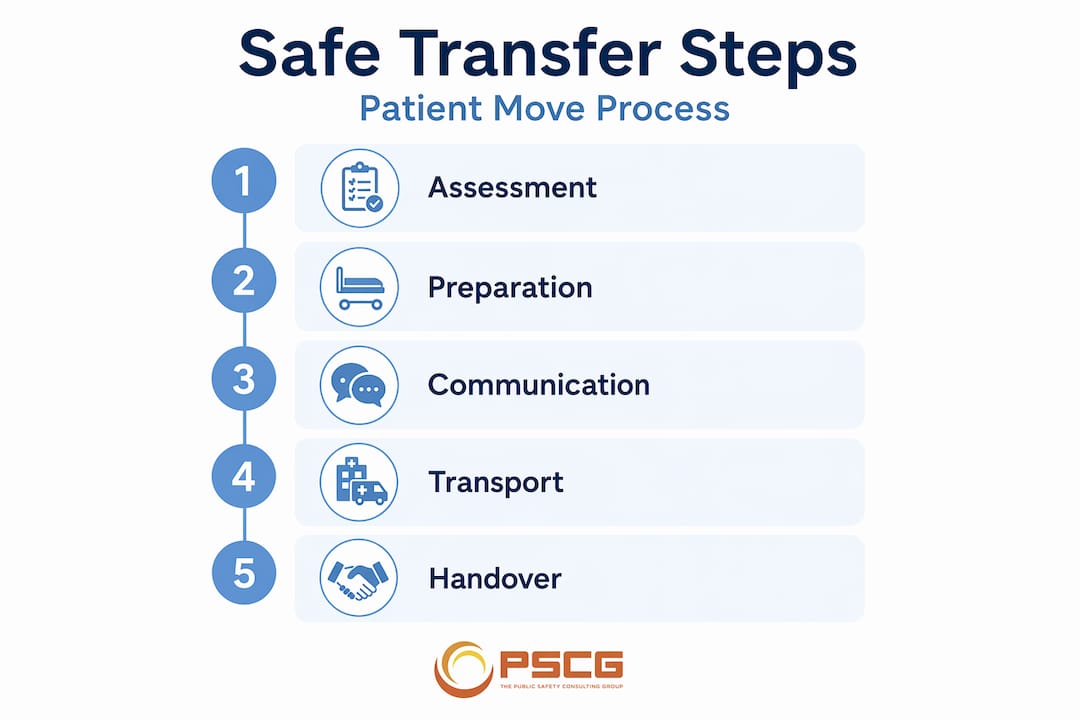
A five-step transfer protocol has emerged as best practice in the clinical literature:
- Physician-to-physician communication between sending and receiving providers to establish clinical need and acceptance.
- Patient stabilization at the sending facility to the extent possible before transport begins.
- Information exchange including all relevant records, imaging, lab results, and current medication orders.
- Qualified transport execution with personnel and equipment matched to the patient’s acuity level.
- Structured handover at the receiving facility using standardized communication tools.
The communication frameworks used at steps one and five matter enormously. SBAR (Situation, Background, Assessment, Recommendation) and I-PASS (Illness severity, Patient summary, Action list, Situation awareness, Synthesis by receiver) both reduce the likelihood of information loss during critical transitions. Many transfer failures trace back to handovers treated as narrative storytelling rather than structured data transmission. That distinction costs lives.
Pro Tip: Require the sending physician to complete a standardized pre-transfer checklist before transport is dispatched. This simple step catches medication discrepancies, missing consents, and unstabilized conditions that would otherwise surface during transport or at the receiving facility.

Common barriers and risks in interfacility transfers
The barriers to effective hospital transfer services are both clinical and structural, and they compound each other. Understanding them separately helps you address each with the right intervention.
Clinical barriers include patient instability at time of transfer, incomplete medication reconciliation, and the subtle but dangerous phenomenon known as diagnostic momentum. Diagnostic momentum during handoffs occurs when a provisional diagnosis made early in the care episode is passed forward uncritically, without reassessment, causing the receiving team to anchor on an assumption rather than the patient’s actual presentation. This is not a rare failure mode. It is a predictable consequence of handover processes that prioritize speed over accuracy.
Logistical and structural barriers include:
- Specialty availability: Specialty service gaps account for 53.9% of identified transfer barriers at academic medical centers, making this the single largest systemic bottleneck.
- Bed and staff capacity: Receiving facilities frequently cannot accept transfers due to census pressures, leaving sending facilities managing patients beyond their capability for extended periods.
- Patient consent challenges: Patients or families who do not understand the clinical rationale for transfer may delay or refuse, particularly when communication from the sending team has been unclear.
- Transport resource constraints: Availability of appropriately equipped transport units and qualified personnel varies significantly by geography and time of day, creating unpredictable delays in emergency transfer protocols.
“Incomplete handovers and diagnostic momentum are not communication failures in isolation. They are system failures. When your transfer process treats a handover as a verbal summary rather than a structured clinical transaction, you have already accepted the risk of preventable harm.” — Insight synthesized from Cureus 2026 Narrative Review
The data make this concrete. At least 1 million patients annually arrive at U.S. emergency departments by interfacility transport. The volume alone demands that every sending facility treat transfer readiness as an operational priority, not an afterthought.
Best practices for safer, higher-quality transfers
The most effective shift any healthcare administrator can make is treating every interfacility transfer as a clinical intervention with its own preparation, execution, and quality review cycle. A transfer is not a dispatch event. It is an extension of patient care across a physical boundary, and it requires the same discipline as any other clinical handoff.
Several evidence-based practices separate high-performing transfer programs from reactive ones.
Critical communication elements
Every handover must include the patient’s current clinical status, the reason for transfer with supporting data, active medications and recent changes, known allergies, pending results, and the receiving provider’s name and direct contact. Treating handovers as narrative reports rather than structured data exchanges is a documented source of preventable errors. SBAR and I-PASS exist precisely to counter this tendency.
Centralized transfer centers versus decentralized coordination
| Approach | Strengths | Limitations |
|---|---|---|
| Decentralized, phone-based coordination | Low initial infrastructure cost; familiar to staff | Creates bottlenecks, relies on individual provider networks, produces inconsistent outcomes |
| Centralized transfer center | Real-time bed and resource visibility; consistent protocols; faster placement | Requires investment in staffing and technology infrastructure |
| Dedicated transport model | Predictable availability; personnel matched to acuity; reduces cost per transfer | Requires contractual relationships and ongoing coordination with transport partners |
Centralized transfer centers improve resource matching and reduce preventable delays by giving coordinators real-time visibility into bed availability, specialty capability, and transport resources across a network. This is not theoretical. High-volume regional health systems have demonstrated consistent throughput improvements after moving from ad hoc phone coordination to dedicated transfer hub models.
Pro Tip: Before investing in transfer center technology, map your current transfer volume, average time-to-placement, and adverse event rate. These three metrics establish your performance baseline and make the ROI case to leadership with data rather than assumptions.
Clinical preparation before transport is equally non-negotiable. Planning transfers around clinical readiness, not scheduling convenience, reduces adverse events during transport. This means completing indicated labs, imaging, and interventions before departure, confirming IV access and airway status, and briefing transport personnel on the patient’s specific risks.
Operational strategies to optimize transfer logistics
System-level improvements to patient transfer logistics require both technology and structural redesign. The two most impactful levers are real-time visibility and transport model selection.
High-performing transfer programs share a common feature: coordinators who can see bed availability, specialist on-call schedules, and transport unit status across the entire network at any moment. Manual, phone-based coordination creates delays at every decision point, from identifying the right receiving facility to confirming transport availability. Technology-enabled centralized hubs eliminate most of these delays by removing the dependency on individual provider relationships and incomplete information.
Consider what this looks like in practice. A sending ED identifies a patient needing neurosurgical intervention. Under manual coordination, the attending calls two or three hospitals, leaves messages, waits for callbacks, and spends 30 to 45 minutes confirming acceptance before dispatch. Under a centralized hub model, a transfer coordinator accesses a live dashboard, identifies the closest facility with neurosurgical capacity and available beds, and confirms acceptance in under ten minutes. That time difference is clinically meaningful for a patient with an expanding intracranial hemorrhage.
Key operational improvements worth prioritizing include:
- Real-time bed and specialty tracking across your network to eliminate the information gaps that drive placement delays.
- Dedicated transfer coordinators staffed by nurses or logistics specialists who can assess clinical fit and manage transport simultaneously. Specialized transfer hubs staffed by clinical-logistics personnel consistently outperform facilities relying on physicians or charge nurses to manage transfers as a secondary duty.
- Structured transport partnerships: Dedicated transport models reduce costs, delays, and improve patient throughput compared to traditional ambulance reliance. Predictable availability and acuity-matched personnel are the differentiating factors.
- Post-transfer quality review: Close the loop by tracking adverse events, time-to-placement, and transport delays. This data drives continuous improvement and identifies systemic gaps before they become patterns.
Reviewing your EMS deployment models alongside transfer volume data often reveals where dedicated transport contracts can replace inconsistent ambulance coverage at lower total cost. The comparison is worth making with real numbers from your system.
My perspective on where most transfer programs fall short
I’ve spent years working with EMS systems and healthcare administrators across a range of community sizes and operational contexts, and the same failure pattern appears repeatedly. Hospitals and EMS agencies build their transfer processes around what’s convenient rather than what’s clinically sound. The sending physician makes a call, a unit gets dispatched, and the receiving team gets a verbal summary that may or may not capture what actually happened in the last six hours. That is not a transfer protocol. That is an improvised handoff, and the adverse event data reflect exactly what you’d expect from that approach.
What I’ve learned is that the gap is rarely one of intention. Clinicians and administrators want good outcomes. The gap is structural. Transfer processes are not designed with the same rigor applied to other clinical interventions. Nobody would accept a surgical checklist that was optional or a medication reconciliation process that depended on whoever happened to be at the desk. Yet transfer handovers are routinely treated as flexible and informal.
The uncomfortable truth is that incomplete handovers and diagnostic momentum are not edge cases. They are the norm in systems without structured transfer protocols. The fix is not complicated, but it does require commitment from both clinical and operational leadership to treat transfers as the clinical events they are. Integrating EMS quality improvement consulting into your transfer program review is one of the fastest ways to expose where your current process creates risk you haven’t yet measured.
The systems that get this right share one trait: they stopped treating transfers as someone else’s problem once the patient left the building. Continuity of care doesn’t end at the ambulance bay.
— Mike
How Thepscgroup can strengthen your transfer program

At Thepscgroup, we work directly with healthcare systems and EMS agencies to build transfer programs that function as clinical systems, not logistical workarounds. Our team brings deep experience in EMS system design to help you assess your current transfer protocols, identify performance gaps, and implement structured improvements across communication, transport coordination, and handover quality. We understand the operational pressures your team faces, and we design solutions that work within your resource constraints while delivering measurable outcomes. Whether you need a full transfer program assessment or targeted support for a specific bottleneck, we are ready to work alongside your team. Contact us at thepscgroup.net to start the conversation.
FAQ
What is an interfacility transfer in healthcare?
An interfacility transfer moves a patient from one healthcare facility to another when the sending facility cannot fully meet the patient’s clinical needs. This includes urgent transfers for specialty care, non-emergency transfers to rehabilitation settings, and transfers driven by bed or resource availability.
What percentage of interfacility transfers result in adverse events?
Research published in the Canadian Journal of Emergency Medicine found that 64.9% of interhospital transfers involved adverse events, with 49.1% classified as clinical and 12.3% as logistical.
What are the biggest barriers to successful interfacility transfers?
Specialty service unavailability is the leading structural barrier, accounting for 53.9% of transfer barriers at academic centers. Bed capacity, communication failures, and transport resource gaps follow closely behind.
How does a centralized transfer center improve outcomes?
Centralized transfer centers give coordinators real-time visibility into bed availability, specialty coverage, and transport resources, reducing placement delays and improving consistency across every transfer handled by the system.
What communication framework works best for transfer handovers?
SBAR and I-PASS are both evidence-supported frameworks that structure critical information transfer between sending and receiving providers, reducing the risk of diagnostic momentum and information loss during handoff.
Recommended
- Best Practices for EMS Instructors: Shaping the Future of Emergency Medical Services Education | The Public Safety Consulting Group
- Mobile Integrated Healthcare: A Guide For EMS Leaders
- Public Safety Interoperability Consulting: A Step-by-step Guide
- Effective Public Safety Partnerships: Examples For 2026