



TL;DR:
- Regular EMS billing audits help identify documentation and medical necessity gaps before external reviewers do.
- Audits protect revenue and minimize federal audit risks by standardizing compliance and documentation quality.
Regular EMS billing audits protect revenue and reduce federal audit risk by finding documentation and medical-necessity gaps before external reviewers do. CMS data shows ambulance services carry a high improper payment rate, with a substantial projected improper payment amount. Insufficient documentation drives the majority of those improper payments, and medical necessity accounts for another significant portion. These data indicate where your exposure primarily lies.
If you lead an EMS agency or manage its finances, here is what you can do in the next 72 hours:
- Pull a random sample of patient care reports (PCRs) from the past three months and check each one for a complete medical necessity narrative.
- Verify that physician certification statements (PCS) are on file for all non-emergency transports billed to Medicare.
- Confirm your billing staff can locate and produce any claim record within 24 hours of a request.
- Schedule an internal audit session or contact an external reviewer such as The Public Safety Consulting Group (PSCG) if you have not completed a formal review recently.
Medicare Administrative Contractors (MACs) and Recovery Audit Contractors (RACs) are actively reviewing ambulance claims. Waiting for an audit notice before acting is the most expensive mistake an agency can make.
Table of Contents
- Why do EMS agencies run billing audits?
- What do auditors look for in EMS billing claims?
- How do you conduct an effective internal EMS billing audit?
- When should you audit, and what triggers an immediate review?
- Internal audits vs. external reviews: which do you need?
- What are the consequences of unaddressed billing problems?
- Are you audit-ready? A practical compliance checklist
- What PSCG’s operational audits consistently reveal
- Key Takeaways
- Audits are not optional: a perspective on what actually matters
- Thepscgroup can help you close the compliance gap
- Useful sources for EMS billing compliance
Why do EMS agencies run billing audits?
The short answer: because the financial and regulatory stakes are too high to operate without one. The longer answer involves four distinct benefits that justify the investment.
Compliance protection
Participation in Medicare and Medicaid is not optional for most EMS agencies. Neither is compliance. CMS certification and compliance requirements make clear that agencies cannot simply decline an audit tied to their participation in federal programs. A proactive internal audit program gives you documented evidence of due diligence, which matters significantly when a MAC or RAC comes calling. Without it, repayment demands, civil monetary penalties, and exclusion from federal programs are all on the table.
Revenue protection
Audits find money you are leaving behind, not just money you may owe back. Underpayments caused by incorrect level-of-service selection, missing modifiers, or mileage calculation errors are common findings. Identifying those patterns early and correcting them upstream improves cash flow without adding a single new transport to your call volume.
Documentation as a clinical quality function
The CMS improper payment breakdown is worth reading twice. CMS reports that 63.5% of improper payments trace back to insufficient documentation, while 27.5% are due to medical necessity errors. The billing department alone cannot fix the problem. PCR narratives must show clinical context and reasoning that supports medical necessity, not just a list of interventions. That means documentation quality is a clinical leadership responsibility, not just a billing control.
Operational benefits
Audits generate training data. Every finding is a signal about where field providers need reinforcement, where billing templates fall short, or where payer rules have shifted. Agencies that treat EMS billing audits as a quality-improvement function rather than a compliance checkbox build stronger denial-management processes and better payer relationships over time.
| Benefit category | What audits reveal | Operational outcome |
|---|---|---|
| Compliance | Documentation gaps, missing signatures, PCS errors | Reduced repayment risk and penalty exposure |
| Revenue | Underpayments, level-of-service errors, mileage miscalculations | Improved cash flow and collections rate |
| Clinical quality | PCR narrative deficiencies, medical necessity gaps | Stronger field documentation standards |
| Training | Recurring error patterns by provider or crew | Targeted education and QI feedback loops |
What do auditors look for in EMS billing claims?
MACs and RACs review ambulance claims against a specific set of documentation and medical necessity standards. Knowing what they examine lets you self-check before they arrive.
Primary documentation elements
- Patient care report (PCR) narrative: Does it describe the patient’s condition, clinical findings, and the reason transport by ambulance was medically necessary? A list of vitals and interventions is not sufficient.
- Medical necessity: Does the record support that the patient could not have been transported safely by any other means?
- Origin and destination: Are both addresses documented and consistent with the claim?
- Mileage: Is loaded mileage calculated from the point of patient pickup to the receiving facility, and does it match the claim?
- Level of service (BLS vs. ALS): Does the documentation support the level billed? ALS claims require documented ALS interventions or an ALS assessment.
- Physician certification statements: For non-emergency transports billed to Medicare, is a valid PCS on file, signed by the ordering physician?
- Signatures: Are patient or authorized representative signatures present on the trip sheet?
- Supporting documentation: Are hospital records, nursing home orders, or physician orders available to corroborate the transport?
MAC and RAC review triggers
External auditors frequently initiate targeted reviews based on patterns rather than individual claims. Common triggers include:
- High claim volume relative to your service area or peer group
- Sudden payment spikes in a specific transport category
- Repetitive transports for the same patient or facility
- Outlier mileage or destination patterns
- Elevated ALS-to-BLS billing ratios
- New billing staff or a recent software migration
- Denial rates trending upward without a clear cause
If any of these patterns appear in your data, treat them as an immediate prompt for an internal review, not a reason to wait.
How do you conduct an effective internal EMS billing audit?
A structured internal audit follows a repeatable workflow. Here is the process we recommend at PSCG, adapted from OIG compliance guidance and industry practice.
Define scope and objective. Decide whether you are conducting a retrospective review (past claims) or concurrent review (claims before submission). Identify which payers, transport types, and date ranges to include. A focused audit on Medicare non-emergency transports, for example, will surface PCS and medical necessity issues faster than a broad sweep.
Select your sample. For routine audits, pull a random sample proportional to your call volume. A practical starting point is pulling a representative sample of claims proportional to your agency’s call volume for each payer per quarter. For targeted reviews triggered by a denial spike, pull all claims in the affected category for the relevant period.
Pull documentation. Retrieve PCRs, billing records, PCS forms, and any supporting hospital or facility records for each sampled claim. Your ability to produce records quickly is itself a readiness indicator.
Assign reviewers and classify findings. Each claim should be reviewed against a standard checklist. Classify findings as: underpayment, overpayment, documentation gap, or coding error. Separate billing staff from audit duties where possible.
Compile findings and root-cause analysis. Group findings by type and identify whether errors are isolated or systemic. A single mileage error is a training moment; ten mileage errors across three crews is a process problem.
Develop a corrective action plan. For each finding category, assign a responsible party, a remediation action, and a target completion date. Corrective actions may include field training, PCR template revision, billing workflow changes, or, when overpayments are identified, voluntary self-disclosure to the appropriate payer.
Document everything. Your audit records are evidence of a functioning compliance program. Retain them for at least seven years.
Pro Tip: Rotate audit reviewers each cycle. Assign a supervisor or compliance officer to review claims rather than having billers audit their own work. JEMS guidance and OIG recommendations both emphasize that reviewer independence is what makes an audit defensible and maximizes its training value.
When should you audit, and what triggers an immediate review?
Recommended cadence
- Continuous: Integrate PCR documentation review into your existing clinical QA process. Every QA review of a patient care report is also a documentation audit.
- Monthly or quarterly: Conduct formal claim sampling based on call volume. Higher-volume agencies benefit from monthly sampling; smaller agencies can manage with quarterly reviews.
- Annually: Complete a full external claims review with an independent reviewer. Industry guidance consistently recommends this cadence as the minimum for objective assessment and defensible compliance documentation.
Ad hoc triggers that require immediate action
- A MAC or RAC audit notice or probe letter arrives.
- Denial rates increase by more than 10% in a single month without a clear operational explanation.
- A payment spike appears in a specific transport category.
- You hire new billing staff or implement new billing software.
- A payer changes coverage or documentation requirements.
- A whistleblower complaint or internal concern is raised about billing practices.
When a trigger occurs, the response timeline matters. Pull a targeted sample within 48 hours, complete root-cause analysis within two weeks, and document corrective actions before the next billing cycle closes.
Internal audits vs. external reviews: which do you need?
Both. They serve different purposes and neither replaces the other.
| Dimension | Internal audit | External review |
|---|---|---|
| Frequency | Continuous / monthly / quarterly | Annually at minimum |
| Objectivity | Limited by familiarity with own processes | High — independent perspective |
| Speed of remediation | Fast — direct access to staff and records | Slower — findings delivered as a report |
| Primary value | Training, early detection, QA integration | Defensible compliance evidence, OIG/CIA support |
| Cost | Staff time | Consulting or review fee |
| Best for | Routine monitoring and process improvement | Contract validation, post-notice response, systemic review |
Internal audits are your early-warning system. They catch problems while they are still correctable without regulatory consequence. External reviews provide the objective, third-party perspective that internal teams cannot give themselves, and they produce documentation that holds up under scrutiny from a MAC, RAC, or OIG investigator.
When should you escalate to an external reviewer? Three situations make it clear:
- Internal audits repeatedly surface the same findings without resolution.
- You suspect a systemic overpayment that may require voluntary self-disclosure.
- You have received an audit notice, probe letter, or prepayment review notification from a MAC or RAC.
Reimbursement consultants who specialize in EMS billing bring the payer-side knowledge and independence that internal staff cannot replicate.
What are the consequences of unaddressed billing problems?
The regulatory and financial consequences of billing noncompliance are not theoretical. They are documented, quantifiable, and serious.
| Consequence type | Description |
|---|---|
| Repayment demands | MACs and RACs can demand repayment of overpayments, often with interest, for claims going back multiple years |
| Civil monetary penalties | The False Claims Act and related statutes allow penalties per false claim, which can accumulate rapidly across a high-volume billing operation |
| Program exclusion | Repeated or egregious noncompliance can result in exclusion from Medicare and Medicaid, effectively ending operations for most agencies |
| Cash-flow disruption | Prepayment review suspensions freeze reimbursement while claims are held for manual review |
| Reputational damage | OIG investigations and settlement agreements are public record |
| Resource diversion | Defending an external audit or investigation consumes staff time, legal fees, and leadership attention that should be directed at operations |
The False Claims Act exposure alone is why proactive auditing is not a discretionary activity. Agencies that outsource billing remain fully accountable for every claim submitted in their name. Contracts with third-party billers should require the vendor to participate in compliance activities and annual external reviews.
Are you audit-ready? A practical compliance checklist
Use this checklist to assess your agency’s current readiness. Each item represents a documented standard that external auditors expect to find in place.
- [ ] Written billing compliance policies reviewed and updated within the past 12 months
- [ ] Designated compliance officer or compliance function with clear authority
- [ ] PCR documentation standards defined in writing and communicated to all field providers
- [ ] Physician certification statement process documented, with a tracking log for non-emergency Medicare transports
- [ ] Patient and authorized representative signature policy in place, with a process for documenting refusals
- [ ] Record retention policy requiring retrievable records for at least seven years
- [ ] Denial-trend reporting reviewed monthly by billing leadership
- [ ] Staff training on documentation and billing compliance conducted at least annually, with attendance records
- [ ] Internal audit results documented and corrective actions tracked to completion
- [ ] Contract with third-party biller (if applicable) requires annual external review and performance reporting
Pro Tip: Integrate PCR documentation review directly into your clinical QA process. When clinical leadership reviews patient care reports for care quality, they should simultaneously flag documentation that would not survive a Medicare audit. This approach makes documentation a clinical leadership responsibility rather than an afterthought, and it closes the gap between what clinicians document and what payers require.
What PSCG’s operational audits consistently reveal
PSCG’s EMS operational audits consistently surface a compliance gap that aligns directly with CMS improper payment data: the most common finding is not a coding error. It is a documentation deficiency in the PCR narrative that fails to establish medical necessity in terms a payer will accept.
Field providers document what they did. Payers need to understand why the patient required ambulance transport specifically. That gap, between clinical action and documented medical necessity, is where most audit failures originate.
PSCG recommends the following prioritized remediation sequence for agencies that identify documentation gaps:
- Conduct an immediate targeted sample of Medicare non-emergency transports to quantify the scope.
- Brief clinical leadership on the specific documentation elements payers require, not just care quality standards.
- Revise PCR templates or narrative prompts to guide providers toward medically necessary language.
- Schedule a follow-up internal audit within 60 days to measure improvement.
- Engage an external reviewer annually to validate internal findings and provide independent documentation.
Pro Tip: A proactive audit program converts what most agencies experience as “audit panic” into operational readiness. When documentation review is embedded in your QI process and your records are retrievable on demand, an external audit notice becomes a manageable event rather than a crisis. That shift in posture is what PSCG works to build with every client engagement.
Key Takeaways
EMS billing audits are the single most effective tool for protecting revenue and reducing federal audit exposure, because insufficient documentation accounts for 63.5% and medical necessity issues for 27.5% of improper payments—far more than coding errors.
| Point | Details |
|---|---|
| Run an immediate sample | Pull a sample of PCRs now and check each for a complete medical necessity narrative and valid PCS. |
| Fix documentation at the source | PCR narrative deficiencies drive a majority of improper payments; clinical leadership must own documentation standards. |
| Audit on a defined schedule | Conduct internal sampling monthly or quarterly and complete an annual external claims review at minimum. |
| Know the consequences | Unaddressed billing problems risk repayment demands, civil monetary penalties, and exclusion from federal healthcare programs. |
| Engage Thepscgroup | PSCG provides external claims review, audit program design, and documentation training to close compliance gaps before external auditors find them. |
Audits are not optional: a perspective on what actually matters
Most EMS leaders understand, at least abstractly, that billing compliance is important. What tends to get underestimated is how quickly a documentation problem at the field level becomes a federal liability at the agency level. The gap between those two points is narrower than most leaders realize, and it closes faster than any corrective action plan can move.
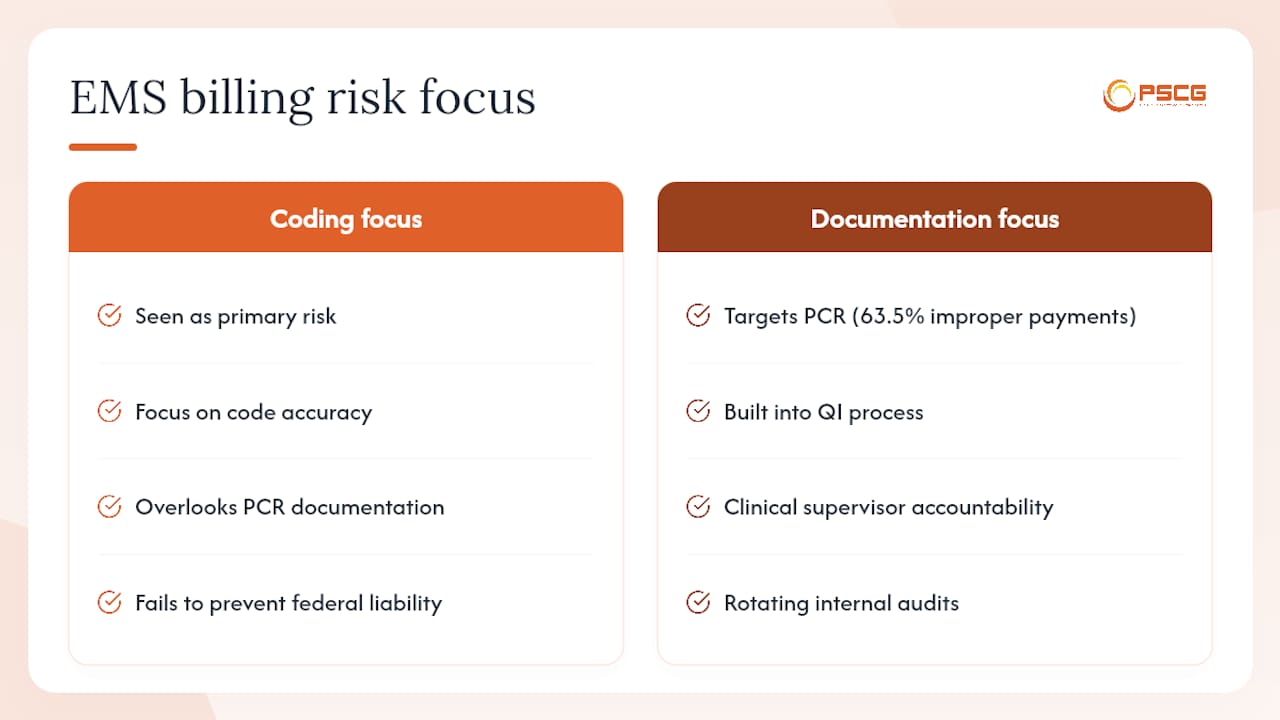
The conventional wisdom in EMS billing has long been that coding accuracy is the primary risk. The CMS data tells a different story. With 63.5% of improper payments caused by insufficient documentation and 27.5% by medical necessity issues, the real risk is clinical, not administrative. It lives in the PCR narrative, in the space between what a paramedic observed and treated and what a Medicare auditor needs to see to justify reimbursement. Agencies that focus their compliance energy on billing code accuracy while leaving PCR documentation to chance are solving the wrong problem.
What actually works is treating documentation as a clinical standard, not a billing afterthought. Agencies that build PCR review into their QI process, that hold clinical supervisors accountable for documentation quality, and that conduct regular internal audits with rotating reviewers are the ones that survive external scrutiny without disruption. The audit readiness is a byproduct of the operational discipline, not a separate program layered on top of it.
The other thing worth saying plainly: if you outsource billing, you do not outsource accountability. Every claim submitted in your agency’s name is your responsibility. Contracts that do not require annual external review and performance reporting from your billing vendor are contracts that leave you exposed. That is a structural risk, and it is one that a well-designed compliance program addresses directly.
We work alongside EMS agencies to build that kind of program, not to audit for the sake of auditing, but to create the operational readiness that makes compliance a sustainable part of how your agency runs. Visit thepscgroup.net to learn more about how we approach this work.
Thepscgroup can help you close the compliance gap

Thepscgroup provides EMS agencies and municipal leaders with the external perspective and structured methodology that internal teams cannot provide themselves. Our services directly relevant to billing compliance include external claims review, audit program design, PCR documentation improvement training, and reimbursement consulting. We work alongside your team to identify gaps, prioritize remediation, and build the internal processes that make compliance sustainable.
If your agency has not completed an external claims review in the past 12 months, or if you have received an audit notice from a MAC or RAC, that is the right moment to bring in an independent reviewer. Our reimbursement consulting services are designed specifically for EMS agencies navigating these challenges, whether you are building a compliance program from scratch or responding to a specific finding.
Contact PSCG today to schedule a readiness assessment or request an external claims review. Reach us at thepscgroup.net and let’s build the compliance foundation your agency needs.
Useful sources for EMS billing compliance
- CMS Ambulance Services Compliance Tips (Medicare Learning Network) — Primary source for improper payment rates, documentation requirements, and Medicare billing standards for ambulance services.
- CMS Certification and Compliance — Covers MAC and RAC audit authority, compliance expectations, and the consequences of noncompliance for Medicare-participating providers.
- OIG Compliance 101 Tips (PDF) — OIG guidance on building effective compliance programs, including reviewer independence and audit documentation standards.
- JEMS — Documentation Presents Greater Risk Than Coding — Industry analysis on why PCR documentation is the primary audit vulnerability and how agencies can address it.
- City of Cincinnati EMS Billing Audit Report — A real-world municipal EMS billing audit report illustrating common findings and remediation approaches.
- HBMA — Compliance Issues for Ambulance Billers — Industry association guidance on specific compliance risks in ambulance billing, including documentation and medical necessity standards.
- Thepscgroup.net — EMS Compliance and Reimbursement Services — PSCG’s consulting services for EMS audit readiness, external claims review, and reimbursement optimization.