



An EMS hardship policy lets an agency reduce, waive, or arrange payment for ambulance bills for people who cannot afford them. Most programs reference Federal Poverty Guidelines and pause collections while an application sits under review. We cover eligibility rules, how to apply, real municipal examples, payer interactions, and what to do next if you receive an ambulance bill you cannot pay.
TL;DR:
- Many agencies apply a sliding scale based on income, with Texas EMS offering a 100% discount at 125% of the federal poverty level and up to 25% at 200%.
- Eligibility hinges on household income below specific thresholds or documented medical hardship, with different agencies setting their own cutoff percentages.
- Applying requires submitting income proof, insurance details, and household size, with a written request for a collections hold during review.
- Enforcement of collection activity is often paused during application review, with Sonoma County and others explicitly stating they will not pursue collections while under review.
- Reimbursement limitations from Medicare and emerging models like ET3 mean hardship programs are largely patient-advocacy tools, not cost-recovery solutions, making accurate data tracking essential.
Table of Contents
- What an EMS financial hardship policy covers
- How agencies decide who qualifies for hardship relief
- How to apply for an EMS hardship waiver
- Real municipal hardship policies worth knowing
- How hardship policies interact with Medicare, Medicaid, and ET3
- Building a hardship policy that lasts: practitioner guidance
- What to do if you receive an ambulance bill you cannot pay
- Balancing access and sustainability in EMS billing
- How PSCG helps agencies design hardship and reimbursement programs
- FAQ
- Sources
What an EMS financial hardship policy covers
An EMS financial hardship policy is a formal agency rule that lowers, cancels, or restructures what a patient owes for an ambulance response. These programs take several forms, and the terminology varies by jurisdiction, but the underlying mechanics tend to repeat across the country.
Municipal fire departments, county-run EMS systems, and private ambulance contractors each set their own versions, usually through a board-approved policy or administrative rule. The reasons agencies adopt them are practical as much as compassionate: unpaid ambulance bills become uncollectible debt either way, and a structured hardship program lets an agency write off that debt on its own terms rather than through costly collection efforts that rarely recover much from patients who genuinely cannot pay.
The relief typically takes one of these shapes:
- Full waiver: the entire bill is forgiven once eligibility is confirmed.
- Partial discount: a set percentage is deducted from the balance based on income tier.
- Sliding-fee reduction: the discount percentage moves with how far a household’s income sits below a poverty threshold.
- Payment plan: the balance stays in place but is spread over manageable monthly installments.
We see agencies combine these tools.
How agencies decide who qualifies for hardship relief
Eligibility almost always starts with the Federal Poverty Guidelines published by the U.S. Department of Health and Human Services, but the percentage bands an agency applies vary by program, so the same household income can qualify for very different relief depending on where the ambulance ride happened.
Agencies generally test for two separate conditions, and knowing the difference matters when you fill out an application:
- Financially indigent: your household income falls below a set percentage of the Federal Poverty Guidelines, regardless of the bill amount.
- Medically indigent: your income is too high for the first test, but the ambulance bill itself, combined with other medical debt, creates a documented hardship relative to what you earn.
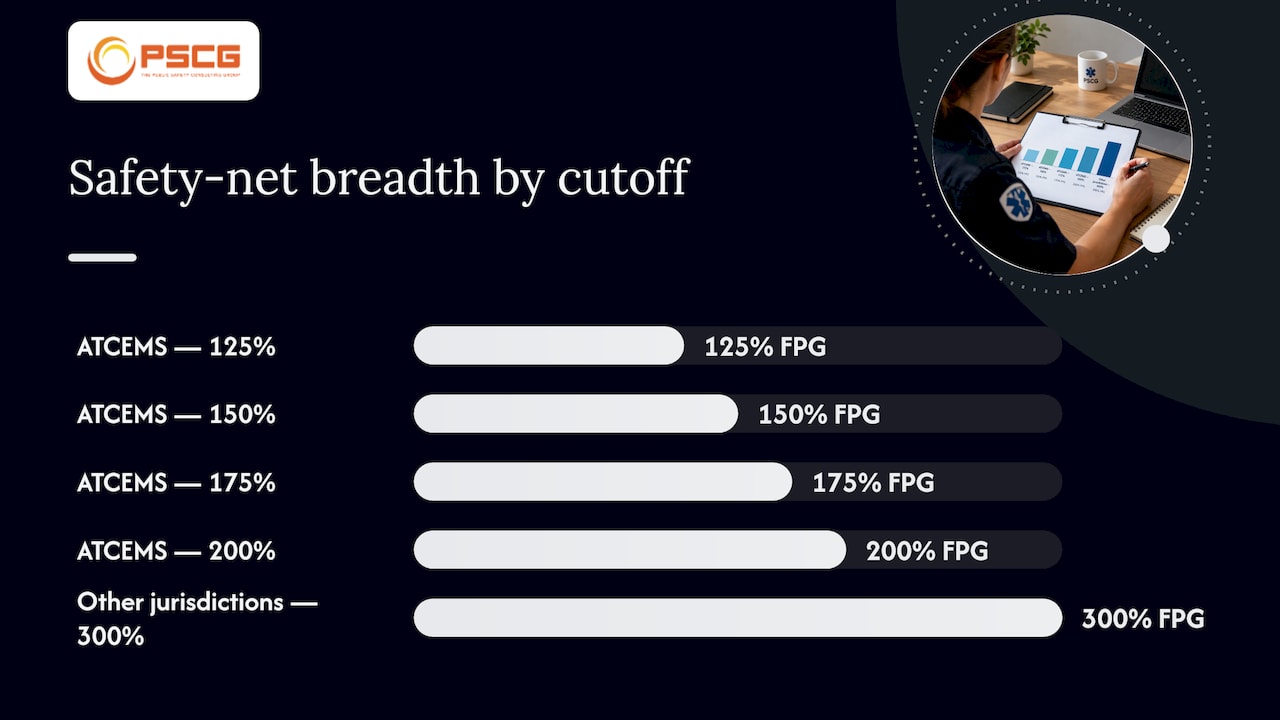
Austin-Travis County EMS runs one of the clearest tiered models in the country, offering a 100% discount at or below 125% of the Federal Poverty Guidelines, 75% at 150%, 50% at 175%, and 25% at 200%, with re-application required after 90 days for additional transports. That structure gives applicants a predictable answer instead of a case-by-case guess, and it shows how a sliding scale can serve both low-income households and the agency’s need for consistent, auditable rules.
Other jurisdictions set their income cutoff much higher. Some programs forgive the full balance for households at or below a higher percentage of the Federal Poverty Guidelines, which captures a wider slice of working families who would otherwise face a bill with no relief option. The gap between a 125% cutoff and a 300% cutoff is the difference between a narrow safety net and a broad one, and it is worth checking your specific agency’s published threshold before assuming you do not qualify.
How to apply for an EMS hardship waiver
Applying for hardship relief follows a fairly consistent pattern across agencies, even though the forms themselves differ.
- Request the hardship application from the billing office or municipal EMS website as soon as you receive a bill.
- Gather income documentation: recent pay stubs, a tax return, or proof of enrollment in a means-tested program like Medicaid or SNAP.
- Confirm your insurance status, since the application usually asks whether you have coverage and what it paid toward the transport.
- Report household size, which determines where your income falls on the Federal Poverty Guidelines scale.
- Submit the application to the billing department or the agency’s outside billing contractor, and ask in writing for a collections hold while the review is pending.
- Wait for a decision, which most programs issue within 30 to 45 days, and follow up if you have not heard back by that window.
Recurring transports, such as repeated dialysis or hospital transfers, sometimes require a separate application for each trip or each 90-day period, so confirm whether your agency expects you to reapply.
Pro Tip: Always ask for your collections hold request in writing, and keep a copy, since a verbal request is harder to prove if your account gets sent to a collection agency by mistake.
If an application is denied, most policies allow an appeal, usually triggered by submitting additional documentation or requesting a supervisor review. Agencies also conduct basic verification checks, cross-referencing income claims against submitted documents, before finalizing a decision.
Real municipal hardship policies worth knowing
Several U.S. jurisdictions have published hardship or discount policies that illustrate how this works in practice, and comparing them side by side shows both the common ground and the real differences in generosity and process.
- Austin-Travis County ties discounts directly to Federal Poverty Guidelines percentages and separates financially indigent applicants from medically indigent ones, giving each a distinct qualification path through the ATCEMS discount program.
- Loudoun County, Virginia offers a full 100% waiver for households at or below 300% of the Federal Poverty Level through its Financial Hardship Waiver, with a new application required for each transport.
- Sonoma County Fire District runs a Financial Hardship/Compassionate Care Policy that uses current HHS Poverty Guidelines, limits applicants to one hardship modification every 12 months, and commits to a 45-day decision window.
- Philadelphia Fire Department maintains a low-income assistance application that can partially or fully waive EMS and ambulance fees, routed through the department or its billing contractor.
- Wisconsin builds waiver authority directly into administrative code, with DHS 110.04(21m) allowing the state to waive certain non-statutory EMS requirements when strict enforcement would create unreasonable hardship.
The common thread is a documented, repeatable process. Sonoma County’s policy goes as far as stating that no collection activity will progress while an account is under review, which protects applicants from being sent to collections before a decision is even made. That kind of explicit collections hold is one of the clearest signs of a well-designed program, and we think every jurisdiction considering a new policy should build that protection in from the start.
How hardship policies interact with Medicare, Medicaid, and ET3
Federal payer rules shape how much flexibility an agency actually has when designing a hardship program, since Medicare’s ambulance benefit ties payment to specific transport and destination requirements rather than letting agencies bill freely for any response.
- Medicare generally pays only for transport to specific destination types, which means a treat-and-release call or a transport to an unconventional destination may not generate reimbursement at all, pushing more of that cost into the uncompensated care category hardship policies are meant to address.
- The ET3 model introduced alternative payment pathways for treatment-in-place and transport to destinations other than the emergency department, which changes the revenue picture agencies have to plan around.
- The NEMSAC advisory on EMS system funding finds that reimbursement often falls short of actual cost and recommends that agencies and policymakers build comprehensive cost and uncompensated care estimates before making funding decisions.
That NEMSAC finding matters directly for hardship policy design: a sliding-fee discount program is a patient-facing fairness tool, not a fix for a reimbursement system that already underpays relative to cost. Agencies that treat hardship write-offs as their only cost-control strategy tend to find the math does not work over time.
Building a hardship policy that lasts: practitioner guidance
A hardship policy earns trust when it is predictable, and it earns budget approval when it is measurable. We recommend agencies set clear income bands tied to the Federal Poverty Guidelines, require one application per 12-month window to limit administrative churn, and keep a documented audit trail for every decision, approval or denial.
- Pause collections immediately once an application is submitted, and put that hold in writing so patients and billing contractors are both protected.
- Define documentation requirements and decision timelines up front, following examples like Sonoma County’s 45-day window, so staff and applicants know what to expect.
- Track charity-care costs separately from bad debt so the true cost of the hardship program is visible in annual budget conversations.
- Pilot changes on a small scale, measure the financial impact over one budget cycle, and adjust the thresholds annually rather than leaving a policy untouched for a decade.
Pro Tip: Link your hardship database to your billing system so write-offs reconcile automatically with your annual uncompensated care report, instead of relying on manual spreadsheets that drift out of sync.
Agencies managing complex reimbursement structures, multiple payer contracts, or a mix of municipal and contracted billing sometimes bring in outside consulting support to design or audit this process, which can shorten the time it takes to get a sustainable policy in place.
What to do if you receive an ambulance bill you cannot pay
If you cannot afford an EMS bill, acting quickly protects you from collections and keeps your options open.
- Call the billing office right away and ask for the hardship or financial assistance application.
- Gather your documents: pay stubs, tax return, insurance card, and proof of household size.
- Request a collections hold in writing while your application is pending.
- Follow up if you have not received a decision within the agency’s stated window, usually 30 to 45 days.
- Appeal a denial with additional documentation, and contact a local legal aid office or benefits navigator if you need help building your case.
- Reach out to your municipal elected officials if you believe the process is being mishandled or delayed without explanation.
Balancing access and sustainability in EMS billing
Compassionate hardship programs matter, but they only work long term when they are built on real numbers rather than good intentions alone, emphasizing the importance of quality in healthcare to balance patient access and operational viability. An agency that waives bills without tracking the cost will eventually face a budget crisis that threatens the very service it is trying to protect.
We believe the agencies getting this right treat hardship policy as a measured program: clear thresholds, periodic review, and targeted subsidies instead of ad-hoc waivers granted case by case. That approach protects both patients and the service levels their communities depend on.
— Mike
How PSCG helps agencies design hardship and reimbursement programs
Consulting firms in this space help agencies build hardship and billing programs that hold up under budget scrutiny and public records requests alike. Our relevant service lines include:
- Reimbursement optimization to close the gap between billed charges and actual collections.
- Billing and collections process improvement to formalize hardship procedures and reduce write-off leakage.
- Municipal EMS strategy consulting to align hardship policy with broader budget and service goals.
A typical engagement starts with an assessment of your current billing and hardship data, moves into pilot recommendations based on what we find, and continues through implementation support until the new process is running on its own. If your agency is weighing a new or updated hardship policy, visit our EMS consulting services page to start that conversation, or reach us through our contact page directly.

This article is general information, not a substitute for advice from a qualified financial advisor. Consult a qualified financial professional about your own circumstances before acting on anything here.
FAQ
Why are ambulances not free in the US?
Ambulance service in the United States is typically billed because most EMS agencies rely on a mix of patient fees, insurance reimbursement, and local tax subsidies to cover operating costs, and reimbursement from payers often falls short of the actual cost of a response, according to the NEMSAC advisory on EMS funding. Hardship policies exist precisely because that billing model can create real financial strain for lower-income patients.
Which states have EMS as an essential service?
EMS essential service designation varies by state, and some states classify EMS as a required local government service while others leave it optional or structured through a mix of municipal, volunteer, and private providers. Because the rules differ so much by state, we recommend checking your state’s own EMS office or administrative code, such as Wisconsin’s DHS 110 rule, for the exact designation that applies where you live.
What is EMS financial assistance?
EMS financial assistance refers to programs that reduce, waive, or restructure what a patient owes for an ambulance response, usually based on household income compared to the Federal Poverty Guidelines. Relief can include a full waiver, a percentage discount, or a payment plan, depending on the agency’s specific policy.
Do I need to pay for an ambulance ride in the US?
In most cases, yes, you will receive a bill for an ambulance transport unless you qualify for a hardship waiver, Medicaid coverage, or another assistance program. Programs like the ATCEMS discount program and Philadelphia’s low-income assistance application can reduce or eliminate that bill if you meet their income criteria.
How long does an EMS hardship application take to process?
Decision timelines vary by agency, but Sonoma County Fire District commits to a 45-day decision window while holding collection activity during the review. Other programs cite a similar 30 to 45 day range, so confirm the specific timeline with your billing office when you submit your application.
Sources
- Austintexas
- Financial Hardship/Compassionate Care Policy | Sonoma County Fire District
- Financial hardship application for EMS bills, including ambulance bills | Philadelphia Fire Department | City of Philadelphia