



The fastest way to improve EMS patient pay collections is to find insurance before you classify anyone as self-pay, build a complete documentation file before any collection attempt, and provide patients with clear, compassionate payment paths including defined escalation timelines. Get those three things right, and the rest of the collections process becomes far less risky and far more effective.
TL;DR:
- Automatically recheck eligibility for workplace injuries, motor vehicle accidents, and patients over 65; audit self pay accounts from the prior 90 days against updated files monthly.
- Send statements within 10 days, follow up at 30 days and 60 days, review accounts at 90 days, and assess referral readiness at 120 days.
- Tailor outreach by sorting accounts into likely collectible, hardship candidates, and likely uncollectible groups; blanket dialer campaigns can alienate patients and waste effort.
- Before referring an account or reporting it to credit bureaus, require leadership signoff and verify the balance, insurance outcome, notices, and documented patient contacts.
Table of Contents
- Why patient-pay collections matter now: landscape and regulatory context
- Payor discovery and prevention: capture insurance upstream
- Documentation and compliance: build a defensible collection file
- Patient engagement and payment options that raise voluntary payment rates
- Operational workflows, KPIs, and timing: when to escalate
- Vendor vs. in-house collections: decision criteria and governance
- PSCG field-proven checklist and where agencies find the biggest wins
- Revenue recovery that preserves community trust
- How PSCG can help: services for reimbursement and collections improvement
- FAQ
- Sources
Why patient-pay collections matter now: landscape and regulatory context
Every EMS agency wrestles with the same tension: the patients who need transport most urgently are often the ones least equipped to navigate billing afterward. When insurance discovery is skipped or rushed, accounts get coded as self-pay that should never have landed there, inflating receivables and inviting disputes.
At the same time, federal oversight of medical debt collection has tightened. The Consumer Financial Protection Bureau’s 2022 bulletin ties No Surprises Act protections directly to debt-collection conduct, warning that collectors who pursue amounts already covered by insurance, or who fail to substantiate a debt, risk violating the Fair Debt Collection Practices Act and the Fair Credit Reporting Act. For municipal EMS leaders, that is not an abstract compliance note. It is a direct statement that billing practices and legal exposure are now the same conversation.
Here is what success actually looks like when agencies get this right:
- A higher net collection rate on self-pay balances, driven by fewer accounts wrongly classified as uninsured.
- Fewer patient disputes and complaints reaching municipal officials or elected leaders.
- A documented, auditable compliance trail that withstands scrutiny from CMS, the CFPB, or a credit-reporting challenge.
Agencies that treat collections as a governance function, not a back-office task, tend to see all three outcomes move together.
Payor discovery and prevention: capture insurance upstream
Most self-pay problems start long before a bill goes out. They start at the point of contact, when a crew is focused on patient care and billing information gets collected quickly, incompletely, or not at all.
The fix begins with eligibility verification tools that run against commercial and government payer databases in near real time, flagging coverage a patient may not have mentioned or may not have known they had. Pair that technology with a disciplined intake process, and self-pay volume drops before it ever reaches a biller’s desk.
A workable upstream sequence looks like this:
- Verify patient name, date of birth, and address against a government-issued ID whenever one is available.
- Collect policy holder name, relationship to patient, and employer information, since many patients are covered under a spouse’s or parent’s plan.
- Capture a Social Security number only when appropriate and consistent with your agency’s privacy policy, since it often resolves coverage matches that name and date of birth alone cannot.
- Obtain a signed consent for billing and release of information at the time of transport, not days later.
- Flag any account where a patient mentions Medicare, Medicaid, or a commercial plan, even informally, for immediate verification before self-pay coding.
Accounts should also carry built-in audit triggers: a transport tied to a workplace injury, a motor vehicle accident, or a patient over 65 should automatically prompt a second eligibility check before anyone labels it self-pay. The EMS1 industry analysis on self-pay recovery confirms that upstream insurance discovery, paired with intake training, consistently reduces both unpaid balances and patient disputes.
Pro Tip: Run a monthly audit of accounts coded self-pay in the last 90 days against updated eligibility files. You will almost always find coverage you missed the first time.
Documentation and compliance: build a defensible collection file
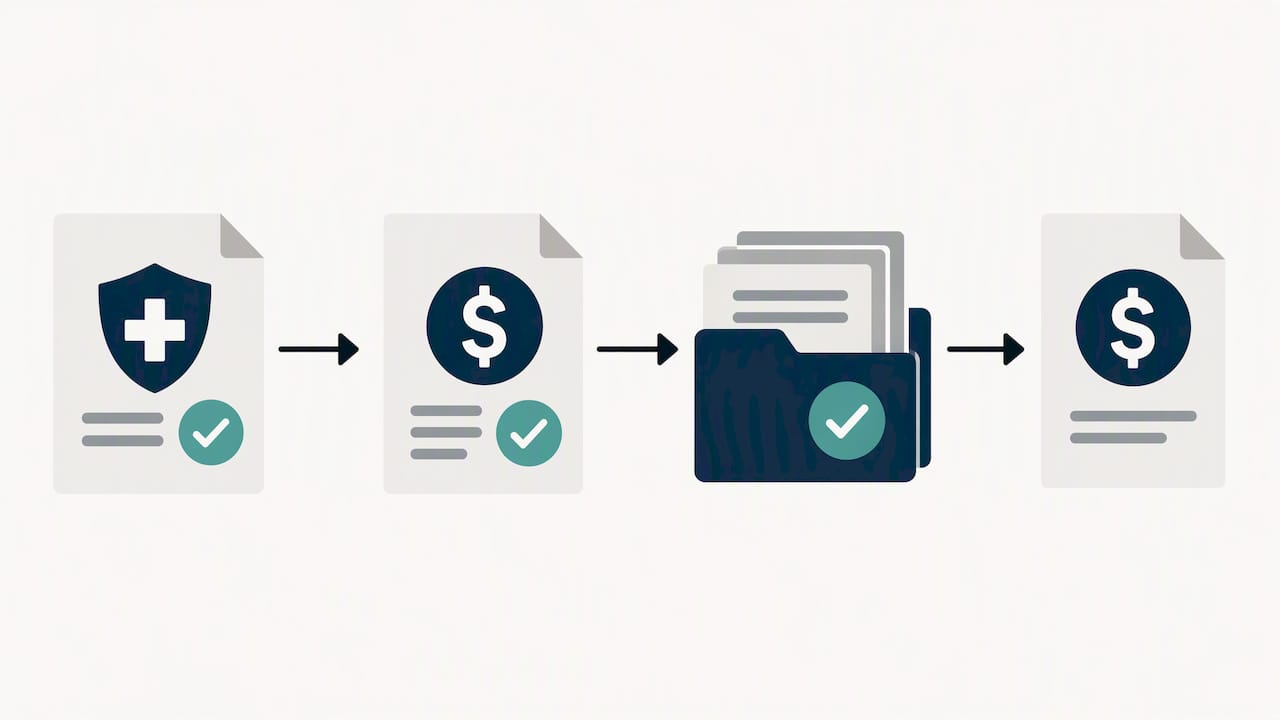
A collection effort is only as strong as the paper trail behind it. Before any agency pursues a patient balance, especially one headed toward a third-party collector or credit reporting, the file needs to hold up under outside review.
A defensible documentation packet includes:
- The complete transport record, including dispatch time, response, and treatment provided.
- All payer correspondence, including denials, explanations of benefits, and any appeals filed.
- Itemized charges that match the services actually rendered, not boilerplate codes.
- A full payment history showing every attempt to bill, every patient contact, and every response.
- Evidence that the patient was screened for financial assistance or hardship programs before escalation.
CMS guidance on Medicare bad debt defines what counts as a “reasonable collection effort” for deductible and coinsurance amounts, and it matters more than most billing teams realize: after a defined collection period, Medicare presumes an account is noncollectible unless the agency can show it made genuine, documented efforts to collect. Miss that documentation window, and a legitimately uncollected balance can still be disallowed as bad debt.
The CFPB’s 2024 advisory opinion raises the stakes further, stating that collectors are strictly liable under the FDCPA and Regulation F for pursuing amounts not actually owed, whether due to insurance payment, billing error, or an unsubstantiated charge. That is an absolute standard, not a best-efforts one, which means a missing document is not just an administrative gap. It is legal exposure.
Patient engagement and payment options that raise voluntary payment rates
Patients pay faster when the process feels fair and manageable, not when they feel chased. The agencies that see the strongest voluntary payment rates tend to lead with clarity rather than pressure.
Practical tools that move the needle include:
- Text-to-pay links and QR codes on the first statement, so patients can settle a balance in seconds from a phone.
- A plain-language first bill that explains the charge, the insurance status, and exactly how to ask questions, before any collection language appears.
- Standardized payment plans with transparent terms, so two patients in similar financial situations are treated the same way.
- Written hardship and financial assistance criteria, applied consistently and documented in the account file.
Segmentation matters as much as the tools themselves. Treating every self-pay account the same way, whether through a blanket dialer campaign or an identical letter sequence, wastes effort on accounts that will never pay and alienates patients who would have paid voluntarily with a little more time. The EMS1 practitioner research describes sorting accounts into likely-collectible, hardship-candidate, and likely-uncollectible groups, then tailoring outreach to each.
Pro Tip: Send the first statement within 10 days of transport. Patients who hear from you early, in clear language, are far more likely to engage before a balance feels old or confusing.
Operational workflows, KPIs, and timing: when to escalate
A collections process needs a calendar as much as it needs a policy. Without defined checkpoints, accounts drift until they either age into bad debt or get escalated too aggressively, too soon.
A workable timeline:
- First statement within 10 days of transport, written in plain language.
- Follow-up contact at 30 and 60 days, offering a payment plan or hardship screening before any collection letter escalates in tone.
- A documented internal review at 90 days to confirm insurance status has not changed and all required notices were sent.
- A formal reasonable-collection-effort review at 120 days, consistent with CMS bad-debt presumption guidance, before any referral to an outside collector or credit bureau.
Track performance with a small set of KPIs: net collection rate, days sales outstanding, the percentage of referred accounts that actually recover, and dispute volume per thousand transports. Require documented leadership sign-off before any account moves to external collections or credit reporting, since that step carries the highest compliance and community-relations risk.
Vendor vs. in-house collections: decision criteria and governance
Choosing between an in-house collections team and an outside vendor comes down to volume, staffing capacity, and how much legal and political risk your agency is prepared to manage directly. Smaller agencies with limited billing staff often lean on vendors for scale, while larger systems with mature compliance teams may keep more of the process in-house to control patient experience directly.
Whichever path you choose, the contract language matters as much as the decision itself. Require:
- Full access to documentation and payment histories for every referred account.
- Explicit compliance with Regulation F and the FDCPA, written into the agreement, not assumed.
- A defined dispute-resolution process that pauses collection activity while a dispute is under review.
- Agency approval required before any credit reporting or legal action.
Ongoing oversight should include periodic audits, a regular reporting cadence, and active monitoring of consumer complaints tied to your agency’s accounts, regardless of which model you choose.
PSCG field-proven checklist and where agencies find the biggest wins
Agencies we have worked alongside typically find the fastest gains from a short list: upstream insurance discovery, a standardized documentation packet, a defined outreach cadence, and a written hardship policy. Clean intake and trained crews consistently matter more than any single piece of software.
- Verify insurance before coding an account self-pay.
- Build one documentation template every biller uses the same way.
- Set a fixed statement and follow-up schedule.
- Add text-to-pay and a written hardship policy before expanding collection efforts.
Revenue recovery that preserves community trust
Collections work is, at its core, an act of public stewardship. Every dollar recovered responsibly keeps the ambulance funded without asking more of the community than fairness allows, and every dollar pursued carelessly chips away at the trust that makes EMS systems work in the first place.
This month, do two things: verify insurance on every open self-pay account older than 30 days, and confirm your documentation packet meets the standard CMS and the CFPB expect.
— Mike
How PSCG can help: services for reimbursement and collections improvement
We work with municipal EMS agencies to close the gap between what you bill and what you actually collect, without compromising compliance or community trust. We typically start with an audit of your current intake, documentation, and vendor practices, followed by a prioritized set of fixes and hands-on support through implementation.

- A payor-mix and self-pay audit to find where revenue is leaking upstream.
- A documentation review against CMS and CFPB expectations.
- Staff training on intake scripts and compassionate patient payment conversations.
- Vendor contract review for compliance and oversight gaps.
Agencies evaluating collections technology on their own sometimes turn to platforms like Interval for automated outreach and dispute tracking. Where that kind of tool fits, we help agencies build the compliance and documentation foundation underneath it. If you are ready to talk through what that looks like for your agency, visit our services overview or reach out through our contact and team page to start the conversation.
This article is general information, not a substitute for advice from a qualified financial advisor. Consult a qualified financial professional about your own circumstances before acting on anything here.
FAQ
What happens if an ambulance bill goes to collections?
An unpaid ambulance balance typically moves to a third-party collector or gets reported to a credit bureau, which can affect a patient’s credit history. Before that step, federal guidance expects the agency to have documented reasonable collection efforts and to have confirmed the balance is accurate and not already covered by insurance, per CFPB standards.
What is the average collection rate for medical billing?
Collection rates vary widely by payer mix, patient demographics, and how early an agency catches missed insurance coverage, so there is no single industry-wide figure that applies to every EMS agency. Agencies that prioritize upstream insurance discovery and clear patient communication generally see stronger recovery on self-pay balances than those relying on collections alone, according to EMS1 practitioner reporting.
What are patient collections in medical billing?
Patient collections refer to the process of recovering balances owed directly by patients after insurance has paid its portion, or when no insurance coverage applies. This includes billing statements, payment plans, hardship screening, and, when necessary, referral to an outside collector, all governed by documentation and consumer-protection rules like the FDCPA and Regulation F.
How should EMS agencies choose a billing or collections approach?
The right approach depends on an agency’s transport volume, staffing capacity, and tolerance for handling disputes and compliance oversight directly. Many agencies benefit from a structured audit of intake, documentation, and payment options before deciding between in-house collections and a vetted outside vendor, as outlined in our billing and collections improvement guidance.
Sources
- CFPB Bulletin on No Surprises Act and medical debt collection (2022)
- CMS guidance on bad debts, charity, and reasonable collection efforts (Medicare)
- Proven ways EMS can minimize impact and maximize reimbursement from self-pay accounts — EMS1