



Coaching in EMS is agency-level organizational and leadership coaching that helps system leaders improve governance, operational readiness, reimbursement, and measurable clinical performance. It is built for municipal leaders, EMS agency executives, fire chiefs, and private ambulance managers, not for individual providers chasing a certification or a promotion. The goal is straightforward: a system that runs with clearer accountability, faster and more consistent response, and a stronger financial foundation.
TL;DR:
- Coaching in EMS improves system design, governance, performance metrics, financial workflows, and leadership development to produce lasting operational changes.
- Success depends on clear, prioritized plans with measurable goals, staff ownership, and strong executive sponsorship, especially for full implementation projects.
- Engagements typically involve initial assessment, pilot testing, active deployment support, and capability transfer, with longer projects yielding more sustainable improvements.
- Challenges include data access issues, heterogeneous systems, and staffing constraints, while automation and in-person training enhance output and engagement.
- Agencies should consider coaching when facing recurring claim denials, staffing issues, plateaued response times, or weak governance, ensuring ROI is assessed through benchmark metrics.
Table of Contents
- What Coaching in EMS Covers: Scope and Engagement Areas
- How Coaching Engagements Work: Models, Deliverables, and Timeline
- When to Hire a Coach: Evaluating ROI and Cost-Effectiveness
- Implementation Barriers and What Actually Drives Success
- Our Perspective on What Separates Lasting Change From a Binder on a Shelf
- How We Support Agencies Ready to Coach Their Way to Better Performance
- FAQ
- Sources
What Coaching in EMS Covers: Scope and Engagement Areas
When we talk about coaching in EMS, we mean a structured review and improvement process that touches every major lever a leader controls. It is not a single workshop. It is a working relationship that moves through an agency’s design, oversight, measurement, and money, because those four pieces rarely improve in isolation.
A typical engagement covers:
- System design and deployment, including System Status Management, peak-load staffing models, and deployment plans that match unit placement to actual demand patterns.
- Governance and medical oversight, aligning protocols and clinical authority so the medical director’s role and the agency’s operational decisions reinforce each other.
- Performance measurement, using frameworks like the NEMSQA performance measures, which organize a comprehensive set of performance clusters and indicators that give leaders a common language for benchmarking.
- Financial and reimbursement review, examining billing workflows, denial patterns, and Medicare or Medicaid exposure that quietly drain revenue.
- Training and leadership development, building the bench strength an agency needs once the engagement ends.
Each of these areas connects to EMS performance metrics that leaders can track over time, and to the governance structures that keep a medical director’s clinical authority and an agency’s operational choices moving in the same direction. Coaching works best when these pieces are treated as one system rather than five separate projects competing for the same hours.
How Coaching Engagements Work: Models, Deliverables, and Timeline
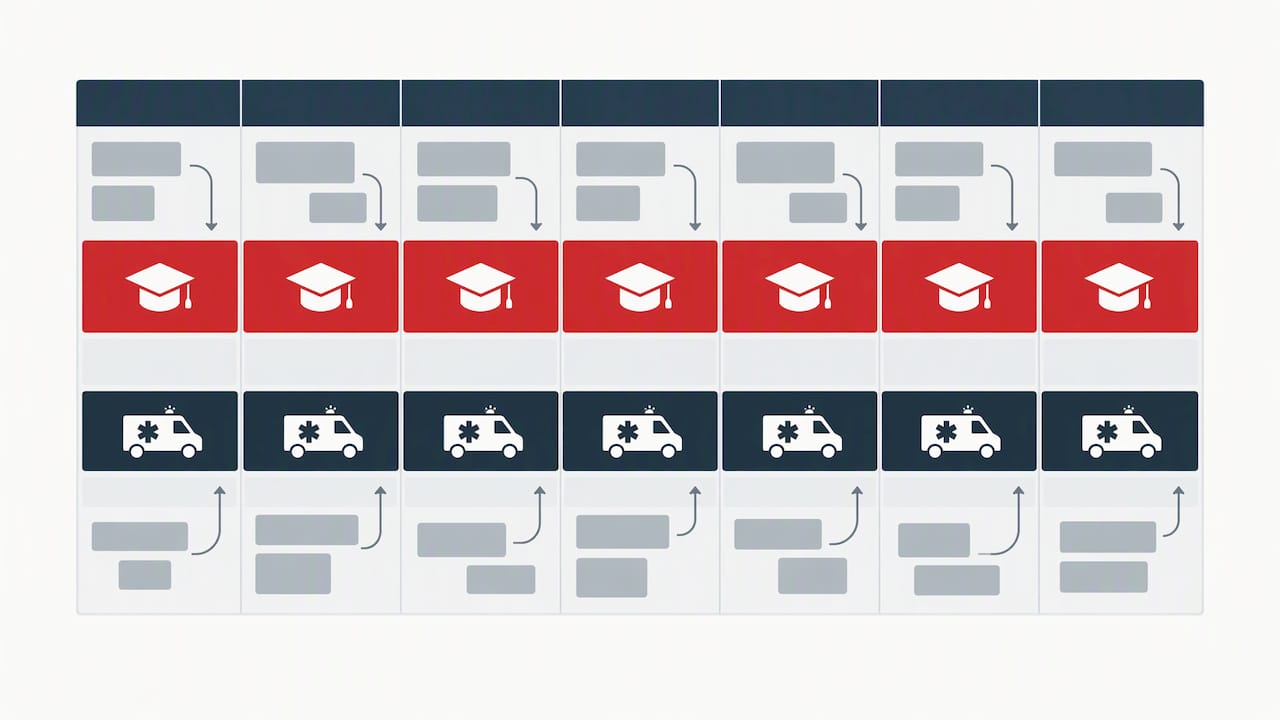
A coaching engagement generally moves through four phases, each with its own deliverable and its own demand on your team’s time.
- Assessment and gap analysis. We review response data, billing records, and staffing patterns, then interview dispatchers, field crews, and command staff to understand where the written plan and daily reality diverge.
- Prioritized plan and pilot design. Findings become a ranked list of fixes, often tested first through a small Plan-Do-Study-Act (PDSA) cycle with a handful of measurable indicators rather than an agency-wide overhaul.
- Implementation support. This is where deployment plans, revised staffing schedules, and updated billing workflows actually go live, with coaching staff working alongside your team rather than handing over a binder.
- Measurement and sustainment. Dashboards and audit tools get built or automated, and your own staff learn to run them, because the point is capability transfer, not permanent dependency.
Pro Tip: Start every pilot with no more than three KPIs. Agencies that try to track fifteen metrics at once rarely finish measuring any of them.
Timeline and resourcing vary by scope. An assessment-only engagement can often run a matter of weeks and mostly requires access to records and staff interview time. A full implementation, covering deployment redesign, staff training, and billing process changes, takes longer and asks more of your command staff’s calendar, but it is also where most of the durable gains show up. Agencies weighing the two should think about what they can realistically sustain once outside support steps back, since a plan nobody owns internally tends to fade within a year.
When to Hire a Coach: Evaluating ROI and Cost-Effectiveness
Certain signals tend to show up before an agency decides it is time to bring in outside coaching: recurring claim denials, staffing shortages that never seem to resolve, response times that have plateaued despite added resources, or a governance structure where the medical director and operations leadership rarely coordinate.
Estimating return on investment starts with a baseline, not a guess. Useful inputs include:
- Readiness metrics, such as unit-hour utilization and peak-load coverage gaps that drive overtime costs.
- Cost-per-transport drivers, since ambulance provider costs vary widely between agencies and personnel costs are the largest cost component.
- Reimbursement leakage, meaning the gap between what an agency bills and what it actually collects.
- Contract structure, whether a project-based engagement, a retainer, or a bundled training package fits the problem size.
Before signing, ask any prospective coaching partner what measurable acceptance criteria define success, how capability transfers to your staff, and what happens to the dashboards and training materials once the contract ends.
Implementation Barriers and What Actually Drives Success
Coaching engagements fail for predictable reasons. A qualitative study of EMS leadership found that heterogeneity across agencies, inconsistent data access, and a lack of protected time for training are recurring obstacles, and that in-person, simulation-based training tends to be viewed as the most effective format despite its cost.
Common barriers include:
- Heterogeneous systems and governance, where neighboring agencies run different protocols and reporting structures.
- Data quality and access gaps, since many EMS organizations lack dedicated quality improvement resources.
- Funding and staff time constraints that make even a good plan hard to sustain.
Success tends to follow a different pattern: strong executive sponsorship, an engaged medical director, clear NEMSQA-aligned measures, and a just-culture approach that treats errors as system data rather than individual blame.
Pro Tip: Protect training time on the schedule the same way you protect vehicle maintenance time. If it is optional, it gets skipped.
Our Perspective on What Separates Lasting Change From a Binder on a Shelf
We have spent more than three decades working inside the regulatory, clinical, and political constraints that make EMS leadership genuinely hard, and the pattern is consistent: agencies that succeed start with an honest assessment that produces a short, prioritized, measurable plan informed by continuous improvement methodologies, not a wish list. The best engagements end with your own staff running the dashboards and PDSA cycles, because outside support should build capability, not permanent reliance.
— Mike
How We Support Agencies Ready to Coach Their Way to Better Performance
Working with The Public Safety Consulting Group, we bring the same field-tested approach to every engagement, whether an agency needs a full system redesign or a focused fix on one problem area.
Our services map directly to the areas covered in this guide:
- High Performance EMS (HPEMS) System Design and System Status Management for agencies rethinking deployment from the ground up.
- Peak-Load Staffing Modeling & Scheduling to match crew availability to real demand.
- Reimbursement optimization and billing and collections process improvement to close the gap between billed and collected revenue through our municipal EMS strategy services.
- Professional education services that build internal leadership capacity rather than lasting dependency.
An initial assessment engagement typically includes a records and data review, stakeholder interviews, and a prioritized improvement plan with measurable indicators your team can act on immediately. If your agency is weighing where to start, visit Thepscgroup to talk through what an assessment would look like for your system.
This article is general information, not a substitute for advice from a qualified doctor. Consult a qualified healthcare professional about your own circumstances before acting on anything here.
FAQ
What is the difference between organizational coaching and individual EMS coaching?
Organizational coaching works at the agency and system level, addressing deployment, governance, and reimbursement, while individual coaching focuses on a single provider’s clinical skills or career path. This guide addresses the first category, aimed at municipal leaders and agency executives rather than field staff.
How long does an EMS coaching engagement typically last?
Timelines depend on scope: an assessment-only engagement can often be completed in weeks, while full implementation covering staffing, deployment, and billing changes takes considerably longer. The right duration depends on how much internal capacity your team has to carry the work forward.
What results should we expect to measure from coaching?
Agencies typically track NEMSQA-aligned indicators such as response time benchmarks, unit-hour utilization, and clinical process measures, alongside financial metrics like denial rates and cost per transport. A GAO analysis found that personnel costs are usually the largest driver of per-transport costs, making staffing efficiency a central metric.
Can clinical audits really cover more cases without more staff?
Yes. One technology-enabled audit tool increased audit coverage from about 10% to full coverage of cases in a pilot program, showing that automation can expand oversight without adding headcount.
Does PSCG offer ongoing retainer support or only one-time projects?
Engagements are structured to meet agency needs, from assessment projects to longer implementation and training support; pricing and scope vary, so the best next step is to reach out through Thepscgroup to discuss your specific situation.
Sources
- Ems
- Emergency Medical Services Leadership Perspectives on Implementation of Evidence-Based Guidelines: A Qualitative Study
- EMS Quality Improvement Programs – StatPearls (NCBI Bookshelf)
- Ambulance providers: costs and Medicare margins varied widely (GAO)