



An ambulance franchise ordinance gives a county or city the legal authority to require a franchise before any provider can run certain ambulance operations within its borders, and most of these ordinances reach non-emergency transports while leaving emergency EMS systems alone. If you are responsible for drafting or enforcing one, your first move is straightforward: confirm what your state’s enabling statute actually permits, check whether emergency services carry an exemption, and review how existing providers in your jurisdiction would be affected before you touch the ordinance language.
TL;DR:
- Franchise ordinances typically apply only to non-emergency and convalescent transports, leaving emergency EMS systems outside the franchise or under separate agreements.
- Local regulations must clearly define terms like franchise scope, territory, and differentiate emergency from non-emergency services to avoid legal challenges or ambiguities.
- Most jurisdictions exempt government-operated emergency services, mutual aid responses, through-transport vehicles, and air ambulances from franchise requirements, often due to statutory or federal preemption.
- Application processes should include detailed submission requirements like insurance, staffing, and vehicle documentation, with review procedures that safeguard against arbitrary decisions.
- Franchise terms usually last one to five years, with renewal contingent on compliance and providings, and standards should align with state licensure and federal data reporting obligations.
Table of Contents
- Where Local Governments Get the Authority to Franchise Ambulance Services
- What an Ordinance Must Define and How Scope Choices Shape Enforcement
- Who Needs a Franchise and How Exemptions Are Typically Written
- Building an Application and Review Process That Holds Up Under Scrutiny
- Setting Franchise Terms, Renewal Rules, and Minimum Operating Standards
- How Ordinances Handle Insurance Minimums and Billing Protections
- Designing Enforcement, Suspension, Revocation, and Appeal Procedures
- Structuring Franchise Districts and Managing Redistricting Over Time
- Where State and Federal Law Limit What Local Ordinances Can Require
- A Practical Checklist for Drafting and Implementing an Ordinance
- Choosing Between Franchising, Contracting, and Direct Operation
- How We Help Local Governments Draft and Implement These Ordinances
- FAQ
- Sources
Where Local Governments Get the Authority to Franchise Ambulance Services
Local governments cannot simply decide to regulate ambulance operators. The power has to come from somewhere, and that somewhere is state law. Counties and municipalities act under authority their state legislature grants them, and ambulance franchising is no exception. North Carolina’s statute is a useful reference point: it allows a county to franchise ambulance service by ordinance, but it also requires the county to hold a public hearing on the need for such an ordinance before adopting it. This is a safeguard built directly into G.S. 153A-250. Every jurisdiction considering a similar path should locate its own state’s equivalent provision and read it closely, because the specifics of hearing notice, timing, and findings vary from state to state.
The policy reasoning behind franchising tends to be consistent across jurisdictions, even where the statutory language differs. Local officials turn to franchise ordinances because open competition in ambulance service can produce fragmented coverage, inconsistent response standards, and providers who enter and exit a market based on short-term profitability rather than long-term community need. A franchise structure lets a locality set conditions up front and hold providers accountable to them for the life of the agreement.
Franchising sits between two other options: operating the ambulance system directly through a government department, or awarding service through a straight competitive contract. We find that franchising tends to make sense when a jurisdiction wants private or nonprofit providers in the market but also wants enforceable standards, defined territories, and a mechanism for removing a provider who fails to perform.
- Franchising preserves private-sector participation while giving the locality enforcement leverage that informal licensing does not.
- Direct municipal operation gives full control but carries higher fixed costs and staffing obligations.
- Competitive contracting works well for single-provider arrangements but offers less flexibility for managing multiple operators across a county.
What an Ordinance Must Define and How Scope Choices Shape Enforcement
Vague definitions are where ambulance franchise ordinances run into trouble, whether through litigation, unintended loopholes, or conflicts with state licensure rules. A defensible ordinance starts with a clear list of defined terms, and that list should be treated as a drafting checklist rather than an afterthought.
- Franchise: the specific grant of authority the ordinance confers, including whether it is exclusive to a territory or non-exclusive.
- Non-emergency transport: scheduled, convalescent, or interfacility transport that does not involve an immediate threat to life.
- Emergency ambulance service: response to calls dispatched through 911 or an equivalent emergency system, often the category most likely to carry a statutory exemption.
- Franchise territory: the geographic boundary within which the franchise applies, defined precisely enough to avoid overlap disputes.
- State licensing authority: the office of emergency medical services (OEMS) or equivalent state agency responsible for personnel and vehicle licensure, referenced so the ordinance does not attempt to duplicate state standards.
The line between emergency and non-emergency service matters because most state enabling statutes draw that same line, and many exempt emergency 911 response from local franchise requirements entirely. An ordinance that blurs this distinction, or that tries to regulate emergency dispatch alongside non-emergency transport without separating the two, invites both legal challenge and confusion among providers trying to determine whether they need a franchise at all. Drafters should also resist the temptation to borrow vague phrases like “adequate service” without pairing them to measurable standards elsewhere in the ordinance, since undefined terms tend to become the first target in an appeal.
Who Needs a Franchise and How Exemptions Are Typically Written
Most ambulance franchise ordinances reach a narrower set of operators than people assume. The typical structure requires a franchise for non-emergency and convalescent transport providers operating within the jurisdiction, while leaving the county’s primary emergency EMS system, whether that is a government department or a long-standing contracted provider, outside the franchise requirement or subject to a separate operating agreement.
Common exemptions, drawn from the structure seen across county ordinances like the Washington County ambulance ordinance, include:
- Government-operated emergency ambulance services already authorized under a separate statutory or contractual arrangement.
- Mutual aid responses, where an out-of-jurisdiction provider assists during a declared emergency or mass-casualty event.
- Vehicles passing through the jurisdiction while transporting a patient to or from a point outside the county, sometimes called through-transport.
- Air ambulance operators, which are generally addressed separately given federal preemption concerns discussed later in this guide.
Grandfathering deserves specific attention when a locality adopts its first franchise ordinance in a market where providers are already operating. A sudden requirement with no transition period can disrupt continuity of care and invite legal exposure from incumbents who built their business around the absence of a franchise requirement. The more defensible approach gives existing providers a defined window, often 90 to 180 days, to submit a complete application and demonstrate compliance before enforcement begins, while making clear that grandfathering is a transition mechanism and not a permanent exemption from the standards new entrants must meet.
Building an Application and Review Process That Holds Up Under Scrutiny
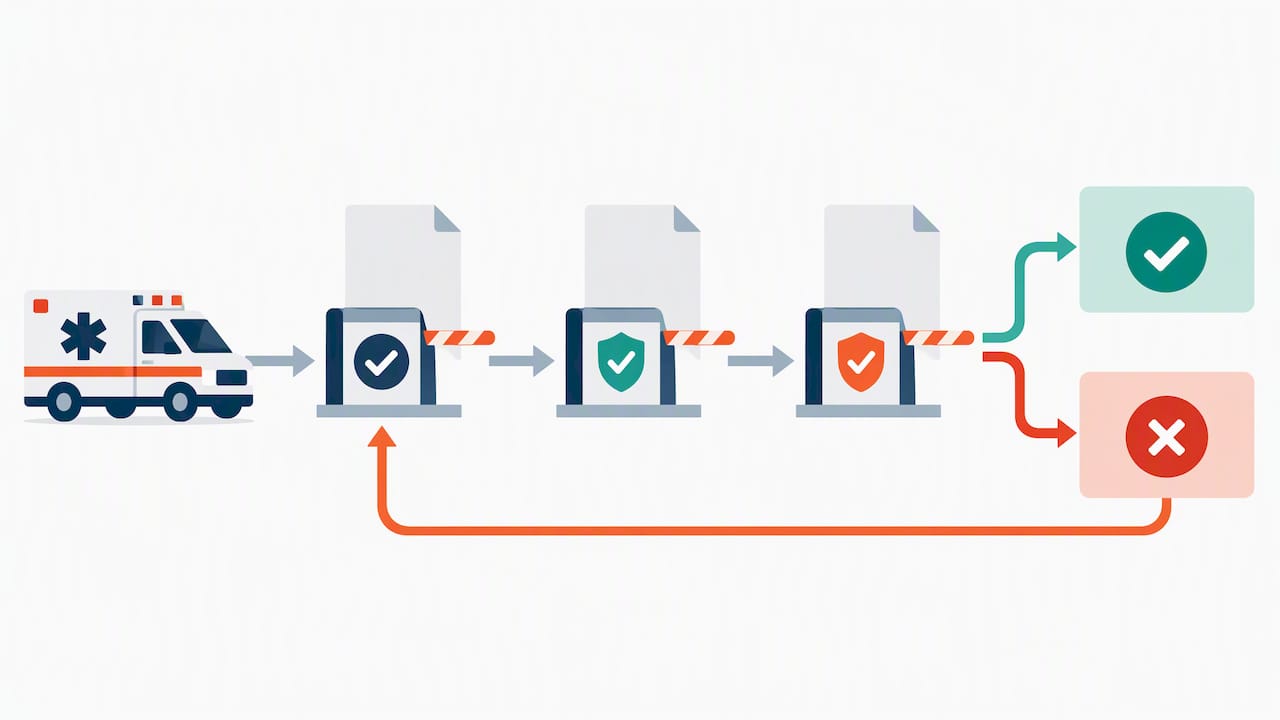
The application and review process is where most franchise disputes originate, because a poorly structured process invites claims of arbitrary decision-making. A strong ordinance spells out exactly what an applicant must submit and exactly how the locality will evaluate it.
A complete application file typically includes:
- Proof of ownership structure, including any parent company or affiliated entities operating under a different name.
- Documentation of Medicare and Medicaid billing standing, including National Provider Identifier (NPI) status where applicable.
- Certificates of insurance meeting the ordinance’s stated minimums for general liability and commercial auto coverage.
- Staffing plans identifying crew credentials, shift coverage, and base of operations within or near the proposed territory.
- An equipment inventory confirming each vehicle meets state OEMS standards for licensure and medical supplies.
- Sample operating policies covering dispatch protocols, mutual aid agreements, and patient complaint handling.
On the review side, the process should move through a defined sequence rather than an open-ended discretionary review. A typical structure assigns initial review to the EMS department or public safety office, which verifies completeness and confirms the application meets baseline standards. That review period should be followed by published notice and, where the ordinance requires it, a public hearing that allows residents, incumbent providers, and other stakeholders to comment before a governing board acts. Wake County’s ordinance structure illustrates this pattern well, pairing departmental review with public hearing requirements and clearly defined application contents before any board vote.
Fees should be set to cover the administrative cost of review rather than to function as a revenue source, since outsized fees can themselves become a basis for a preemption or equal-protection challenge. Grounds for denial should be written as specific, verifiable failures, such as an incomplete application, an unresolved licensure deficiency, or insurance that falls below the stated minimum, rather than broad discretionary language like “not in the public interest,” which is far harder to defend if an applicant appeals.
Setting Franchise Terms, Renewal Rules, and Minimum Operating Standards
Once a franchise is awarded, the ordinance needs to say clearly how long it lasts and what the holder has to keep doing to keep it. Franchise terms across the county ordinances we reviewed commonly run from one to five years, with Wake County’s structure permitting terms of up to five years as a common upper bound. Shorter terms give the locality more frequent opportunities to reassess performance, while longer terms give providers enough stability to invest in staffing and equipment.
Renewal should never be automatic in substance even when it is automatic in form. The strongest ordinances require an active renewal filing, a current compliance review, and confirmation that insurance and licensure remain in good standing, rather than allowing a franchise to roll over by default. This gives the locality a built-in checkpoint without having to initiate a full revocation process to address a provider who has drifted out of compliance.
Minimum personnel and vehicle standards should tie back to the state licensure system rather than recreate it. The National EMS Scope of Practice Model provides a nationally recognized reference for personnel credentialing levels, and an ordinance that anchors its crewing requirements to that framework, layered on top of state OEMS licensure, avoids the trap of inventing standards that conflict with what the state already requires.
- Crew composition should specify minimum certification level per vehicle, consistent with state OEMS licensure categories.
- Vehicle standards should require current state inspection and licensure rather than a separate local inspection regime.
- Base location requirements should specify a maximum response radius or response-time expectation tied to the franchise territory.
- Recordkeeping requirements should mandate standardized trip logs and dispatch records available for county audit on request.
Pro Tip: Build your inspection schedule around your state’s existing vehicle licensure renewal cycle so franchisees face one compliance calendar instead of two.
How Ordinances Handle Insurance Minimums and Billing Protections
Insurance requirements are one of the more straightforward sections to draft because the structure is well established across jurisdictions, but the rates and charges section tends to raise harder policy questions about how far local authority should reach into a provider’s billing practices.
- Commercial general liability coverage is typically required at a stated minimum, often paired with a separate commercial auto liability minimum for the ambulance fleet itself.
- Certificates of insurance should be required as a condition of both initial award and ongoing renewal, with the locality named as a certificate holder entitled to advance notice of cancellation.
- Workers’ compensation coverage is commonly required where state law mandates it for the provider’s employee classification.
On rates and charges, most ordinances take one of two approaches: requiring public disclosure of rate schedules without directly setting prices, or asserting authority to review and approve rate changes as a condition of the franchise. The disclosure-only approach is generally easier to defend and administer, since direct rate regulation raises more complex legal questions depending on state law and the provider’s payer mix.
Balance billing has become a live concern in communities debating whether to bring in private, for-profit ambulance operators, and local reporting on negotiations in Pflugerville shows how billing practices and collections approaches become central to the public debate over a new provider agreement. An ordinance that requires rate transparency and coordination with any subscription or membership billing program a provider offers gives residents and the governing board visibility without necessarily wading into rate-setting.
Designing Enforcement, Suspension, Revocation, and Appeal Procedures
An ordinance with no enforcement teeth is just a statement of intent, but enforcement language written without due process protections tends to collapse the first time it is tested. The strongest approach uses a progressive structure that gives providers a real opportunity to correct a problem before losing their franchise.
- Monitoring and reporting: require periodic trip logs, dispatch records, and complaint summaries so violations surface through routine reporting rather than only through crisis events.
- Notice of deficiency: when a violation is identified, issue written notice specifying the exact standard at issue and a defined cure period, commonly 30 days, before further action.
- Suspension: reserve suspension for deficiencies that create an immediate safety concern, such as lapsed insurance or an unlicensed vehicle still in service.
- Revocation: apply revocation only after a documented pattern of violations or a failure to cure within the stated period, paired with a right to a hearing before the governing board.
- Appeal rights: give the franchisee a clear administrative appeal path, with a defined timeline, before revocation becomes final.
Alamance County’s ordinance illustrates a common penalty structure that pairs daily fines for ongoing violations with the locality’s right to seek injunctive relief in cases where a provider continues operating despite suspension or revocation. Civil penalties and injunctions give a locality enforcement options short of a full license termination, which matters in situations where interrupting service entirely would leave residents without coverage during the transition to a new provider. Building an emergency authority clause, allowing the county to step in temporarily if a franchisee abruptly ceases operation, closes a gap that pure revocation language tends to leave open.
Structuring Franchise Districts and Managing Redistricting Over Time
Territorial design is where franchise ordinances intersect most directly with service-level planning. A jurisdiction awarding a single exclusive franchise for its entire county faces different considerations than one dividing coverage into multiple districts tied to call volume or geography.
- Base district boundaries on documented call volume, population density, and existing response-time data rather than administrative convenience.
- Decide early whether franchises will be exclusive within a district or whether multiple providers may compete within the same territory.
- Build in a defined redistricting trigger, such as a population threshold or a sustained response-time deficiency, rather than leaving boundary changes to ad hoc board action.
- Require advance public notice and stakeholder input, including affected providers, before any territory is redrawn.
Award limits matter most in counties with more than one franchise district, where a single operator holding every district can recreate the same lack of accountability franchising was meant to solve. A cap on the number of districts one franchisee may hold, or a requirement that an operator demonstrate adequate capacity before expanding into an additional district, keeps the structure from drifting into a de facto monopoly without a competitive check.
Where State and Federal Law Limit What Local Ordinances Can Require
Local authority to franchise ambulance service is real, but it is not unlimited, and the clearest boundary is federal preemption of air ambulance regulation. The Airline Deregulation Act generally preempts state and local regulation of air carrier prices, routes, and services, and federal guidance on helicopter emergency medical transport makes clear that this preemption extends to attempts by localities to economically regulate air ambulance operators through pricing or route requirements, as outlined in federal helicopter EMS guidance. Ordinances that reach air ambulance providers at all should limit those provisions to medically related standards, such as equipment and credentialing, and avoid language that touches pricing or service routes.
On the reporting side, selected ground ambulance organizations must participate in the Medicare Ground Ambulance Data Collection System, a federal requirement with payment-reduction consequences for noncompliance. Aligning local reporting templates with GADCS definitions, rather than inventing a separate local reporting format, reduces the burden on franchisees and gives county staff data that is directly comparable to federal benchmarks.
- State OEMS licensure remains the baseline for personnel and vehicle standards; an ordinance should reference it rather than recreate it.
- Public hearing requirements, where a state’s enabling statute specifies them, are a procedural precondition to adoption, not an optional courtesy.
- CMS reporting obligations under GADCS apply independently of any local franchise requirement and should inform how a county structures its own reporting templates.
A Practical Checklist for Drafting and Implementing an Ordinance
Drafting an ambulance franchise ordinance is a legal exercise, but adopting one successfully is an operational project that touches legal counsel, the EMS director, procurement staff, and whatever oversight committee will monitor compliance after the ink dries.
- Commission a service-level analysis before drafting begins, documenting current call volume, response times, and provider coverage gaps across the jurisdiction.
- Map stakeholders early, including incumbent providers, hospital partners, and neighboring jurisdictions whose mutual aid agreements may be affected.
- Run a fiscal impact analysis covering administrative costs of application review, ongoing monitoring, and any fee structure the ordinance proposes.
- Prepare standardized forms in advance: an application checklist, an insurance certificate template, an inspection form, and a quarterly reporting template aligned to GADCS definitions where relevant.
- Assign clear roles before adoption: legal counsel drafts and reviews language for preemption risk, the EMS director owns the service-level and standards sections, procurement manages the application and award process, and an oversight committee reviews performance data after franchises are awarded.
Pro Tip: Draft your inspection checklist and quarterly reporting template at the same time as the ordinance itself, rather than after adoption, so franchisees receive both documents together and compliance expectations are clear from day one.
A sample inspection checklist and standardized quarterly reporting format, covering dispatch logs, trip volume, and response-time data, give enforcement staff something concrete to work from rather than relying on the ordinance text alone during a dispute.
Choosing Between Franchising, Contracting, and Direct Operation
Franchising earns its keep when a jurisdiction has real service gaps, wants more than one qualified provider in the market, and needs enforceable standards without taking on the fixed costs of running an ambulance fleet directly. It is a weaker fit for a small jurisdiction already well served by a single long-standing provider, where the administrative overhead of a franchise process may outweigh the accountability gained.
Whatever structure a governing board chooses, the ordinance is only as strong as the oversight behind it. We recommend pairing any franchise award with measurable performance standards, an audit clause giving the county real access to a provider’s records, and a public reporting requirement that puts response-time and complaint data in front of elected officials on a regular schedule, not just at renewal.
Franchising is not a one-time decision. The ordinance and the franchise terms it produces deserve periodic re-evaluation against actual service outcomes, not just the assumptions made at adoption.
— Mike
How We Help Local Governments Draft and Implement These Ordinances
Drafting a defensible ambulance franchise ordinance means getting the legal structure, the operational standards, and the enforcement language right at the same time, and most municipal staff are doing this work alongside a dozen other priorities. We provide consulting support on municipal EMS strategy, reimbursement optimization, and operational risk reduction, bringing practical insight into effective safety precautions for EMS and first responders that improve franchise implementation and enforcement.

Our engagements typically start with a diagnostic review of current service levels and existing provider agreements, move into draft language and standards development, and finish with implementation support, including the reporting templates and oversight structures your staff will use after adoption. If your jurisdiction is considering a new franchise ordinance or revising one that is no longer matching your service needs, visit our services overview to see how an engagement with The Public Safety Consulting Group (PSCG) typically runs, or reach out through our contact page to talk through where your ordinance stands today.
FAQ
How profitable is an ambulance business?
Profitability varies widely by payer mix, call volume, and whether the provider handles emergency or non-emergency transport, and no single figure applies across markets. Billing and collections efficiency, including how well a provider manages Medicare and Medicaid claims, tends to matter more to long-term viability than call volume alone.
What’s a code 3 in an ambulance?
“Code 3” generally refers to an emergency response using lights and sirens, signaling that a crew is responding to or transporting a patient under urgent conditions. The exact terminology and protocols for when code 3 response is appropriate are set by state EMS authorities and local medical protocols, so definitions can vary slightly between jurisdictions.
Are private ambulances legal?
Private ambulance companies operate legally in most U.S. jurisdictions, typically subject to state EMS licensure and, in many counties, a local franchise or permit requirement for non-emergency transport. Whether a private provider needs a local franchise depends on the jurisdiction’s enabling statute and whether emergency services carry an exemption, as outlined earlier in this guide.
Can a civilian own an ambulance?
A private individual or company can own and operate ambulance vehicles, but operating an ambulance service still requires meeting state EMS licensure standards for vehicles and personnel, along with any local franchise or permit requirement that applies in that jurisdiction. Ownership alone does not satisfy the licensing and franchise obligations that come with running the service commercially.
Sources
- G.S. 153A-250
- Ambulance Franchise Ordinance (Washington County, amended June 2016)
- National EMS Scope of Practice Model (2019)
- Medicare Ground Ambulance Data Collection System (GADCS) Report appendix