



TL;DR:
- EMS staffing analysis uses operational data and workload metrics to align workforce deployment with actual patient demand. It promotes evidence-based, tiered deployment models that optimize crew configurations, reduce burnout, and improve system sustainability amid staffing shortages. Continuous monitoring and stakeholder engagement are essential for effective, lasting system improvement.
EMS staffing analysis is defined as the systematic use of operational data, workload metrics, and call volume patterns to optimize emergency medical services workforce deployment and improve patient care outcomes. Unlike traditional staffing models built on historical precedent or budget convenience, modern EMS staffing analysis aligns crew configurations, unit deployment, and shift scheduling with actual patient acuity and geographic demand. Michigan alone reports over 500 paramedic and EMT vacancies with annual turnover rates between 6% and 30%, making data-driven workforce planning not a luxury but a necessity. For public safety officials, understanding this process is the first step toward building an EMS system that is both operationally sound and financially sustainable.
What is EMS staffing analysis and how does it work?
EMS staffing analysis is the structured process of collecting, mapping, and interpreting operational data to determine whether an agency’s current workforce matches the actual demands placed on it. The industry also refers to this practice as workforce demand analysis or operational staffing assessment, and the terms are used interchangeably across EMS management literature. At its core, the process answers one question: does the right resource reach the right patient at the right time, with the right crew?

The primary data inputs include dispatch records, call volume trends, response acuity classifications, geographic coverage maps, and crew utilization rates. Analysts map this data against objective performance indicators such as overlapping call rates, mutual aid reliance frequency, and unit-hour utilization. These indicators reveal whether an agency is understaffed during peak demand windows or overextended across geographic zones.
Workload analysis adds a critical layer. The Visual, Auditory, Cognitive, and Psychomotor (VACP) framework quantifies the actual demands placed on crew members during different call types. Mapping dispatch data to VACP estimates helps determine optimal crew configurations and workload distribution, which is essential for preventing burnout and maintaining clinical performance.
Key data points that drive effective EMS staffing analysis include:
- Call volume trends segmented by time of day, day of week, and season to identify demand peaks
- Response acuity data categorizing calls by clinical complexity and intervention requirements
- Crew workload metrics using VACP variables to assess cognitive and physical demands per call type
- Mutual aid reliance rates indicating when local resources are consistently insufficient
- Overlapping call frequency measuring how often simultaneous incidents strain unit availability
Pro Tip: Avoid using average response time as your sole performance indicator. Response time measures speed, not system capacity or clinical effectiveness. Agencies that track overlapping calls and mutual aid dependency get a far more accurate picture of staffing adequacy.
How do evidence-based staffing models improve EMS outcomes?
Evidence-based EMS staffing models replace assumption-driven deployment with configurations grounded in call data and clinical research. The most significant shift in modern EMS workforce planning is the move toward tiered deployment, which matches the level of clinical resources to the documented acuity of calls rather than sending Advanced Life Support units to every incident by default.
The clinical rationale for tiered deployment is well established. Only 6.9% of EMS 911 calls require potentially life-saving interventions, meaning the vast majority of responses involve assessment, monitoring, and transport rather than advanced clinical procedures. Deploying two-paramedic crews to low-acuity calls consumes high-cost resources unnecessarily and contributes to paramedic fatigue. Tiered models that pair Basic Life Support units for lower-acuity calls with ALS intercept capability preserve paramedic capacity for calls that genuinely require it.
Crew configuration is equally important. Research comparing two-paramedic crews against paramedic-EMT combinations shows that neither configuration consistently lowers total workload. The lead paramedic in either model carries significantly higher cognitive and task demands. This finding means agencies cannot resolve burnout simply by adding a second paramedic. Workload must be mapped at the call-type level to identify where configuration changes will actually reduce lead provider burden.
| Staffing model | Key strengths | Key considerations |
|---|---|---|
| Two-paramedic ALS crew | High clinical capacity on all calls; strong for high-acuity systems | Higher cost per unit hour; paramedic fatigue on low-acuity calls |
| Paramedic-EMT combination | Cost-effective; EMT handles lower-acuity tasks | Lead paramedic carries heavier cognitive load; requires clear scope protocols |
| Tiered ALS/BLS deployment | Matches resource level to call acuity; preserves ALS capacity | Requires accurate dispatch triage; coordination between unit types |
| Community paramedicine integration | Extends EMS reach; reduces unnecessary 911 activation | Requires additional training and program infrastructure |
Pro Tip: When redesigning crew configurations, bring frontline paramedics and EMTs into the planning process early. NAEMT President Chris Way has noted that staff involvement in planning produces realistic strategies that hold up during actual implementation, not just on paper.
What challenges make EMS staffing analysis critical in 2026?
The workforce pressures facing EMS agencies in 2026 make staffing analysis more urgent than at any prior point in the profession’s history. Turnover, burnout, funding constraints, and misaligned community expectations combine to create systems that are perpetually reactive rather than strategically managed.
The workforce shortage is measurable and severe. Michigan’s documented paramedic and EMT vacancy crisis reflects a national pattern in which rural and suburban agencies struggle to maintain minimum staffing levels. Some metro Detroit communities have turned to private ambulance providers to cover gaps, with call volume increases of 35% driving demand beyond what existing staff can absorb. Relying on contract staffing as a permanent solution creates financial instability and inconsistent care quality.
The financial dimension compounds the staffing challenge. EMS reimbursement structures frequently fail to cover the true cost of service delivery, leaving agencies underfunded relative to their operational demands. Fire-based EMS models face particular pressure, as fire resources are often underutilized on medical calls, suggesting that system redesign integrating medical oversight and data-driven staffing is overdue.
The following factors consistently drive the need for formal staffing analysis:
- High turnover rates between 6% and 30% annually that destabilize crew continuity and increase training costs
- Burnout from workload imbalance when crew configurations do not match call complexity
- Reimbursement shortfalls that limit hiring capacity and force agencies into reactive staffing decisions
- Community expectations built around response time benchmarks that do not reflect clinical evidence
- Seasonal demand variation that creates predictable but unmanaged staffing gaps
Public misconceptions about response times deserve specific attention. FDNY data shows response times increased from 9:34 in 2021 to 11:21 in 2025 without significant outcome changes, reinforcing that speed alone is not the primary driver of patient survival in most call categories. Educating elected officials and community stakeholders on this distinction is part of responsible EMS leadership.
How to conduct an EMS staffing analysis: a practical framework
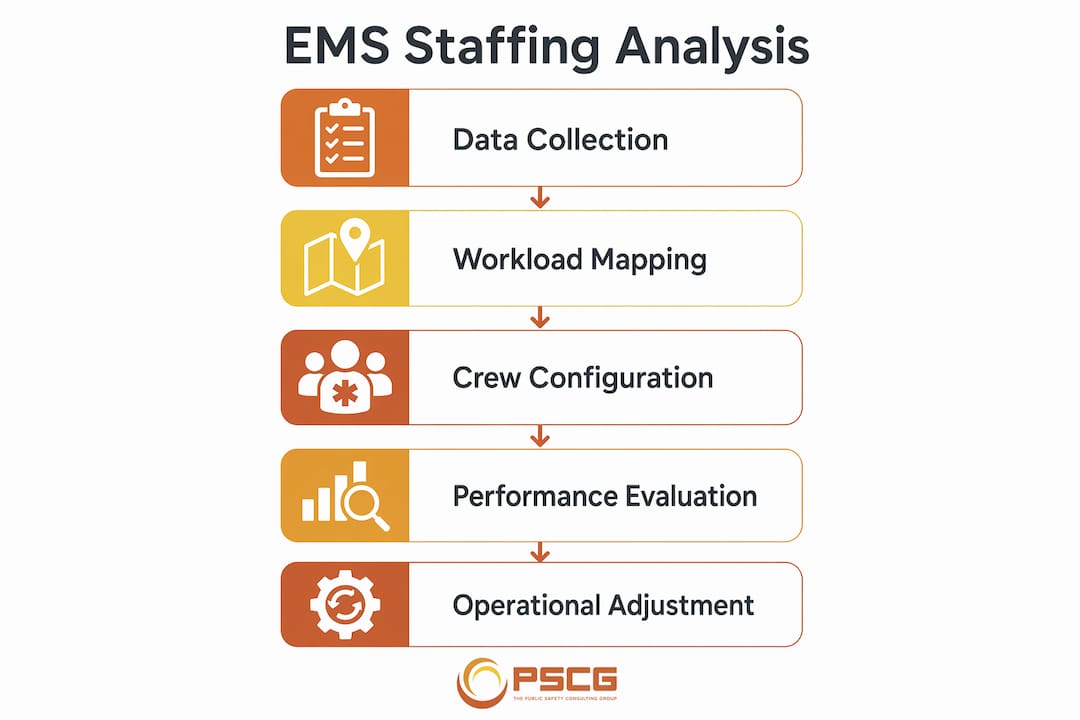
Conducting a credible EMS staffing analysis requires a structured, sequential process that moves from data collection through implementation and continuous monitoring. Public safety officials who skip steps or rely on incomplete data sets produce findings that do not hold up under operational scrutiny.
Collect baseline operational data. Pull at least 12 months of computer-aided dispatch records, unit-hour utilization reports, mutual aid logs, and call acuity classifications. Twelve months captures seasonal variation; anything shorter produces misleading demand averages.
Map workload using VACP variables. Categorize calls by their visual, auditory, cognitive, and psychomotor demands. This step reveals which call types are driving crew fatigue and where configuration changes will have the most impact on lead provider workload.
Identify performance gaps. Analyze overlapping call rates, mutual aid dependency, and geographic coverage gaps. Staffing trials require predefined metrics including overlapping calls and mutual aid reliance to accurately measure system resilience. Agencies that rely solely on average response times miss the structural indicators of understaffing.
Model alternative configurations. Use call data to simulate how different crew configurations or deployment schedules would affect unit availability, workload distribution, and cost per call. Compare tiered deployment options against current models using the EMS staffing models that align with your community’s call profile.
Pilot test with defined success criteria. Run staffing changes as structured trials of at least six months to account for seasonal demand shifts. Define success metrics before the trial begins, including overlapping call thresholds, mutual aid frequency targets, and crew utilization benchmarks.
Engage stakeholders throughout. Medical directors, union representatives, elected officials, and frontline staff all hold information that improves plan quality. Sustainable staffing depends on planned recruitment pipelines rather than reactive hiring, and building that pipeline requires cross-functional commitment.
Monitor continuously and adjust. Staffing analysis is not a one-time project. Demand patterns shift, workforce composition changes, and community risk profiles evolve. Build quarterly review cycles into your operational calendar and treat staffing analysis as an ongoing management function rather than a periodic study.
Community risk assessments also inform paramedic placement decisions. Agencies serving populations with high rates of cardiac events, behavioral health calls, or fall-related injuries should weight their deployment models accordingly, placing ALS resources where clinical complexity is statistically highest.
Key takeaways
Effective EMS staffing analysis requires integrating VACP workload data, call acuity trends, and evidence-based crew configurations to build a workforce model that matches actual demand rather than historical assumptions.
| Point | Details |
|---|---|
| Define the right data inputs | Collect dispatch records, VACP workload data, and mutual aid logs across at least 12 months. |
| Match resources to acuity | Only 6.9% of calls require ALS interventions; tiered deployment preserves paramedic capacity. |
| Evaluate crew configuration carefully | Neither two-paramedic nor paramedic-EMT crews consistently reduce total workload without call-type mapping. |
| Use multi-metric performance measures | Overlapping call rates and mutual aid reliance reveal staffing gaps that response times alone cannot show. |
| Build continuous review cycles | Staffing analysis is an ongoing management function, not a one-time study. |
What I’ve learned from watching agencies get staffing analysis wrong
I have worked alongside EMS agencies that invested significant resources in staffing studies, only to shelve the findings because the recommendations conflicted with existing labor agreements or political expectations. That outcome is not a failure of analysis. It is a failure of process. The data was right. The engagement was wrong.
The agencies that translate staffing analysis into lasting operational change share one consistent trait: they bring execution-level staff into the planning process before the analysis is complete, not after. When a paramedic who runs 12-hour shifts in a rural county tells you that the call volume model does not reflect how mutual aid actually flows on weekend nights, that is information no dataset will surface on its own. Ignoring it produces a plan that looks correct on paper and fails in practice.
The other pattern I see repeatedly is an overreliance on response time as the primary performance measure. Response time is visible, politically legible, and easy to report to a city council. It is also a poor proxy for system health. The FDNY data showing minimal outcome change despite a nearly two-minute increase in average response time should prompt every public safety official to ask harder questions about what they are actually measuring and why.
Moving to a data-driven EMS workforce model requires leadership that is willing to reframe the conversation with elected officials, community boards, and the public. That is not a technical challenge. It is a leadership challenge. The analysis gives you the evidence. What you do with it determines whether your system improves.
— Mike
How Thepscgroup supports your EMS staffing strategy
Thepscgroup works directly with municipal EMS agencies, fire-based EMS systems, and public safety officials to conduct rigorous staffing analyses grounded in operational data and clinical evidence. Our team brings expertise in EMS system design consulting, workforce demand modeling, and performance gap analysis to every engagement. We do not deliver generic reports. We build staffing strategies your team can implement and sustain.
Whether you are managing a workforce shortage, evaluating a transition to tiered deployment, or preparing a staffing study for your governing board, our municipal EMS strategy resources provide the framework to move from analysis to action. Contact us at thepscgroup.net to start the conversation.
FAQ
What is EMS staffing analysis?
EMS staffing analysis is the process of using operational data, call volume trends, and workload metrics to determine whether an agency’s workforce matches actual patient demand. It replaces assumption-based staffing with evidence-based deployment decisions.
How does VACP workload analysis apply to EMS crews?
VACP stands for Visual, Auditory, Cognitive, and Psychomotor workload. Mapping dispatch data to these variables reveals the specific demands different call types place on crew members, which informs crew configuration decisions and burnout risk assessment.
Why are response times insufficient as the only staffing metric?
Response time measures speed but not system capacity or clinical effectiveness. Metrics like overlapping call rates and mutual aid reliance frequency provide a more accurate picture of whether an agency is adequately staffed for its actual demand profile.
How long should an EMS staffing trial period last?
Staffing trials should run for at least six months to capture seasonal demand variation. Success metrics including overlapping call thresholds and mutual aid frequency targets must be defined before the trial begins, not evaluated after the fact.
What staffing model works best for a tiered EMS system?
No single model fits every community. Tiered ALS and BLS deployment works well when dispatch triage accurately classifies call acuity, while paramedic-EMT combinations offer cost efficiency for moderate-acuity systems. Call volume data and VACP workload mapping should drive the selection.