

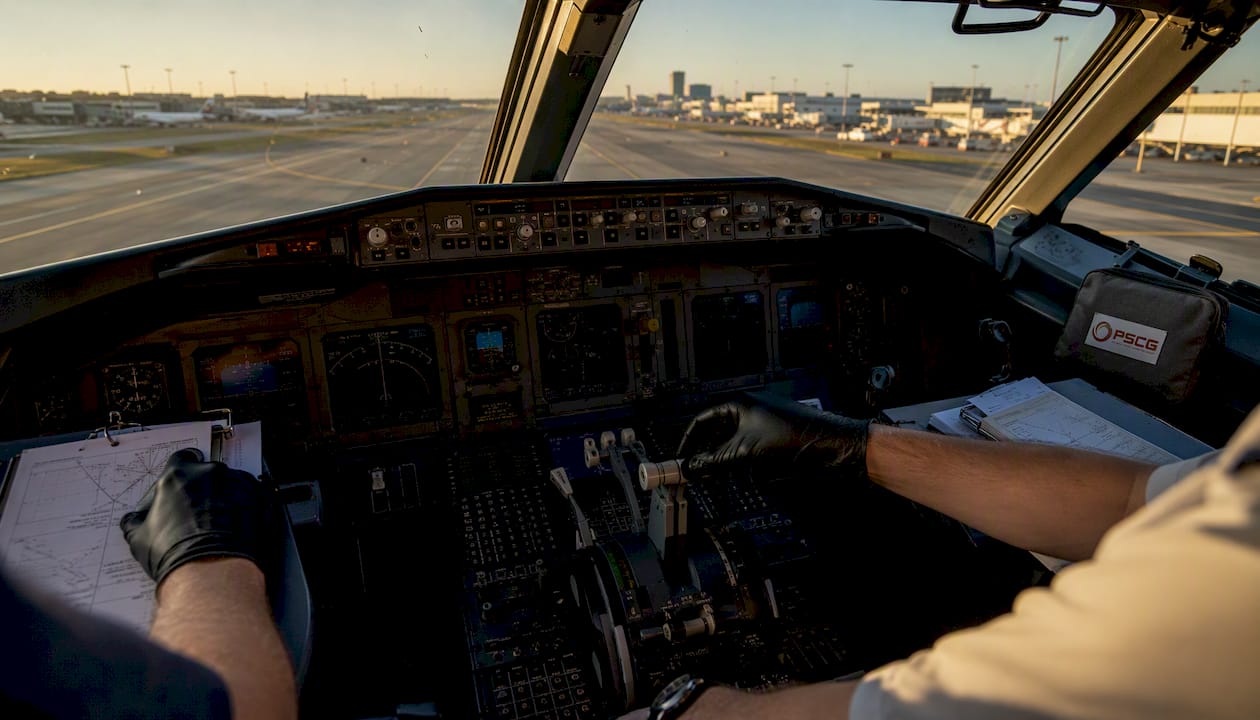
Crew Resource Management (CRM) is the structured use of all available resources — human, hardware, and information resources — to reduce error, improve decision-making, and keep crews and passengers safe. The The FAA defines CRM as a discipline that addresses team building, information transfer, problem-solving, situational awareness, and the effective management of automation. ICAO and NTSB findings have reinforced CRM as a foundational safety practice across commercial and general aviation.
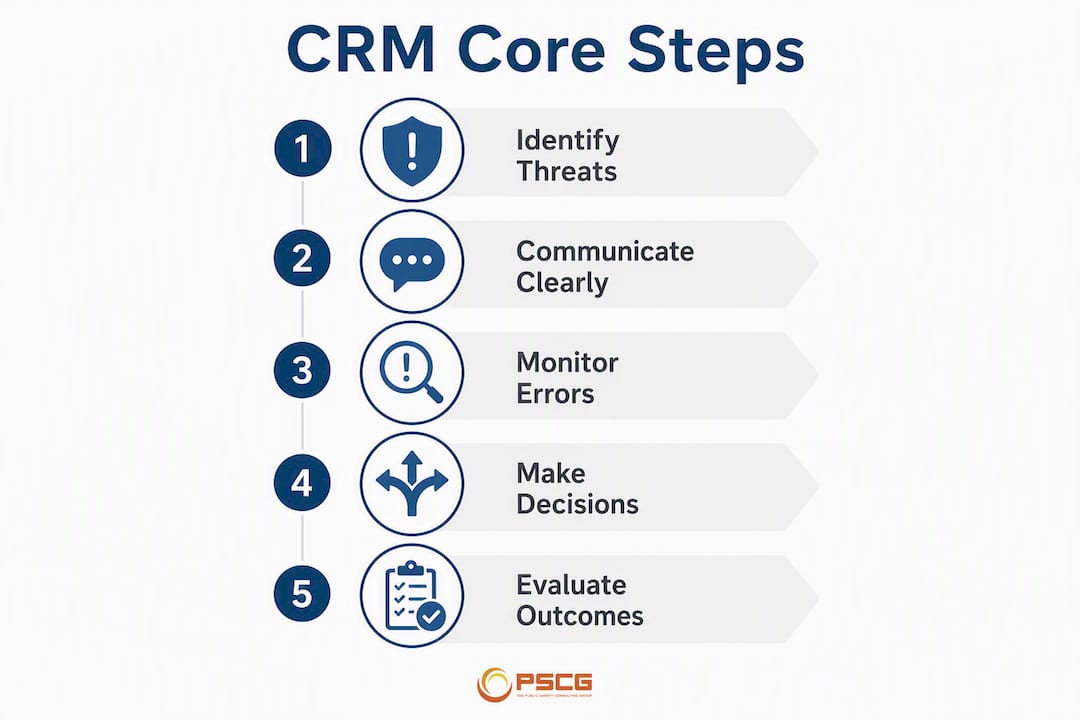
At its core, CRM training builds five non-technical skills that shape how crews perform under pressure:
- Communication — explicit callouts, closed-loop confirmation, and assertive speaking
- Situational awareness — shared mental models and continuous information updates
- Decision-making — structured options analysis and risk assessment under time pressure
- Teamwork and leadership — clear role assignments, briefings, and mutual support
- Workload management — deliberate task allocation so critical items never fall through
Human factors contribute to a large share of civil aviation incidents — industry sources commonly cite that up to 70–80% of occurrences are attributable to these causes. That single statistic explains why aviation authorities worldwide have made CRM training a regulatory expectation rather than an optional add-on.
Table of Contents
- What CRM covers and why it matters in aviation
- How CRM evolved from cockpit authority to crew teamwork
- Core CRM principles and the non-technical skills they build
- Common CRM frameworks and the tools that make them practical
- What FAA and ICAO actually require for CRM training
- How CRM training is actually delivered in practice
- Three case studies that show CRM in action
- How to measure whether CRM training is actually working
- Where CRM principles are applied beyond aviation
- Adapting aviation CRM to EMS and public safety
- Key Takeaways
- Why CRM’s cultural shift matters more than its curriculum
- How Thepscgroup supports CRM adoption for EMS and public safety leaders
- Authoritative sources and further reading
What CRM covers and why it matters in aviation
CRM is not a soft-skills seminar. It is a professional discipline that standardizes how crews communicate, monitor each other, and allocate tasks so that performance stays reliable under stress. The FAA’s guidance makes clear that CRM addresses three categories of resources simultaneously: the human element (crew members, dispatchers, maintenance), hardware (aircraft systems, automation, checklists), and information (weather data, ATC instructions, NOTAMs, and real-time sensor outputs).

The practical benefits are concrete. Crews trained in CRM principles conduct higher-quality pre-flight briefings, catch procedural errors before they compound, and hand off information more completely during crew changes. Captains who apply CRM leadership principles actively solicit input from first officers and cabin crew rather than relying solely on their own assessment, which distributes the cognitive load and surfaces threats earlier.
Industry sources commonly cite that up to 70–80% of civil aviation incidents are attributable to human factors. That figure is not an argument against pilot skill — it is an argument for systematic training in the non-technical behaviors that determine whether a skilled crew catches a problem or misses it. CRM is the structured answer to that challenge.
How CRM evolved from cockpit authority to crew teamwork
CRM did not emerge from a single study. It grew out of a pattern of accidents in the 1970s where technically capable crews made fatal errors because of poor communication, unchallenged authority, and missed situational cues.
The intellectual groundwork came from human-factors researchers including David Beaty, whose work on pilot error identified the behavioral and organizational contributors to accidents. The formal turning point came in 1979, when NASA researcher John Lauber convened a workshop on cockpit management that produced the term “cockpit resource management.” The historical record shows that the NTSB’s accident investigations during this period repeatedly flagged crew coordination failures as causal factors, giving the new discipline an urgent evidence base.

The FAA formalized CRM guidance through its Advisory Circular series, and ICAO followed with its own CRM training program guidance recommending CRM as a standard component of operator training worldwide. The name itself evolved: “cockpit” became “crew” to reflect the inclusion of cabin crew, dispatchers, and maintenance personnel — recognizing that safety depends on the entire operational team, not just the flight deck.
Scholarly reviews of CRM’s development trace a parallel story of cross-industry adoption. Healthcare, maritime, and emergency services organizations recognized that the same communication and teamwork failures that brought down aircraft were causing harm in operating rooms and on ship bridges. CRM’s migration beyond aviation was not accidental — it was a direct response to shared evidence.
Core CRM principles and the non-technical skills they build
CRM emphasizes non-technical skills that shape safe team behavior. Technical proficiency gets a crew airborne; non-technical skills determine what happens when something unexpected occurs. The six core skill areas below represent the curriculum backbone of any credible CRM program.
Communication. Effective communication in aviation means explicit, unambiguous callouts and closed-loop confirmation. When a first officer calls “V1, rotate” and the captain acknowledges, both crew members have confirmed the same information at the same moment. Closed-loop communication eliminates the assumption that a message was received and understood.
Teamwork and leadership. CRM reframes the captain’s role from sole authority to team leader. Pre-flight briefings that assign roles, set expectations for speaking up, and rehearse abnormal procedures are a direct expression of this principle. A crew that has briefed a go-around procedure executes it faster and more accurately than one that has not.
Situational awareness. Situational awareness is the continuous process of gathering, interpreting, and sharing information about the flight environment. When one crew member notices a discrepancy — an unexpected altitude deviation, an unusual system indication — CRM training establishes the expectation that they will voice it rather than wait for the captain to notice independently.
Decision-making. Structured decision-making under time pressure means generating options, assessing risk, and selecting a course of action rather than fixating on the first solution that comes to mind. Crews trained in CRM decision-making are less susceptible to plan continuation bias, one of the most common contributors to controlled-flight-into-terrain accidents.
Workload management. During high-workload phases — approach, departure, abnormal procedures — CRM-trained crews explicitly allocate tasks. One pilot flies; the other handles checklists and communications. That division is not improvised; it is briefed and rehearsed.
Error management (Threat and Error Management). Modern CRM programs use the Threat and Error Management (TEM) framework, which teaches crews to identify threats before they become errors, catch errors before they become undesired aircraft states, and recover from undesired states before they become accidents. TEM gives crews a shared vocabulary for discussing risk in real time.
Pro Tip: Make your pre-flight briefing specific, not ceremonial. Name the threats for this particular flight — weather, runway configuration, known system status — and explicitly invite the first officer to raise concerns. A briefing that covers only standard items is a missed opportunity to build shared situational awareness before the engines start.
Common CRM frameworks and the tools that make them practical
CRM programs draw on several established frameworks and training tools. The table below maps the major ones to their purpose and typical application.
| Framework / Tool | Purpose | Typical Training Format | Example of Use |
|---|---|---|---|
| Threat and Error Management (TEM) | Identify threats, catch errors, recover from undesired states | Classroom briefing + simulator debrief | Crew identifies icing as a pre-departure threat and briefs a response before pushback |
| Line Oriented Flight Training (LOFT) | Practice CRM skills in realistic, full-mission scenarios | Full-mission simulator session | Crew manages an engine failure and diversion while maintaining crew coordination |
| Crew Briefing Protocols | Standardize information sharing before and during flight | Classroom + line check observation | Captain briefs approach threats, assigns go-around responsibilities, invites input |
| Sterile Cockpit Procedure | Eliminate non-essential communication during critical phases | Procedural training + recurrent reinforcement | No non-operational conversation during critical phases of flight |
| Behavioral Marker Systems | Provide observable, objective criteria for CRM skill assessment | Instructor-led LOFT debrief | Instructor scores crew on communication clarity and leadership using a structured rubric |
| Checklists | Standardize task completion and reduce memory-dependent errors | Initial and recurrent procedural training | Crew completes approach checklist with explicit callouts before final approach fix |
FAA Advisory Circular AC 120-51E provides detailed curriculum guidance on LOFT as a training modality, emphasizing that simulator-based scenarios are where CRM skills move from classroom concepts to operational habits. A LOFT session is not a checkride — it is a structured learning environment where crews can work through realistic emergencies, debrief their communication and decision-making on video, and identify specific behaviors to reinforce. That debrief step is what separates high-impact LOFT from a standard simulator proficiency check.
What FAA and ICAO actually require for CRM training
FAA and ICAO provide guidance that operators must follow, and CRM should be integrated into training programs and daily operations — not treated as a standalone course completed once and forgotten.
Key regulatory and guidance points include:
- FAA Advisory Circular AC 120-51 series — establishes CRM training requirements and curriculum guidance for U.S. air carriers. It covers initial awareness training, recurrent modules, and the integration of CRM into simulator and line training.
- ICAO CRM guidance — recommends CRM training as a standard component of operator training programs, listing critical topics including human error, decision-making, communications, automation management, and LOFT practice.
Civil aviation authorities in other countries mirror this structure. Malaysia’s Civil Aviation Authority, for example, publishes guidance material CAGM-6013 that reflects the same ICAO-aligned curriculum topics, illustrating how CRM has become a global standard rather than a U.S.-specific requirement.
Check your Operations Manual and certificate-holder obligations before designing a CRM curriculum. Regulatory requirements vary by operation type, and the specific applicability of FAA advisory circulars to your certificate depends on your operating specifications.
How CRM training is actually delivered in practice
CRM training reaches crews through a layered delivery model: initial classroom awareness, simulator-based LOFT, scenario workshops, and on-the-job reinforcement during line checks. No single modality produces durable behavior change on its own.
Classroom and initial awareness training introduces the conceptual framework — what CRM is, why it matters, and what the core skills look like in practice. This phase builds shared vocabulary and establishes the cultural expectation that speaking up is not insubordination; it is professional responsibility. Classroom training is efficient for knowledge transfer but has limited impact on actual behavior without follow-on practice.
Simulator-based LOFT is where CRM skills become operational. Crews work through realistic, full-mission scenarios that require them to apply communication, decision-making, and workload management under pressure. Videotaped LOFT with structured debrief is a particularly high-impact technique: watching your own crew coordination on replay surfaces behaviors that neither crew member noticed in the moment. The FAA’s AC 120-51E guidance specifically endorses this approach for reinforcing CRM skills.
Scenario-based workshops outside the simulator allow crews to practice briefing protocols, TEM analysis, and decision-making frameworks without the cost and scheduling demands of full-motion simulation. These sessions work well for cabin crew, dispatchers, and maintenance teams who may not have simulator access.
Line checks and in-situ observation close the loop between training and operations. An instructor observing a live flight using behavioral markers can assess whether CRM skills trained in the simulator are transferring to the line. That data feeds back into the training program and, when integrated with a Safety Management System (SMS), supports longitudinal tracking of crew performance trends.
A typical recurrent schedule follows this arc: initial CRM awareness in year one, recurrent module reinforcement in year two, and a full LOFT event with debrief in year three — then the cycle repeats. The goal is not compliance; it is sustained behavioral change across the crew force.
Three case studies that show CRM in action
Case studies make CRM principles concrete in a way that no classroom definition can. Three accidents are cited consistently by NTSB investigators, FAA curriculum designers, and CRM researchers as defining examples.
United Airlines Flight 173 (1978). A DC-8 crew became so focused on a landing gear malfunction that they failed to monitor fuel state. The aircraft ran out of fuel and crashed near Portland, Oregon, killing ten people. The captain did not effectively delegate fuel monitoring, and crew members who noticed the problem did not assert themselves forcefully enough to change the captain’s focus. The CRM lesson: workload management and assertive communication are not optional during abnormal procedures — they are the procedure.
United Airlines Flight 232 (1989). A DC-10 suffered catastrophic hydraulic failure over Iowa. The crew, joined by a deadheading check airman, improvised a control technique using differential thrust and successfully landed at Sioux City — saving 185 of the 296 people on board. The outcome was a direct result of exceptional crew coordination: clear role assignments, continuous communication, and a captain who actively incorporated input from every qualified person in the cockpit. NTSB investigators cited crew performance as a significant factor in the survivable outcome. The lesson: CRM does not just prevent accidents; it shapes how well crews manage the ones that cannot be prevented.
Air France Flight 447 (2009). An Airbus A330 stalled over the Atlantic after pitot tube icing caused autopilot disconnect. The crew’s response was marked by confusion about who was flying, conflicting control inputs, and a failure to diagnose the stall. All 228 people on board died. Investigators found that the crew lacked a shared mental model of the aircraft’s state and that communication broke down at the moment it was most needed. The lesson: situational awareness and closed-loop communication are not skills that activate automatically under stress — they require deliberate training and reinforcement to hold under pressure.
NTSB accident reports for these events are publicly available at ntsb.gov and provide the full investigative record for readers who want the primary source.
How to measure whether CRM training is actually working
Measurable indicators exist for CRM effectiveness, but they require careful program design to produce conclusions that hold up under scrutiny.
Useful indicators include:
- Behavioral marker scores from LOFT debriefs, rated by trained instructors using standardized rubrics
- LOFT performance trends tracked across crew cohorts over multiple training cycles
- Incident and near-miss reporting rates — an increase in voluntary safety reports often signals improved safety culture, not worsening performance
- Checklist compliance rates observed during line checks
- Safety culture survey results administered before and after training cycles
The measurement challenge is attribution. A reduction in incidents after a CRM training cycle may reflect the training, a change in routes, improved weather, or a dozen other variables. Academic reviews of CRM training effectiveness consistently find that CRM produces reliable improvements in trainee knowledge and observable behavior change intentions, but demonstrating measurable safety outcomes at the organizational level requires embedding CRM into an SMS and sustaining measurement over time.
The most common evaluation pitfall is the single-course feedback form. Trainee satisfaction scores collected immediately after a classroom session measure enthusiasm, not behavior change. Organizations that rely on end-of-course ratings as their primary CRM metric are measuring the wrong thing. Behavioral markers observed during LOFT and line checks, tracked longitudinally and integrated with operational risk reduction data, provide a far more defensible picture of whether CRM is working.
Checkbox training — completing a CRM module to satisfy a regulatory requirement without genuine behavioral reinforcement — is the single greatest threat to CRM program integrity. The research is clear: one-off classroom sessions have limited long-term impact without recurrent simulator practice and operational reinforcement.
Where CRM principles are applied beyond aviation
CRM principles have broad application in other high-risk industries, and the evidence base for cross-sector adoption is substantial.
Healthcare adopted CRM concepts most visibly in surgical team briefings and handoff protocols. The World Health Organization’s Surgical Safety Checklist draws directly on aviation’s checklist discipline, and TeamSTEPPS — a team training program developed by the Department of Defense and the Agency for Healthcare Research and Quality — applies CRM communication and leadership principles to clinical teams. Studies in surgical settings have shown that structured briefings reduce wrong-site surgeries and improve team communication scores.
EMS agencies have begun applying pre-shift briefings, standardized patient handover scripts, and after-action reviews that mirror aviation’s LOFT debrief model. The parallel is direct: an EMS crew responding to a multi-casualty incident faces the same workload management and communication demands as a flight crew managing an in-flight emergency.
Maritime authorities developed Bridge Resource Management (BRM) as a direct adaptation of aviation CRM, applying the same principles of shared situational awareness, explicit communication, and leadership to ship bridge operations. Offshore oil and gas platforms have followed a similar path, using team coordination training to reduce incidents in high-consequence, time-pressured environments.
The adaptation principle is consistent across all sectors: map aviation roles to analogous local roles. The captain becomes the incident commander; the first officer becomes the team leader; the sterile cockpit becomes the focused-operations protocol during active patient care or critical navigation.
Adapting aviation CRM to EMS and public safety
Aviation CRM is directly transferable to EMS and public safety operations when adapted with operational specificity rather than applied wholesale. The core skills — communication, situational awareness, decision-making, workload management — are as relevant on a scene as they are on a flight deck.
Practical adaptations for EMS and public safety agencies include leveraging specialized tools like CMMS for Fire Stations to improve emergency readiness:
- Pre-shift briefings modeled on aviation crew briefings: cover known threats for the shift (high-acuity call volume, equipment status, staffing gaps), assign roles, and invite crew input before the first call goes out.
- Standardized handover scripts using a structured format (SBAR or equivalent) to ensure complete information transfer at patient handoffs, shift changes, and hospital arrivals.
- In-field LOFT-style simulations that place crews in realistic, high-fidelity scenarios and debrief communication and decision-making behaviors using behavioral markers.
- Behavioral markers in performance reviews so that CRM-aligned behaviors — speaking up, confirming orders, flagging workload concerns — are formally recognized and reinforced in the evaluation process.
- Integration into incident action plans so that CRM communication protocols and role assignments are embedded in the operational structure of multi-agency responses, not left to improvisation.
Thepscgroup works alongside EMS agencies and municipal public safety leaders to design and implement these adaptations. Our approach connects public safety leadership development with the structured communication and risk-reduction frameworks that CRM provides, translating aviation best practices into operationally grounded EMS programs.
Pro Tip: Measure CRM transfer in the field by having a supervisor use a simple behavioral marker checklist during one live call per crew per month. Three observable behaviors — closed-loop confirmation, explicit role assignment, and a post-call debrief — give you a repeatable, low-burden measure of whether training is holding.
CRM is a force multiplier, not a replacement for core technical training. A paramedic who cannot manage an airway does not become safer because they completed a CRM module. The value of CRM is in the margin: the cases where technical competence is present but coordination failures would otherwise produce a bad outcome.
For agencies looking to strengthen their EMS staffing models and role clarity alongside CRM adoption, the structural and human-factors work reinforce each other directly.
Key Takeaways
Crew Resource Management is the structured discipline that turns technically capable individuals into high-performing, error-resistant teams — and its principles apply as directly to EMS operations as they do to flight decks.
| Point | Details |
|---|---|
| CRM definition | CRM is the structured use of human, hardware, and information resources to reduce error and improve team safety performance. |
| Core non-technical skills | Communication, situational awareness, decision-making, teamwork, and workload management are the five skill areas every CRM program addresses. |
| Regulatory framework | FAA AC 120-51E and ICAO guidance require CRM training for most commercial operators, with major topics covered on a three-year recurrent cycle. |
| Measurement requires an SMS | Single-course feedback scores do not measure behavior change; embed CRM assessment into an SMS using behavioral markers and longitudinal LOFT data. |
| Thepscgroup | Thepscgroup adapts aviation CRM principles for EMS and public safety agencies, supporting training design, operational risk reduction, and municipal EMS strategy. |
Why CRM’s cultural shift matters more than its curriculum
CRM programs succeed or fail at the cultural level, not the curriculum level. You can build a technically perfect training module covering every topic in FAA AC 120-51E and still produce no meaningful change in crew behavior if the organizational culture punishes speaking up or treats the captain’s first assessment as final.
The research is unambiguous on this point. The core cultural shift CRM demands — moving from authoritarian command to collaborative teams — is what actually reduces accidents. It encourages challenge-and-response rather than silent compliance. That shift is harder to train than any checklist procedure, and it requires leadership commitment that goes beyond scheduling a simulator session.
What I find most underappreciated about CRM is how much it depends on the person at the top of the hierarchy. A captain, an incident commander, a charge nurse, a shift supervisor — whoever holds authority sets the psychological safety conditions for the entire team. If that person signals, even subtly, that pushback is unwelcome, CRM training will not overcome it. The most effective CRM programs I have seen treat leadership behavior as the primary variable, not crew knowledge scores.
The practical leadership action is simple and specific: at the start of every briefing, explicitly invite the team to challenge your assessment. Not as a formality — as a genuine operational expectation. That single behavior, repeated consistently, does more for safety culture than any training module delivered once a year.
How Thepscgroup supports CRM adoption for EMS and public safety leaders
Thepscgroup brings the same evidence-based discipline that aviation CRM applies to flight operations directly into EMS system design and public safety consulting. For municipal leaders and EMS agency directors who recognize that coordination failures, communication breakdowns, and unclear role assignments are contributing to adverse outcomes, we offer a structured path forward.
Our consulting services map directly to CRM adoption: training program design, LOFT-style facilitation for EMS scenarios, operational risk reduction assessments, and integration of CRM communication protocols into your agency’s standard operating procedures. We work alongside your team to identify the specific gaps between current crew behavior and the standards that CRM-trained organizations maintain.
The next step is straightforward. Contact Thepscgroup to request an operational assessment, and we will identify where CRM-aligned practices can reduce risk and improve performance in your agency. Visit thepscgroup.net or review our municipal EMS strategy services to see how we have helped agencies across the country build safer, more coordinated operations.
Authoritative sources and further reading
These are the primary references supporting the regulatory claims, historical timeline, and case-study summaries in this article.
- FAA Advisory Circular AC 120-51 (CRM guidance) — The foundational U.S. regulatory document defining CRM, its curriculum components, and training requirements for air carriers.
- FAA Advisory Circular AC 120-51E (full PDF) — Detailed curriculum topic lists, LOFT recommendations, behavioral measurement guidance, and recurrent training structure.
- ICAO Advisory Circular — Crew Resource Management Training Programme — ICAO’s international guidance on CRM training program design, applicable to operators worldwide.
- NTSB — CVR and FDR resources — Primary source for accident investigation records, including the United 173 and United 232 cases cited in this article.
- SKYbrary — Crew Resource Management — The aviation safety knowledge base maintained by EUROCONTROL and ICAO; covers CRM definitions, principles, and case studies in depth.
- NBAA — CRM resources — The National Business Aviation Association provides CRM guidance and training resources specifically oriented toward business aviation operators.
- PMC — Systematic review of CRM training effectiveness — Peer-reviewed academic review examining what CRM training reliably produces and the conditions under which it translates into measurable safety outcomes.
- Crew resource management — Wikipedia (historical overview) — A useful summary of CRM’s historical development, name evolution, and cross-industry adoption.
- SAGE Journal — CRM training: research and practice — Scholarly review tracing CRM’s growth from cockpit-focused origins to cross-industry application.
- Thepscgroup — EMS and public safety consulting services — PSCG’s services overview for agencies seeking to adapt aviation CRM principles to EMS and public safety operations.