



TL;DR:
- An EMS system assessment evaluates clinical quality, safety culture, and operational reliability beyond response times. It provides data-driven insights to improve system design, ensure equitable service, and guide resource allocation. Regular, comprehensive assessments strengthen community safety and support evidence-based municipal decision-making.
Every public safety official has heard the argument: if your response times are on target, your EMS system is performing well. That assumption is wrong, and the consequences of accepting it can be severe. Understanding why conduct EMS system assessment matters goes far beyond clocking ambulance arrivals. A genuine assessment examines clinical quality, safety culture, documentation integrity, equity in service delivery, and operational reliability. For municipal leaders responsible for protecting communities, this broader picture is not optional. It is the only way to know whether your system is actually saving lives.
Table of Contents
- Key takeaways
- Why conduct EMS system assessment: purpose and scope
- Benefits of EMS evaluation for patient outcomes
- EMS system design and strategic planning
- Challenges in conducting EMS assessments
- Best practices for EMS system assessments
- My perspective on what assessments actually change
- How Thepscgroup supports your EMS assessment work
- FAQ
Key takeaways
| Point | Details |
|---|---|
| Assessment goes beyond response times | Effective EMS evaluations measure clinical outcomes, safety culture, and equity, not just arrival speed. |
| Benchmarking requires quality data | Participation in national quality programs depends on clean, complete documentation at every call. |
| Fundamentals drive survival | Consistent execution of high-frequency basic interventions saves more lives than rare, heroic procedures. |
| Assessment informs system design | Evaluation findings directly guide trauma center designation, deployment models, and resource allocation decisions. |
| Leadership commitment is non-negotiable | Data transparency and a just culture are infrastructure requirements, not soft management preferences. |
Why conduct EMS system assessment: purpose and scope
An EMS system assessment is a structured, evidence-based review of how an emergency medical services system performs across clinical, operational, safety, and administrative dimensions. It is not a single audit. Think of it as a performance inventory that captures what the system does well, where it falls short, and what structural conditions are producing those results.
Most assessments draw on nationally recognized frameworks. NEMSQA and NEMSIS provide the benchmarking infrastructure that allows your agency’s performance to be compared against peer agencies and national standards. The 2019 NEMSIS dataset revealed wide variability in EMS agency performance across the country, making it clear that many agencies were operating without ever knowing how they ranked. That kind of blind spot is a system risk.
A well-structured assessment typically covers:
- Clinical performance: Compliance with evidence-based care protocols across cardiac arrest, stroke, trauma, and airway management
- Operational reliability: Unit availability, deployment coverage, and response time compliance by zone and call type
- Documentation quality: Completeness and accuracy of patient care reports that feed into national quality benchmarks
- Safety culture indicators: Near-miss reporting rates, training investment, and whether staff feel protected when they report errors
- Equity analysis: Whether response times and care quality differ by geography, income level, or demographic group
NASEMSO frames EMS as a coordinated, accountable, public-health-driven network. That framing matters for leaders because it sets the expectation that your agency should be able to demonstrate measurable outcomes, not just activity. Washington State’s statewide EMS and trauma assessment extends through 2025 and includes trauma care projections, cost analysis, and service gap identification across regions. That model reflects what a serious, government-level commitment to EMS assessment looks like in practice.
Pro Tip: Before launching an assessment, audit your data capture process first. Agencies with incomplete or inconsistent documentation cannot participate meaningfully in national quality benchmarking programs, which limits both your improvement potential and your ability to compete for grant funding.
Benefits of EMS evaluation for patient outcomes
The most direct answer to why EMS evaluation matters is this: it shifts your governance from anecdote to evidence. When a medical director says “we’re doing great,” the question that matters is what data supports that claim. Without a formal assessment process, most agencies cannot answer it.
“Response time is a narrow indicator. Patient safety culture and documentation quality must be measured if you want to understand how a system truly performs.” — JEMS, When the Spreadsheet Meets the Street
One of the most significant shifts in modern EMS quality thinking is the move toward patient-centered outcome measures. This means measuring whether patients who received care in cardiac arrest survived to hospital discharge, whether stroke patients received appropriate pre-hospital interventions within target windows, and whether pain management was delivered consistently across all demographics. None of these insights surface from a response time spreadsheet alone.
The 2025 NEMSQA report put it plainly: in trauma care, consistency outperforms heroics. Agencies that reliably execute high-frequency fundamentals like spinal motion restriction decisions, hemorrhage control, and timely transport achieve better survival outcomes than those focused on rare, advanced interventions. That finding should recalibrate how leaders think about training priorities and performance measurement. If your assessment is not measuring fundamental compliance rates, you are measuring the wrong things.
Assessments also expose training and culture gaps that do not appear in operational data. An agency might have strong response times and poor cardiac arrest survival rates simultaneously. The gap almost always traces back to protocol compliance, crew training consistency, or both. Identifying that gap is only possible through structured assessment, not routine reporting.

EMS system design and strategic planning
Assessment data does not just tell you how your system is performing. It tells you how your system should be structured. That distinction is where municipal leaders often miss the most value from the EMS system review process.
Washington State’s biennial trauma services assessment directly informs trauma center designations, regional resource placement, and service coverage decisions. The same principle applies at the municipal level. When your assessment reveals that a specific geographic zone has response time compliance below 70 percent, that is not just a performance problem. It is a system design problem that requires a deployment solution.
The table below illustrates how assessment findings translate into specific planning decisions:
| Assessment finding | Planning implication |
|---|---|
| Response time gaps in suburban zones | Review unit posting locations and deployment models |
| Low cardiac arrest survival rates | Prioritize protocol compliance training and dispatcher CPR coaching |
| Documentation completeness below 85% | Invest in ePCR training and quality review workflows |
| High overtime costs with coverage gaps | Evaluate System Status Management and staffing models |
| Inequitable response by neighborhood | Redesign coverage zones with equity metrics built into targets |
Pro Tip: Tie your assessment cycle to your municipal budget calendar. Findings presented alongside the annual budget process carry far more weight with elected officials and administrators than reports delivered in isolation.
A rigorous EMS system review process also supports evidence-based requests for capital investments. When you can show a city council that a specific station location or additional unit would reduce response time gaps in a quantified geographic area, funding conversations shift from political to technical.
Challenges in conducting EMS assessments
Even well-intentioned assessments run into obstacles that limit their value. Understanding these pitfalls in advance makes your approach sharper.
The most common challenge is data quality. Incomplete EMS documentation prevents agencies from participating in national quality measurement programs. If your patient care reports are missing critical data elements, your benchmarking results will be unreliable, and you will not have a valid baseline from which to measure improvement. Before an assessment produces useful comparisons, the underlying data infrastructure must be solid.
A second challenge is the response time trap. Leaders who anchor their evaluation entirely to response time benchmarks risk missing the deeper drivers of system performance. EMS quality experts consistently note that response time is a proxy metric, not a patient outcome metric. An agency can hit every response time target and still produce poor clinical results if protocol adherence is weak or training is inconsistent.
Additional challenges worth acknowledging:
- Safety culture resistance: Agencies without a just culture framework see underreporting of near-misses and errors, which skews assessment data and masks real risks
- Financial pressure distortion: Cost pressures can erode training investments and safety programs when leaders prioritize short-term budget performance over system infrastructure
- Stakeholder alignment gaps: Without early engagement from medical directors, union leadership, and operational supervisors, assessment recommendations frequently stall before implementation
- Scope creep: Assessments that try to measure everything simultaneously often produce findings that are too diffuse to act on; scoping around specific improvement priorities yields better results
Best practices for EMS system assessments
Getting a high-quality assessment off the ground requires more than data collection. It requires a structured process that builds credibility with stakeholders and produces findings your team can actually use.
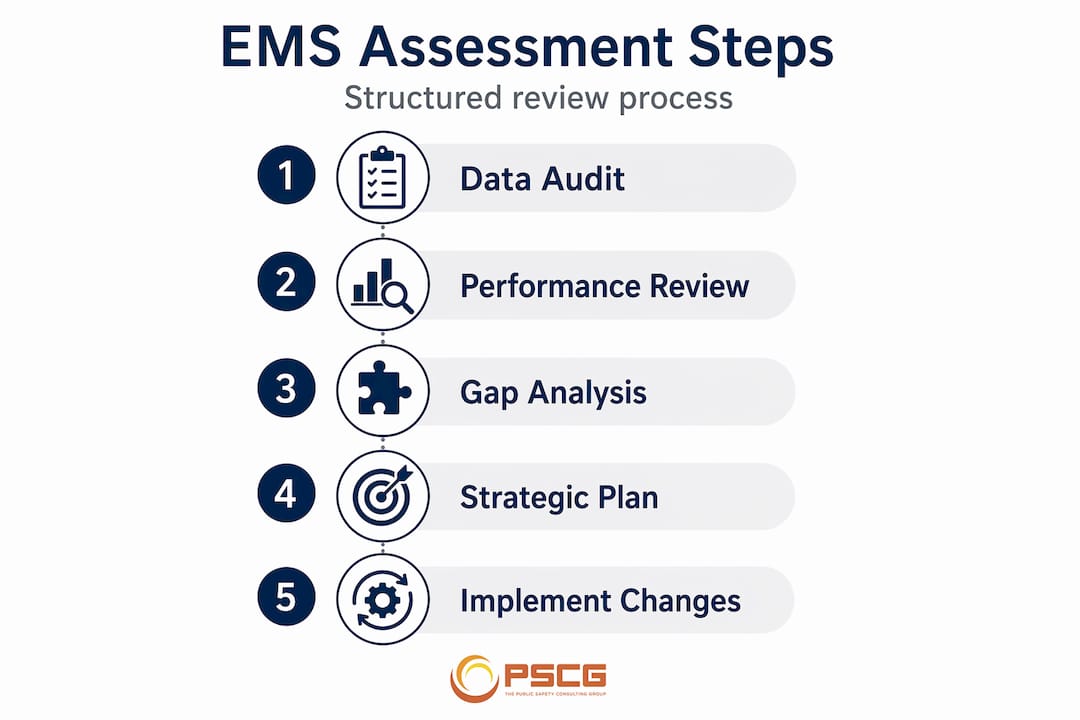
- Define the scope and purpose first. Before selecting metrics, agree on what questions you are trying to answer. Are you assessing clinical quality, operational efficiency, financial sustainability, or all three? Scoped assessments produce cleaner findings.
- Engage stakeholders early. Medical directors, union representatives, frontline supervisors, and municipal finance staff all hold pieces of the system picture. Leaving any of them out of the process creates blind spots and resistance to findings.
- Select metrics aligned with national standards. NEMSQA and NEMSIS provide validated, nationally benchmarked quality measures. Use them. They allow your system to be compared against peer agencies and give your findings external credibility.
- Audit your data infrastructure before analyzing performance. As noted above, poor documentation undermines every downstream finding. Address data quality as a prerequisite.
- Build a continuous feedback loop. A one-time assessment is a snapshot. The real value comes from repeating the process on a defined schedule, typically annually or biennially, with interim monitoring of key indicators. Learning how to assess EMS systems as a regular practice, not a crisis response, changes what your organization is capable of.
- Partner with expert consultants when internal capacity is limited. Municipal EMS leaders carry enormous operational workloads. External partners with deep EMS assessment experience can accelerate the process, provide objectivity, and translate findings into implementable recommendations.
My perspective on what assessments actually change
I have worked alongside municipal leaders who inherited EMS systems that looked fine on paper and were quietly failing their communities. Response time dashboards showed green. Budgets were balanced. And somewhere in those communities, patients were not receiving consistent, evidence-based care.
The honest truth is that most EMS systems are not assessed rigorously because it feels risky. What if the findings are bad? What if a council member uses the data politically? What if the assessment surfaces problems that leadership did not create but now has to fix? I understand those fears. But every day a system operates without a real assessment, the gap between what it could deliver and what it actually delivers grows.
What I have seen work is leadership that treats the assessment not as an audit but as a planning tool. The best municipal EMS leaders I have worked with use findings to build credibility with their governing bodies, to make the case for resources, and to create a culture where measurement is expected and improvement is rewarded. The NEMSQA fundamentals data reinforced something I have always believed: the agencies doing the best work are not the ones with the flashiest equipment. They are the ones where basic protocols are executed correctly, every time, on every call.
Safety culture is not a training topic. It is system infrastructure. When staff do not report errors because they fear punishment, the data your assessment relies on is corrupted at the source. Building a just culture is a prerequisite for a meaningful assessment, not an outcome of one.
— Mike
How Thepscgroup supports your EMS assessment work

At Thepscgroup, we work alongside public safety officials and municipal leaders to conduct structured, evidence-based EMS system assessments that produce findings you can act on. Our team brings direct experience in EMS system design, deployment modeling, quality improvement program development, and municipal EMS strategy. We do not deliver reports and walk away. We stay engaged through the implementation process, helping your team translate assessment data into operational changes, budget justifications, and long-term planning decisions.
Whether you are conducting your first formal assessment or looking to upgrade an existing quality program, we can help you scope the work, identify the right metrics, and build the stakeholder alignment your system needs to improve. Visit us at thepscgroup.net or explore our municipal EMS strategy resources to see how a structured assessment can position your system for measurable, sustained improvement.
FAQ
What is an EMS system assessment?
An EMS system assessment is a structured, evidence-based review of how an EMS agency performs across clinical quality, operational reliability, safety culture, and documentation integrity. It uses national benchmarks such as NEMSQA and NEMSIS measures to identify performance gaps and improvement priorities.
Why is response time alone insufficient for EMS evaluation?
Response time measures speed of arrival, not quality of care. Research and EMS quality experts consistently note that patient-centered outcomes, protocol compliance, and safety culture must be measured alongside response time to accurately evaluate system performance.
How often should an EMS system assessment be conducted?
Most state and regional EMS authorities recommend assessments on a biennial cycle at minimum, with continuous monitoring of key quality indicators between formal reviews. Washington State’s model of biennial statewide assessment represents a strong government-level standard.
What data is needed to conduct an EMS system assessment?
Quality assessments require complete, accurate patient care report data aligned with national NEMSIS data elements, response time records by zone and call type, training completion rates, and near-miss or error reporting data to evaluate safety culture.
How does an EMS assessment inform municipal budget decisions?
Assessment findings quantify specific gaps in coverage, clinical performance, and staffing, which gives municipal leaders concrete evidence to request targeted investments. Data-backed budget requests carry significantly more weight with governing bodies than anecdotal operational reports.