



Medical necessity for ambulance transport exists, under the Medicare Benefit Policy Manual, when the patient’s condition is such that any other method of transportation would endanger their health. That is the standard. Not convenience, not physician preference, not the absence of a family member with a car. The ambulance was required because nothing else was safe.
For EMS crews and billing teams, that definition has immediate, practical consequences at the point of care:
- Document why the ambulance was required, not just what the diagnosis was. Auditors look for the functional and clinical reason other transport was contraindicated.
- Record objective vitals with timestamps at first contact and at intervals throughout transport. SpO2, blood pressure, respiratory rate, and GCS are not optional fields.
- Note mobility limitations specifically: whether the patient required a stretcher, how many personnel assisted, and whether a wheelchair or chair was attempted and failed.
- Obtain a written physician order for any non-emergency transport before the trip, and attach it to the patient care report (PCR).
Preserve the evidence while it exists. Note the oxygen flow rate and delivery device. Record whether the patient was moved via stretcher or ambulatory assist. Document the name of any attendant or witness on scene. A claim that cannot be reconstructed from the PCR alone is a claim at risk.
Key Takeaways
Medical necessity for ambulance transport is established only when the patient’s condition makes any other method of transportation a danger to their health, and that determination must be proven by objective PCR documentation, not by a physician order alone.
| Point | Details |
|---|---|
| CMS core standard | Ambulance is covered only when other transport is contraindicated; a physician order does not prove necessity. |
| Bed-confined three elements | All three must be documented: unable to rise without assistance, unable to ambulate, unable to sit in a chair or wheelchair. |
| Clinical indicators | Airway compromise, hemodynamic instability, IV medication needs, fractures, and isolation requirements are common justifications. |
| Documentation discipline | Record objective vitals with timestamps, mobility attempts, oxygen flow, personnel required, and an explicit transport rationale. |
| Thepscgroup support | Thepscgroup provides chart review, policy drafting, staff training, and QA workflow design to reduce denial risk and recoupment exposure. |
Table of Contents
- What is medical necessity in EMS, and what law defines it?
- Does your patient meet the bed-confined criteria?
- What clinical indicators support medical necessity for ambulance transport?
- How does Medicare treat emergency versus non-emergency ambulance coverage?
- What exactly should you document on the PCR to prove medical necessity?
- Why do medical necessity claims get denied?
- How should your agency operationalize medical necessity decisions?
- Why documentation-first practice is the only defensible standard
- How Thepscgroup reduces your medical necessity risk
- Sources
What is medical necessity in EMS, and what law defines it?
The phrase “medical necessity” appears in nearly every payer contract and denial letter in EMS, yet its precise legal meaning is often misunderstood in the field. The CMS Benefit Policy Manual is unambiguous: Medicare covers ambulance services only when the use of any other method of transportation is contraindicated by the patient’s condition. A signed physician order does not, by itself, establish medical necessity. The PCR must independently substantiate the patient’s condition at the time of transport.
The AMA’s policy on medical necessity frames the concept with a three-part test: the service must conform to accepted standards of medical practice, be clinically appropriate in type and frequency, and not be provided primarily for economic benefit or convenience. That framing matters for EMS because it shifts the burden from “did a doctor order it?” to “was it clinically required?”
The NAIC consumer explainer on medical necessity reinforces this across payer types: medical necessity means services needed to diagnose or treat illness, consistent with accepted standards, and excluding experimental or convenience-only care. Private insurers, Medicaid programs, and Medicare all share this core logic, though the specific documentation thresholds vary.
Key regulatory sources governing medical necessity in EMS:
- CMS Benefit Policy Manual, Chapter 10: The primary federal standard for Medicare ambulance coverage, including the “other transport contraindicated” rule.
- Medicare.gov ambulance coverage page: Explains covered destinations, emergency vs. non-emergency distinctions, and the nearest appropriate facility requirement.
- State Medicaid programs: Each state sets its own Medicaid ambulance coverage rules, which may be more or less restrictive than Medicare. Agencies billing Medicaid must verify their state’s specific criteria.
- Private payer contracts: Commercial insurers often adopt CMS language as a baseline but may add discrete documentation thresholds, such as specific vital sign values or documented interventions.
- Local Coverage Determinations (LCDs): Medicare Administrative Contractors (MACs) publish LCDs that add regional specificity to national policy. Billing staff should check the applicable MAC’s LCD before submitting claims or preparing appeals.
One distinction worth internalizing: medical necessity asks whether ambulance transport was required at all. Medical reasonableness addresses whether the level of service and destination were appropriate. Both must be satisfied for Medicare payment. Confusing the two is a common and costly error.
Does your patient meet the bed-confined criteria?
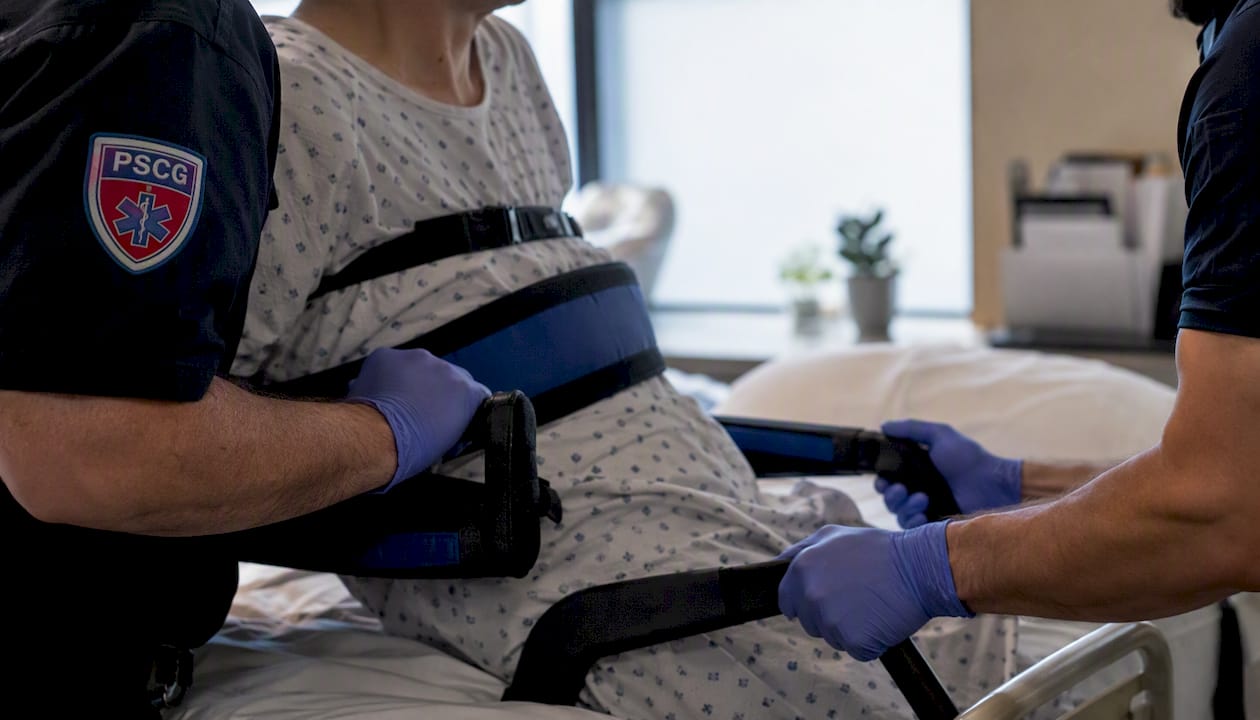
For non-emergency ambulance transport, Medicare applies a specific “bed-confined” test. All three elements must be documented. Meeting one or two is not sufficient.
According to the Medicare Benefit Policy Manual, the patient must be:
- Unable to get up from bed without assistance
- Unable to ambulate
- Unable to sit in a chair or wheelchair
Each element requires objective, specific documentation, not a checkbox or a diagnosis code. Auditors want to know who assisted, how many personnel were needed, what was attempted, and what the outcome was.
Sample PCR phrasing for each element
Element 1 — Unable to get up from bed without assistance:
“Patient required two-person assist to move from supine position to sitting. Patient unable to bear weight on left lower extremity due to non-healed femur fracture (surgical repair 12 days prior). Attempt to sit upright resulted in pain rated 9/10 and immediate return to supine at 08:14.”
Element 2 — Unable to ambulate:
“Patient unable to bear weight bilaterally. No ambulation attempted due to documented fall risk and active wound to right heel. Walker present at bedside but not used per nursing staff report.”
Element 3 — Unable to sit in chair or wheelchair:
“Wheelchair available on scene. Patient placed in wheelchair at 08:22; patient slumped immediately to left due to trunk weakness and required two-person support. Transport via stretcher determined necessary at 08:25.”
Pro Tip: Record failed attempts with exact timestamps. “Wheelchair attempted at 08:22, patient unable to maintain upright position, stretcher used at 08:25” is far stronger than “patient unable to sit in wheelchair.” The attempt, the failure, and the time are the evidence.
Agencies that use electronic PCR systems should build mandatory fields for each of the three bed-confined elements. If the field is optional, crews will skip it under time pressure. If it is required, the documentation exists when the audit arrives.
What clinical indicators support medical necessity for ambulance transport?
Bed-confined status is one pathway to medical necessity, but it is not the only one. Many patients who require ambulance transport are not bed-confined. The clinical indicator is the condition that makes other transport dangerous, and it must be documented with objective data.
Commonly accepted clinical indicators:
- Airway compromise or respiratory distress: SpO2 below acceptable thresholds, active use of accessory muscles, stridor, or inability to maintain airway without intervention.
- Hemodynamic instability: Hypotension, tachycardia, or signs of shock requiring monitoring and potential intervention en route.
- Active IV medication or fluid administration: When a patient requires IV access, fluids, or medications that cannot be safely administered in a private vehicle or taxi.
- Uncontrolled pain with impaired mobility: Pain that prevents safe positioning in a standard vehicle, particularly with fractures or post-surgical wounds.
- Non-healed fractures requiring immobilization: Especially lower extremity fractures where weight-bearing is contraindicated.
- Morbid obesity requiring specialized handling: When patient size necessitates bariatric equipment, additional personnel, or specialized lift capability.
- Active bleeding or wound management: Wounds requiring continuous pressure, monitoring, or dressing changes during transport.
- Infectious isolation requirements: Patients requiring airborne or contact precautions that cannot be maintained in standard transport.
- Severe contractures or positioning needs: Patients whose body positioning requires specialized equipment or trained personnel.
- DVT or thromboembolic risk: Where limb elevation, monitoring, or anticoagulation management is required during transport.
Brief case examples with sample phrasing
Case 1 — Respiratory distress:
Patient unable to speak in full sentences. Stretcher transport required due to exertional desaturation with any positional change.
Case 2 — Post-surgical mobility:
Patient 8 days post right hip arthroplasty. Non-weight-bearing per surgical orders. Two-person assist required for all transfers. Private vehicle transport contraindicated due to inability to safely position patient without risk of dislocation.
Case 3 — IV medication requirement:
Patient receiving continuous IV heparin infusion for acute DVT. Pump and IV access required throughout transport. No alternative transport capable of maintaining IV access and monitoring.
The NAEMSP position statement on EMS provider determinations of necessity is direct: EMS providers must exercise clinical judgment and document the objective, evidence-based reasons for transport. A diagnosis alone does not satisfy this standard. The “why” must be explicit and grounded in observable findings.
Pro Tip: Separate the diagnosis from the transport rationale in your PCR narrative. “Patient has CHF” is a diagnosis. “Patient has CHF with active respiratory distress, SpO2 88% on 4 L/min O2, unable to lie flat without desaturation, requiring continuous monitoring and potential intervention en route” is a medical necessity statement.
How does Medicare treat emergency versus non-emergency ambulance coverage?
The coverage rules differ meaningfully between emergency and non-emergency transport, and the documentation burden shifts accordingly. Medicare explains both categories and the destinations Medicare will cover: hospitals, critical access hospitals, rural emergency hospitals, and skilled nursing facilities, among others.
Emergency transport is evaluated retrospectively. Medicare applies a “reasonable layperson” standard: would a person with average knowledge of health and medicine believe the situation required immediate ambulance response? If yes, and if the transport meets the “other transport contraindicated” standard, coverage applies. The PCR must capture the presenting signs and symptoms that justified the emergency response, not just the final diagnosis.
Non-emergency transport carries a higher documentation burden. A written physician order is required, and the order must be obtained before transport. Critically, the physician order alone does not establish medical necessity. The PCR must still demonstrate, independently, why alternative transport would endanger the patient’s health.
The nearest appropriate facility rule applies to both categories. Medicare covers transport to the nearest facility capable of treating the patient’s condition. If a crew bypasses a closer facility at the patient’s request, the billing must reflect that the closer facility lacked the capability to treat the condition, or the claim may be denied for the mileage beyond the nearest appropriate facility.
| Criterion | Emergency transport | Non-emergency transport |
|---|---|---|
| Coverage standard | Other transport contraindicated; immediate threat | Other transport contraindicated; not an immediate emergency |
| Physician order required | Not required pre-transport | Written order required before transport |
| Evaluation timing | Retrospective (based on presenting symptoms) | Prospective (order and documentation before trip) |
| PCR focus | Presenting signs/symptoms justifying emergency response | Functional limitations, mobility assessment, clinical indicators |
| Nearest facility rule | Applies | Applies |
| Destination options | Hospital, CAH, rural emergency hospital, SNF | Same, with additional restrictions on frequency for dialysis, etc. |
What exactly should you document on the PCR to prove medical necessity?
The PCR is the primary evidence document in any audit. If it is not in the PCR, it did not happen, as far as a Medicare auditor is concerned. The NAEMSP position statement reinforces that objective, evidence-based documentation is the standard, not subjective impressions. Payer clinical review guidelines, such as those published by Cigna/eviCore, specify discrete clinical data points payers expect to see, including oxygen flow rates, IV medications administered, and documented vital sign trends.
PCR field mapping to medical necessity elements:
| PCR field | Medical necessity element it supports |
|---|---|
| Chief complaint (objective) | Establishes the presenting condition requiring transport |
| Vitals with timestamps | Demonstrates hemodynamic status and response to treatment |
| Mobility assessment | Supports bed-confined determination or functional limitation |
| Oxygen delivery device and flow rate | Documents respiratory support required en route |
| IV access, fluids, medications | Shows interventions requiring trained personnel |
| Physician order (attached) | Required for non-emergency; does not substitute for clinical documentation |
| Personnel on scene and assistance required | Quantifies functional dependency |
| Stretcher vs. ambulatory vs. chair | Documents transport method and why alternatives were not used |
| Narrative: transport rationale | Explicitly states why other transport was contraindicated |
Sample medical necessity statement for billing notes:
“Patient transported via stretcher from [facility] to [destination] due to [clinical indicator]. Patient unable to [specific functional limitation] without [specific assistance/equipment]. Alternative transport contraindicated due to [specific risk]. Vitals at time of transport: [values]. Interventions en route:
For agencies seeking guidance on compliant recordkeeping for public safety agencies, mapping PCR fields to payer expectations before a claim is submitted is far more efficient than reconstructing documentation after a denial. Aligning your EMS data reporting requirements with payer expectations is a structural fix, not a one-time correction.
Why do medical necessity claims get denied?
Denials rarely happen because the transport was not medically necessary. They happen because the documentation does not prove it was. The Cigna/eviCore clinical guidelines identify incomplete or unclear documentation as a leading cause of denial, a finding consistent with what EMS billing auditors encounter across payer types.
Common audit triggers and documentation failures:
- Incomplete vitals: Missing SpO2, blood pressure, or respiratory rate at first contact or during transport.
- No mobility detail: PCR states “patient unable to walk” without specifying who assisted, how many personnel, what was attempted, or why alternatives failed.
- Physician order misinterpretation: Billing team treats a signed order as proof of medical necessity; CMS explicitly states it is not.
- “Transport for convenience” language: Phrases like “patient requested ambulance” or “family unavailable” signal convenience rather than clinical necessity.
- Generic or templated narrative: Copy-paste narratives that do not reflect the specific patient’s condition on that specific date.
- Missing timestamps: Vitals without times, interventions without times, and scene times without documentation of what occurred.
- Illegible or incomplete records: Handwritten PCRs with missing fields or unreadable entries.
The consequences extend beyond individual claim denials. Patterns of deficient documentation can trigger EMS operational audits, recoupment demands, and, in cases involving knowing and repeated false claims, exposure under the False Claims Act. Agencies that treat documentation as a billing afterthought rather than a clinical responsibility carry disproportionate audit risk.
Corrective actions that reduce denial rates:
- Implement mandatory PCR fields for vitals, mobility assessment, and transport rationale.
- Conduct real-time coaching during field supervision, not just post-incident review.
- Use pre-bill peer review for high-risk transport categories (non-emergency, dialysis, SNF-to-hospital).
- Establish supervisory review triggers for PCRs that lack narrative detail or mobility documentation.
- Align PCR templates with the specific documentation elements your MAC’s LCD requires.
Pro Tip: Run a quarterly internal audit of 20–30 randomly selected non-emergency PCRs. Score each one against the bed-confined three-element checklist and the transport rationale standard. The patterns you find in that sample predict what a Medicare auditor will find in a full review.
How should your agency operationalize medical necessity decisions?
Policy language and field training are where medical necessity moves from a regulatory concept to a daily operational standard. The NAEMSP position statement and CMS guidance together provide the clinical and regulatory foundation; the agency’s job is to translate that into protocols crews can apply at the bedside.
Adaptable policy snippet
“Ambulance transport shall be authorized only when the patient’s medical condition is such that use of any other method of transportation is contraindicated. The determination of medical necessity shall be made by the attending EMS provider based on objective clinical findings, consistent with CMS Benefit Policy Manual standards and applicable MAC LCD guidance. A physician order for non-emergency transport is required prior to dispatch but does not, by itself, constitute a determination of medical necessity.”
Training checklist for crews
- Review the CMS “other transport contraindicated” standard and what it means at the bedside.
- Practice completing all three bed-confined elements with objective, specific language.
- Distinguish diagnosis from transport rationale in PCR narrative writing.
- Identify the clinical indicators that support medical necessity beyond bed-confined status.
- Understand the nearest appropriate facility rule and how destination choices affect billing.
- Know when a physician order is required and what it does and does not prove.
- Complete a PCR documentation exercise using real case scenarios and peer review.
QA workflow for supervisors and billing staff
- Case selection: Flag all non-emergency transports, SNF-to-hospital trips, and any PCR with a generic or incomplete narrative for review.
- Peer review: Assign a senior clinician or billing compliance lead to score flagged PCRs against the medical necessity checklist before claim submission.
- Feedback loop: Return deficient PCRs to the originating crew with specific, written feedback. Track correction rates by provider.
- Trend reporting: Report denial rates, documentation deficiency rates, and audit findings to agency leadership monthly.
- Protocol updates: Align PCR templates and field protocols with any changes to MAC LCD guidance or payer contract requirements at least annually.
Thepscgroup typically intervenes at four points in this cycle: policy drafting that aligns with CMS and NAEMSP language, staff training programs built around real case scenarios, chart review programs that identify documentation gaps before an auditor, and targeted billing audits that quantify denial risk and recovery opportunity. Agencies working with reimbursement consultants who understand both the clinical and regulatory dimensions of medical necessity tend to build more durable compliance programs than those addressing documentation and billing in isolation.
For a broader view of how EMS compliance intersects with operational performance, the structural fixes that reduce audit risk are often the same ones that improve clinical documentation quality across the board.
Why documentation-first practice is the only defensible standard
The agencies that get into trouble with medical necessity audits are rarely the ones transporting patients who did not need an ambulance. They are the ones transporting patients who clearly did need one, but whose crews documented it as though the auditor would simply take their word for it.
That gap, between what happened on scene and what the PCR reflects, is where recoupments are born. A crew that managed a genuinely critical patient but recorded “patient unable to walk, transported to hospital” has handed an auditor a claim they cannot defend. The clinical reality was sound. The documentation was not.
The deeper issue is that documentation-first practice is not primarily a billing strategy. It is a clinical standard. When a crew records objective vitals, specific functional limitations, and a clear transport rationale, they are producing a record that serves the patient, the receiving facility, and the agency’s legal standing simultaneously. The billing benefit is a byproduct of good clinical documentation, not a separate task.
Agencies that frame medical necessity documentation as a compliance burden tend to produce the minimum required and no more. Agencies that frame it as a professional standard tend to produce records that hold up under any level of scrutiny. The difference in audit outcomes between those two cultures is not marginal.
How Thepscgroup reduces your medical necessity risk
Thepscgroup works directly with EMS agencies, municipal leaders, and private ambulance companies to close the gap between what crews document and what payers require. Our reimbursement consulting services address medical necessity from the policy level down to the individual PCR, combining chart review, staff training, and QA workflow design into a coordinated program that reduces denial rates and recoupment exposure.

Where most agencies address documentation reactively, after a denial or an audit notice, we build the systems that prevent those outcomes. That includes policy language aligned with CMS and NAEMSP standards, PCR template design that maps to payer expectations, pre-bill peer review programs, and targeted billing audits that identify risk before it becomes a recoupment demand. For agencies ready to move from reactive to proactive, our municipal EMS strategy services provide the operational framework to make that shift sustainable.
Contact Thepscgroup at Thepscgroup to schedule a consultation and find out where your agency’s documentation stands.
Sources
The sources below represent the primary regulatory, clinical, and operational references for medical necessity in EMS. Each serves a distinct purpose.
- Medicare Benefit Policy Manual (Ambulance services section)
- Ambulance services coverage – Medicare
- EMS Provider Determinations of Necessity for Transport – NAEMSP
- AMA policy defining medical necessity
- What Is Medical Necessity? – NAIC consumer explainer