



A Physician Certification Statement (PCS) is a signed clinical document that establishes why ambulance transport is medically necessary for a Medicare beneficiary. Under 42 CFR §410.40, ambulance transportation is payable only when other means of transport would endanger the beneficiary’s health. The PCS serves as supporting evidence toward that standard — not as automatic authorization for payment.
For official sample forms, start with your Medicare Administrative Contractor (MAC). WPS Government Health Administrators and the J5 MAC both publish downloadable PCS templates on their provider portals. CMS guidance pages and the PECOS provider portal are the authoritative starting points for enrollment verification and billing workflow alignment. Thepscgroup works alongside EMS agencies and billing teams to close the documentation gaps that turn clean claims into costly denials.
- A PCS is supporting evidence, not a standalone proof of medical necessity.
- CMS does not prescribe a single form or format — MACs publish accepted sample templates.
- Non-physician signers are permitted under specific conditions defined by CMS guidance.
- Vague clinical language on a PCS is among the most common triggers for Medicare claim denials.
Key Takeaways
A Physician Certification Statement is supporting evidence for Medicare ambulance payment, not a standalone authorization, and its clinical specificity determines whether a claim survives review.
| Point | Details |
|---|---|
| PCS is supporting evidence only | Under 42 CFR §410.40, a PCS does not alone prove medical necessity; the full medical record must corroborate it. |
| Non-physician signers are permitted | PAs, NPs, RNs, and discharge planners may sign when the attending physician is unavailable, with credentials documented. |
| Clinical specificity prevents denials | Vague diagnosis-only language is a leading denial trigger; explain functional limitations and contraindications explicitly. |
| No single CMS form is required | MACs publish accepted sample templates; agencies may use custom forms that include all required fields. |
| Thepscgroup closes documentation gaps | PSCG provides reimbursement consulting, PCS template development, and staff training to reduce denial rates. |
Table of Contents
- What is a physician certification statement and when is it required?
- Who may sign a PCS?
- What must a PCS include?
- Where can you find authoritative sample PCS forms?
- Timing, renewal, and record retention
- How does a PCS affect billing, denials, and appeals?
- PSCG compliance checklist and operational best practices
- Annotated PCS template and sample certification language
- Why documentation quality is an organizational risk, not just a billing problem
- Thepscgroup supports your PCS compliance and reimbursement outcomes
- Sources
What is a physician certification statement and when is it required?
The PCS documents that a patient’s condition made ambulance transport medically necessary and that alternative transport modes would have endangered their health. That standard comes directly from 42 CFR §410.40, which also makes clear that the presence of a certification statement does not alone demonstrate medical necessity. Reviewers weigh the PCS alongside the full medical record.
Three transport categories commonly require a PCS:
- Scheduled non-emergency transport: A planned, non-urgent ambulance trip where the ordering provider must certify medical necessity before or at the time of transport.
- Unscheduled non-emergency transport: A non-emergency trip that was not pre-planned; certification is still required and must be obtained as close to the transport date as possible.
- Repetitive transport: Three or more medically necessary ambulance trips within a 10-day period, or at least one round trip per week for at least three weeks. CMS and MAC guidance establish specific rules for how long a single PCS remains valid for repetitive trips and when a new certification is needed.
A PCS is generally not required for emergency transports where the nature of the call itself documents medical necessity. 42 CFR §410.41 provides additional statutory context on coverage criteria for Medicare ambulance benefits.
Who may sign a PCS?
The attending physician is the preferred signer. When the attending physician is unavailable, CMS guidance via Pub 100-08 clarifies that review contractors shall accept a physician certification statement as one piece of evidence, and that certain non-physician staff may provide a non-physician certification statement (NCS) in specified situations.
Accepted non-physician signers typically include:
- Physician Assistant (PA)
- Nurse Practitioner (NP)
- Clinical Nurse Specialist (CNS)
- Registered Nurse (RN)
- Licensed Practical Nurse (LPN) or Licensed Vocational Nurse (LVN)
- Social worker, discharge planner, or case manager
The practical distinction between a PCS and an NCS matters at audit. A PCS carries the attending physician’s clinical authority. An NCS is acceptable when the physician is genuinely unavailable, but the record should document why the physician did not sign and confirm the signer’s relationship to the patient’s care team. Missing that documentation creates a vulnerability reviewers will flag.
Pro Tip: Formalize an internal signatory policy that lists accepted signer roles, the required credential notation, and the documentation step for recording why the attending physician was unavailable. Post it at nursing stations and in your dispatch-to-billing workflow. Staff who understand the rule make fewer errors under time pressure.
What must a PCS include?
CMS does not mandate a specific form, but the CMS Signature Requirements Fact Sheet (ICN905364) is explicit about what reviewers expect to find. A PCS missing any of the minimum fields below is a denial waiting to happen.
The difference between a minimal PCS and an audit-resistant one comes down to clinical specificity. A statement reading “patient requires ambulance transport” tells a reviewer nothing. A statement reading “patient is unable to sit upright due to acute decompensated heart failure with orthopnea; requires continuous cardiac monitoring and IV access during transport; alternative transport would risk acute deterioration” gives the reviewer exactly what 42 CFR §410.40 asks them to confirm.
Where can you find authoritative sample PCS forms?
CMS does not publish a single universal PCS form. Instead, MACs publish sample templates that are widely accepted for Medicare claims. The following are the primary sources to bookmark:
- WPS Government Health Administrators: Publishes a sample PCS form on its provider education portal; search “PCS” in the WPS provider resources section.
- J5 MAC: Offers PCS documentation guidance and sample forms through its ambulance provider resources.
- Illinois HFS sample form (HFS 2270): The Illinois HFS PCS template is a practical example of a state-level form that includes signer checkboxes for MD, PA, NP, RN, and discharge planner — useful as a field-level reference even outside Illinois.
- CMS guidance pages: The CMS website hosts the Program Integrity Manual, the PIM Chapter 3, and related manuals that define reviewer expectations.
- PECOS: Use the PECOS portal to verify provider enrollment status, which affects whether a claim will process cleanly regardless of PCS quality.
Agencies may use their own custom forms as long as the required fields are present. When downloading any MAC sample, note the version date and confirm it reflects current guidance before distributing it to clinical staff.
Timing, renewal, and record retention
Signatures should be obtained at or before the time of transport for scheduled non-emergency trips. For unscheduled transports, obtain the certification as close to the transport date as the clinical situation allows. A signature dated weeks after transport, with no documented reason for the delay, is a common audit finding.
For repetitive transports, many MACs accept a single PCS covering a defined period, but they expect the medical record to contain periodic clinical reassessments confirming continued necessity. Build an internal reminder system for PCS renewals so certifications do not lapse mid-treatment cycle.
On retention: Medicare generally expects providers to retain documentation for a minimum of seven years, though state law may require longer. Electronic records with time-stamped metadata, signer role notation, and a clear link to the transport date reduce audit friction compared to handwritten-only pages. The CMS Claims Processing Manual, Chapter 15 provides additional operational guidance on documentation acceptance standards.
How does a PCS affect billing, denials, and appeals?
The CMS Program Integrity Manual makes the reviewer’s job clear: the PCS is one input, not a green light. Claims denied on medical necessity grounds often trace back to one of these PCS failures:
- Vague or diagnosis-only language with no functional limitation explanation
- Missing signer credentials or title
- Signature dated after transport with no documented reason
- No corroborating clinical evidence in the medical record (vitals, nursing notes, transport report)
- Mismatch between the documented transport level (BLS vs. ALS) and the clinical picture on the PCS
When a PCS-based claim is denied, assemble the appeal packet in this order:
- The signed PCS with signer credentials visible
- The ambulance transport report (PCR)
- Relevant nursing notes and vitals from the day of transport
- Discharge summary or physician orders supporting the transport
- Any prior authorization or referral documentation
- A written narrative explaining how the clinical record supports medical necessity under 42 CFR §410.40
The CMS benefit policy manual reinforces that reviewers may request corroborating clinical records and will deny claims when the PCS lacks sufficient clinical detail. A strong appeal packet addresses that expectation directly.
PSCG compliance checklist and operational best practices
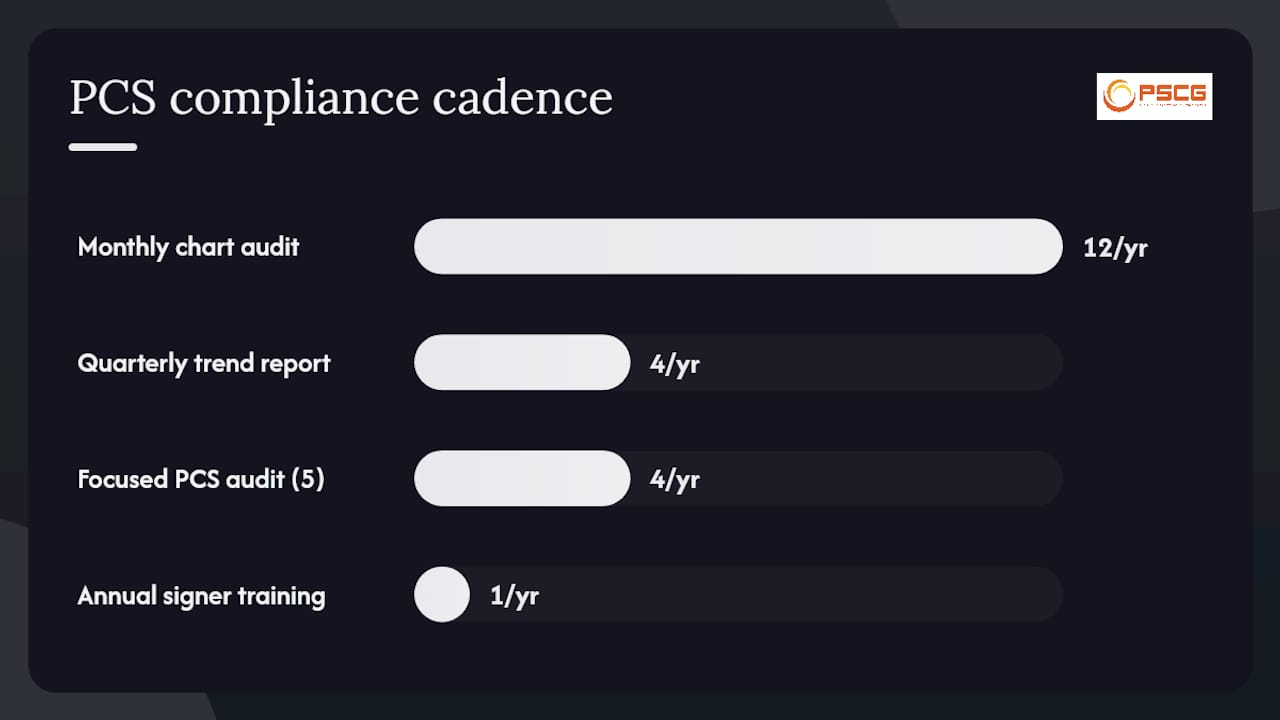
Agencies that standardize PCS fields, train discharge planners and nursing staff on signer eligibility, and run a routine chart-audit loop see fewer documentation-related denials. The following checklist reflects EMS documentation standards that reduce audit exposure across transport types.
Policy and governance:
- Maintain a written signatory policy listing accepted signer roles and credential notation requirements
- Define the documentation step for recording physician unavailability when a non-physician signs
Templates and forms:
- Use a MAC-published sample PCS or a custom form that includes all required fields
- Include a version date and revision control on every internal template
Training:
- Train all potential signers (RNs, discharge planners, case managers) on signer eligibility rules at least annually
- Include PCS documentation in new-hire orientation for clinical and billing staff
Quality assurance:
- Conduct a monthly chart audit of a random sample of PCS documents against the required-field checklist
- Track denial reason codes tied to PCS deficiencies and report trends to leadership quarterly
Technology:
- Use fillable PDFs or EHR-integrated forms with time-stamp and signer-role metadata
- Confirm electronic signatures meet CMS requirements before deploying them agency-wide
Pro Tip: Run a focused PCS audit every quarter using a five-chart sample per transport type. Compare denial rates before and after each audit cycle. That cadence catches recurring errors — a missing credential field, a consistently vague clinical phrase — before they compound into a pattern reviewers flag during a focused review.
Annotated PCS template and sample certification language
The fields below represent an audit-resistant PCS structure. Adapt them to your MAC’s sample form or your agency’s custom template.
| Field | Guidance Note |
|---|---|
| Patient name / Medicare ID | Match exactly to the Medicare card; transcription errors delay processing |
| Date(s) of transport | For repetitive transport, list the full authorized date range |
| Origin address | Full street address, including facility name and unit/floor |
| Destination address | Full street address of receiving facility |
| Clinical necessity statement | Explain functional limitation and specific contraindication to alternative transport |
| Bed confinement criteria | Note whether patient is bed-confined and the clinical basis (e.g., unable to sit upright, unable to ambulate) |
| Signer name and credentials | Print name, degree/license (MD, NP, RN), and title |
| Signer signature and date | Must be contemporaneous; late signatures require a documented explanation |
| Attending physician name | Required when signer is a non-physician |
Minimal statement (meets signature requirement only):
“Patient requires ambulance transport due to medical condition.”
Audit-resistant statement:
“Patient presents with severe chronic obstructive pulmonary disease requiring continuous supplemental oxygen at 4 L/min via nasal cannula. Patient is unable to sit upright for more than two minutes without acute respiratory distress. Transport by wheelchair van or private vehicle would risk acute hypoxic decompensation. Ambulance transport with ALS monitoring is medically necessary.”
Reviewers most commonly question the bed confinement criteria and the contraindication to alternative transport. Address both explicitly in the clinical necessity statement rather than leaving them implied by a diagnosis code.
Why documentation quality is an organizational risk, not just a billing problem
Documentation failures on a PCS are not clerical errors. They are operational risk events. When a claim is denied because a discharge planner signed without noting the attending physician’s name, or because the clinical statement read “patient needs ambulance,” the agency absorbs the financial loss and the administrative cost of an appeal. Multiply that across dozens of transports per month and the revenue impact becomes a budget problem, not a paperwork problem.
We have seen agencies with strong clinical operations lose significant reimbursement because their PCS workflow was never formalized. The fix is rarely complex. A written policy, a trained staff, a MAC-aligned template, and a quarterly audit loop address the vast majority of PCS-related denial patterns. Thepscgroup works directly with EMS agencies and municipal leaders to build those systems, and we are available to support your team at Thepscgroup.
Thepscgroup supports your PCS compliance and reimbursement outcomes
Reimbursement losses tied to PCS deficiencies are preventable. Thepscgroup provides reimbursement consulting specifically designed to reduce documentation-related denials, build MAC-aligned PCS templates, and train clinical and billing staff on signer eligibility and clinical language standards.

Our consulting engagements include documentation gap analysis, staff training programs, and audit-ready workflow design — the same operational infrastructure that helps agencies move from reactive appeals to proactive compliance. Whether your agency is managing a high volume of repetitive transports or preparing for a focused medical review, we work alongside your team to close the gaps before they affect cashflow. Contact us at Thepscgroup to schedule a documentation gap analysis or training engagement.
Sources
This article is general information, not a substitute for advice from a qualified financial advisor. Consult a qualified financial professional about your own circumstances before acting on anything here.