



TL;DR:
- Mutual aid is reciprocal community support built on trust and shared responsibility, unlike charity. Small groups with clear agreements and role clarity sustain resilient networks that respond faster than formal systems. Structured, ongoing collaboration fosters long-term community safety and systemic advocacy.
Mutual aid is one of the most misunderstood concepts in community organizing. People frequently confuse it with charity, volunteerism, or emergency relief, when in reality it operates on an entirely different principle: collective assistance built on reciprocity, not on donor-recipient hierarchies. As public services face mounting pressure and federal safety nets tighten, mutual aid networks are filling gaps that no government program or nonprofit can fully address. This guide walks you through the history, structure, real-world examples, and sustainability strategies that make mutual aid one of the most reliable tools for community resilience available today.
Table of Contents
- Key takeaways
- Mutual aid: foundational principles and history
- Structuring an effective mutual aid network
- Real-world mutual aid in action
- Sustaining mutual aid and integrating advocacy
- My perspective on mutual aid’s real potential
- How Thepscgroup supports community resilience
- FAQ
Key takeaways
| Point | Details |
|---|---|
| Mutual aid is not charity | It is reciprocal care built on trust and shared commitment, not one-directional giving. |
| Written agreements matter | A one-page agreement covering roles, communication, and review cycles prevents burnout and confusion. |
| Small groups work best | Groups of 3 to 8 households or members are easier to coordinate and sustain over time. |
| Real-world models exist | From Chicago microgrants to Denver’s Mutual Aid Monday, proven frameworks are already working. |
| Advocacy and aid connect | Sustained mutual aid integrates systemic advocacy rather than treating direct support as an endpoint. |
Mutual aid: foundational principles and history
Most people encounter the term “mutual aid” and assume it means community charity. It does not. Mutual aid is reciprocal support, rooted in the understanding that community members have both something to offer and something to gain. Nobody is permanently the helper or the helped. That distinction matters enormously when you are building a network meant to last.
The concept has deep historical roots. Indigenous communities across North America practiced reciprocal resource sharing long before European colonization formalized any social contract. Black mutual aid societies in the 19th century funded burial insurance, medical care, and legal defense for communities locked out of state protections. The labor movement formalized mutual support groups in the early 20th century to protect workers from industrial hazards and wage theft.
“Mutual aid means we will save us.” — W. Kamau Bell, activist and author, describing mutual aid as radical self-reliance beyond dependence on the state.
This framing matters because it separates mutual aid from state assistance in a way that is not anti-government but rather community-determined. Dean Spade, whose work is central to contemporary mutual aid theory, argues that aid and social movement demands must operate together. Survival support and systemic change are not competing priorities. They reinforce each other.
A few core principles define authentic mutual aid:
- Reciprocity: Everyone contributes according to their capacity and receives according to their need.
- Non-hierarchy: Decisions are made collectively, not delegated to a central authority.
- No conditions: Support is given without moral judgment, eligibility screening, or requirement of gratitude.
- Relationship-based: Trust built during stable times is the infrastructure that functions during crisis.
Understanding these principles is not academic. If you are organizing a local mutual aid network, these values determine the decisions you make every day, from how you handle disagreements to how you welcome new members.
Structuring an effective mutual aid network
The most common reason mutual aid networks collapse is not a shortage of willing participants. It is a lack of clear structure. Good intentions without coordination produce confusion, uneven workloads, and eventual disengagement. Building your network on a concrete framework from the start prevents most of these problems.
Starting with the right group size
Research consistently points to small groups as the most functional unit for local mutual aid. Groups of 3 to 8 households can coordinate easily, maintain accountability, and adapt quickly when circumstances change. Larger networks can be built by connecting multiple small groups rather than by expanding a single group indefinitely.
Writing a one-page mutual aid agreement
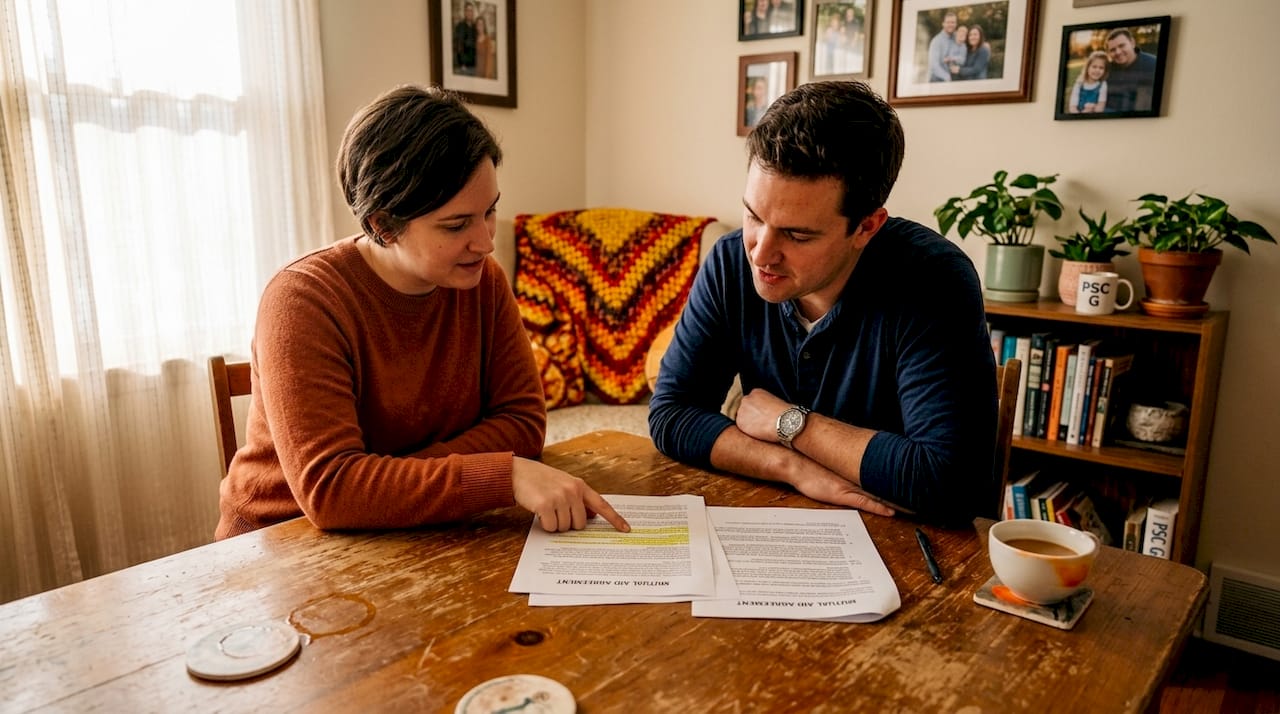
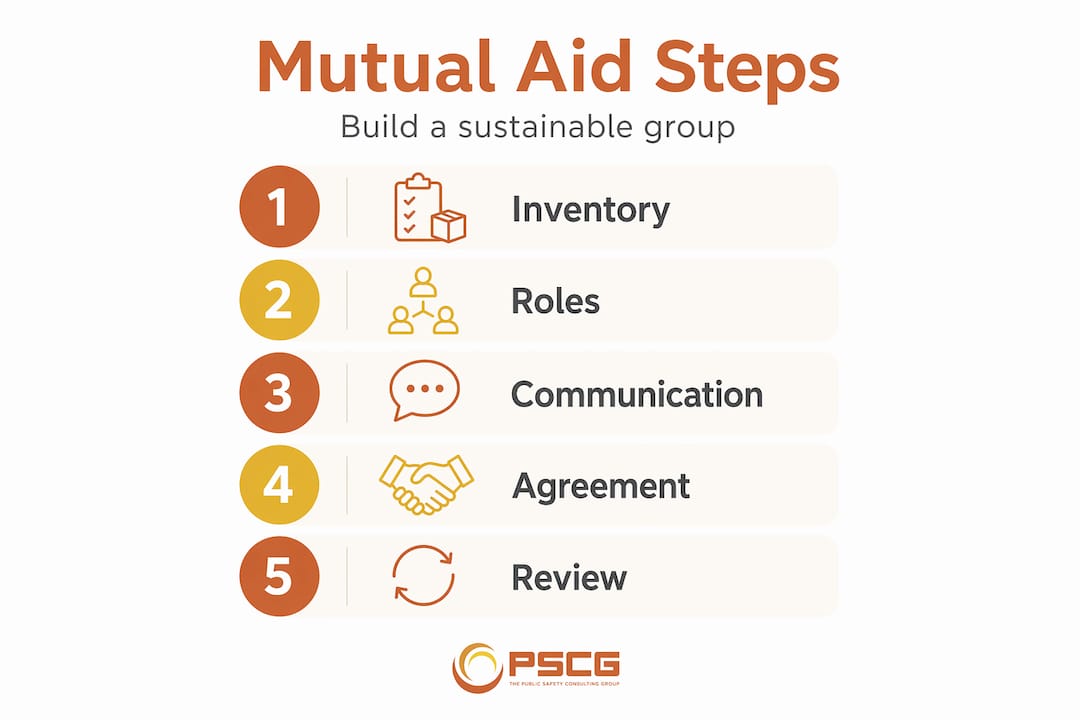
A written agreement is not bureaucracy. It is clarity. A well-constructed one-page document covers five areas and eliminates the ambiguity that causes resentment:
- Membership: Who is part of this group, and how are new members added?
- Commitments: What does each member agree to contribute, and on what schedule?
- Communication protocols: What channels do you use? What is the escalation process when a member cannot fulfill a commitment?
- Boundaries: What does this group explicitly not cover? Knowing limits is as important as knowing capacities.
- Review cycle: When will the group revisit and update the agreement?
One-page agreements with these five elements improve group functionality and significantly reduce burnout, because everyone knows what they signed up for and what they can reasonably expect from others.
Pro Tip: Schedule your first agreement review at 90 days, not one year out. Early adjustments are easier to make and signal to members that the group is responsive rather than rigid.
The table below outlines practical components to include in your network’s resource planning:
| Component | What to document | Review frequency |
|---|---|---|
| Resource inventory | Tools, vehicles, food stores, medical supplies | Quarterly |
| Skills registry | CPR certification, language fluency, trades expertise | Annually |
| Communication tree | Phone chain, Signal group, in-person check-in protocol | Bi-annually |
| Mutual commitments | Time availability, delivery capacity, financial contributions | Per agreement cycle |
| Emergency contacts | Backup contacts outside the group for escalation | Annually |
Communication systems that actually work
Monthly 45-minute check-ins and quarterly tabletop exercises build the kind of practiced communication that functions under pressure. Do not wait for a crisis to test your protocols. Practice them during calm periods so that members’ responses become instinctive rather than improvised.
Real-world mutual aid in action
Theory is useful. Examples are persuasive. These three cases demonstrate how mutual aid networks operate across very different contexts and community needs.
Chicago microgrant program
In 2026, the city of Chicago partnered with the Greater Chicago Food Depository to launch a mutual aid microgrant program that awarded $4,500 grants to 67 community organizations. The goal was to offset the impact of federal SNAP cuts by directing over $300,000 to grassroots food access work. This model is notable because it used municipal infrastructure to amplify self-organized community aid rather than replace it. Government funding flowed to locally-led organizations, not centralized relief programs.
CoMo Mobile Aid Collective
In Columbia, Missouri, the CoMo Mobile Aid Collective built what its members call parallel systems for unhoused neighbors. Weekly meal routes, nursing clinics, and supportive services operate without punitive eligibility requirements. The collective operates on consensus decision-making and explicitly rejects conditions for receiving care. This model reflects the principle of radical hospitality. Nobody is screened or evaluated before receiving support.
The collective also demonstrates one of the most transferable lessons in volunteer sustainability: one-hour weekly commitments that fit organically into participants’ schedules. No member is asked to restructure their life. The result is a network that has maintained operational continuity across years rather than burning out after months.
Mutual Aid Monday in Denver
Denver’s Mutual Aid Monday distributes meals and basic supplies at City Hall every week, timed to coincide with city council meetings. The group refuses to obtain permits as a deliberate assertion of community agency and political visibility. This is not incidental. By situating aid within a protest context, the group makes visible the connection between immediate need and policy failure.
The benefits of this integrated approach are clear from each of these examples:
- Mutual aid networks respond faster than formal systems because they operate without eligibility bureaucracy.
- Trust built through consistent service makes community members more likely to seek help before a crisis becomes unmanageable.
- Combining direct service with political visibility keeps systemic accountability visible even when immediate needs dominate attention.
- Self-organized community aid models build local leadership capacity that outlasts any single program.
Sustaining mutual aid and integrating advocacy
Building a mutual aid network is a six-month challenge. Sustaining one for three years is a different skill set entirely. Most networks that collapse do so because of two predictable failures: volunteer fatigue and mission drift.
Pro Tip: Assign roles by recurring task rather than by open-ended commitment. “I bring meals every second Tuesday” is sustainable. “I help whenever needed” is a path to resentment.
Volunteer sustainability depends on specificity. When you know exactly what you are responsible for and when, you can plan your life around it. Vague commitments create anxiety and inconsistency. Assigning manageable, recurring roles is the single most effective structural change most networks can make.
Integrating advocacy alongside direct support requires deliberate attention. A few practices that help:
- Reserve a portion of every meeting for systemic discussion. What policy failures are your members experiencing? What demands could your collective voice support?
- Connect with mutual support groups and broader coalitions that share your values. Solidarity across networks multiplies political pressure.
- Document what your network is doing. Data on the number of households served, the types of needs met, and the gaps you cannot fill is exactly the kind of evidence that informs both internal strategy and external advocacy.
- Update your written agreement annually to reflect changes in membership, resources, and community context. A living agreement prevents the rigidity that kills networks.
Burnout prevention is not just a personal wellness concern. It is a structural responsibility. When key organizers leave due to exhaustion, networks often collapse entirely because their functions were not distributed. Building redundancy into every role, so that at least two people know how to perform every critical task, protects the network from the inevitable realities of member turnover.
There is also a tax consideration worth understanding for networks that manage shared funds. The federal 1099-K reporting threshold was restored to $20,000 in 2026, easing a significant administrative burden that had threatened mutual aid funds under a prior $600 threshold. If your network moves money through peer-to-peer payment platforms, verify your current obligations with a tax advisor.
My perspective on mutual aid’s real potential
I have spent years working at the intersection of emergency management, public safety systems, and community preparedness. What I find genuinely compelling about mutual aid is that it solves the problem that formal systems are worst at: the gap between when something goes wrong and when a formal response arrives.
In EMS, we talk about the first few minutes as the window where outcomes are determined. Community members who have practiced communication protocols, who know their neighbors’ medical histories, and who have pre-positioned resources are not just good citizens. They are the first responders. Mutual aid multiplies preparedness in a way that no amount of municipal investment can fully replicate.
What I have learned from watching both well-structured and poorly-structured networks is that the difference is almost never motivation. People who show up for mutual aid are already committed. The difference is agreement quality, role clarity, and whether the network treated sustainability as a design problem rather than a morale problem.
The uncomfortable truth about mutual aid is that it requires structure to remain radical. Without clear agreements, even the most values-aligned groups drift toward informal hierarchies where a few people carry everything. That is neither sustainable nor equitable. Build the structure first. It protects the principles, not dilutes them.
— Mike
How Thepscgroup supports community resilience

At Thepscgroup, we work alongside municipalities, community organizations, and public safety leaders to build systems that function when people need them most. The principles behind effective mutual aid, including clear agreements, defined roles, practiced communication, and sustainable workload distribution, are the same principles we apply to EMS system design and municipal emergency management frameworks.
If your community is scaling a mutual aid network or integrating volunteer support initiatives into a broader emergency preparedness strategy, our team brings the analytical framework and operational experience to help you do it right. Explore our municipal EMS strategy resources or reach out directly at thepscgroup.net to discuss how we can support your work.
FAQ
What is mutual aid and how does it differ from charity?
Mutual aid is reciprocal collective assistance where participants both give and receive based on capacity and need. Charity flows one direction from donor to recipient, while mutual aid operates on trust and relationship rather than hierarchy.
How does mutual aid work in practice?
Mutual aid networks operate through small groups with written agreements that define roles, communication methods, and resource sharing protocols. Members commit to recurring, manageable tasks that collectively build community capacity over time.
What are the benefits of mutual aid networks?
Mutual aid networks respond faster than formal systems, build trust before crises occur, and create local leadership capacity that strengthens long-term community resilience. They also provide direct community support while maintaining visibility around the systemic conditions that create need.
How do you prevent burnout in mutual aid groups?
Assign specific, recurring roles rather than open-ended commitments, and build redundancy so that no critical function depends on a single person. Monthly check-ins and quarterly exercises help sustain engagement and catch problems early.
Can mutual aid networks work alongside formal emergency systems?
Yes, and the most resilient communities use both. Formal mutual aid agreements between municipalities require legal clarity and defined roles, while grassroots networks fill the gaps that formal systems cannot address quickly enough.