



TL;DR:
- Continuing education is a mandatory operational requirement for public safety professionals, ensuring ongoing skill competence and compliance. It plays a critical role in maintaining skills, introducing new techniques, and standardizing procedures across agencies to enhance community safety. Effective programs are data-driven, competency-based, flexible, and integrated into long-term career development to improve service outcomes and community trust.
Continuing education is defined as the structured, ongoing acquisition of skills and knowledge that public safety professionals need to remain competent, compliant, and effective throughout their careers. For EMS providers, law enforcement officers, and firefighters, this is not a supplemental activity. It is a core operational requirement. Agencies such as MCOLES in Michigan and POST in California have codified this reality into mandatory training cycles, and modern formats including microcredentials and competency-based programs are reshaping how that education is delivered. The role of continuing education in public safety extends well beyond license renewal. It directly determines whether a professional performs at the level their community depends on.
What role does continuing education play in enhancing public safety skills?
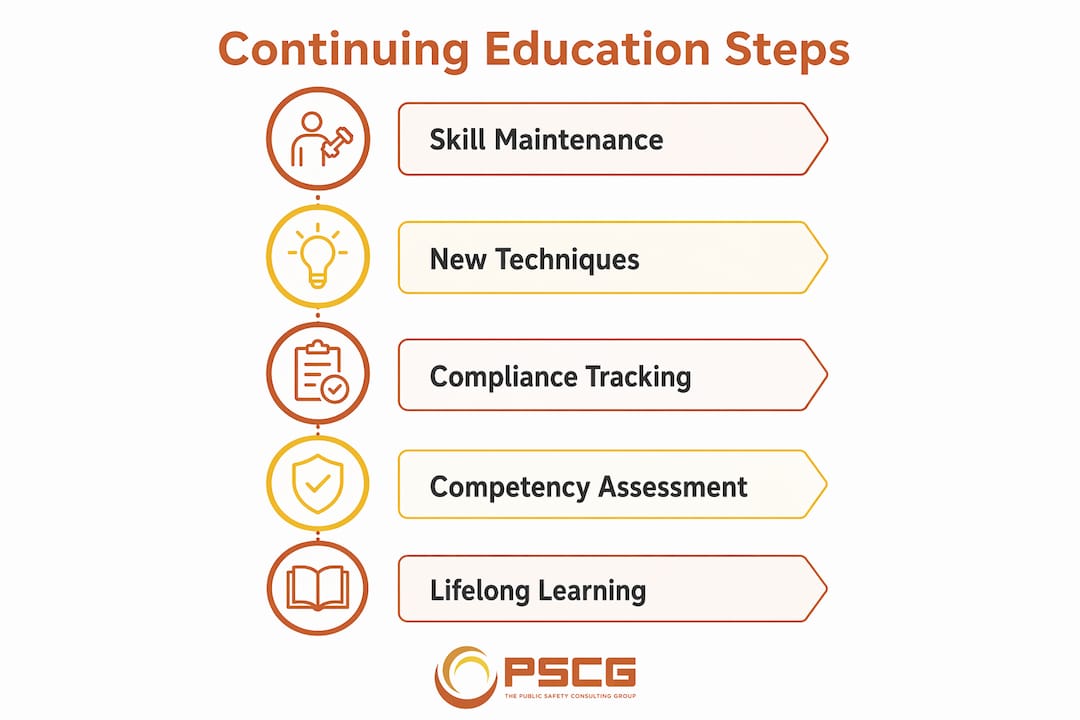
Continuing education in public safety serves four distinct functions: skill maintenance, introduction of new techniques, adaptation to evolving threats, and procedural standardization across agencies. Each function addresses a different gap in professional readiness, and none of them can be addressed by initial training alone.
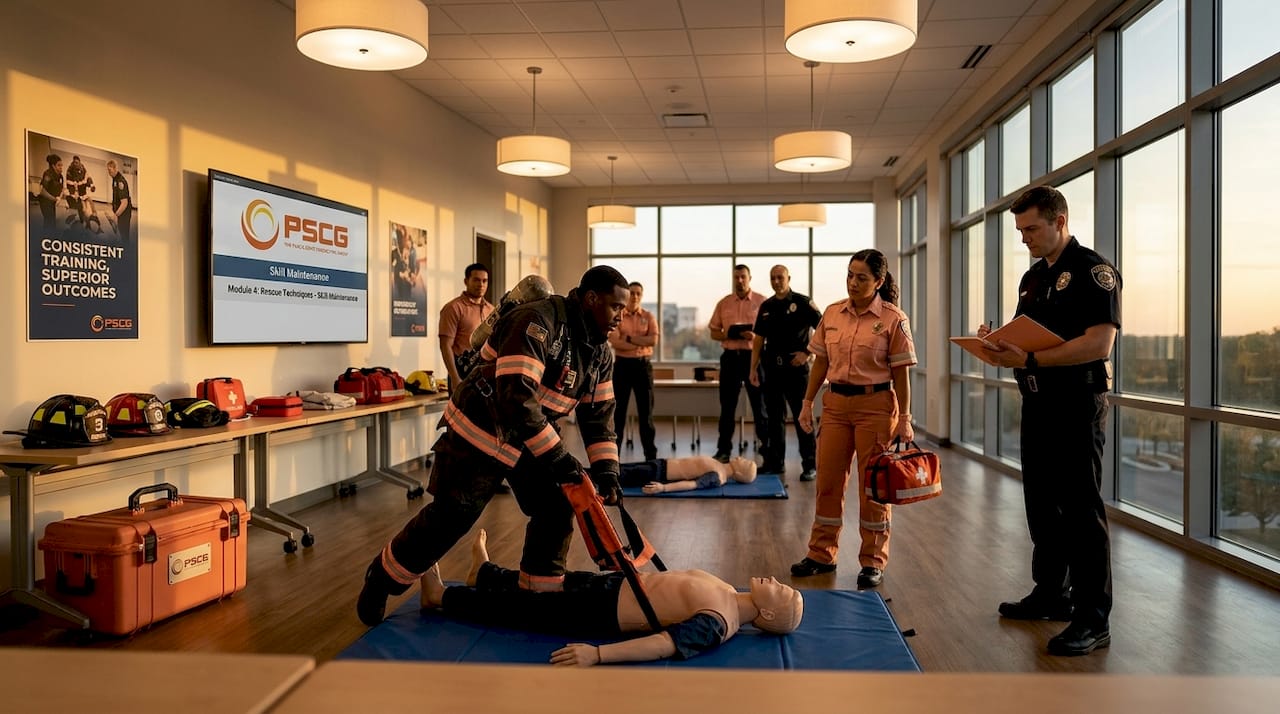
Skill maintenance is the most visible function. Tactical operations, advanced officer training, and specialized medical responder competencies all degrade without regular reinforcement. A paramedic who completed initial certification five years ago but has not practiced low-frequency, high-acuity skills such as surgical airway management will perform less reliably under pressure than one who has trained on those skills within the past year. The same principle applies to law enforcement officers managing active threat scenarios or firefighters executing technical rescue operations.
The introduction of new techniques is equally significant. Public safety professionals now operate with tools and protocols that did not exist a decade ago. Body-worn cameras, naloxone administration in the field, and real-time GPS dispatch integration all require structured learning to deploy correctly. Continuing education programs create the formal pathway for that knowledge to reach practitioners in a standardized way.
- Skill refreshment: Reinforces foundational competencies that degrade over time without practice.
- New technique integration: Delivers structured training on updated protocols, equipment, and legal standards.
- Threat adaptation: Prepares personnel for emerging risks including active violence, mass casualty events, and public health crises.
- Procedural standardization: Aligns individual performance with agency-wide and national benchmarks.
Pro Tip: When designing a continuing education calendar for your agency, map each training module to a specific competency gap identified in your last performance review cycle. Generic refresher training produces generic results. Targeted training produces measurable improvement.
Effective continuing education for EMS instructors also emphasizes scenario-based delivery over lecture formats, because practical application under simulated pressure translates more directly to on-scene performance.
How does continuing education support compliance and certification maintenance?
Compliance is the non-negotiable floor of continuing education in public safety. Agencies do not treat training cycles as optional professional development. They treat them as conditions of employment and certification.
The San Francisco Police Department’s Advanced Officer and Continuing Professional Training policy illustrates this precisely. Under SFPD Policy 24-195, officers must complete their assigned AO/CPT training within a designated six-month window. Failure to do so results in noncompliance status, which directly affects POST certification and can trigger disciplinary action. The policy uses a star-number system to track training windows, creating a structured lifecycle that ties duty status to completion. This model demonstrates that CE lifecycle management works best when consequences are clearly defined and enforced.
Michigan’s MCOLES framework applies the same logic at the state level. The 2026 CPE requirements mandate the following:
- 24 total hours of continuing professional education annually for all certified law enforcement officers.
- 8 hours must cover Commission-designated topics, with active violence response as a required component in 2026.
- 16 hours are agency-selected, with MCOLES recommending alignment with Tactical Operations training.
- Noncompliance carries funding penalties for the employing agency, not just the individual officer.
Michigan’s 24-hour annual requirement creates a clear accountability structure that connects individual training completion to agency-level financial consequences. That linkage is deliberate. It ensures administrators treat CE scheduling as a resource allocation priority, not an administrative afterthought.
The practical implication for your agency is straightforward: backward planning from certification deadlines is the most reliable method for maintaining full-duty compliance across your entire roster. Build your training calendar from the due date backward, not from the start of the year forward.
What are the benefits of competency-based continuing education programs?
Competency-based continuing education produces measurable outcomes because it starts with a specific performance gap rather than a predetermined curriculum. The difference between generic refresher training and targeted, data-driven education is the difference between activity and improvement.
An Ohio fire department demonstrated this distinction in practice. By using AI-assisted quality assurance tools to analyze patient care records, the department identified that personnel were underperforming on recognition of atypical heart attack presentations, particularly in female patients. Rather than scheduling a broad cardiac care refresher, the department issued brief, targeted education modules focused specifically on that gap. The result was a marked improvement in patient treatment within six months. This closed-loop model, where outcome data drives curriculum design, represents the most effective application of continuing education in EMS and fire services.
The Texas A&M Engineering Extension Service (TEEX) applies a similar philosophy in traffic incident management. Their responder courses are mapped directly to MUTCD and NFPA standards, with practical skills training focused on temporary traffic control and incident clearance. The competency alignment means that what personnel learn in the classroom translates directly to on-scene command decisions under pressure.
| Training Model | Approach | Outcome Focus |
|---|---|---|
| Generic refresher | Broad topic review on a fixed schedule | Compliance completion |
| Competency-based | Gap-identified, standards-aligned curriculum | Measurable skill improvement |
| AI-assisted targeted CE | Data-driven gap analysis, personalized modules | Patient care and operational outcomes |
The New Braunfels Fire Department’s Mobile Integrated Health program reinforces this point at the community level. By training staff specifically to manage frequent 911 callers through telehealth navigation and coordination, the program achieved up to a 70% call reduction among high-utilization patients. That result did not come from general EMS training. It came from targeted education aligned to a specific operational challenge.
Pro Tip: Use your agency’s patient care reports, incident reviews, and quality assurance data as the primary inputs for your CE curriculum design. The gaps your data reveals are more reliable than any standardized training catalog.
For agencies working to connect training investments to clinical outcomes, the EMS quality improvement framework developed by Thepscgroup provides a structured methodology for doing exactly that.
How do flexible continuing education programs support lifelong learning?
The importance of lifelong learning in public safety is well established in policy. The structural capacity to deliver it consistently is where most agencies and institutions fall short.
Traditional continuing education models were built around discrete, periodic events: an annual recertification course, a biennial skills check, a mandated block of hours completed in a classroom. That model does not reflect the career arc of a public safety professional who may serve for 25 to 30 years across multiple roles, specialties, and jurisdictions. The shift toward modular, stackable microcredentials addresses this gap directly. Microcredentials are now offered by 88% of online and professional continuing education units, with average enrollment reaching 16,046 per program. That adoption rate signals a structural shift in how professional education is delivered, not just a trend.
The challenge is institutional integration. Only 13% of continuing education units report that their offerings are well integrated into the traditional academic portfolio, and many lack cross-departmental collaboration. For public safety agencies, this means that even when flexible formats exist, accessing them requires navigating fragmented systems that were not designed for operational schedules.
The most effective agencies address this through several practical strategies:
- Modular scheduling: Breaking annual CE requirements into monthly or quarterly units rather than single-block events reduces scheduling conflicts and improves completion rates.
- Blended delivery: Combining online didactic content with in-person skills verification allows personnel to complete knowledge components on their own time while preserving hands-on competency assessment.
- Career-stage alignment: Tailoring CE content to where a professional is in their career, whether entry-level, mid-career specialist, or senior supervisor, increases relevance and engagement.
- Stackable credentials: Designing CE modules that build toward recognized certifications, such as EMS supervisor credentials or hazmat technician endorsements, gives professionals a long-term development pathway rather than isolated compliance checkboxes.
The value of ongoing training is realized most fully when it is treated as a career-long system rather than a series of disconnected requirements. Agencies that build that system deliberately produce professionals who are not just compliant but genuinely more capable over time.
Key takeaways
Continuing education in public safety is most effective when it is compliance-structured, competency-driven, and delivered through flexible formats that support career-long professional development.
| Point | Details |
|---|---|
| Compliance is non-negotiable | Agencies like MCOLES and SFPD tie CE completion directly to certification status and funding. |
| Competency-based training outperforms generic refreshers | Targeted, gap-driven education produces measurable outcomes, as demonstrated by the Ohio fire department AI model. |
| Flexible formats expand access | Microcredentials and blended delivery allow CE to fit operational schedules without sacrificing rigor. |
| Data should drive curriculum design | Patient care reports and incident reviews are the most reliable inputs for identifying real training gaps. |
| Lifelong learning requires structural support | Only 13% of CE units are well integrated institutionally, meaning agencies must build their own delivery systems. |
What I’ve learned from watching agencies get CE right and wrong
I have worked alongside public safety agencies long enough to recognize the difference between a continuing education program that exists on paper and one that actually changes how people perform on scene. The gap between those two things is almost never about content. It is almost always about structure and accountability.
The agencies that get CE right treat it as a lifecycle with hard deadlines, clear consequences, and a direct line to operational performance data. They do not schedule training because a calendar says it is time. They schedule it because their quality assurance process identified a specific gap, and they have a specific module designed to close it. That is the model the Ohio fire department used with AI-assisted QA, and it produced results within six months.
What I find most underappreciated in this field is the connection between CE outcomes and community trust. When a paramedic correctly identifies an atypical MI presentation because their agency invested in targeted training, that patient survives. When a law enforcement officer completes active violence response training through MCOLES-aligned programming, their community is safer. Those outcomes are not abstractions. They are the direct product of structured, accountable continuing education. Agencies that treat CE as a compliance checkbox will always underperform relative to agencies that treat it as a performance management tool.
The EMS quality assurance guide from Thepscgroup offers a practical framework for connecting training investments to service outcomes, and it is worth reviewing if your agency is building or rebuilding its CE infrastructure.
— Mike
How Thepscgroup supports your continuing education strategy
Thepscgroup works directly with EMS agencies, municipal public safety departments, and regional systems to build continuing education strategies that are operationally grounded and outcome-focused. We do not offer generic training catalogs. We work alongside your leadership team to identify performance gaps, align CE programming with recognized standards, and connect training investments to measurable service improvements.
Our municipal EMS strategy consulting integrates continuing education planning into broader system design, so your training program supports your operational goals rather than running parallel to them. Whether you are building a new CE framework from the ground up or auditing an existing program for compliance and effectiveness, we bring the expertise and the tools to make it work.
Contact Thepscgroup at thepscgroup.net to start the conversation.
FAQ
What is the role of continuing education in public safety?
Continuing education maintains and advances the skills, knowledge, and compliance status of public safety professionals throughout their careers. It fulfills mandatory training requirements set by agencies like MCOLES and POST while also driving measurable improvements in service delivery and community outcomes.
How does continuing education help with certification compliance?
Agencies such as the San Francisco Police Department and Michigan’s MCOLES require structured training cycles with defined completion windows. Failure to complete assigned training results in noncompliance status, which can affect POST certification, duty status, and agency funding.
What are the benefits of competency-based continuing education programs?
Competency-based programs identify specific performance gaps and deliver targeted training to close them. An Ohio fire department using AI-assisted quality assurance achieved marked improvement in patient treatment within six months by focusing education on identified clinical deficiencies rather than broad topic reviews.
How do microcredentials support lifelong learning for public safety professionals?
Microcredentials provide modular, stackable learning units that fit operational schedules and build toward recognized certifications over time. They are now offered by 88% of professional continuing education units, making them the most accessible format for career-long professional development.
How does continuing education improve community safety outcomes?
Targeted continuing education directly improves the quality of service delivered to the public. The New Braunfels Fire Department’s Mobile Integrated Health program, built on specialized staff training, reduced high-utilization 911 calls by up to 70%, demonstrating a direct link between structured CE and community-level impact.