


TL;DR:
- Community paramedicine is a healthcare model where EMS personnel provide preventive and primary care under medical oversight, focusing on underserved populations. It involves in-home visits, care coordination, and addressing social determinants to reduce hospital readmissions and emergency calls. Successful programs require strong stakeholder engagement, diverse funding sources, and thorough planning aligned with community needs.
Most healthcare administrators assume community paramedicine is just another name for EMS. It is not. Community paramedicine is a structured healthcare delivery model where trained EMS personnel operate in expanded clinical roles under medical oversight, providing preventive care, chronic disease management, and care coordination. The goal is to close persistent gaps in healthcare access, particularly for underserved and high-utilizer populations, while reducing pressure on emergency departments and 911 systems. This guide breaks down how programs are designed, funded, operated, and evaluated so you can move from concept to implementation with confidence.
Table of Contents
- Key takeaways
- What community paramedicine actually covers
- Program models and frameworks
- Funding, sustainability, and regulatory considerations
- Operational structure: operators, staffing, and partnerships
- Benefits, challenges, and best practices
- A perspective on where community paramedicine gets stuck
- How PSCG supports community paramedicine success
- FAQ
Key takeaways
| Point | Details |
|---|---|
| Beyond emergency response | Community paramedicine expands EMS roles into preventive care, chronic disease management, and care coordination. |
| Structured program design | Effective programs use needs assessments like CPNAT to align services with local health and social gaps. |
| Funding complexity is real | Sustainable programs layer multiple funding sources including Medicaid, grants, and hospital partnerships. |
| Operator type matters | Whether a hospital, nonprofit, or government agency runs the program shapes its mission and service scope. |
| Health equity is the foundation | Programs built around social determinants of health consistently deliver stronger long-term outcomes. |
What community paramedicine actually covers
Community paramedicine is defined as a healthcare delivery model where EMS personnel operate in expanded roles under medical oversight to provide preventive and primary care services, with a particular focus on underserved populations. That definition matters because it draws a sharp line between what paramedics traditionally do and what community paramedicine authorizes them to do under formal protocols and physician oversight.
The services that fall under this model include:
- In-home wellness visits for patients recently discharged from the hospital or living with chronic conditions like diabetes, COPD, or congestive heart failure
- Medication reconciliation and compliance checks, helping patients understand and follow prescribed treatment plans between clinical appointments
- Fall risk assessments for elderly patients, reducing preventable injuries and subsequent 911 activations
- Care coordination and referrals, connecting patients to primary care physicians, behavioral health providers, and social services
- Preventive care screenings, such as blood pressure monitoring, wound care, and glucose checks
- Social determinants of health interventions, including identifying housing instability, food insecurity, and transportation barriers
What separates this from a typical 911 response is the longitudinal nature of the work. A community paramedic may visit the same patient multiple times over weeks or months. That care coordination model differs from traditional emergency response, where the interaction ends when the patient reaches the hospital.
Community paramedicine also overlaps significantly with mobile integrated healthcare (MIH). The two terms are often used interchangeably, but MIH is the broader category. Community paramedicine specifically refers to the paramedic’s role within that system.
Pro Tip: When designing your program’s service menu, consult with your medical director and primary care partners early. Services must align with approved protocols and community need, not just what your paramedics are capable of performing.
Program models and frameworks
No two community paramedicine programs look alike, and that is by design. The appropriate model depends on your community’s demographics, existing healthcare infrastructure, and the specific gaps you are trying to close. Programs in rural Montana face different challenges than those in a mid-sized Connecticut city, and the service model must reflect that reality.
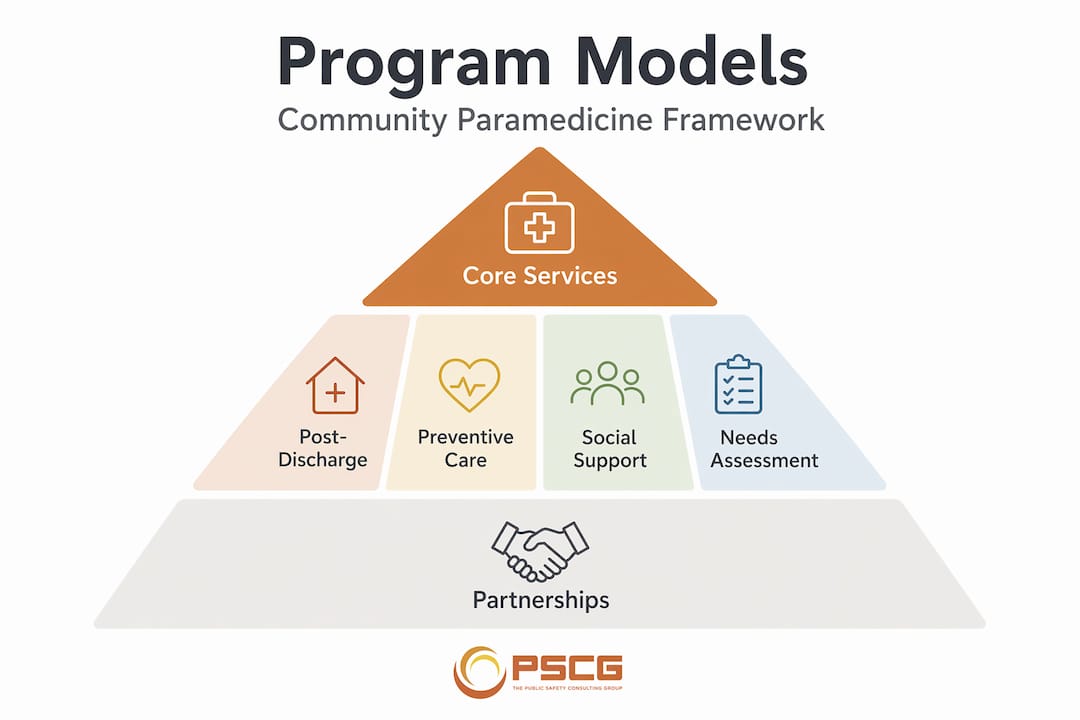
The table below outlines the primary program frameworks used across the country:
| Model | Primary Focus | Best Suited For | Key Feature |
|---|---|---|---|
| Post-discharge follow-up | Hospital readmission reduction | Urban and suburban systems | Home visits within 72 hours of discharge |
| Frequent 911 user diversion | Non-urgent call reduction | High-call-volume urban areas | Coordinated care plans for repeat callers |
| Rural primary care extension | Preventive and primary care access | Remote and frontier communities | Regular home visits as substitute for clinic access |
| Chronic disease management | Long-term health monitoring | Any community with high chronic illness burden | Ongoing monitoring and medication support |
| Behavioral health integration | Mental health and substance use response | Communities with crisis call volume | Co-responder or follow-up model with clinicians |
A critical tool in this process is the Community Paramedicine Needs Assessment Tool (CPNAT), which was developed with input from 112 community paramedicine experts and their partners. CPNAT helps programs systematically identify gaps in local health and social care, aligning service delivery to what the community actually needs rather than what administrators assume it needs. This distinction is not trivial. Programs built on assumptions often underperform or miss the populations most in need.
Social determinants of health should be woven into every framework decision. Transportation access, housing stability, and food security directly affect health outcomes. Programs that address upstream social needs consistently show better long-term results than those focused narrowly on clinical metrics.
Pro Tip: Do not copy a program model from a neighboring county without first conducting a local needs assessment. The service gaps and population characteristics in your community require their own analysis. Models cannot simply be transplanted from urban to rural settings or vice versa.
Funding, sustainability, and regulatory considerations
Funding is where many promising community paramedicine programs stall. The sources exist, but layering them into a sustainable financial model requires planning, patience, and strong stakeholder relationships. Funding sources include hospitals, EMS agencies, Medicaid, federal and state grants, and accountable care organizations (ACOs). The challenge is that each source comes with its own reporting requirements, eligibility constraints, and reimbursement timelines.
Key funding pathways to consider include:
- Medicaid reimbursement: Several states now provide Medicaid coverage for community paramedicine services, though coverage varies significantly by state policy. Nevada, for example, has established formal reimbursement structures through its Medicaid program.
- Hospital partnerships: Hospitals motivated by reducing 30-day readmission penalties under CMS have strong financial incentives to co-fund community paramedicine programs.
- Federal grants: Programs like HRSA rural health grants and FEMA’s Assistance to Firefighters Grants have been used to launch or sustain community paramedicine initiatives.
- ACO contracts: Accountable care organizations that share in savings from reduced hospitalizations can fund community paramedicine as a cost-containment strategy.
- Philanthropic and foundation support: Useful for pilot phases, though not a long-term sustainability strategy on its own.
On the regulatory side, state requirements vary considerably. Most states do not create new licensure categories for community paramedics. Instead, they require medical direction approvals and endorsements from state EMS authorities. Aligning with Medicaid billing codes and state EMS regulations is time-intensive but non-negotiable. Programs that skip this step face billing denials and compliance risk.
Community paramedics also need training beyond standard EMS education. The focus must shift to longitudinal and preventive care, which is a different clinical mindset than the acute, stabilize-and-transport model paramedics are traditionally trained under.
Operational structure: operators, staffing, and partnerships
Who runs the program matters as much as what the program does. Operator type fundamentally shapes mission, sustainability, and how services are delivered. A hospital-run program will likely prioritize readmission reduction and post-discharge follow-up. A nonprofit-operated model may center health equity and reach populations without insurance. A government-operated program may emphasize broad access across a defined geography.
Common operator types include:
- Municipal EMS agencies: Strong infrastructure, existing public trust, and established dispatch integration
- Hospitals and health systems: Access to clinical data, care teams, and financial motivation to reduce readmission penalties
- Nonprofit community health organizations: Mission-driven, often better at reaching marginalized populations and navigating social services networks
- Fire-based EMS services: High community visibility and existing relationships with frequent callers
- Private EMS providers: Can offer scalability, though mission alignment with community health goals must be carefully evaluated
Staffing the program requires more than assigning available paramedics to community visits. Community paramedics must have specific certifications, typically through bodies like the International Board of Specialty Certifications (IBSC), and they need ongoing competency validation in their expanded scope. Supervision ratios, scheduling models, and caseload management all affect program quality.
Partnerships are the operational backbone. Effective programs build formal agreements with primary care practices, behavioral health providers, housing authorities, food banks, and local public health departments. These relationships ensure that when a community paramedic identifies a patient need outside their clinical scope, there is a warm handoff protocol in place rather than a referral that goes nowhere. You can find more on building these relationships by reviewing public safety partnership examples that have worked across different community contexts.
Benefits, challenges, and best practices
The evidence supporting community paramedicine is strong and growing. Documented outcomes include reductions in hospital readmissions, decreases in emergency room utilization, and measurable reductions in non-urgent 911 calls. These are not marginal improvements. In high-utilizer programs, some agencies have reported 40-60% reductions in 911 calls among enrolled patients.
Implementing a program that achieves these results requires avoiding several common pitfalls:
- Underestimating regulatory timelines. State EMS authority approvals, medical director agreements, and Medicaid enrollment can each take months. Build these timelines into your program launch calendar from day one.
- Launching without community input. Programs designed without input from the populations they serve frequently miss the mark on service relevance. Co-design with community members, not just with administrators and clinicians.
- Ignoring social determinants. A community paramedic who identifies a patient’s medication non-compliance without recognizing that the patient cannot afford the prescription has not solved the problem. Health equity focus must be built into protocol design and staff training.
- Neglecting data infrastructure. Programs that cannot produce outcome data cannot attract continued funding. Build your data collection and reporting systems before you start enrolling patients.
- Failing to engage primary care as a partner. Community paramedicine works as an extension of primary care, not a replacement. Physicians need to see your paramedics as part of their care team, which requires deliberate relationship-building.
Pro Tip: Treat your program’s first year as a pilot. Define clear, measurable outcomes, collect rigorous data, and use those results to make the case for expanded funding and scope. A well-documented pilot is your best asset when approaching state Medicaid or hospital system partners.
For administrators considering the operational complexity of deploying a community paramedicine model within an existing EMS structure, reviewing EMS deployment model options can help clarify where community paramedicine fits within your broader service delivery framework.
A perspective on where community paramedicine gets stuck
I have worked with EMS systems across multiple states, and the pattern I keep seeing is this: programs fail not because of bad intentions or poor clinical design, but because the administrative and political infrastructure was not built before the clinical one.
In my experience, the organizations that launch successful community paramedicine programs are the ones that started by getting their medical director, their hospital partners, and their local health department in the same room before they wrote a single protocol. The clinical design came second. The relationships and the shared understanding of goals came first.
What I find consistently underestimated is the stakeholder engagement requirement. Administrators often budget time and money for paramedic training and equipment, then discover six months in that they still do not have a signed data-sharing agreement with the hospital or a billing pathway through their state Medicaid office. Those gaps do not close themselves.
The other thing I would tell any leader considering this work is to treat health equity as a design principle, not a program feature. If your community paramedicine program does not actively reach the people with the worst health outcomes and the least access to care, you are probably optimizing for the patients who were already going to be okay. That is not what this model is for.
The organizations that get this right tend to share one characteristic: they are genuinely curious about what their community needs, and they are willing to let that curiosity shape their program before their assumptions do.
— Mike
How PSCG supports community paramedicine success
At Thepscgroup, we work directly with healthcare administrators, municipal leaders, and EMS agencies to build community paramedicine programs that are structurally sound from the start. Our team brings deep expertise in EMS system design, stakeholder engagement, and reimbursement strategy, which means we help you avoid the administrative and regulatory gaps that derail programs before they reach patients.
We have supported clients through medical direction alignment, state EMS authority coordination, Medicaid billing pathway development, and multi-stakeholder partnership design. Whether you are launching a new program or restructuring an existing one, we bring a performance-oriented methodology grounded in real operational experience.
Explore our EMS system design consulting services to see how we structure programs for communities like yours. You can also review our municipal EMS strategy guide for a broader view of how community paramedicine fits within a high-performing EMS ecosystem.
Reach out to Thepscgroup directly at thepscgroup.net to start the conversation.
FAQ
What is community paramedicine?
Community paramedicine is a healthcare delivery model where EMS personnel work in expanded clinical roles, under physician oversight, to provide preventive care, chronic disease management, and care coordination. It targets underserved populations and reduces reliance on emergency departments for non-urgent health needs.
How is community paramedicine funded?
Funding typically comes from a combination of Medicaid reimbursements, hospital partnerships, federal and state grants, and accountable care organization contracts. Sustainable programs layer multiple sources rather than relying on a single funding stream.
What training do community paramedics need?
Community paramedics require additional certification beyond standard EMS training, with a focus on preventive and longitudinal care management. The IBSC Community Paramedic credential is one recognized pathway used across multiple states.
How do community paramedicine programs measure success?
Key metrics include reductions in 911 call volume among enrolled patients, decreases in hospital readmissions, emergency department utilization rates, and patient-reported outcomes. Programs with strong data infrastructure use these metrics to secure continued funding and expand services.
Is community paramedicine the same as mobile integrated healthcare?
Mobile integrated healthcare (MIH) is the broader system model, while community paramedicine refers specifically to the expanded paramedic role within that system. The two terms overlap significantly and are sometimes used interchangeably, though MIH can include other clinical providers beyond paramedics.