


TL;DR:
- Fire department safety emphasizes operational protocols that safeguard firefighters, improve incident results, and prioritize life safety in all emergency phases. Practicing clear communication, maintaining proper equipment, and reviewing emergency plans regularly are essential, especially considering health risks like cardiac events and evolving hazards such as lithium-ion fires. Implementing simple, standardized tactics like rapid intervention and strict ventilation procedures fosters a safety culture aligned with NFPA standards.
Fire department safety tips are structured operational and preventative protocols designed to protect firefighters, reduce incident risk, and improve outcomes across every phase of emergency response. From the fireground to the firehouse kitchen, these practices span tactical decision-making, personal protective equipment, family preparedness, and communication coordination. The 2026 NFPA 1700 Guide for Structural Fire Fighting reinforces that life safety is the primary mission of every fire department operation. At Thepscgroup, we work alongside fire service leaders to translate these protocols into measurable, department-wide safety improvements.
1. Fire department safety tips for home and family protection
Firefighters spend their careers protecting others, yet their own homes and families are often under-prepared for fire emergencies. The California State Firefighters’ Association (CSFA) recommends monthly smoke alarm tests and replacing batteries twice per year, treating any chirping alarm as an immediate replacement signal. Smoke alarms belong outside every bedroom and in hallways on every floor. This baseline is non-negotiable for fire safety guidelines that actually protect lives.
Kitchen fires remain the leading cause of residential fire injuries. Preventing house fires starts with never leaving cooking unattended and keeping flammable materials at least three feet from any heat source. Mississauga Fire’s community fire prevention guidance specifies exact clearance distances for BBQs and outdoor equipment, a model worth replicating in department-issued family safety materials.
Key home fire safety practices for firefighter families include:
- Install smoke alarms on every floor, including basements and attics
- Test alarms monthly and replace batteries biannually
- Keep electrical cords undamaged and outlets free from overloading
- Establish a family escape plan with two exit routes from every room
- Designate a meeting point at least 200 feet from the structure
- Practice the escape plan with all household members at least twice per year
Pro Tip: Install 10-year sealed-battery smoke alarms in bedrooms and hallways. They eliminate the battery replacement variable entirely and maintain consistent protection without reliance on manual upkeep.
2. Tactical fireground safety aligned with NFPA 1700
The 2026 NFPA 1700 update places life safety as the primary mission of structural firefighting, with tactical decisions driven by occupant survivability profiling and hazard assessment. Hoseline placement and ventilation must align directly with primary search areas. This is not a preference. It is a doctrine-level requirement that shapes every fireground decision from initial size-up through overhaul.
Flow-path management and door control are among the most consequential tactical tools available to interior crews. Closing doors between the fire and unburned areas slows heat transfer, reduces oxygen availability to the fire, and buys time for search operations. Departments that train door control as a reflex, not an afterthought, consistently report improved interior conditions during primary search.
“Ventilation ahead of hoseline deployment can create flow paths that increase risk to interior crews by drawing heat and smoke toward them. Tactical ventilation requires close incident management coordination.” — Fire Engineering, Essential Operations: Offensive Ventilation
Premature ventilation without a charged hoseline in place is one of the most preventable causes of deteriorating interior conditions. Coordination between the ventilation crew and the attack crew is not optional. It is the difference between a controlled fire environment and a rapid escalation that traps interior crews. Incident commanders must confirm hoseline readiness before any ventilation evolution begins.
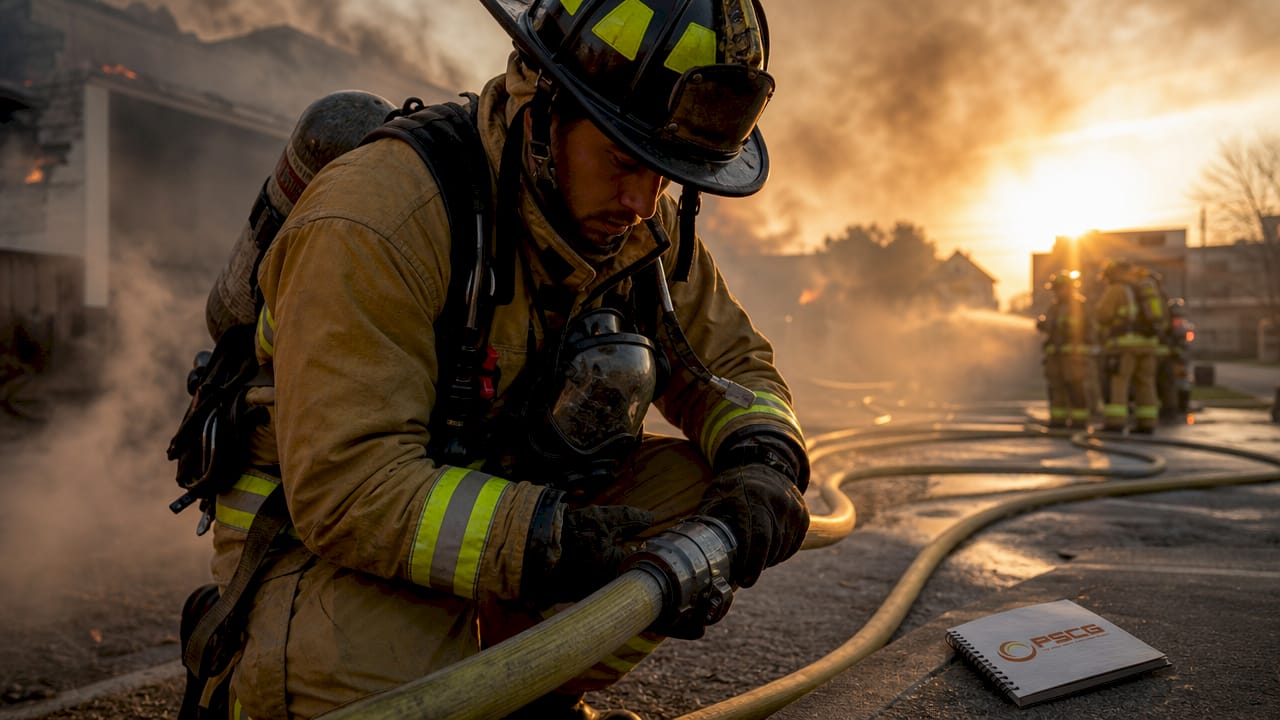
Personal protective equipment and situational awareness complete the tactical safety picture. SCBA discipline, PASS device activation, and crew accountability tracking are foundational emergency fire procedures that no tactical innovation replaces.
3. Rapid intervention team tactics that save lives
Rapid intervention team (RIT) effectiveness depends on speed and simplicity, not equipment complexity. Snap-and-grab and load-and-go tactics prioritize immediate physical extraction over multi-step airway procedures that can cost three to five minutes in zero-visibility conditions. Those minutes are not recoverable. Every second spent managing air fittings in a mayday environment is a second the downed firefighter is not moving toward safety.
RIT sizing and deployment must match the specific incident profile. A working structure fire with multiple interior crews requires a dedicated, fully staffed RIT staged and briefed before any interior attack begins. Smaller incidents may allow a modified RIT posture, but the decision must be deliberate and documented. Reducing equipment redundancy within the RIT pack also matters. Carrying gear that duplicates what the downed firefighter already has slows the team without adding rescue capability.
Key RIT safety practices include:
- Stage RIT at a position that allows rapid entry from multiple access points
- Brief RIT members on the floor plan, last known crew positions, and radio channels before deployment
- Limit RIT pack contents to extraction-critical tools only
- Prioritize physical drag and carry techniques over complex airway management in zero visibility
- Confirm RIT activation criteria and mayday protocols with all crews at the incident briefing
Pro Tip: Assign a dedicated RIT radio monitor who tracks all interior crew communications in real time. Early detection of a developing mayday reduces activation time and improves extraction outcomes.
4. Building and maintaining fire emergency action plans
A fire emergency action plan (EAP) is a documented, practiced operational framework that assigns roles, maps evacuation routes, and establishes communication protocols for every phase of a fire emergency. AlertMedia’s six-step EAP framework includes hazard mapping, communication planning, contingency route development, assembly point designation, role assignment, and scheduled plan updates. Departments that treat the EAP as a living document, rather than a compliance checkbox, consistently identify gaps before incidents expose them.
Primary and secondary evacuation routes must be mapped for every occupied structure in a department’s response area. Assembly points belong at least 200 feet from the structure, positioned to avoid blocking apparatus access. Incorporating recent hazard categories, including lithium-ion battery fires, into EAP scenarios reflects the current risk environment and keeps planning relevant to what crews actually face.
| EAP Component | Operational Requirement |
|---|---|
| Evacuation routes | Primary and secondary routes mapped, posted, and rehearsed |
| Communication plan | Multi-channel system with designated backup channels |
| Role assignments | Named individuals with documented responsibilities |
| Assembly points | Minimum 200 feet from structure, apparatus access preserved |
| Plan review cycle | Updated after every drill, incident, or new hazard identification |
Technology integration strengthens EAP execution. Multi-channel communication systems, including radio, mobile alert platforms, and public address systems, reduce the risk of information gaps during active incidents. Strategic planning in public safety frameworks recommend layering communication channels so that no single point of failure disrupts coordination. After every drill or live incident, a documented after-action review should drive specific EAP revisions.
5. Communication protocols that protect firefighters and the public
Effective fire emergency communication begins the moment a fire is detected. The sequence is clear: activate the nearest manual alarm, contact the fire department from a safe location, and initiate evacuation through the nearest safe exit. Centennial College’s fire safety procedures specify assembly at least 200 meters from the building, a standard that keeps civilians clear of apparatus operations and reduces on-scene congestion.
Elevators are not evacuation tools. Closing doors between the fire and evacuation routes slows fire spread and protects egress paths. These instructions must be communicated clearly to building occupants before an incident, not during one. Pre-incident public education is a core component of fire prevention advice that departments too often defer.
For on-scene coordination, crisis communication workflow practices recommend establishing a unified command communication structure that covers pre-incident briefings, active incident updates, and post-incident notifications. Multi-channel redundancy, where radio communications are backed by mobile alerts and direct liaison with public safety officials, prevents the information gaps that cause coordination failures.
Pro Tip: Designate a public information officer at every working incident. A single, credible voice managing external communications reduces misinformation, supports family notification, and keeps media inquiries from distracting incident command.
6. Firefighter health as a safety priority
Cardiovascular events account for 63% of line-of-duty firefighter deaths, with USFA data showing 48 of 76 line-of-duty deaths in 2025 attributed to cardiac events during emergency duties. That statistic reframes the entire conversation about fire department safety. Tactical excellence and proper equipment matter, but a firefighter who is not physically prepared for the cardiovascular demands of interior attack is at risk before the first hoseline is charged.
Department-level wellness programs that include annual physical fitness assessments, cardiovascular screening, and behavioral health support directly reduce LODD risk. Fire safety guidelines that address only fireground tactics miss the single largest cause of firefighter death. Leaders who integrate health and wellness into their safety culture, not just their policy manual, build departments that are operationally ready and personally resilient.
The fire department operational assessment process at Thepscgroup includes wellness program evaluation as a component of overall operational risk reduction. Physical readiness is an operational variable, and it deserves the same analytical rigor as apparatus maintenance or training frequency.
Key takeaways
Effective fire department safety requires integrating tactical protocols, health readiness, and practiced emergency action plans into a unified operational culture.
| Point | Details |
|---|---|
| NFPA 1700 tactical alignment | Hoseline placement and ventilation must coordinate with primary search areas to protect interior crews. |
| RIT simplicity saves lives | Snap-and-grab extraction outperforms complex airway procedures in zero-visibility mayday situations. |
| EAPs require rehearsal | Emergency action plans must be practiced, updated after every drill, and adapted to emerging hazards. |
| Cardiovascular risk is primary | Cardiac events cause 63% of firefighter line-of-duty deaths, making wellness a core safety priority. |
| Communication redundancy matters | Multi-channel communication systems prevent coordination failures during active fire emergencies. |
What I’ve learned about fire safety that most plans miss
The most persistent gap I see in fire department safety planning is not a missing piece of equipment or an outdated protocol. It is the absence of a genuine safety culture. Departments can have every NFPA standard on the shelf and still operate in ways that treat safety as a compliance exercise rather than a professional discipline. That gap shows up in ventilation decisions made without confirming hoseline readiness, in RIT teams that have never actually practiced a mayday extraction under realistic conditions, and in emergency action plans that were written three years ago and have not been touched since.
Flow-path management is a perfect example of where doctrine and field reality diverge. The science is clear: uncoordinated ventilation creates conditions that kill interior crews. But the pressure to vent quickly, to show visible progress, to match the pace of the fire, is real and constant. The departments that get this right are not the ones with the best ventilation equipment. They are the ones where incident commanders have the authority and the discipline to hold ventilation until the hoseline is ready, every time, without exception.
Rapid intervention is another area where simplicity is harder to achieve than complexity. It is genuinely difficult to train a team to do less in a high-stress environment. The instinct is to bring more gear, run more steps, and cover every contingency. But in a zero-visibility mayday, every additional step is a liability. The teams that extract downed firefighters successfully are the ones that have drilled the simplest possible sequence until it is automatic.
The evolving hazard profile, particularly lithium-ion battery fires, demands that we treat emergency action plans as living documents. A plan that does not account for the thermal runaway characteristics of battery storage is not a current plan. It is a historical artifact. Regular review, after every drill and every significant incident, is not optional. It is the mechanism by which safety planning stays connected to operational reality.
— Mike
How Thepscgroup supports your department’s safety mission
Thepscgroup works directly with fire departments, EMS agencies, and municipal public safety leaders to assess operational risk, strengthen emergency action plans, and build safety cultures that hold up under real-world conditions. Our consulting process starts with a structured operational assessment that identifies gaps in tactical protocols, wellness programs, communication systems, and EAP documentation. From there, we develop department-specific recommendations that translate directly into reduced risk and improved incident outcomes.
Whether your department needs a full municipal EMS strategy review or targeted support on a specific safety challenge, we bring the experience and the analytical framework to move from assessment to implementation. Contact us at thepscgroup.net to start the conversation.
FAQ
What are the most critical fire department safety tips for fireground operations?
The most critical fireground safety practices include coordinating ventilation with hoseline placement, maintaining crew accountability, and activating RIT before interior attack begins. The 2026 NFPA 1700 standard identifies life safety as the primary mission and requires tactical decisions to reflect occupant survivability profiling.
How often should fire departments update their emergency action plans?
Emergency action plans should be reviewed and updated after every drill, significant incident, or identification of a new hazard category. Plans that are not regularly rehearsed and revised fail to reflect current operational conditions and emerging risks like lithium-ion battery fires.
What is the leading cause of firefighter line-of-duty deaths?
Cardiovascular events cause 63% of firefighter line-of-duty deaths, with USFA data attributing 48 of 76 LODDs in 2025 to cardiac events. This makes physical fitness and wellness program integration a primary fire department safety priority, not a secondary concern.
What makes RIT tactics effective in zero-visibility mayday situations?
Simplicity and speed define effective RIT performance. Snap-and-grab and load-and-go extraction techniques outperform complex airway management procedures in zero-visibility conditions, where every additional step costs time the downed firefighter does not have.
How far should assembly points be from a burning structure?
Assembly points should be positioned at least 200 feet (approximately 200 meters) from the structure, placed to avoid blocking apparatus access routes. This distance keeps civilians clear of active operations and reduces the risk of secondary injuries during fire suppression.
Recommended
- Best Practices for EMS Instructors: Shaping the Future of Emergency Medical Services Education | The Public Safety Consulting Group
- Fire Department Operational Assessment Guide For Safer Communities
- Fire Department Consulting: Optimize Operations And Safety
- Operational Risk Reduction in EMS – Improving Safety and Service