



TL;DR:
- Analytics in EMS involves collecting and analyzing healthcare data to enhance decision-making and service delivery. Effective use depends on unified data systems, leadership buy-in, and proactive KPI tracking. AI tools notably improve prediction accuracy, but organizational culture ultimately drives successful adoption.
Analytics in EMS refers to the systematic collection, integration, and analysis of emergency medical data to improve decision-making and service delivery across public safety systems. The role of analytics in EMS has shifted from a back-office reporting function to a core operational discipline, one that directly shapes how agencies deploy units, manage clinical outcomes, and defend funding before municipal leaders. Tools like AI-driven predictive models, electronic patient care records (ePCRs), and automated data pipelines are now central to how forward-thinking agencies operate. This guide breaks down what works, what holds agencies back, and where the field is heading in 2026.
How analytics improve EMS operational efficiency and outcomes
Predictive analytics enable EMS agencies to forecast demand surges, allocate resources during peak periods, and identify operational bottlenecks before they affect response times. That shift from reactive to proactive planning is the single most consequential change in modern EMS system design. Agencies that act on forecast data place units where calls are most likely to occur, not where they were last night.
Integrating dispatch data, ePCR records, and hospital information creates a connected care picture that was impossible to build just a decade ago. Integrated EMS and hospital data allow crews to transmit real-time clinical information, including EKGs, en route to the receiving facility. That capability shortens critical handoff times and improves treatment readiness before the patient arrives.

Seattle’s open-source EMS data pipeline is one of the clearest examples of what unified infrastructure produces. Automated data pipelines have doubled the efficiency of EMS emergency response studies, cutting cardiac arrest survival analysis time from up to three months down to a fraction of that. That speed matters because faster analysis means faster protocol adjustments and better patient outcomes.
Key operational gains analytics deliver include:
- Response time benchmarking against historical call volume and geography
- Unit utilization tracking to identify over-deployed and under-deployed resources
- Clinical outcome monitoring tied to specific protocols or crew configurations
- System Status Management adjustments driven by real-time demand forecasting
Pro Tip: Link your ePCR platform directly to your CAD system before building any dashboard. Clean, connected data at the source eliminates the most common cause of unreliable analytics outputs.
What are the biggest challenges in EMS analytics adoption?
Fragmented EMS data systems prevent a complete operational and clinical picture, making unified data pipelines the most critical infrastructure investment an agency can make. The problem is not a lack of data. EMS agencies generate enormous volumes of call records, clinical notes, and dispatch logs every day. The problem is that those records live in separate systems that do not talk to each other.
The four most common fragmentation points are:
- ePCR platforms that store clinical data in proprietary formats with limited export capability
- CAD systems that capture dispatch and response data but rarely connect to clinical records
- Fire department reports that document scene conditions separately from EMS records
- Hospital records that receive patients but rarely send outcome data back to the transporting agency
Closing those gaps requires building automated pipelines that pull, clean, and merge data from each source into a single secure environment. Agencies that wait for a media inquiry or a government data request to build that infrastructure risk producing dashboards that are inaccurate or too late to be useful. Proactive metric tracking is the only defensible position.
Cultural adoption is the second major barrier. A data-driven culture that earns trust from frontline EMS staff is what determines whether analytics actually influence decisions. Without that trust, even a well-built dashboard sits unused. Leadership must show crews how data insights connect directly to their daily work, their safety, and their patients’ outcomes.
Pro Tip: Involve field supervisors in dashboard design from day one. When frontline leaders help define the metrics, adoption follows naturally because the data reflects what they already care about.
What emerging technologies are shaping EMS analytics?
AI and machine learning are producing measurable gains in EMS prediction accuracy that traditional scoring tools cannot match. An AI LSTM model predicts emergency department crowding with an AUC of 0.84, compared to an AUC of 0.73 for the modified NEDOCS score. That difference translates directly into better diversion decisions and fewer patients stuck in crowded EDs.
| Technology | Primary Application | Key Advantage |
|---|---|---|
| AI LSTM models | ED crowding prediction | AUC 0.84 vs. 0.73 for traditional scores |
| Predictive demand modeling | Unit deployment planning | Reduces response time by anticipating call volume |
| Automated data pipelines | Multi-source data integration | Cuts analysis time from months to days |
| Behavioral health analytics | Dispatch flagging for mental health calls | Addresses the 12% of EMS calls involving mental health that go unflagged |
Behavioral health is one of the most underdeveloped areas in EMS analytics. Mental health-related EMS responses represent approximately 12% of all calls, yet most are not flagged during dispatch. Predictive models built on call history, geographic data, and time patterns can identify high-risk addresses and times, giving dispatchers better information before a crew arrives on scene.
Workforce analytics is another area gaining traction. Agencies are beginning to use call volume data, shift patterns, and overtime records to forecast burnout risk and adjust scheduling before turnover occurs. That application connects public safety trend analysis directly to staffing strategy, which is one of the highest-cost line items in any EMS budget.
Essential KPIs and frameworks for EMS leaders
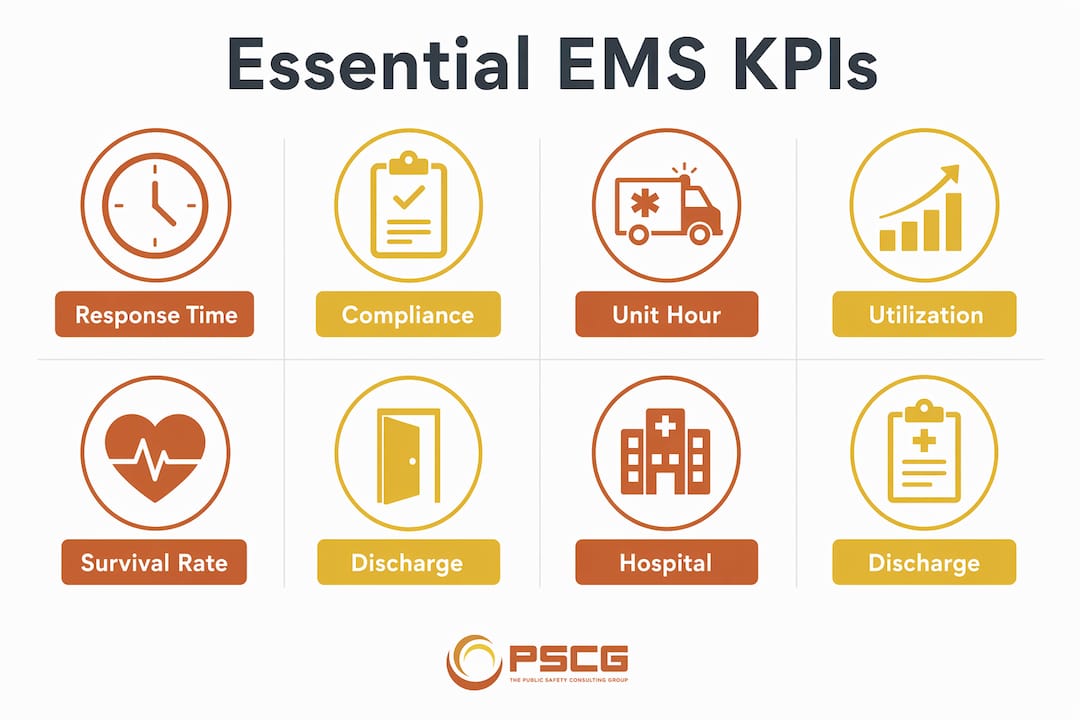
Data-driven decision making in EMS requires a defined set of key performance indicators tracked consistently over time, not pulled together reactively when a question arises. The most defensible EMS analytics programs build dashboards around metrics that connect operational inputs to clinical and community outcomes.
Core KPIs every EMS leader should track include:
- Response time compliance measured against local benchmarks and NFPA standards
- First-pass intubation success rate and other clinical quality indicators
- Hospital diversion frequency and its correlation with patient outcomes
- Unit hour utilization as a measure of deployment efficiency
- Cardiac arrest survival to discharge as the ultimate outcome metric
Real-time monitoring dashboards give leadership the ability to act on trends as they develop rather than discovering problems in a quarterly review. Agencies that connect their EMS deployment models to live data feeds can adjust unit positioning mid-shift based on actual demand patterns. That capability is the operational definition of data-driven decision making in EMS.
Analytics also serve a political function. Data analytics is critical to defending EMS funding, demonstrating value to communities, and responding to media scrutiny with credible numbers. Municipal leaders who can present response time trends, outcome data, and cost-per-call metrics are far better positioned in budget negotiations than those who rely on anecdote.
Practical steps to implement analytics in your EMS agency
Building analytics capability in an EMS agency is a phased process. Agencies that try to build everything at once typically produce fragmented results. A sequential approach produces a more durable foundation.
- Audit your current data sources. Map every system that generates EMS data, including CAD, ePCR, billing, and hospital records. Identify which systems have API access or export capability.
- Build a unified data pipeline. Work with your IT team or a qualified vendor to automate data pulls from each source into a central repository. Prioritize data cleaning and standardization before building any reports.
- Define your KPIs before you build dashboards. Identify the five to seven metrics that matter most to your leadership team and your community. Build your first dashboard around those metrics only.
- Pilot with one operational question. Choose a specific problem, such as response time compliance in a particular zone, and build your first analytics project around answering it. A focused pilot builds credibility faster than a broad rollout.
- Engage stakeholders at every level. Present findings to medical directors, shift supervisors, and municipal finance officers. Each audience needs a different view of the same data. Tailor your reporting accordingly.
- Scale after proving value. Once your pilot produces a decision that improves operations, expand the data model to include additional sources and metrics. Scaling on a proven foundation avoids the technical debt that derails larger programs.
Agencies pursuing public safety interoperability across fire, EMS, and law enforcement will find that a unified data infrastructure also supports cross-agency coordination, which is increasingly required for major incident response.
Key Takeaways
Analytics in EMS works when agencies build unified data infrastructure, earn frontline trust, and track KPIs proactively rather than reactively.
| Point | Details |
|---|---|
| Unify data sources first | Merge ePCR, CAD, fire, and hospital data into one pipeline before building dashboards. |
| Predictive analytics reduce response gaps | Demand forecasting lets agencies position units before surges occur, not after. |
| Culture determines adoption | Frontline staff must trust the data for analytics to influence real decisions. |
| AI outperforms traditional scoring | LSTM models predict ED crowding at AUC 0.84 vs. 0.73 for conventional tools. |
| Proactive KPI tracking defends funding | Agencies with live dashboards respond to budget and media scrutiny with credible data. |
Why analytics in EMS is a leadership issue, not just a technology issue
I have worked with EMS agencies that had excellent data and did nothing with it, and agencies that had mediocre data and used it to make genuinely better decisions. The difference was never the software. It was always leadership.
The agencies that get the most out of analytics are the ones where the chief or medical director treats data as a management tool, not an IT project. When leadership asks for response time trends in every staff meeting, field supervisors start paying attention to response time trends. That behavioral shift is what moves the needle, not the dashboard itself.
The hardest part of this work is not technical. It is convincing experienced paramedics and EMTs that a number on a screen reflects something real about their work. That requires showing them data that is accurate, relevant, and connected to outcomes they care about. When a crew sees that their cardiac arrest protocol produces better survival rates in the data, they believe the data. That is the moment analytics becomes part of the culture.
My honest view is that most EMS agencies in 2026 are still in the early stages of this transition. The technology is ready. The data is available. What is missing in most places is a leader willing to make data literacy a professional expectation, not an optional skill. That is the gap worth closing.
— Mike
How Thepscgroup supports data-driven EMS system design
Thepscgroup works directly with EMS agencies and municipal leaders to build the operational and analytical foundations that produce measurable results. We bring experience in EMS system design, deployment modeling, and performance gap analysis to every engagement.
Whether your agency is starting from scratch with data infrastructure or looking to sharpen an existing analytics program, our team can help you define the right KPIs, build the right reporting structure, and earn the staff trust that makes it all work. Explore our EMS system design consulting services or review our municipal EMS strategy guide to see how we approach analytics-driven improvement. Reach us directly at thepscgroup.net.
FAQ
What is the role of analytics in EMS?
Analytics in EMS is the systematic use of data from dispatch, ePCR, and hospital systems to improve resource deployment, response times, and patient outcomes. It shifts EMS operations from reactive to proactive planning.
How does data fragmentation affect EMS analytics?
Fragmented systems, including separate CAD, ePCR, and hospital records, prevent agencies from seeing a complete operational picture. Building a unified, automated data pipeline is the foundational fix.
What KPIs should EMS leaders track?
Core KPIs include response time compliance, unit hour utilization, cardiac arrest survival to discharge, and hospital diversion rates. Tracking these consistently over time produces the most defensible performance data.
How does AI improve emergency management analytics?
AI models like LSTM predict emergency department crowding with an AUC of 0.84, outperforming traditional scoring tools. That accuracy supports better diversion decisions and reduces patient harm from ED overcrowding.
Why does EMS analytics adoption fail?
Adoption fails most often because frontline staff do not trust the data or see its relevance to their work. Leadership must connect analytics outputs to decisions that matter to crews, not just to administrators.