

TL;DR:
- Fire-based EMS integrates emergency medical services into fire departments through shared infrastructure and cross-trained personnel. This model improves response times, clinical outcomes, and operational efficiency in many communities. Effective leadership and cultural alignment are key to its long-term success and sustainability.
Fire-based EMS is defined as the delivery of emergency medical services directly by fire departments, using cross-trained firefighter-paramedics and shared infrastructure to produce faster, more coordinated emergency response. This integrated model places EMS management and operations inside the fire service, rather than contracting to private providers or creating a separate third-service agency. Departments like the Spokane Fire Department and City of Bend Fire & Rescue have demonstrated that this structure produces measurable clinical gains and operational efficiency. For municipal leaders evaluating EMS delivery options, understanding what is fire-based EMS and how it performs is the starting point for every sound system design decision.
What is fire-based EMS and how does it work?
Fire-based EMS integrates EMS management and delivery into fire departments through cross-trained personnel and shared infrastructure. Firefighters serve as EMTs or paramedics, responding to medical calls from the same stations, using the same dispatch centers, and operating under unified command. This eliminates the coordination gap that exists when fire and EMS are separate agencies.
The model is not new, but its scale is significant. Medical emergencies account for roughly 75% of fire department call volume in many cities. The City of Bend Fire & Rescue responded to nearly 14,000 medical calls in 2024 alone. That volume means fire-based EMS is not a secondary function. It is the primary daily workload of most fire departments operating under this model.
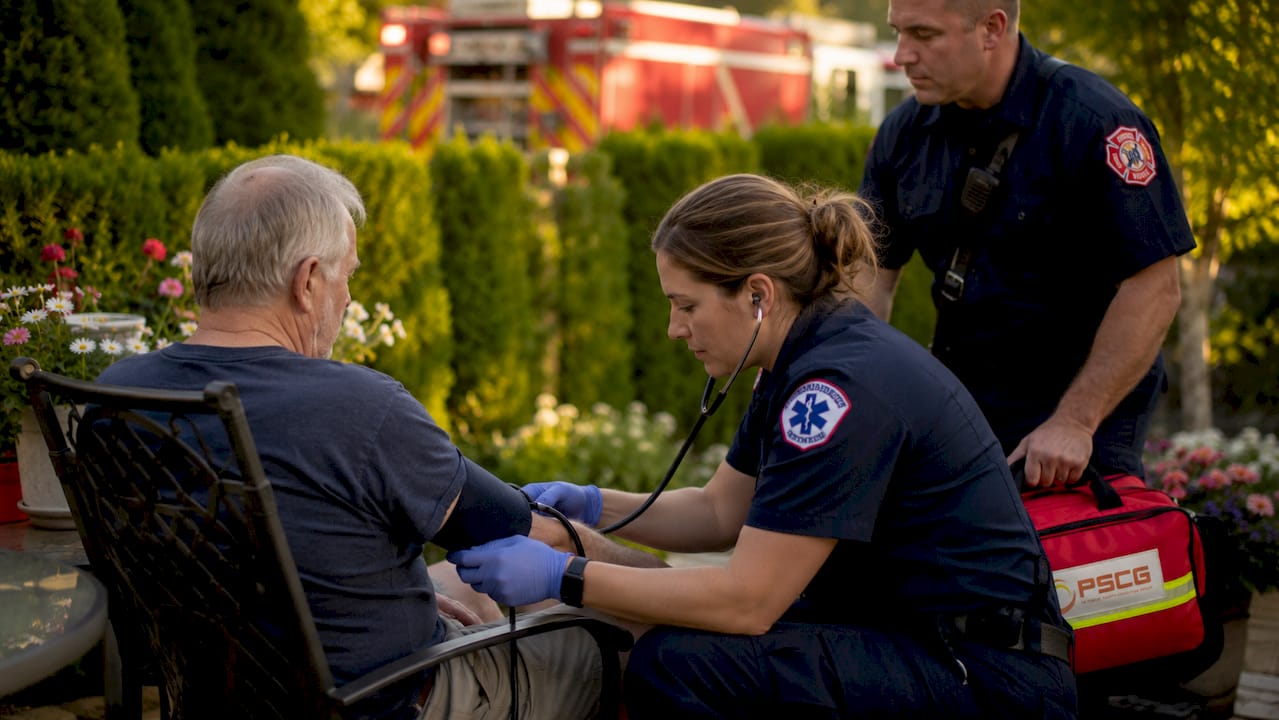
Firefighter-paramedics respond as first responders and, in many systems, also staff the transport ambulance. This dual role reduces the number of separate units needed on scene and keeps command authority consolidated. The result is faster scene management and clearer accountability for patient care.
How does fire-based EMS compare to private or third-service models?
Each EMS delivery model carries distinct operational characteristics. Fire-based EMS, private EMS, and third-service agencies each serve communities effectively. The right choice depends on local priorities, resources, and governance structures.
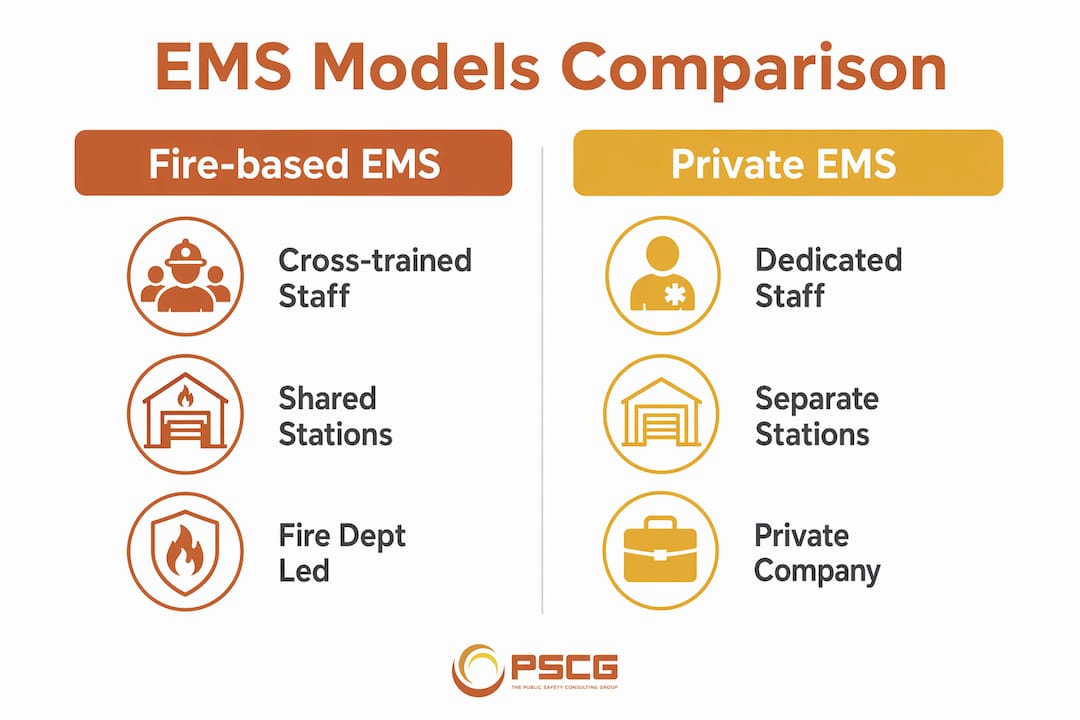
| Feature | Fire-based EMS | Private EMS | Third-service EMS |
|---|---|---|---|
| Staffing model | Cross-trained firefighter-paramedics | Dedicated EMS personnel | Dedicated municipal EMS personnel |
| Infrastructure | Shared fire stations and dispatch | Separate facilities | Separate municipal facilities |
| Command structure | Unified fire/EMS command | Independent EMS command | Independent municipal command |
| Revenue model | Billing, subscriptions, tax base | Fee-for-service, contracts | Tax base, billing |
| Response integration | High, co-located with fire | Lower, separate deployment | Moderate, municipal coordination |
Private EMS agencies offer specialized focus and can scale contract services across multiple jurisdictions. Third-service agencies give municipalities direct control over EMS without merging it into the fire service culture. Both models have produced strong outcomes in the right environments.
Fire-based EMS offers specific advantages in communities where fire stations are already distributed across the service area. Key operational characteristics include:
- Shared dispatch reduces call processing time and eliminates inter-agency communication delays.
- Co-located personnel allow simultaneous fire and EMS deployment without additional travel time.
- Unified incident command simplifies scene management, particularly for multi-patient or complex incidents.
- Regional mutual aid agreements between fire departments extend EMS coverage without duplicating infrastructure.
Pro Tip: When evaluating EMS deployment models, assess your existing fire station distribution first. If stations already cover your target response zones, fire-based EMS may deliver the fastest return on infrastructure investment.
What are the benefits of fire-based EMS for patient outcomes?
Rapid on-scene intervention is the core clinical advantage of fire-based EMS. Because firefighter-paramedics are already positioned throughout the community, they reach patients faster than units dispatched from centralized facilities. Rapid on-scene care delivers superior long-term patient outcomes compared to transport-speed-focused models. Speed to the patient, not speed to the hospital, determines survival in cardiac arrest and stroke.
The Spokane Fire Department provides a compelling data point. Upgraded cardiac arrest protocols and CPR training in their fire-based EMS system improved cardiac arrest survival rates from the mid-20% range to above 50% between 2010 and 2026. That improvement reflects what happens when advanced life support training is embedded in a department with high call volume and consistent clinical oversight.
Financial sustainability is another documented benefit. Billing for transports and FireMed subscriptions can cover staffing and equipment costs, reducing reliance on general municipal funds. This matters for smaller cities where EMS costs have historically been absorbed entirely by the tax base without a recovery mechanism.
Additional benefits municipal leaders consistently identify include:
- Unified command reduces duplication of effort at multi-agency incidents.
- Cross-trained personnel provide surge capacity during mass casualty events.
- Shared maintenance and logistics lower per-unit operating costs.
- Community trust built through consistent, visible fire and EMS presence.
What challenges should leaders consider when adopting fire-based EMS?
The most underestimated challenge in fire-based EMS is cultural, not operational. Effective fire-based EMS requires treating EMS as an equal mission to fire suppression. When medical staff feel like second-class responders within the department, morale declines, retention suffers, and clinical quality erodes. Leadership must actively signal that EMS performance is measured, valued, and rewarded at the same level as fire operations.
Staffing models require careful design. Departments that assign ambulance crews exclusively to patient care miss a significant operational opportunity. Ambulance crews on the fireground can perform hose line pulling, ventilation, and search tasks. Using them only as patient caregivers underutilizes trained personnel and reduces overall incident effectiveness.
Pro Tip: Build your EMS accountability framework before you finalize staffing assignments. Departments that define clinical performance metrics at the design stage avoid the common problem of measuring activity instead of outcomes.
Funding structure also requires deliberate planning. Key financial considerations include:
- Transport billing must be set up correctly from day one to capture maximum reimbursement.
- Subscription programs like FireMed create predictable revenue outside the annual budget cycle.
- Equipment replacement schedules should be funded through EMS revenue, not deferred to general funds.
- Overtime costs rise when cross-training requirements are not built into the staffing model from the start.
Municipal EMS financial analysis is not optional. It is the foundation of a sustainable system.
How do municipal leaders implement and modernize fire-based EMS?
Strategic implementation follows a clear sequence. Leaders who skip steps in this process typically encounter avoidable problems in year two or three of operations.
Assess total system value. Evaluating EMS systems solely on transport costs misses the greater patient value delivered by rapid on-scene care. Build your evaluation framework around clinical outcomes, response time benchmarks, and cost per unit hour, not just per-transport cost.
Define clinical accountability structures. Appoint a medical director with authority to set protocols, review cases, and require retraining. Departments without strong medical oversight drift toward activity metrics and away from patient outcomes.
Engage the community. Subscription programs and billing policies require public understanding and trust. Transparent communication about how EMS is funded and what residents receive builds the political support needed for long-term sustainability.
Invest in leadership development. Municipal leaders must provide investment and modernization to maintain high-quality fire-based EMS care. The core question is not whether EMS belongs in the fire service. It is whether leadership is willing to support the system it has built.
| Implementation Priority | Key Action | Expected Outcome |
|---|---|---|
| Response time benchmarks | Set and publish targets before launch | Accountability from day one |
| Clinical oversight | Appoint medical director with protocol authority | Consistent, measurable patient care |
| Revenue capture | Implement billing and subscription programs | Reduced general fund dependence |
| Cultural integration | Recognize EMS performance equally with fire | Improved retention and morale |
| Data systems | Deploy EMS reporting and performance tracking | Evidence base for continuous improvement |
A municipal EMS strategy guide provides the framework for working through each of these priorities in sequence, with benchmarks appropriate to your community’s size and call volume.
Key Takeaways
Fire-based EMS succeeds when departments treat medical response as a core mission, invest in clinical accountability, and build sustainable funding structures from the start.
| Point | Details |
|---|---|
| Integrated model | Fire-based EMS uses shared stations, dispatch, and cross-trained staff to unify fire and medical response. |
| Clinical outcomes | Spokane Fire Department improved cardiac arrest survival from mid-20% to above 50% through upgraded protocols. |
| Financial sustainability | Billing and subscription programs reduce general fund dependence and cover staffing and equipment costs. |
| Cultural equality | EMS must hold equal status to fire suppression or personnel morale and clinical quality will decline. |
| Leadership accountability | Municipal leaders who invest in modernization and oversight determine whether fire-based EMS succeeds or stagnates. |
Fire-based EMS works when leaders treat it as a system, not a structure
I have worked with departments that built fire-based EMS programs on paper and then wondered why outcomes were mediocre three years later. The structure was right. The culture was not. That gap is the most common failure point I see, and it is entirely preventable.
The departments that get this right share one characteristic: their chiefs talk about EMS performance at every staff meeting, not just after a bad outcome. They track cardiac arrest survival rates the same way they track fire suppression response times. They fund paramedic continuing education the same way they fund driver training. That consistency sends a signal to every firefighter-paramedic in the organization that medical care is not a side job.
The financial argument for fire-based EMS is real, but it requires discipline. Subscription programs and billing revenue do not manage themselves. Departments that treat revenue capture as an afterthought leave money on the table and then blame the model when budgets tighten. The model is not the problem. The management of the model is.
Municipal leaders who are serious about fire-based EMS should start with an honest performance gap analysis. Where are your response times relative to benchmarks? What is your cardiac arrest survival rate? What percentage of eligible transports are being billed correctly? Those three questions will tell you more about your system’s health than any organizational chart. We work alongside leadership teams to answer exactly those questions, and the answers almost always point toward specific, fixable problems rather than structural overhauls.
Fire-based EMS is the right model for many communities. It is not self-executing. It requires the same level of leadership investment as any other high-performance public safety function.
— Mike
How Thepscgroup supports fire-based EMS system design
Public safety leaders building or modernizing a fire-based EMS program need more than general guidance. They need a structured process, performance benchmarks, and a partner who understands both the clinical and operational dimensions of the work.

Thepscgroup works directly with municipal agencies to design, evaluate, and improve fire-based EMS systems. Our work covers EMS system design, reimbursement optimization, leadership development, and performance gap analysis. Whether you are launching a new program or assessing an existing one, we bring the technical depth and field experience to move your system forward. Explore our EMS system design consulting services or review EMS system design examples from agencies that have built high-performing fire-based programs. Reach us directly at thepscgroup.net.
FAQ
What is fire-based EMS in simple terms?
Fire-based EMS is a system in which a fire department manages and delivers emergency medical services using cross-trained firefighter-paramedics and shared fire department resources, including stations, dispatch, and vehicles.
How does fire-based EMS differ from private ambulance services?
Fire-based EMS uses fire department personnel and infrastructure under unified command, while private ambulance services operate as separate entities with independent staffing and facilities. Both models can deliver quality care; the key difference is integration and command structure.
What does fire-based EMS do on a daily basis?
Fire-based EMS units respond to medical emergencies, provide advanced life support on scene, transport patients to hospitals, and in many departments also perform fireground tasks such as hose line operations and search during fire incidents.
Is fire-based EMS financially sustainable for small cities?
Yes. Properly structured billing programs and subscription services like FireMed can cover staffing and equipment costs, reducing dependence on general municipal funds and making fire-based EMS financially viable for smaller departments.
What is the biggest risk when implementing fire-based EMS?
The biggest risk is cultural. If EMS is treated as secondary to fire suppression within the department, clinical quality and personnel retention both suffer. Leadership must establish EMS as an equal mission from the first day of operations.