



TL;DR:
- Municipal EMS is operated by local governments to deliver emergency medical care and ambulance transport. It relies on three models: fire-based, third-service, and regionalized, each suited to different community needs. Funding comes from taxes and ambulance fees, with clinical protocols advancing paramedic skills to improve patient survival.
Municipal EMS is defined as emergency medical services managed by city or county governments to deliver pre-hospital urgent medical care and ambulance transport as a core public safety function. Unlike private ambulance companies or hospital-based systems, municipal emergency services operate under local government authority, funded through a combination of tax levies and ambulance fee collections. The New York City Fire Department and Baltimore City Fire Department both illustrate how deeply municipal EMS can be woven into a city’s public safety identity. For municipal leaders and emergency managers, understanding the definition of municipal EMS is the first step toward building systems that are financially sustainable, clinically advanced, and genuinely responsive to community needs.
What is municipal EMS and how does it work?
Municipal EMS is the government-operated framework for delivering pre-hospital emergency medical care within a defined jurisdiction. It encompasses dispatch, clinical response, patient stabilization, and transport to definitive care. The system sits at the intersection of public health and public safety, making its governance and funding structure critically important to every elected official and emergency manager.

Municipal EMS systems operate primarily under three models: fire-based, third-service standalone, and regionalized shared systems. Each model carries distinct governance implications, staffing requirements, and community coverage profiles. Choosing the right model for your jurisdiction is not a theoretical exercise. It directly affects response time benchmarks, budget sustainability, and patient outcomes.
The pre-hospital care delivered by municipal EMS spans basic life support through advanced interventions. Paramedics perform 12-lead EKG interpretation, cardiac pacing, cardioversion, and defibrillation on scene. This level of clinical capability means the ambulance is not simply a transport vehicle. It is a mobile treatment platform.
What are the main operational models of municipal EMS?
The three primary models each offer real advantages, and the right choice depends on your community’s geography, call volume, and budget structure.
Fire-based EMS integrates emergency medical response with fire suppression services under one department. Fire-based EMS is the most common model in the United States, with major urban departments providing comprehensive services including emergency transport. This model benefits from shared infrastructure, cross-trained personnel, and consolidated command structures. The tradeoff is that EMS call volume, which typically far exceeds fire calls, can strain a department designed around fire suppression priorities.
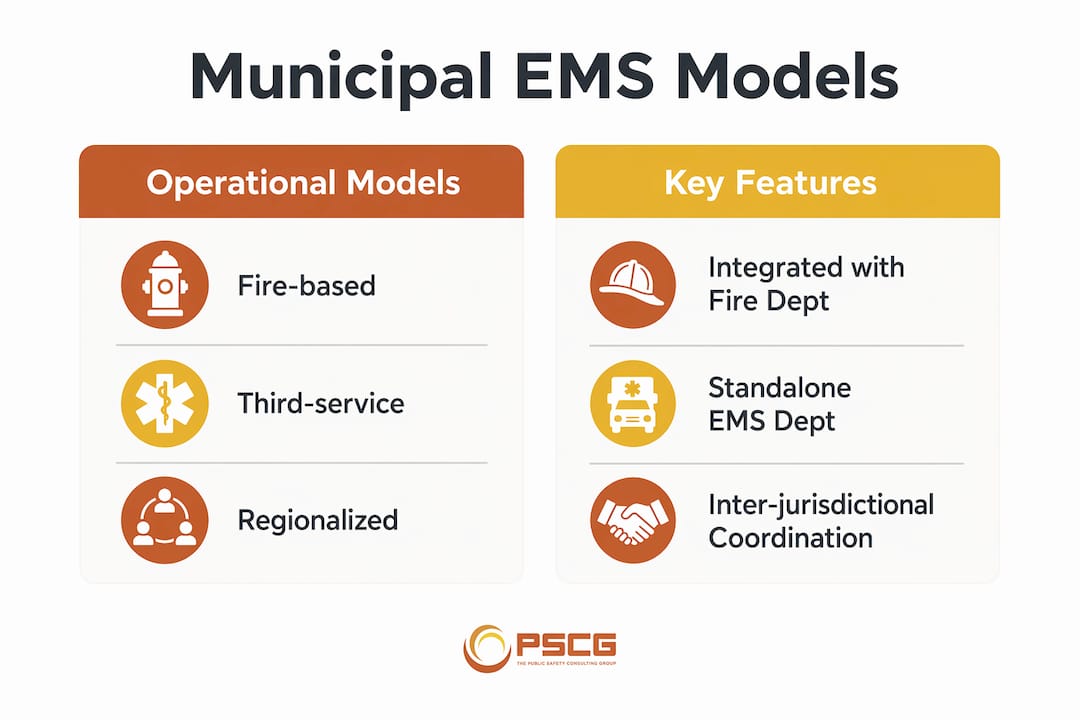
Third-service EMS operates as a standalone municipal department, separate from fire and police. This model gives EMS its own budget line, its own leadership chain, and its own performance metrics. Many mid-sized cities have adopted this structure to give EMS the administrative focus it requires as call volumes grow.
Regionalized EMS shares resources across multiple jurisdictions, often through inter-municipal agreements or county-level authorities. This model works well in areas where no single municipality can sustain a full-time ALS system independently.
| Model | Governance | Funding Reliance | Best Fit |
|---|---|---|---|
| Fire-based | Fire department command | Tax levy and fee revenue | Urban and suburban areas |
| Third-service | Standalone EMS department | Tax levy and fee revenue | Mid-size cities with high call volume |
| Regionalized | County or multi-jurisdictional authority | Shared tax levy and fees | Rural and low-density areas |
Key factors that differentiate these models include:
- Staffing flexibility: Third-service agencies can hire and promote based purely on EMS competencies.
- Deployment strategy: Regionalized systems can use System Status Management to position units dynamically.
- Community coverage: EMS agencies run by municipalities, fire departments, hospitals, or volunteers each serve distinct geographic and demographic profiles.
- Budget accountability: Standalone departments make EMS costs more visible to elected officials and taxpayers.
How is municipal EMS funded and governed?
Municipal EMS funding comes from two primary sources: local tax levies and ambulance fee collections regulated by the Centers for Medicare and Medicaid Services (CMS). Understanding how these sources interact is non-negotiable for any municipal budget planner.
CMS publishes annual ambulance fee schedules that reimburse transport rather than treat-and-release services. This creates a structural tension: clinically, the best outcome for a patient may be treatment on scene without transport, but the reimbursement system only pays when the ambulance moves. Municipal leaders need to account for this gap when projecting EMS revenue.
Governance follows a two-tier structure. State EMS agencies set broad regulations, licensing standards, and certification frameworks. Local and regional EMS agencies then tailor plans and coordination to their specific geography and risk profiles. This architecture supports both uniform standards and adaptable, region-specific delivery. Interstate compacts are beginning to address cross-state licensure, which matters for municipalities near state borders.
- Identify your tax levy baseline. Know exactly what percentage of EMS operating costs your municipality covers through general fund appropriations.
- Audit your CMS reimbursement capture rate. Many agencies leave significant Medicare and Medicaid revenue uncollected due to billing errors or incomplete documentation.
- Evaluate membership program viability. Programs like FireMed, offered by agencies such as Bend Fire and Rescue at approximately $60 per year, eliminate surprise bills for residents and stabilize agency revenue.
- Map your governance relationships. Clarify which decisions rest with the state EMS office versus your local medical director versus elected officials.
- Build a multi-year financial model. EMS costs rise with call volume, wage inflation, and equipment cycles. A single-year budget view is insufficient.
Pro Tip: Membership programs do more than generate revenue. They build community trust by removing the fear of a large ambulance bill, which increases willingness to call 911 when it matters most.
What clinical capabilities define modern municipal EMS?
Modern municipal EMS delivers advanced clinical care that would have been hospital-only territory two decades ago. The Spokane Fire Department’s EMS program illustrates this shift clearly. After implementing curriculum and procedural reforms, cardiac arrest survival rates improved from the mid-20% range to above 50%. That is not a marginal gain. It represents hundreds of lives saved annually in a single mid-sized city.
Municipal EMS paramedics now treat a wide range of patient populations on scene, including pediatric emergencies, obstetric complications, respiratory crises, and drug-related overdoses. The Spokane Fire Department’s EMS program equips paramedics with on-scene cardiology tools including 12-lead EKG, cardiac pacing, cardioversion, and defibrillation. These capabilities compress the time between symptom onset and definitive intervention, which is the single most important variable in cardiac and stroke outcomes.
Clinical advancement in municipal EMS depends on three pillars:
- Progressive protocols: Written clinical guidelines that authorize paramedics to perform advanced interventions without real-time physician contact.
- Continuous education: Regular simulation training, case review, and skills verification keep paramedics current with evolving standards.
- Community training programs: Bend Fire and Rescue and similar agencies offer public CPR classes, Stop the Bleed training, and AED registry programs. These programs extend the effective reach of EMS by creating trained lay responders in every neighborhood.
Technology and data play a growing role in quality improvement. Agencies that track response time benchmarks, clinical outcome metrics, and protocol compliance rates can identify performance gaps before they become patient safety issues. For more on implementing current standards, the 2026 clinical protocols guide from Thepscgroup provides a practical framework.
What strategic considerations should municipal leaders prioritize?
Effective municipal EMS strategy starts with aligning your deployment model to your actual call volume and geography, not to what neighboring jurisdictions do. A rural county with 8,000 annual calls has fundamentally different needs than an urban municipality with 80,000. The right EMS deployment model depends on honest data, not tradition.
Municipal leaders who treat EMS as a pure cost center miss the larger picture. EMS is a revenue-generating public safety function when billed and governed correctly. The gap between what agencies collect and what they are entitled to collect is often substantial, particularly in Medicare and Medicaid populations.
Key strategic priorities for municipal EMS leaders include:
- Performance gap analysis: Benchmark your response times, unit hour utilization, and clinical outcomes against comparable systems annually.
- Inter-agency collaboration: Coordinate with fire, police, public health, and hospital systems to avoid duplication and close care gaps.
- Governance clarity: Define who holds medical oversight authority and who controls operational decisions. Ambiguity here creates liability.
- Billing and reimbursement strategy: A dedicated reimbursement consulting relationship often pays for itself within the first year.
- Operational risk reduction: Identify the highest-risk call types in your system and build protocols, training, and supervision structures around them.
Pro Tip: The most common strategic mistake municipal leaders make is redesigning EMS structure during a budget crisis. Build your system design process into your annual planning cycle, not your emergency response to fiscal pressure.
Local EMS governance adapts state standards to community-specific challenges, balancing uniform regulation with geographic realities. The leaders who navigate this well are the ones who invest in understanding both levels of the governance architecture before making structural changes.
Key Takeaways
Municipal EMS is a government-managed emergency medical system that requires aligned operational models, sustainable funding, advanced clinical protocols, and clear governance to deliver reliable pre-hospital care.
| Point | Details |
|---|---|
| Three operational models | Fire-based, third-service, and regionalized systems each fit different community sizes and governance needs. |
| Dual funding structure | Tax levies and CMS ambulance fee schedules together fund municipal EMS, with reimbursement tied to transport. |
| Clinical advancement matters | Spokane’s protocol reforms improved cardiac arrest survival from the mid-20% range to above 50%. |
| Membership programs stabilize revenue | A yearly membership fee eliminates surprise bills for residents and improves fiscal predictability for agencies. |
| Governance is two-tiered | State agencies set standards; local agencies adapt them to geography, risk, and community need. |
The part of municipal EMS that most leaders underestimate
After working with municipal EMS systems across different governance structures and budget environments, the pattern I see most often is this: leaders understand the operational mechanics of EMS far better than they understand its governance architecture. They know what paramedics do. They do not always know who is legally responsible for the clinical decisions those paramedics make, or how that responsibility connects to the municipal budget process.
That gap creates real risk. When a municipality restructures its EMS system without clearly defining medical oversight authority, it exposes elected officials, department heads, and medical directors to liability that nobody anticipated. The clinical and the administrative cannot be separated in EMS. They are the same system.
The other thing I would push back on is the assumption that clinical innovation is primarily a training budget issue. The Spokane Fire Department’s cardiac arrest survival improvement did not come from buying new equipment. It came from reforming curriculum and procedures. That is a leadership and governance decision, not a procurement decision. Municipal leaders have more control over clinical outcomes than they typically realize.
The future of municipal EMS belongs to systems that treat data as a management tool, not a reporting obligation. Agencies that track outcome metrics, analyze protocol compliance, and share findings with their medical directors are the ones improving. The ones that collect data only for state reporting requirements are falling behind without knowing it.
— Mike
How Thepscgroup supports municipal EMS leaders
Municipal EMS systems face real pressure from every direction: rising call volumes, constrained budgets, evolving clinical standards, and complex governance relationships. Thepscgroup works directly with municipal leaders and emergency managers to address each of these challenges with structured, data-driven consulting.

From EMS system design to reimbursement optimization and leadership development, Thepscgroup brings the operational and strategic expertise that municipal EMS programs need to perform at their best. Our team has supported agencies across the full spectrum of municipal EMS models, and we understand the governance, clinical, and financial dimensions that determine long-term success. Contact us at thepscgroup.net to discuss how we can work alongside your team to strengthen your EMS system.
FAQ
What is the definition of municipal EMS?
Municipal EMS is emergency medical services operated by a city or county government to provide pre-hospital care and ambulance transport as a public safety function. It is funded through local tax levies and ambulance fee collections regulated by CMS.
What are the three main municipal EMS models?
The three primary models are fire-based EMS, third-service standalone EMS, and regionalized EMS. Each differs in governance structure, staffing approach, and funding reliance.
How does CMS reimbursement affect municipal EMS funding?
CMS ambulance fee schedules reimburse transport rather than treat-and-release services, which creates financial pressure on agencies that provide on-scene care without transport. This structural gap requires municipalities to supplement EMS revenue through tax levies or membership programs.
What clinical capabilities do municipal EMS paramedics have?
Municipal EMS paramedics perform advanced interventions including 12-lead EKG, cardiac pacing, cardioversion, and defibrillation on scene. Progressive clinical protocols authorize these interventions without requiring real-time physician contact.
Why do municipal EMS membership programs matter?
Membership programs, such as a yearly fee that covers out-of-pocket ambulance costs after insurance, eliminate surprise medical bills for residents and provide agencies with predictable revenue. Bend Fire and Rescue uses this model to stabilize both community trust and fiscal planning.