



TL;DR:
- Rising EMS costs and shifting reimbursements pressure municipal budgets, requiring strategic financial management. EMS agencies must understand cost structures, set appropriate reserves, optimize billing practices, and use data to ensure long-term financial health. Continuous analysis and transparent leadership are essential for sustainable EMS operations amid complex regional and payer variability.
Rising EMS costs and increasingly volatile reimbursement landscapes are placing serious pressure on municipal budgets nationwide. Labor costs have climbed, call volumes continue shifting, and payer behavior is changing faster than many agencies can adapt. For municipal leaders and emergency services planners, guessing your way through EMS financial management is no longer viable. This guide delivers a structured, practical approach to understanding your cost structure, setting appropriate reserves, optimizing reimbursement, and using data systematically to protect service delivery and long-term financial health.
Table of Contents
- Understand EMS cost structures and regional fee variability
- Set EMS reserve targets and manage financial risk
- Optimize EMS reimbursement: strategies for improved collections
- Track, analyze, and report: turning data into actionable EMS insights
- Why most EMS financial analysis falls short—and how to fix it
- Expert support for sustainable EMS financial analysis
- Frequently asked questions
Key Takeaways
| Point | Details |
|---|---|
| Know your EMS costs | Review national and local base fees along with transport costs to build accurate budgets. |
| Prioritize sufficient reserves | Municipal EMS agencies should target at least six months of operating expenses in reserves to manage risk. |
| Adapt to payer trends | Billing strategies should evolve with value-based care models and include Treat-in-Place billing at transport rates. |
| Data drives strategy | Systematic tracking, analysis, and reporting of financials enable better oversight and decision-making. |
Understand EMS cost structures and regional fee variability
To optimize your EMS finances, start with a clear grasp of baseline costs and the price differences that define your operating environment.
EMS financial planning begins with understanding what you are actually spending and billing compared to national benchmarks. Most municipal EMS budgets involve a mix of fixed costs, including personnel, vehicles, equipment, and facility overhead, and variable costs that shift with call volume. Neither category can be managed effectively without precise data.
Key cost drivers in municipal EMS operations include:
- Personnel salaries, benefits, and overtime (typically 60 to 80% of total budget)
- Medical supply costs per unit and per call
- Vehicle fleet maintenance and replacement cycles
- Technology infrastructure, including CAD and ePCR systems
- Training, certification, and continuing education
- Debt service on capital expenditures
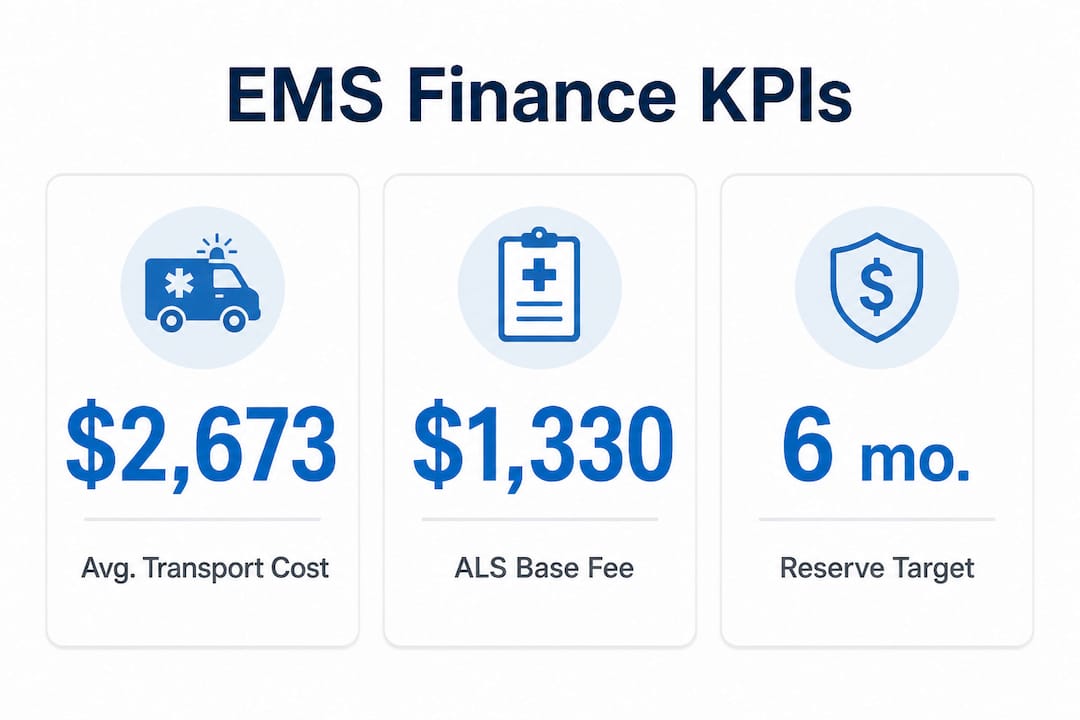
Understanding the billing side is equally important. National average base fees show ALS Emergency at $1,330 and BLS Emergency at $1,068, representing a 24.6% variation between service levels. The CMS Ground Ambulance Data Collection System (GADCS) reports an average transport cost of $2,673 per response. The gap between what agencies bill and what they actually collect remains one of the most important financial metrics in EMS.

| Service level | Avg. base fee | Avg. transport cost | Collection gap risk |
|---|---|---|---|
| ALS Emergency | $1,330 | $2,673 | High |
| BLS Emergency | $1,068 | $2,673 | Very High |
| ALS Non-emergency | $768 | $1,800 est. | Moderate |
Regional and system size variations compound this picture significantly. A rural volunteer-based system in the Midwest faces entirely different cost dynamics than a career urban agency in the Northeast. Factors like payer mix, Medicaid penetration rates, local wage scales, and mutual aid dependencies all affect the bottom line in ways that national averages cannot capture on their own. Following EMS best practices for your region is essential to establishing meaningful benchmarks.
When you map your actual expenses against your billing rates and collection ratios, patterns emerge that point directly to budget vulnerabilities and untapped revenue. Without this mapping, budget decisions rely on assumptions that may have been outdated years ago. Reviewing your EMS strategy guide framework can help you structure this analysis across departments and fiscal years.
Set EMS reserve targets and manage financial risk
Knowing your costs is just step one. Choosing the right financial safeguards ensures EMS can weather uncertainty without compromising service delivery.
Most municipal finance officers default to General Fund reserve guidelines when planning for EMS. That approach significantly underestimates the financial risk unique to emergency medical services. EMS operations face a combination of unpredictable call surges, delayed reimbursement cycles, equipment failures, and unfunded regulatory mandates that demand a more conservative reserve posture.
“ESD reserves should be at least 6 months of operating expenses due to unique risks. GFOA recommends 2 months for general governments, but EMS needs more.” ESD Reserve Study, 2025
This distinction is critical. The Government Finance Officers Association (GFOA) standard for general government reserve funds is roughly two months of operating expenses. For Emergency Services Districts and municipal EMS agencies, that threshold is dangerously insufficient.
| Entity type | Recommended reserve level | Key risk factors driving target |
|---|---|---|
| General government | 2 months operating expenses | Revenue shortfalls, budget timing |
| Municipal EMS agency | 6+ months operating expenses | Equipment failure, surge staffing, delayed billing |
| Volunteer/hybrid EMS | 6 to 9 months operating expenses | Membership decline, grant dependency |
A practical framework for calculating your EMS reserve target:
- Calculate your total average monthly operating expenditure, including all personnel, supplies, debt service, and overhead.
- Multiply by six to establish your minimum reserve floor.
- Add a supplemental buffer for any known upcoming capital expenditures within the next 24 months, such as ambulance replacements or station upgrades.
- Factor in your payer mix risk. A higher proportion of Medicaid or uninsured patients warrants a larger cushion due to slower and lower reimbursement rates.
- Review the reserve level annually and adjust based on actual collection performance and expenditure trends.
Pro Tip: When presenting reserve targets to elected officials or budget committees, frame the six-month standard within the context of equipment replacement cycles. A single advanced life support unit can cost $250,000 or more to replace. Pairing that number with actual reserve projections makes the case in terms any budget committee will understand.
Aligning your reserve strategy with strong EMS policy standards also helps you communicate the rationale to stakeholders who may not have an EMS background. Justifying reserves is not just a numbers exercise. It is a governance exercise. The clearer your methodology, the more likely your budget requests will succeed.
Optimize EMS reimbursement: strategies for improved collections
Even with healthy reserves, maximizing steady revenue depends on how and what you bill. Reimbursement optimization is where many agencies leave significant money on the table.
EMS billing is not a simple fee-for-service transaction. It involves a complex web of payer contracts, coverage determinations, medical necessity documentation, coding accuracy, and appeals processes. Agencies that treat billing as a back-office administrative function rather than a strategic revenue activity consistently underperform on collections.
Steps to improve your reimbursement performance:
- Conduct a full payer mix audit. Identify your current split between Medicare, Medicaid, commercial insurance, and self-pay patients. Each category carries different collection rates and documentation requirements.
- Review your coding practices for ALS vs. BLS differentiation. Miscoding patient encounters, even unintentionally, is a leading cause of underpayment and audit risk.
- Evaluate your documentation workflows. Incomplete or inconsistent Patient Care Reports (PCRs) directly reduce reimbursement and increase denial rates.
- Assess your denial management process. Are denials being tracked by payer and reason code? Agencies without a structured appeal workflow routinely write off recoverable revenue.
- Review your Treat-in-Place (TIP) billing practices immediately.
On TIP billing specifically, the data is striking. Only 11% of agencies bill TIP at transport rates, despite clear evidence that doing so improves collections and aligns with payer trends toward value-based care. TIP encounters, where a patient is treated on scene and not transported, are often billed at lower rates or not billed at all. That is a direct, avoidable revenue loss.
The shift toward value-based care strategies in payer contracting is not a distant future scenario. It is already influencing how Medicare Advantage and commercial payers view EMS encounters. Agencies that position their billing practices to reflect outcomes-based documentation will be better positioned as these trends accelerate.
Pro Tip: Partnering with experienced reimbursement consultants who specialize in EMS, rather than general healthcare billing firms, consistently produces better results. EMS coding nuances, ground transport rules, and state-specific Medicaid policies require specialized expertise that generalist billing vendors often lack.
The financial return on optimizing reimbursement often exceeds what agencies can gain through budget cuts alone. A 5 to 8% improvement in net collection rate on a $5 million billing program translates to $250,000 to $400,000 in recovered annual revenue. That is real money that supports staffing, equipment, and sustainability.
Track, analyze, and report: turning data into actionable EMS insights
Sound billing practices are only as effective as the oversight behind them. Here is how to systematize your agency’s financial intelligence.
Data collection in EMS is not new. What remains inconsistent across many municipal agencies is the structured analysis and reporting of that data in ways that actually drive decisions. Too often, financial data sits in disconnected systems, reviewed only at budget time rather than as a continuous management tool.
Build your EMS financial data monitoring framework around these core metrics:
- Monthly transport volume by service level (ALS, BLS, SCT)
- Payer mix percentage breakdown, updated quarterly
- Average charge per transport vs. average net collection per transport
- Denial rate by payer and denial reason code
- Days in Accounts Receivable (A/R), tracked at 30, 60, and 90-day intervals
- Reserve fund balance as a percentage of monthly operating expenses
- Cost per call, including full loaded costs with overhead
The CMS GADCS average transport cost of $2,673 per response gives you a powerful national comparison point. If your cost per call is significantly above or below that figure, you need to understand why.
| Financial metric | Tracking frequency | Benchmark target |
|---|---|---|
| Cost per transport | Monthly | Compare to CMS GADCS $2,673 baseline |
| Net collection rate | Monthly | 65 to 75%+ depending on payer mix |
| Denial rate | Monthly | Below 5% of submitted claims |
| Days in A/R | Monthly | Under 45 days |
| Reserve fund balance | Quarterly | Minimum 6 months operating expenses |
Building feedback loops between your operations staff and finance team is essential. When run data, response patterns, or staffing anomalies go unshared between departments, financial surprises become more frequent. A weekly or bi-weekly financial dashboard shared between EMS leadership and the municipal finance office creates the accountability structure that prevents small issues from becoming large deficits.
Pro Tip: Use quarterly financial review meetings to benchmark your agency’s key metrics against comparable systems. Working with a quality improvement consulting partner can accelerate this process by establishing the right peer comparison groups and identifying specific performance gaps faster than internal review alone.
Regular public reporting, even at a high level, increases community trust and political support for EMS funding requests. When residents and elected officials can see transparent financial data, they are more likely to support rate adjustments, capital levies, and staff investments.
Why most EMS financial analysis falls short—and how to fix it
We have covered the tactical steps. Now it is time for an unfiltered look at what truly moves the needle in EMS finance.
The most common failure we see in EMS financial analysis is not a lack of data. It is a lack of willingness to act on what the data reveals. Municipal EMS leaders often have access to the reports, dashboards, and benchmarks they need. What holds them back is the institutional resistance to surfacing uncomfortable findings, especially in front of elected bodies or union leadership.
Agencies that break this pattern share a consistent trait: their leadership treats financial transparency as a strength, not a liability. When an agency proactively presents its funding gap, explains the connection between reimbursement rates and service sustainability, and brings specific corrective strategies to the table, it almost always receives a more favorable response than agencies that present problems without context or solutions.
Another widespread issue is the tendency to optimize incrementally when structural change is what the situation requires. Tweaking billing codes, adjusting a line item here and there, and hoping reimbursement trends improve on their own is not a financial strategy. It is a deferral. Agencies that have made meaningful financial improvements have done so by conducting honest structural assessments and then executing the changes those assessments recommend, even when those changes were politically or operationally inconvenient.
We also see a pattern where strategic EMS planning is treated as a one-time event rather than an ongoing discipline. The agencies with the most sustainable financial positions revisit their strategy annually, updating assumptions, refreshing benchmarks, and recalibrating priorities in response to actual performance data. Treat financial planning as a continuous cycle, not a deliverable you check off every five years.
The hard truth is that EMS financial sustainability requires leadership courage. It requires saying clearly that current funding is insufficient, that reserves are below safe thresholds, or that billing practices have left recoverable revenue uncollected. Those conversations are difficult. They are also exactly what your community depends on you to have.
Expert support for sustainable EMS financial analysis
For leaders ready to implement and sustain best practices, experienced partners can accelerate your progress significantly.
At The Public Safety Consulting Group, we work alongside municipal EMS leaders to translate financial data into actionable strategy. Whether your agency needs a complete reimbursement audit, a reserve framework that will hold up to budget scrutiny, or a comprehensive EMS strategy guide review, our team brings the EMS-specific expertise to move you forward.

Our approach combines system design consulting with financial analysis to give you the full picture, not just the billing numbers in isolation. We also connect you with specialized reimbursement consultants who understand EMS coding, payer contracts, and regulatory nuance at the level your agency deserves. Contact us today to schedule a consultation and take the first step toward a financially resilient EMS system your community can count on.
Frequently asked questions
How much should a municipal EMS agency keep in reserves?
Experts recommend EMS-specific reserves of at least six months of operating expenses, significantly above the two-month standard GFOA recommends for general government entities, due to the unique financial risks EMS operations face.
What are the average costs and billing rates for EMS transports?
National average base fees are $1,330 for ALS Emergency and $1,068 for BLS Emergency, while the CMS GADCS reports an average transport cost of $2,673, though regional variation can push these figures significantly higher or lower.
Why do so few agencies bill Treat-in-Place (TIP) at transport rates?
Only 11% of agencies currently bill TIP at transport rates, leaving substantial recoverable revenue uncollected despite growing payer movement toward value-based care models that support this approach.
What data should EMS agencies track for meaningful financial analysis?
Agencies should track base and variable cost per call, payer mix, transport volume by service level, net collection rate, denial rate by reason code, days in accounts receivable, and reserve fund balance as a percentage of monthly operating expenses.
Recommended
- Municipal EMS Best Practices: Optimize Response And Impact
- How To Assess Municipal EMS Needs For Better Response
- Optimize Municipal EMS: Consulting Strategies For Better Public Safety
- 5 Key Advantages Of EMS Consulting For Public Safety
- Boost financial integrity with ethical accounting practices | Ready Accounting