



TL;DR:
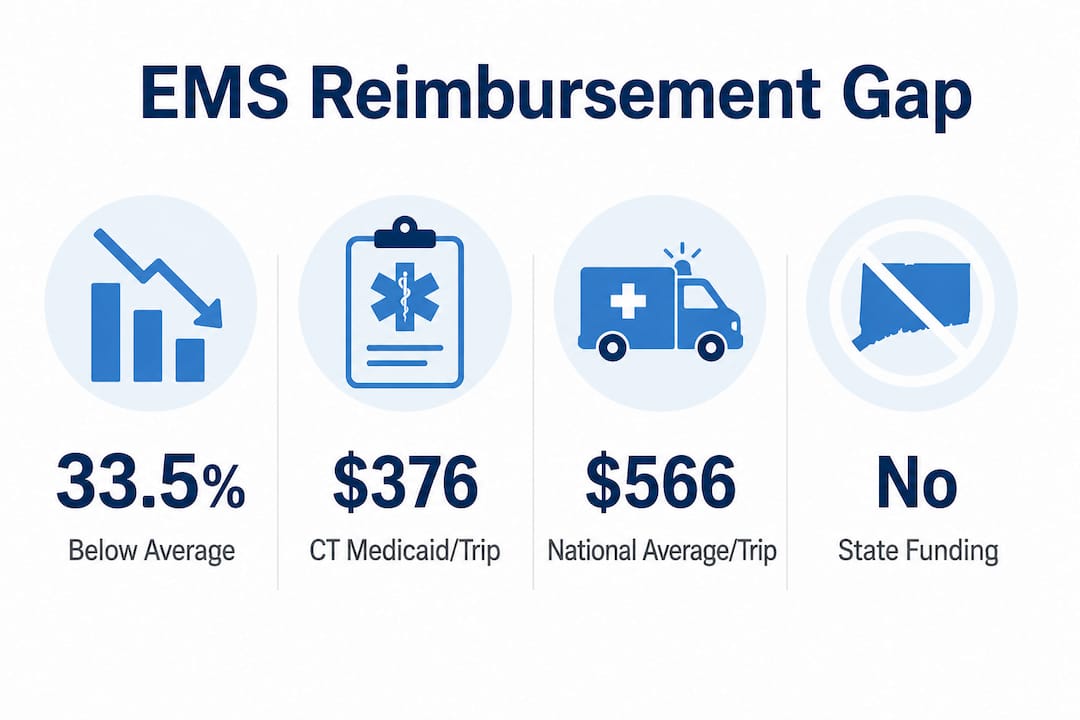
- Connecticut EMS departments have reimbursement rates about 33.5% below the national average, relying heavily on local taxes.
- Improving billing accuracy and policy advocacy are essential to building financial resilience amid ongoing Medicaid funding shortfalls.
- A combined focus on operational process and strategic funding efforts is necessary for long-term sustainability.
Connecticut’s municipal EMS departments are caught in a funding structure that consistently undercuts their operational capacity. Despite Medicaid rate increases of 10% in 2021 and 20% in FY2025, Connecticut still reimburses EMS at rates approximately 33.5% below the national Medicaid average, leaving municipalities to absorb the difference through local tax revenue. The misconception that these recent increases have resolved the gap is dangerous for leaders making long-term budget decisions. This article presents practical, consulting-driven strategies that municipal leaders and EMS directors in Connecticut can apply right now to improve billing accuracy, maximize reimbursements, and build more resilient funding models.
Table of Contents
- Understanding the Connecticut EMS reimbursement challenge
- How consulting improves EMS billing and reimbursement
- Practical strategies to maximize EMS reimbursements
- Ensuring clarity and sustainability in EMS billing processes
- The uncomfortable truth most guides miss about EMS reimbursement in Connecticut
- Explore professional EMS consulting solutions for Connecticut municipalities
- Frequently asked questions
Key Takeaways
| Point | Details |
|---|---|
| Medicaid reimbursement gap | Connecticut EMS rates are 33.5% below national averages, posing major funding challenges. |
| Consulting expertise | EMS billing consultants drive workflow optimization, compliance, and strategic advocacy for higher reimbursements. |
| Effective strategies | Accurate documentation, staff training, and regular audits are core to maximizing Medicaid reimbursements. |
| Sustainable improvement | Ongoing planning, data-driven advocacy, and consultant support help maintain long-term EMS funding quality. |
| Policy engagement | Municipal leaders must prioritize EMS policy advocacy alongside operational improvements for lasting impact. |
Understanding the Connecticut EMS reimbursement challenge
To address the problem effectively, you first need to understand exactly where the funding model breaks down. Connecticut’s EMS reimbursement environment is shaped by a combination of low Medicaid rates, no dedicated state EMS funding, and a heavy reliance on municipal tax revenue. This creates a financial model that is both underpowered and fragile.
The state’s Medicaid program, known as HUSKY, reimburses below national averages, and even with the recent rate adjustments, the gap has not closed enough to protect municipalities from serious revenue shortfalls. When you factor in that a large percentage of ambulance transports involve HUSKY-enrolled patients, the cumulative financial impact across a department is significant.
| Reimbursement metric | Connecticut rate | National average |
|---|---|---|
| Medicaid EMS reimbursement level | ~33.5% below average | Baseline |
| FY2025 rate increase applied | 20% | Varies by state |
| Pre-2021 last increase before reform | Prior period | Multiple states higher |
| Dedicated state EMS funding | None | Varies |
Beyond raw reimbursement numbers, the State EMS Plan 2023-2028 acknowledges that rural Connecticut EMS departments face compounding pressures. Longer response times, smaller patient volumes, and thinner tax bases make rural agencies especially vulnerable to any reduction in Medicaid reimbursement. Statewide, the absence of a dedicated EMS funding mechanism means that local governments bear the entire burden when state Medicaid rates fall short.
Key structural vulnerabilities for Connecticut EMS funding include:
- No dedicated state appropriation for municipal EMS operations
- High Medicaid patient volume creating significant payer-mix risk
- Local tax revenue serving as the default backstop for reimbursement shortfalls
- Rural agencies facing both lower call volumes and higher per-unit operational costs
- Federal Medicaid policy shifts creating unpredictable year-to-year revenue changes
“The challenge isn’t simply that reimbursement rates are low. It’s that the entire funding architecture places the financial risk squarely on municipalities, with very little state-level cushion.”
Building on this context, let’s explore how consulting can address these reimbursement challenges directly and give your department a stronger financial position. Reviewing EMS response impact best practices alongside reimbursement strategy creates a more complete picture of what operational excellence actually looks like in a Connecticut context. Understanding the EMS public policy landscape is equally critical before moving into operational fixes.
How consulting improves EMS billing and reimbursement
Consulting support is not a luxury reserved for large urban departments. For Connecticut municipalities of any size, an experienced EMS consulting firm performs a targeted set of functions that directly improve billing outcomes and reimbursement recovery. The role of reimbursement consultants in EMS spans four primary areas: billing workflow analysis, compliance and documentation improvement, alternative funding identification, and policy advocacy support.
Consider how the two approaches compare when a municipality handles billing internally versus with consulting support:
| Capability area | Internal management only | With consulting support |
|---|---|---|
| Billing workflow analysis | Periodic, often reactive | Systematic, scheduled audits |
| Compliance monitoring | Dependent on staff awareness | Protocol-driven and current |
| Documentation accuracy | Variable by crew and shift | Standardized across all units |
| Alternative funding pursuit | Limited capacity | Structured grant and advocacy strategy |
| Policy engagement | Rarely formalized | Data-backed and consistent |
The value consultants deliver is clearest in billing workflow analysis. CT EMS is vulnerable to Medicaid volatility, and internal billing teams frequently lack the bandwidth to keep pace with regulatory updates. Consultants bring dedicated expertise and external perspective that internal teams cannot replicate, especially when Medicaid billing rules shift at the federal or state level.
Here is how a structured consulting engagement typically improves reimbursement outcomes in sequence:
- Initial billing audit — Review all active billing codes, denial rates, and payer mix to establish a clear performance baseline.
- Workflow mapping — Identify specific steps in the documentation and submission process where errors or delays occur.
- Compliance gap analysis — Compare current practices against current Medicaid requirements and Centers for Medicare and Medicaid Services (CMS) regulations.
- Staff training — Deliver targeted training on documentation accuracy, coding updates, and denial management procedures.
- Alternative funding identification — Research state and federal grant programs, supplemental Medicaid funding mechanisms, and cost-reporting opportunities.
- Advocacy data preparation — Compile cost-per-call data and payer-mix reports that can support requests for higher reimbursement rates at the state level.
Pro Tip: Municipalities that document the full cost per response, including labor, equipment, and overhead, create the most persuasive case for rate advocacy. Without detailed cost data, reimbursement arguments lack the credibility they need to move policy.
Explore consulting strategies for EMS and the advantages of EMS consulting to see how these frameworks apply to Connecticut departments across different call volumes and service areas.
Practical strategies to maximize EMS reimbursements
Knowing that a gap exists is different from knowing how to close it. The following strategies reflect what works in practice for Connecticut EMS departments seeking to improve their reimbursement performance, particularly in a payer environment dominated by Medicaid.

Connecticut cities with higher Medicaid patient volumes have a direct stake in documentation quality. Hartford and New Haven receive 40-50% of their reimbursements from Medicaid, which means that billing inaccuracies in those payer claims have an outsized financial impact. Even a modest reduction in denial rates can translate into hundreds of thousands of dollars in recovered revenue annually for a high-volume department.
Key documentation and billing practices that directly affect reimbursement rates include:
- Medical necessity documentation — Every patient care report must clearly support the medical necessity of the transport level billed, whether BLS (Basic Life Support) or ALS (Advanced Life Support). Vague or incomplete narratives are the leading cause of Medicaid claim denials.
- Accurate level-of-service coding — Billing ALS when BLS criteria were met, or vice versa, creates compliance risk and denial exposure. Regular coding calibration sessions with clinical staff reduce this risk.
- Timely claim submission — Medicaid has strict timely filing requirements. Departments that allow claims to age past submission windows forfeit recoverable revenue entirely.
- Denial management protocols — Every denied claim should enter a structured appeals process. Without a formal denial management workflow, departments often fail to recover revenue that would otherwise be collectible.
- Continuous regulatory monitoring — Connecticut Medicaid billing requirements update periodically. Departments without a systematic process for tracking regulatory changes are often billing under outdated rules.
The numbered sequence below outlines the quarterly reimbursement improvement cycle we recommend for Connecticut EMS departments:
- Pull denial rate and reason code reports for the prior quarter.
- Identify the top three denial categories by volume and dollar value.
- Trace each denial category back to its root cause in documentation, coding, or submission timing.
- Deliver targeted training to address identified root causes before the next billing cycle.
- Resubmit corrected claims within the applicable Medicaid appeals window.
- Track resolution rates to measure whether corrective actions are working.
Pro Tip: Establish a dedicated denial management log that tracks each denied claim through to resolution. Departments that treat denials as isolated events rather than systemic indicators miss repeating patterns that cost them revenue quarter after quarter.
Supporting your EMS quality improvement efforts with disciplined billing processes creates alignment between clinical excellence and financial performance. The two are not separate concerns. Strong documentation supports both patient care quality and reimbursement accuracy simultaneously. For longer-term planning, smart EMS growth strategies emphasize building financial resilience before investing in additional resources.
Ensuring clarity and sustainability in EMS billing processes
One-time improvements are not enough. Connecticut EMS departments need billing and reimbursement processes that hold up over time, particularly given the ongoing volatility of Medicaid funding at both the state and federal level. Sustainability requires measurement, governance, and a proactive posture toward regulatory and policy change.
Hartford and New Haven receiving 40-50% of reimbursements from Medicaid illustrates just how exposed municipal EMS can be to policy shifts. When state or federal Medicaid rules change, departments without strong internal controls and clear key performance indicators (KPIs) are often the last to recognize the financial impact.
Critical KPIs for sustainable EMS billing performance:
- Overall claim denial rate (target below 5% for mature billing programs)
- First-pass claim acceptance rate by payer type
- Average days to payment by payer
- Revenue collected per transport by service level (BLS, ALS1, ALS2, SCT)
- Percentage of denied claims resolved through appeals
- Timeliness of claim submission relative to date of service
- Documentation completeness score per crew and per shift
Quarterly audits are the most reliable mechanism for maintaining billing integrity over time. A structured audit process examines a random sample of patient care reports, matches documentation against billed service levels, and confirms compliance with current Medicaid requirements. Departments that conduct audits annually, or only when problems surface, tend to accumulate billing errors that compound into larger denial clusters.
The State EMS Plan 2023-2028 is clear that no dedicated state EMS funding stream exists in Connecticut. This reality means municipal EMS leaders must treat every available reimbursement dollar as mission-critical revenue. Relying on local tax appropriations to make up shortfalls is not a strategy. It is a dependency that limits your department’s ability to invest in staffing, equipment, and training.
Strategic planning that accounts for Medicaid rate volatility should include:
- A reserve funding mechanism for years when reimbursements decline
- Annual payer-mix analysis to project revenue under multiple rate scenarios
- Formal engagement with state EMS leadership and legislative contacts to stay ahead of policy changes
- Integration of billing performance data into annual budget presentations to municipal leadership
Connecting billing sustainability to broader EMS strategic planning ensures that your financial processes support your department’s operational goals rather than operating in isolation. Departments that treat billing as a support function divorced from strategic planning consistently underperform those that integrate financial management into every layer of EMS governance. For departments exploring cross-agency models, fire department consulting frameworks offer relevant parallels in managing shared service cost structures.
The uncomfortable truth most guides miss about EMS reimbursement in Connecticut
Here is what most consulting guides and industry publications will not say directly: optimizing your billing process is necessary, but it is not sufficient. Even a world-class billing operation cannot overcome a reimbursement rate that is 33.5% below national average. Process improvement recovers what you are owed. Policy advocacy changes what you are paid.
We have seen Connecticut municipalities invest heavily in billing workflow improvements, achieve meaningful reductions in denial rates, and still face structural deficits because the underlying rates are simply too low. That is not a failure of execution. It is a failure of strategy if advocacy does not run parallel to operations.
Municipal EMS leaders who limit their focus to internal process improvement are fighting half the battle. The other half is showing up at the table when Medicaid rate policy is being shaped, backed by transparent, credible cost data that makes your case undeniable. The State EMS Plan acknowledges this gap, and it calls for exactly this kind of coordinated, data-driven engagement. Without it, rate increases remain incremental and insufficient.
The most effective Connecticut EMS directors we work alongside operate on two tracks simultaneously. Track one is operational: billing accuracy, compliance, documentation quality, and denial management. Track two is advocacy: compiling cost-per-call data, engaging with state EMS leadership, building coalitions with peer municipalities, and making the financial case for sustainable rate reform. Neither track works without the other.
EMS public policy advocacy is not a distraction from running your department. It is an extension of your responsibility to ensure the long-term viability of the services your community depends on. The EMS response advocacy best practices framework we use reinforces this connection between operational performance and policy engagement, treating them as complementary rather than competing priorities.
Explore professional EMS consulting solutions for Connecticut municipalities
Closing the reimbursement gap in Connecticut requires both technical expertise and strategic partnership. If your department is ready to move from identifying the problem to solving it, the resources and consulting support available through PSCG are built specifically for Connecticut municipal EMS leaders facing these exact challenges.
Our municipal EMS strategy guide provides a structured framework for aligning your billing, staffing, and operational decisions with the financial realities of Connecticut’s payer environment. If you are ready to work with experienced EMS reimbursement consultants, we can help you audit your current processes, identify recoverable revenue, and build a sustainable billing program that holds up through Medicaid volatility. For departments considering broader structural changes, our EMS system design consulting services address the full operational and financial architecture of high-performing municipal EMS. Let’s work together to build a stronger, more financially resilient EMS system for your community.
Frequently asked questions
What are the biggest reimbursement challenges for Connecticut EMS?
Connecticut EMS faces Medicaid rates approximately 33.5% below the national average, with no dedicated state funding and a payer mix that makes Medicaid reimbursement levels critical to department financial health.
How can consulting help increase EMS reimbursement rates?
Consulting supports municipalities by improving billing workflow, strengthening compliance, and building the cost data infrastructure needed to advocate effectively for higher Medicaid reimbursement rates at the state level.
What are practical strategies EMS directors can implement right now?
Improve documentation specificity on every patient care report, establish a formal denial management process, and conduct quarterly compliance audits to maximize recoverable Medicaid revenue. Cities like Hartford and New Haven, where 40-50% of reimbursements come from Medicaid, demonstrate how high the stakes are for billing accuracy.
Why are rural EMS departments especially affected by funding gaps?
Rural Connecticut EMS agencies face longer response times and funding gaps driven by lower call volumes, higher per-unit costs, and complete reliance on local tax appropriations with no state-level funding backstop available to offset Medicaid shortfalls.