



TL;DR:
- Most EMS agencies are operating at a financial loss, losing over $1,000 per call on average due to a significant cost-to-reimbursement gap. Accurate cost analysis, separating fixed and marginal costs and accounting for non-transport and readiness expenses, is essential for sustainable funding and effective system planning. Regularly updating these analyses ensures informed decision-making, appropriate rate-setting, and long-term community access to emergency medical services.
Most EMS agencies are operating in the red, and few municipal leaders fully realize it until a budget crisis forces the issue. A rigorous ambulance service cost analysis reveals a sobering reality: agencies lose over $1,000 per call on average, with a cost-to-reimbursement gap exceeding 56% across 7,387 ambulance agencies studied in the Medicare Ground Ambulance Data Collection System. For healthcare administrators and city officials responsible for EMS budgeting, understanding where that gap originates and how to measure it accurately is the foundation of every sound funding and deployment decision.
Table of Contents
- Key takeaways
- Ambulance service cost analysis: the key cost drivers
- How to conduct a thorough cost analysis
- Common mistakes that undermine ambulance cost evaluations
- Interpreting results to drive funding and system decisions
- My perspective on getting ambulance cost analysis right
- How Thepscgroup can support your EMS cost and system analysis
- FAQ
Key takeaways
| Point | Details |
|---|---|
| Labor dominates EMS costs | Staffing represents over 70% of operating costs, making workforce decisions the highest-leverage financial variable. |
| Readiness costs are non-negotiable | Fixed standby costs exist whether or not a unit transports a single patient, and they must be fully accounted for in any analysis. |
| Reimbursement ≠ revenue collected | Charges, allowed amounts, and actual cash collected are three different numbers; conflating them produces dangerously flawed forecasts. |
| Payer mix shapes financial outcomes | Medicare Advantage growth is compressing net revenue below Medicare Part B levels for many agencies. |
| Cost analysis drives policy | Accurate cost data is the prerequisite for defensible rate setting, subsidy requests, and long-term EMS system sustainability. |
Ambulance service cost analysis: the key cost drivers
Before you can conduct a credible analysis, you need a clear map of what drives costs in an EMS operation. These are not simple line items. They fall into structural categories that behave very differently under financial pressure.
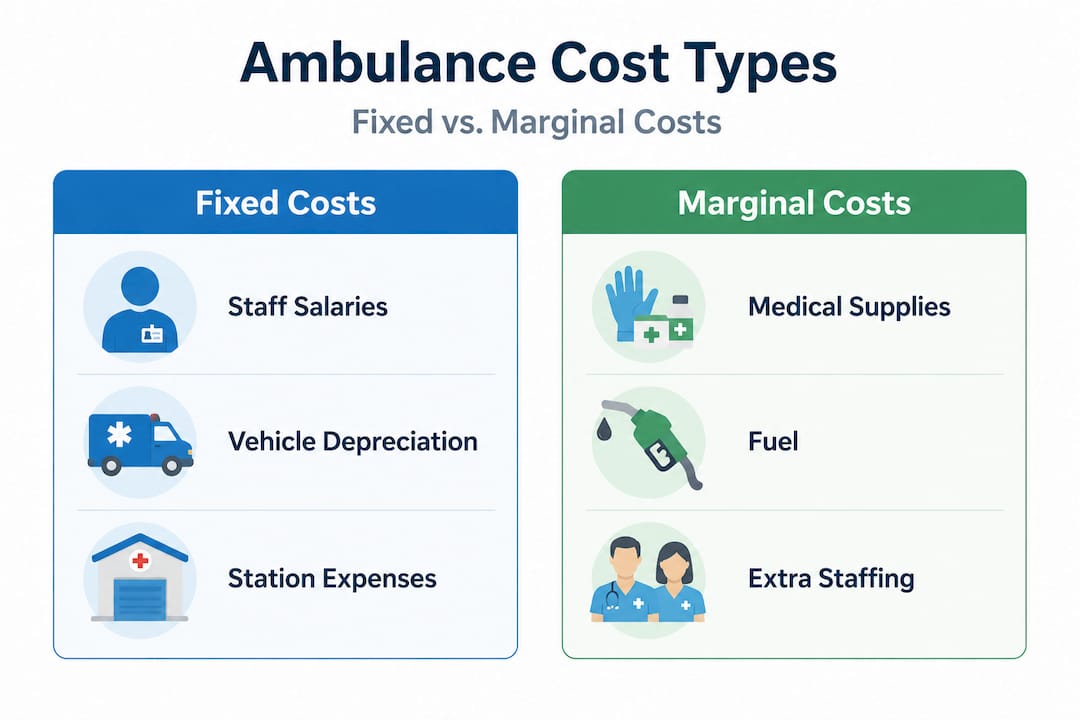
Fixed versus marginal costs
Fixed costs are the expenses your agency incurs simply by existing: station leases, vehicle depreciation, 24/7 staffing coverage, dispatch infrastructure, and administrative overhead. These costs do not decrease when call volume drops. Readiness costs create gaps between revenue and expenses even in periods of low activity, which is why modeling EMS finances on transport volume alone produces chronic underestimates.
Marginal costs, by contrast, are the incremental expenses tied to each call: medical supplies consumed, fuel, additional overtime if a unit is committed past shift end, and equipment wear. Separating fixed from marginal costs is not an academic exercise. It is the only way to understand whether adding call volume genuinely improves your financial position or simply adds marginal costs to a fixed cost base that never changes.
The BLS versus ALS cost distinction
ALS requires higher personnel intensity and correspondingly higher costs than Basic Life Support. An ALS response typically requires at least one paramedic, more advanced equipment on the unit, and more intensive maintenance and restocking protocols. A BLS response, staffed with EMTs, carries a lower marginal cost per call but still draws from the same fixed cost pool.
This distinction matters enormously when your payer mix is shifting or when you are modeling different deployment scenarios. An agency running primarily ALS units in a low-acuity call environment is structurally expensive relative to its reimbursable workload.
Cost category benchmarks
The table below summarizes the primary cost drivers and typical ranges based on publicly available data and industry reporting:
| Cost category | Share of total operating costs | Notes |
|---|---|---|
| Labor (wages, benefits, overtime) | 70%+ | Labor exceeded 70% in expanded GADCS cohort data |
| Vehicle costs (depreciation, fuel, maintenance) | 8–12% | Varies significantly by fleet age and geography |
| Medical supplies and equipment | 5–8% | Higher for ALS-heavy systems |
| Overhead (admin, dispatch, facilities) | 10–15% | Often underreported in agency self-assessments |
| Capital replacement and readiness | Variable | Frequently omitted from annual operating budgets |
Pro Tip: When building your cost model, include a readiness cost allocation for non-transport calls and canceled responses. These calls still consume staff time and vehicle availability and represent real costs with zero offsetting revenue.
Geographic and volume factors add another layer of complexity. Rural agencies with lower call density spread fixed costs across fewer transports, making their per-call cost significantly higher than urban counterparts. Transport costs range from $414 to $2,317 depending on care level and destination, with median EMS bills reaching $3,570 in some studies. These are not outliers. They reflect genuine cost variability driven by geography, acuity, and operational model.

How to conduct a thorough cost analysis
A rigorous analysis follows a structured sequence. Skipping steps or working with unvalidated data produces results that will not survive scrutiny from a city council, a state regulator, or a federal auditor.
Collect and validate service volume data. Pull two to three years of Computer-Aided Dispatch records and cross-reference them against billing records. You need accurate call counts by type: ALS transport, BLS transport, non-transport, and mutual aid.
Separate costs by service level and unit type. Do not lump ALS and BLS costs together. Build separate cost models for each service tier so you can assess subsidy needs and rate structures with precision.
Incorporate the CMS Ambulance Fee Schedule. Medicare reimbursements are set by the CMS Ambulance Fee Schedule, which controls Part B payments by ZIP code and provider type. Pull the public use files for your service area and calculate your Medicare allowed amounts per transport category.
Account for non-transport calls. Calls that do not result in a transport generate costs but no direct reimbursement. Quantify these calls and allocate a proportional share of fixed costs to them in your model.
Adjust for your payer mix. Identify the percentage of your transports billed to Medicare, Medicaid, Medicare Advantage, commercial insurance, and self-pay. Apply expected collection rates to each category to project realistic net revenue, not gross charges.
Reconcile charges against actual collected revenue. Reconciling allowed charges against actual reimbursements is where many analyses go wrong. Gross charges mean almost nothing. Your subsidy calculation must be built on net cash collected versus total operating cost.
Pro Tip: Run your analysis using conservative collection assumptions. Agencies consistently overestimate Medicaid recovery rates and underestimate bad debt. A conservative model protects your funding request from being challenged on unrealistic revenue projections.
Analysis steps summary
| Step | Action required | Output |
|---|---|---|
| 1. Volume validation | Cross-reference CAD and billing data | Verified call counts by type |
| 2. Cost separation | Segregate BLS, ALS, and fixed costs | Per-call cost by service level |
| 3. Fee schedule integration | Apply CMS Ambulance Fee Schedule | Medicare allowed amounts by ZIP |
| 4. Non-transport accounting | Allocate costs to non-billable calls | Full cost visibility |
| 5. Payer mix adjustment | Apply realistic collection rates by payer | Projected net revenue |
| 6. Revenue reconciliation | Compare net revenue to total cost | True subsidy gap |
Administrators who want a deeper framework for this work can explore EMS financial analysis guidance that addresses the specific modeling challenges municipal agencies face.
Common mistakes that undermine ambulance cost evaluations
Even experienced finance teams make predictable errors when analyzing ambulance expenses. Recognizing these pitfalls before you begin is what separates a defensible analysis from one that gets sent back for revision.
Confusing charges with revenue. Billed charges are a starting point, not a financial reality. Allowed amounts, contractual adjustments, and actual cash collected are each different figures. Using gross charges to justify a subsidy request is a credibility risk.
Ignoring readiness costs. Agencies that model costs purely on transported calls systematically underreport their true financial burden. 24/7 readiness obligations drive significant fixed costs that exist regardless of transport volume.
Underestimating Medicare Advantage shortfalls. Medicare Advantage reimbursements trend below Part B levels despite greater administrative complexity. As MA enrollment grows, agencies relying on historical Medicare revenue assumptions are increasingly underprojecting their shortfalls.
Blending BLS and ALS cost structures. Running a single blended cost model obscures the distinct financial profiles of each service tier and prevents accurate rate setting or deployment modeling.
Underestimating geography’s effect. Low-volume rural service areas carry disproportionately high per-call costs. Applying urban or national averages to a rural or semi-rural agency will produce a cost estimate that is too low.
Accuracy in EMS cost analysis is not a technical nicety. It is the foundation of your agency’s funding strategy, your rate-setting credibility, and your community’s long-term access to emergency medical services.
Pro Tip: Before finalizing your analysis, have your billing team reconcile the last 24 months of remittance data against your general ledger. Discrepancies between what was billed, what was allowed, and what was deposited are more common than most administrators expect, and they will distort your model if left unresolved.
The role of reimbursement consultants in catching these errors early is often underappreciated until an agency has already submitted a flawed funding proposal.
Interpreting results to drive funding and system decisions
A completed cost analysis is only valuable if it informs decisions. The data you collect must translate into rate structures, subsidy models, and operational adjustments that hold up over time.
Aligning results with reimbursement frameworks
Financial sustainability of EMS depends on the interplay of call volume, acuity, and payer mix, not just transport numbers. A cost analysis that isolates only one dimension of that triangle will produce incomplete guidance. Administrators must actively track CMS Ambulance Fee Schedule updates and incorporate those changes into annual financial planning models, because reimbursement rates adjust annually and static models go stale quickly.
Designing sustainable rate structures and subsidy models
Once you know your true per-call cost by service level, you can build a rate structure that reflects actual financial requirements rather than arbitrary fee schedules set years ago. The comparison below illustrates two common funding approaches:
| Funding approach | Strengths | Limitations |
|---|---|---|
| Fee-for-service with rate adjustments | Directly ties revenue to utilization | Still leaves uncovered fixed costs in low-volume periods |
| Readiness subsidy plus transport fees | Covers fixed cost base regardless of call volume | Requires political support and recurring appropriations |
| Municipal tax levy support | Provides stable, predictable revenue | Politically sensitive; may face resistance without data support |
| Contract services with municipalities | Guarantees minimum revenue per contract term | Requires robust cost data to negotiate favorable terms |
The Laguna Beach example illustrates what data-driven rate decisions look like in practice. The city raised its BLS rate by 10.3% from $2,800 to $3,088.40 and simultaneously commissioned an expanded fleet to meet rising demand. That decision was not made arbitrarily. It reflected a documented gap between operating costs and existing rates, supported by the kind of cost analysis this guide describes.
Strategies that consistently address funding gaps include:
- Establishing a formal readiness subsidy funded through the general budget, separate from transport revenue
- Pursuing state or federal grant programs tied to rural EMS access or public safety infrastructure
- Exploring EMS mutual aid agreements that share fixed costs across jurisdictions without duplicating infrastructure
- Reviewing your EMS deployment models to confirm unit placement and staffing levels are calibrated to actual demand patterns rather than historical habit
My perspective on getting ambulance cost analysis right
I’ve spent years working alongside municipal officials and EMS leaders who are doing their best with incomplete financial pictures. What I’ve learned is that most EMS cost analyses fail not because the people doing them lack intelligence, but because they are working with the wrong framework from the start.
The most common error I see is treating EMS like a utility that should pay for itself through transport revenue. It doesn’t. It can’t. EMS is public safety infrastructure, and its readiness value exists whether or not a unit moves an inch on a given shift. When you start from that premise, the entire cost analysis changes. You stop asking “why don’t we break even?” and start asking “what is the right public investment for the level of readiness this community requires?”
What I prioritize when working through a medical transport fee analysis is making sure fixed costs are never invisible. The moment fixed costs disappear into an overhead percentage or a blended rate assumption, the analysis loses its integrity. Municipal leaders who receive that kind of analysis make underfunded decisions without knowing it.
My strongest recommendation: treat your cost analysis as a living document. Update it annually with actual payer mix data and CMS rate changes. Do not let a three-year-old model drive a budget request in the current fiscal year. The agencies I’ve seen achieve sustainable EMS funding are the ones that treat cost analysis as an ongoing operational discipline, not a one-time exercise.
— Mike
How Thepscgroup can support your EMS cost and system analysis

At Thepscgroup, we work directly with healthcare administrators and city officials to conduct the kind of rigorous, data-driven EMS cost analysis that produces defensible funding strategies and real operational improvement. Our team brings deep experience in municipal EMS financial modeling, reimbursement optimization, and system design, so your analysis reflects the full complexity of your operating environment rather than generic benchmarks that do not apply to your community.
Whether you are building a rate justification, designing a readiness subsidy model, or evaluating deployment efficiency, our EMS system design consulting gives you the technical foundation and strategic clarity to make decisions that last. You can also explore our municipal EMS strategy resources to understand how cost analysis fits into a broader framework for sustainable service delivery. Contact us at thepscgroup.net to start the conversation.
FAQ
What is the average cost-to-reimbursement gap for ambulance services?
The average gap between actual costs and reimbursements is approximately 56%, with agencies losing over $1,000 per call on average based on GADCS data covering nearly 7,400 ambulance agencies.
What are the biggest factors affecting ambulance costs?
Labor is the single largest factor, accounting for over 70% of operating costs. Geographic service area, call volume, service level (BLS versus ALS), and payer mix are the next most significant cost drivers.
How does payer mix affect ambulance service cost analysis?
Payer mix determines how much of your billed revenue is actually collected. Medicare Advantage plans, which are growing rapidly, typically reimburse below Medicare Part B levels, reducing net revenue and widening the subsidy gap that municipalities must cover.
Why should non-transport calls be included in a cost analysis?
Non-transport calls consume staffing time and vehicle availability without generating billable revenue. Excluding them understates true operating costs and weakens the case for adequate public funding.
How often should an EMS cost analysis be updated?
Cost analyses should be updated at minimum annually to reflect changes in the CMS Ambulance Fee Schedule, payer mix shifts, and actual collected revenue. Using outdated models in budget negotiations leads to structural underfunding.