


TL;DR:
- Organizational assessments provide police departments with vital data to identify leadership gaps, improve strategies, and align community expectations. Preparation, stakeholder engagement, and rigorous methodology are essential for credible results and sustained improvements, including ongoing monitoring. Partnering with experienced consultants ensures transparent, effective evaluations that foster trust and continuous self-assessment beyond mere compliance.
Accountability pressures on local law enforcement have never been more visible, and many municipal leaders find themselves in a difficult position: expected to demonstrate measurable improvement without a clear picture of where their department actually stands. A police department organizational assessment gives you that picture. Without one, leadership decisions rely on assumptions rather than data, and operational gaps go unaddressed until they become public failures. This guide walks you through every phase of a well-executed law enforcement agency evaluation, from initial preparation through implementation and ongoing monitoring, so your department can build lasting accountability and community trust.
Table of Contents
- Understanding the need for police department organizational assessments
- Preparing for an organizational assessment: gathering resources and engaging stakeholders
- Executing the organizational assessment: key steps and methodologies
- Verifying results and implementing improvements: action planning and monitoring progress
- Rethinking organizational assessments: cultivating trust and agility beyond the checklist
- Partnering with The Public Safety Consulting Group for impactful organizational assessments
- Frequently asked questions
Key Takeaways
| Point | Details |
|---|---|
| Strategic plans unify departments | Clear mission and measurable goals boost morale and align policing with public safety objectives. |
| Inclusive stakeholder engagement | Involving all staff levels and community builds buy-in and uncovers operational insights missed otherwise. |
| Phased implementation succeeds | Breaking improvements into short and long-term phases prevents overwhelm and sustains momentum. |
| Assessments foster trust | Integrating community feedback and framing assessments as coaching tools improve accountability and relationships. |
| Expert consultation adds value | Neutral facilitators enhance candid input, consensus, and implementation quality for organizational improvements. |
Understanding the need for police department organizational assessments
Most departments collect operational data. Fewer actually use it to drive decisions. Call volume trends, response time benchmarks, use-of-force statistics, and community complaint patterns all tell a story, but only when someone is asking the right questions. A structured police department review creates the framework for those questions.
Organizational assessments serve three core functions that routine reporting cannot replace:
- Identifying leadership and policy gaps that quietly erode officer morale and public confidence before they become crises
- Converting raw operational data into strategy by surfacing patterns, prioritizing resources, and aligning department goals with measurable outcomes
- Integrating community expectations into day-to-day policing so that enforcement priorities reflect the populations being served, not just internal assumptions
The consequences of skipping assessments are well documented. A Utah State Legislature performance audit found that without a strategic plan, departments like Salt Lake City PD experience poor morale and disconnect between officers and leadership, both of which directly affect public safety outcomes. Poor morale is not a soft concern. It drives turnover, reduces performance, and erodes the institutional knowledge that experienced officers carry.
A public safety efficiency analysis also surfaces problems that internal leadership is often too close to see clearly. Budget constraints, cultural blind spots, and institutional inertia all make it harder for department leaders to identify their own gaps. An external or structured internal review cuts through that noise. For practical public safety strategy tips on building the foundation before your assessment begins, your planning team can draw on guidance tailored specifically for municipal administrators.
Having introduced the importance of assessments, let’s explore what you need to effectively prepare your department for a successful evaluation.
Preparing for an organizational assessment: gathering resources and engaging stakeholders
Preparation separates assessments that produce actionable change from those that generate a report nobody reads. The work you do before the first interview or data pull determines whether findings will be trusted and acted upon.
What to gather before you begin:
- Current policy manuals, use-of-force guidelines, and standard operating procedures
- At least 24 months of operational metrics including response times, call classifications, officer activity logs, and complaint records
- Previous audits, accreditation reports, or consultant findings
- Community survey data or public feedback already on file
- Organizational charts showing current structure and any recent restructuring
Who must be at the table:
- Command staff and mid-level supervisors
- Patrol officers and detectives representing day-to-day operations
- Civilian staff including dispatch, records, and administrative personnel
- Community members, especially from neighborhoods with elevated engagement or complaint histories
- Union representatives where applicable, since their participation directly affects candor and cooperation
As ICMA guidance confirms, successful organizational management plans require input from all employees and stakeholder engagement to ensure a plan embedded in department culture. Plans that bypass frontline staff almost always face implementation resistance.
| Stakeholder group | Role in assessment | Risk if excluded |
|---|---|---|
| Command staff | Set objectives and validate findings | Findings lack authority |
| Patrol officers | Identify operational realities | Ground-level gaps go undetected |
| Civilian personnel | Surface administrative inefficiencies | Support functions overlooked |
| Community members | Align priorities with public expectations | Trust-building opportunities missed |
| Independent facilitator | Ensure neutrality and honest input | Bias skews results |
Consider engaging an independent facilitator. Officers and civilians are more likely to provide candid feedback when they believe the process is neutral. The facilitator’s role is not to audit the department but to create conditions where honest input can surface without fear of retaliation. Our police department consulting operations are built around exactly this kind of structured, neutral facilitation.
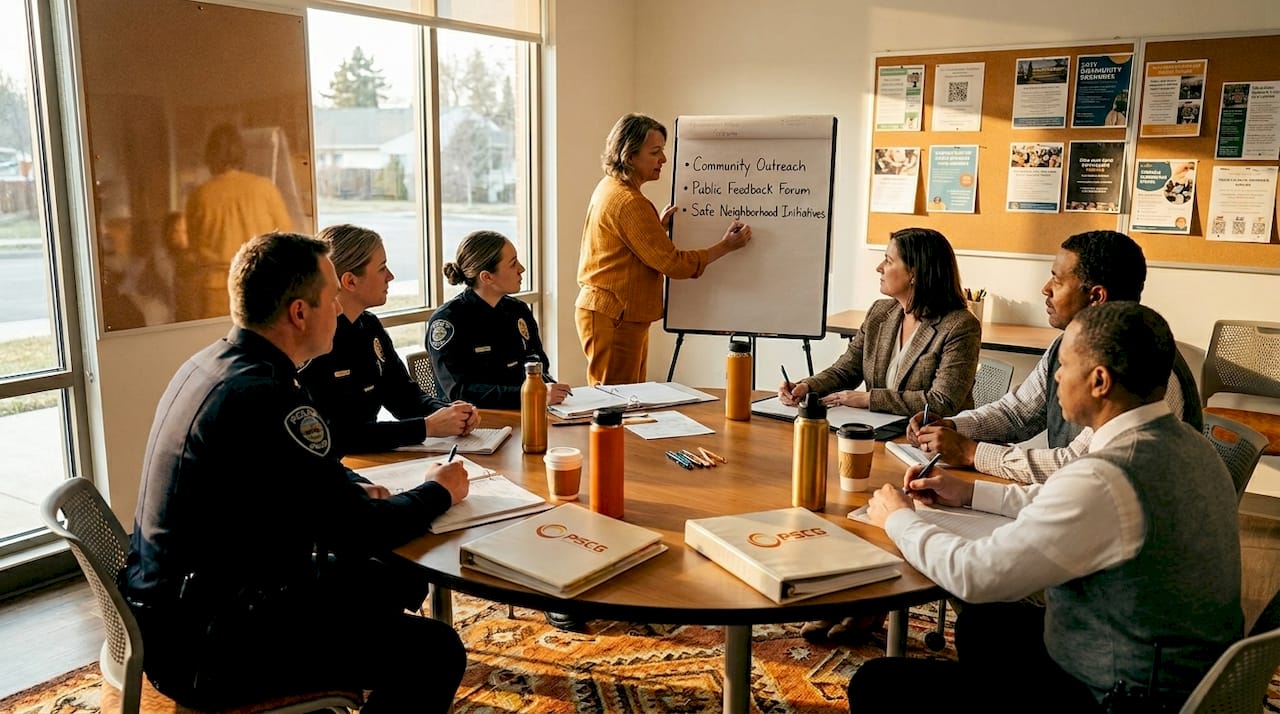
Pro Tip: Publish an internal communication plan at the start of the assessment. Officers who understand the purpose, timeline, and how findings will be used are significantly more cooperative than those left to speculate.
For broader context on how assessments fit into long-term planning, reviewing guidance on strategic planning in public safety before finalizing your scope will sharpen your objectives considerably.
With resources gathered and stakeholders engaged, you can now follow a clear process to execute the organizational assessment effectively.
Executing the organizational assessment: key steps and methodologies
Execution is where an organizational structure assessment either delivers real insight or settles for surface-level observations. The methodology you choose determines the depth and credibility of your findings.
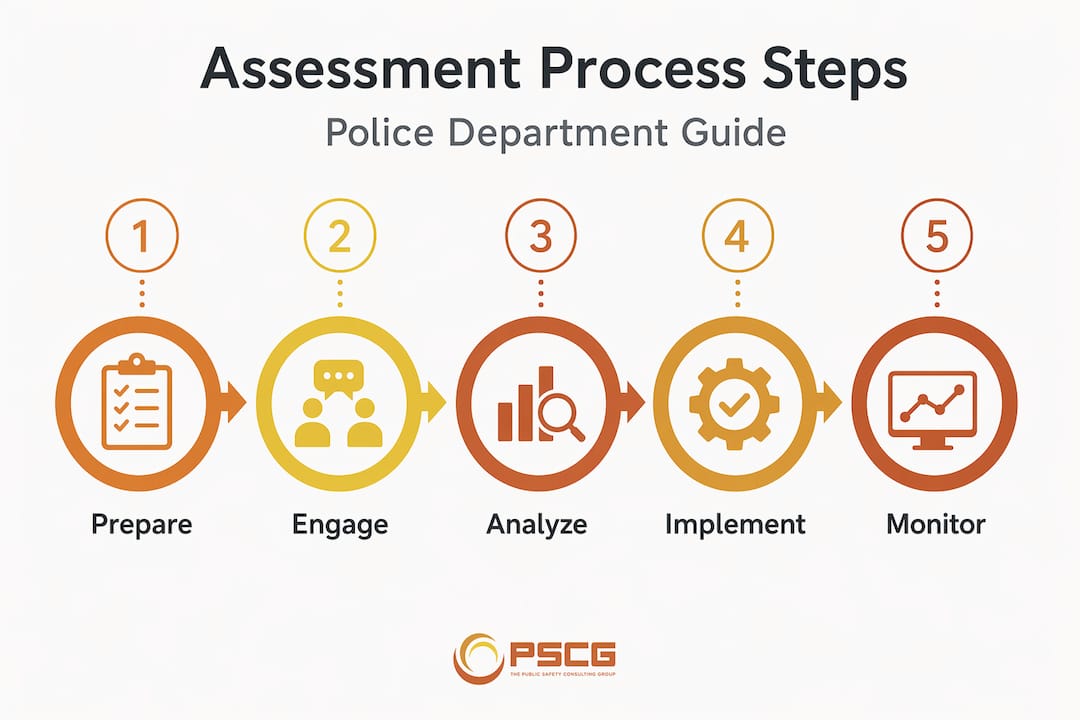
Core steps in the assessment process:
- Operational data analysis: Pull at least two years of performance data and run pattern analysis. Look for shifts in response time by district, use-of-force frequency relative to call type, and any correlation between staffing levels and complaint volume.
- Policy review: Measure current written directives against CALEA standards, state law, and recent case law. Flag any policies that have not been updated in more than three years.
- Structured interviews: Conduct individual and small-group interviews across all ranks. Use standardized questions to allow comparison, but leave room for open-ended responses.
- Focus groups: Separate focus groups for command staff, patrol officers, civilian staff, and community members. Mixed groups often suppress candor.
- Risk assessment: Prioritize findings by likelihood and severity. Not every gap carries the same urgency.
- Community engagement: Go beyond surveys. Host facilitated sessions in neighborhoods the department serves regularly.
A comparison of common assessment methodologies:
| Method | Strengths | Limitations |
|---|---|---|
| Internal self-assessment | Low cost, fast to deploy | High bias risk, lacks credibility |
| Independent consultant review | Neutral, credible, deep expertise | Requires budget and lead time |
| Peer agency review | Practical perspective, practitioner trust | Limited to peer agency experience |
| Hybrid approach | Balances cost, credibility, and depth | Requires strong coordination |
Real-world assessments validate this approach. The Akron Police Department independent review recommended major changes in use-of-force policies, training, and accountability after a process that combined comprehensive data analysis with structured interviews across the department. The credibility of those recommendations came directly from the methodology’s rigor. Similarly, Chicago PD’s workforce allocation study combined staffing data analysis with community input from over 1,100 residents to balance public safety with community trust, a model that produced both internal buy-in and public confidence.
Pro Tip: When analyzing use-of-force data, cross-reference incidents with the time of day, district, and officer tenure. Patterns often point to training deficiencies or supervision gaps rather than individual misconduct.
For departments that want to see how a public safety system assessment integrates with broader operational reviews, or how EMS operational audits inform cross-agency efficiency, those frameworks translate well to police organizational work.
After completing the assessment, the next crucial phase is verifying findings and planning implementation to ensure sustained improvement.
Verifying results and implementing improvements: action planning and monitoring progress
A police department review that ends with a written report and no implementation plan is just an expensive document. The real value comes from what happens after findings are confirmed.
Steps to verify and act on findings:
- Present a preliminary findings summary to command staff before finalizing the report. This allows factual corrections without compromising the integrity of the conclusions.
- Share a redacted or summary version with staff and community stakeholders. Transparency at this stage prevents rumors and builds credibility for the improvement plan.
- Prioritize findings into three categories: immediate risks, near-term improvements, and long-term structural changes.
- Assign a named owner and realistic deadline to every action item.
- Build a quarterly review cycle into the implementation calendar from the start.
The Independence Police Department’s action plan offers one of the most practical models available. Their approach structured implementation across phases ranging from 90 days to 18 months, with staff committees managing specific workstreams and leadership providing consistent oversight throughout.
“Departments that treat assessment findings as a starting point rather than a verdict are the ones that actually change. The plan matters less than the culture that surrounds it.”
Indicators worth tracking after implementation:
- Response time performance by district and shift
- Use-of-force rates per 1,000 calls for service
- Community complaint volume and resolution timelines
- Officer retention and vacancy rates
- Training completion rates by unit
| Timeframe | Focus area | Example action |
|---|---|---|
| 0 to 90 days | Immediate risk reduction | Update use-of-force policy language |
| 90 days to 6 months | Operational efficiency | Restructure patrol assignments by call data |
| 6 to 18 months | Structural and cultural change | Launch leadership development program |
Pro Tip: Assign a department-wide assessment coordinator, not a committee, who holds singular accountability for tracking implementation milestones. Shared accountability is often no accountability.
For departments pursuing formal recognition of their improvement work, reviewing public safety accreditation steps alongside your implementation plan creates a clear path toward credentialed accountability.
Rethinking organizational assessments: cultivating trust and agility beyond the checklist
Most departments approach an organizational assessment the way they approach an audit: something to survive, prepare for, and close out. That framing produces compliant behavior during the review period and regression afterward. We think the more productive question is not “how do we pass this assessment” but “how do we build a department that continuously assesses itself?”
The National Policing Institute is explicit that Rapid Performance Assessments should be positioned as learning-and-coaching tools rather than disciplinary measures to maintain organizational trust. That distinction is not just philosophical. When officers believe an assessment is designed to catch them doing something wrong, they withhold information, align answers with what leadership wants to hear, and disengage from implementation. When they believe it is designed to make their jobs more effective and their working conditions better, they participate with genuine investment.
The departments that sustain improvement are the ones that publicly recognize what is working alongside what needs to change. Most assessment reports lead with deficiencies. Flipping that sequence even slightly, by opening with genuine strengths before addressing gaps, changes how staff receive the findings and how motivated they are to act on them.
Community trust is not a byproduct of good policing. It is a precondition for it. Assessments that integrate community feedback only at the data-gathering stage and then disappear from public view until a report is published miss the point. Keeping community stakeholders engaged through findings review and early implementation not only builds trust, it creates accountability structures outside the department that sustain momentum when internal attention moves elsewhere.
We work alongside departments to build this kind of ongoing relationship with assessment processes, and our optimize police operations consulting reflects exactly that approach.
Partnering with The Public Safety Consulting Group for impactful organizational assessments
Running a rigorous, credible, and actionable police department organizational assessment requires both methodological discipline and deep familiarity with how law enforcement agencies actually function. That combination is not easy to assemble internally, especially when your team is already managing daily operations, community expectations, and budget cycles simultaneously.
At The Public Safety Consulting Group, we bring proven experience in public safety operations, organizational structure assessment, and stakeholder engagement to every engagement. We customize our approach to your department’s specific context, size, and goals rather than applying a generic framework. Our process is built on neutrality, transparency, and practical implementation support, so findings lead to real change rather than shelved reports. If you are ready to move from reactive management to proactive improvement, our police department consulting services and strategic planning consulting are the right starting point. Contact us today to discuss how we can support your department’s next assessment.
Frequently asked questions
What is a police department organizational assessment?
It is a thorough evaluation of a police department’s operations, policies, staffing, and organizational culture designed to identify both strengths and improvement areas, producing actionable findings that enhance effectiveness and accountability.
Who should be involved in the assessment process?
All staff levels including sworn officers and civilian employees should participate, along with external stakeholders like community members and union representatives to ensure comprehensive perspectives and genuine buy-in. As ICMA guidance confirms, successful management plans require input from all employees and stakeholders to create lasting cultural change.
How long does it typically take to complete and implement assessment findings?
The data-gathering and analysis phase typically runs four to twelve weeks depending on department size, while implementation phases span from 90 days to 18 months with early quick wins prioritized alongside longer-term structural improvements.
How can assessments improve community trust?
By formally integrating community feedback into staffing decisions and policy updates, departments demonstrate that enforcement priorities reflect public needs. Chicago PD’s approach of gathering input from over 1,100 community members during their workforce study is a model worth studying for any department serious about public engagement.
What role do independent consultants play in assessments?
Independent consultants provide neutral facilitation that encourages candid feedback from staff at all levels while reducing the risk that findings will reflect internal political pressures. ICMA guidance notes that consultants ease concerns and encourage candid employee input, producing more credible and widely accepted organizational plans.