



TL;DR:
- Municipal EMS systems rely on pre-established mutual aid agreements to handle surges and emergencies effectively. Proper preparation, including documented MRPs and continuous cost tracking, ensures financial recovery and operational resilience. Treating mutual aid as a core system feature, not a backup, enhances community safety and fiscal sustainability.
Municipal leaders know the fear well: a single mass casualty event, a regional surge in call volume, or a neighboring community’s EMS system failing mid-shift can push your own resources past their breaking point within hours. In Lansdowne Borough, Pennsylvania, that scenario became reality when call volume doubled to 3,133 EMS calls in a single year, forcing local leaders to quickly activate mutual aid partnerships that ultimately kept costs manageable through reimbursement recovery. The decisions made before, during, and after that activation determined whether the community stayed financially stable or absorbed a crushing operational deficit.
Table of Contents
- Understanding EMS mutual aid agreements
- Preparing for effective mutual aid: Requirements and frameworks
- Executing and managing mutual aid: Operations in action
- Verifying outcomes: Financial sustainability and compliance
- A new view: Why smart mutual aid beats budget shortcuts
- Discover smarter EMS solutions for your community
- Frequently asked questions
Key Takeaways
| Point | Details |
|---|---|
| Written agreements are vital | Formal documents clarify operational roles and financial responsibilities in EMS mutual aid. |
| Planning drives reimbursement | Pre-planning and thorough documentation maximize cost recovery during mutual aid events. |
| Regional collaboration boosts sustainability | Partnering across municipalities strengthens operational capacity and long-term financial health. |
| Track costs in real time | Maintaining accurate records during operations ensures compliance and improves reimbursement outcomes. |
| Consulting accelerates results | Expert support helps tailor mutual aid strategies to your community’s operational and financial needs. |
Understanding EMS mutual aid agreements
Mutual aid agreements in EMS are formal arrangements between two or more agencies that allow one jurisdiction to request and receive emergency personnel, equipment, and resources from another when local capacity is exceeded. They are not fallback options reserved for catastrophic failures. They are deliberate, pre-planned instruments of operational resilience that modern EMS systems build into their normal operating structure.
Understanding mutual aid in EMS starts with recognizing when these agreements are activated. Common triggers include mass casualty incidents, prolonged high call volume surges, planned events requiring supplemental coverage, equipment failures, and severe weather events that simultaneously increase demand and reduce available units. Each of these scenarios can exhaust even well-staffed departments within hours.
The legal and financial architecture behind these agreements matters enormously. FEMA NIMS encourages written mutual aid agreements across governments, private sector entities, and non-governmental organizations to ensure structured access to resources during emergencies. Without written agreements in place, jurisdictions face ambiguous liability, unclear reimbursement pathways, and inconsistent operational authority during the moments when clarity matters most.
Partners in a municipal EMS mutual aid network typically fall into several categories:
- Government agencies: County EMS, neighboring municipal fire and EMS departments, state emergency management offices
- Private EMS providers: Commercial ambulance companies operating under contracted or cooperative arrangements
- Non-governmental organizations: Volunteer rescue squads, regional hospital systems, and specialty medical units
- Federal assets: National Guard medical units or federal health and medical task forces activated under major disaster declarations
The documentation required to formalize these relationships includes executed written agreements with defined scope, resource lists, reimbursement terms, operational protocols, and activation procedures. The table below summarizes what a well-structured mutual aid agreement should address:
| Agreement component | Purpose | Why it matters |
|---|---|---|
| Scope of services | Defines what resources and personnel are covered | Prevents gaps during activation |
| Activation protocols | Establishes who can request aid and how | Reduces delays in critical moments |
| Reimbursement terms | Clarifies cost recovery expectations | Protects municipal budgets |
| Liability and insurance | Addresses legal exposure for both parties | Reduces post-event disputes |
| Communication standards | Aligns radio, dispatch, and reporting systems | Supports seamless operations |
Following EMS best practices means treating these agreements not as administrative formalities but as operational tools that directly affect response quality and financial outcomes. A jurisdiction that has never tested its mutual aid agreements before a real event will discover their weaknesses at the worst possible time.
Healthcare and public safety systems share a common lesson here. Just as interim leadership for hospitals requires pre-established authority structures to function effectively, EMS mutual aid requires pre-established legal and operational frameworks before the need becomes urgent. Reactive planning consistently underperforms proactive preparation.
Preparing for effective mutual aid: Requirements and frameworks
Having outlined the foundational elements, let’s detail how to prepare and select the right frameworks for mutual aid operations. Preparation is where most municipalities either build durable capability or create future vulnerabilities.
The requirements for mutual aid participation extend beyond signing an agreement. Agencies must maintain current resource inventories, trained personnel rosters, interoperable communications equipment, and realistic deployment timelines. Without these elements confirmed in advance, even a well-written agreement fails at the activation point.
Mission Ready Packages (MRPs) are one of the most practical tools in mutual aid preparation. An MRP is a pre-built, pre-approved resource package that defines exactly what an agency can deploy, including personnel, equipment, certifications, and logistical needs. EMAC provides an interstate mutual aid framework for EMS during governor-declared emergencies, and MRPs are central to how EMAC-eligible jurisdictions request, deploy, and demobilize resources across state lines, with cost reimbursement tied to eligible, pre-documented expenses.
Here is a step-by-step process we recommend for selecting and building your mutual aid framework:
- Conduct a gap analysis: Identify scenarios where your current resources would be insufficient and quantify the shortfall in units and personnel hours.
- Map potential partners: Identify neighboring agencies, regional partners, and state resources that could realistically respond within your operational time windows.
- Choose the right framework: Evaluate whether EMAC (for interstate needs) or intrastate mutual aid agreements better fit your most likely activation scenarios.
- Build or submit MRPs: Document exactly what you can offer and what you need, including costs per unit and reimbursement-eligible expense categories.
- Execute formal written agreements: Ensure legal review covers liability, workers’ compensation for deployed personnel, and reimbursement processes.
- Train and exercise: Conduct at least one tabletop exercise annually and one functional exercise every two to three years to validate your plans.
Choosing between EMAC and intrastate mutual aid is a decision driven by geography, incident type, and declaration status. The table below clarifies key differences:
| Factor | EMAC (interstate) | Intrastate mutual aid |
|---|---|---|
| Activation requirement | Governor-declared emergency | Local or county emergency declaration |
| Reimbursement pathway | Federal and state cost recovery | State or local reimbursement |
| Legal liability coverage | Worker’s comp and liability protection for deployed personnel | Varies by state statute |
| Ideal use case | Large-scale disasters crossing state lines | Regional surges and local shortfalls |
| Documentation complexity | Higher, requires MRPs and formal requests | Moderate, governed by local agreements |
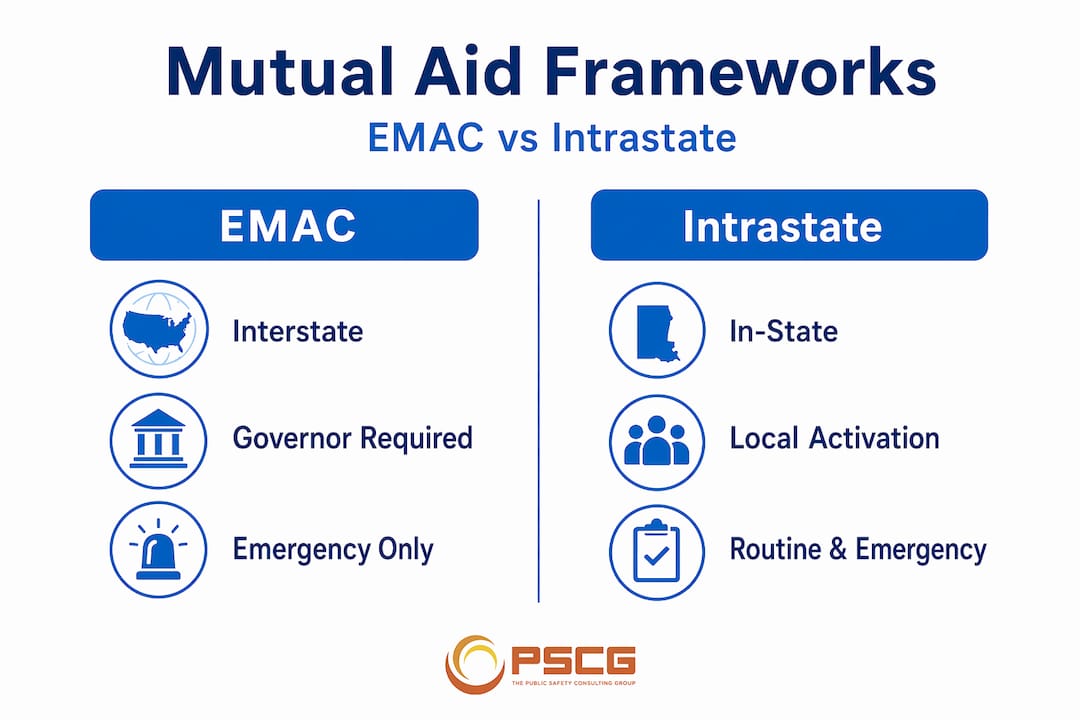
Pairing your framework selection with a solid EMS strategic planning process ensures that mutual aid is built into your system design from the start, rather than treated as an afterthought.
Pro Tip: Begin preparing your documentation and cost-tracking templates before any activation occurs. Reimbursement under EMAC and many state frameworks is tied to documented eligible costs, and agencies that lack pre-built tracking tools consistently recover less than those with systems already in place. The time to build your tracking infrastructure is during planning, not during deployment.

Executing and managing mutual aid: Operations in action
With preparation complete, it’s time to examine what operational excellence looks like through deployment and management. The execution phase is where the quality of preparation becomes visible, and where documentation discipline determines financial outcomes.
Effective mutual aid execution follows a clear operational sequence:
- Request: The incident commander or authorized official formally requests aid through the established channel, referencing the written agreement and specifying resource needs.
- Confirm and deploy: The assisting agency confirms availability, activates MRPs if applicable, and deploys personnel and equipment with clear time-stamped records.
- Integrate into operations: Deployed resources are assigned roles within the requesting agency’s Incident Command System (ICS), with clear communication protocols established.
- Track costs in real time: Every deployed unit, personnel hour, consumable, and equipment use is logged continuously, not reconstructed after the fact.
- Demobilize: Resources are released following a formal process that includes documentation of all expenses, an operational debrief, and return of any borrowed equipment.
- Submit reimbursement claims: Claims are assembled using real-time records and submitted through the appropriate framework within required timelines.
“In Lansdowne Borough, partnering with Narberth Ambulance to manage 3,133 calls in 2024, double the expected volume, demonstrated that cost recovery through reimbursements from neighboring communities could substantially offset mutual aid costs, making proactive collaboration a financially sound strategy.”
The most common execution mistakes we see are entirely avoidable. Agencies frequently fail to assign a dedicated cost-tracking role during the event, meaning financial records are reconstructed from memory after demobilization. That reconstruction process introduces gaps and errors that reduce reimbursement recovery. Another frequent error is failing to integrate deployed resources into the ICS structure clearly, which creates communication breakdowns that affect both operational safety and documentation accuracy.
Role assignment during mutual aid operations should be explicit and recorded. Each deployed unit needs a clear chain of command, a designated communication frequency, and a specific operational area or function. Ambiguity in any of these areas creates problems that compound over time during extended activations.
Developing smart EMS partnerships means treating each mutual aid activation as a learning event. After every activation, conduct a structured after-action review that captures what worked, what failed, and what documentation gaps need to be closed before the next event.
Pro Tip: Assign one person per operational period specifically to cost documentation. This role should have no other duties during the activation. The financial return from complete, accurate records consistently exceeds the cost of that dedicated position by a significant margin.
Verifying outcomes: Financial sustainability and compliance
Once operations are underway, municipal leaders must verify that outcomes align with their financial and compliance goals. Verification is not a post-event exercise. It begins during activation and continues through final audit closure.
Financial sustainability is enhanced by regional collaboration, even when reimbursement shortfalls occur, because shared resources reduce the per-unit cost of coverage for every participating jurisdiction. However, EMAC and state frameworks require pre-planned documentation to ensure maximum cost recovery, and the agencies that invest in that preparation consistently outperform those that rely on after-the-fact reconstruction.
Key compliance requirements for mutual aid verification include:
- Expense documentation: All personnel hours, equipment use, fuel, consumables, and overhead costs must be captured in categorized logs matching the reimbursement framework’s eligible expense definitions.
- Reporting timelines: Most frameworks impose strict deadlines for submitting reimbursement claims. Missing these windows eliminates recovery eligibility regardless of how legitimate the expense is.
- Audit readiness: Documentation must be retained in organized, accessible formats for potential audit review, often for three to five years following the event.
- Performance reporting: Many agreements require the requesting agency to report on outcomes, including call volume handled, response time benchmarks met, and any operational incidents during the mutual aid period.
Best practices for tracking and verification include:
- Use standardized cost-tracking forms approved by your state emergency management agency before any activation
- Maintain a dedicated digital file for each activation, organized by expense category and operational period
- Assign a compliance review point, at least 72 hours after demobilization, to identify any documentation gaps before they become permanent
- Cross-reference personnel deployment records against payroll data to ensure accuracy
- Build reimbursement submission timelines into your post-event standard operating procedures
Integrating these practices with a formal financial analysis for EMS framework gives municipal leaders a clear picture of mutual aid’s net financial impact over time. Working with EMS reimbursement experts can further strengthen your recovery rates and identify eligible expenses that internal teams often miss.
Pro Tip: Start your verification process during the mutual aid event, not after. Assign a compliance lead who reviews documentation daily and flags incomplete records before personnel demobilize. Reconstructing records after the fact is slower, less accurate, and consistently results in lower reimbursement recovery.
A new view: Why smart mutual aid beats budget shortcuts
Here is where we want to offer a perspective that gets lost in most budget-driven conversations about EMS. Mutual aid is frequently framed by administrators as a last resort, something you activate when your own system fails. That framing is both factually wrong and operationally dangerous.
The municipalities that deploy mutual aid most effectively treat it as a core design feature of their EMS system, not a backup plan. They have tested agreements, verified MRPs, trained personnel, and documented cost-tracking procedures before any incident requires activation. This level of preparation transforms mutual aid from a reactive measure into a proactive financial and operational asset.
The uncomfortable truth for many municipal leaders is that the instinct to “manage internally” often costs more than regional collaboration. A jurisdiction that stretches its own units to cover surges incurs overtime costs, accelerates apparatus wear, increases provider burnout, and degrades response time benchmarks, all without generating the reimbursement recovery that structured mutual aid can provide.
Regional collaboration is not a sign of weakness. It is a sign that your community has built a resilient, mature EMS system that can absorb stress without transferring that stress entirely onto your own budget and personnel. The smart EMS system growth model prioritizes sustainable capacity over the appearance of self-sufficiency.
The hard-won lesson we share with every municipal client is this: cost recovery in mutual aid depends almost entirely on the quality of preparation, not the quality of the paperwork filed after the event. The documentation practices, agreement structures, and tracking systems you build before an incident determine what you recover afterward. Financial sustainability in EMS thrives on collective, well-planned action, not competitive isolation.
Discover smarter EMS solutions for your community
Municipal leaders ready to apply these strategies should consider expert EMS support to accelerate operational and financial improvements.

At PSCG, we work directly alongside municipal leaders and public safety administrators to design EMS systems that incorporate mutual aid as a strategic tool, not an afterthought. From developing a municipal EMS strategy that accounts for regional partnerships, to conducting a detailed financial analysis for EMS that identifies reimbursement opportunities you may be leaving on the table, we bring operational depth and financial rigor to every engagement. We also offer guidance on EMS system design examples that have delivered measurable improvements in response performance and fiscal sustainability across diverse municipal contexts. Contact us today to start building a more resilient EMS system for your community.
Frequently asked questions
What is the Emergency Management Assistance Compact (EMAC) and how does it support EMS mutual aid?
EMAC provides a legal and financial framework for EMS mutual aid across state lines during declared emergencies, including structured processes for reimbursement and deployment that protect both requesting and assisting jurisdictions.
How can municipalities ensure financial sustainability in EMS mutual aid?
By pre-planning documentation systems and building regional collaboration before incidents occur, municipalities can maximize cost reimbursement and reduce per-unit operational costs. Regional collaboration improves sustainability even when some reimbursement shortfalls occur.
What operational steps are essential for successful mutual aid management?
Requesting aid, deploying resources through pre-established agreements, managing operations within ICS, tracking costs continuously, and demobilizing with full documentation are the key steps for EMAC and intrastate mutual aid success.
Are written agreements required for EMS mutual aid partnerships?
Yes, written agreements are strongly recommended by FEMA NIMS guidance to clarify operational authority, liability, and financial responsibilities across all partner types, including government, private sector, and non-governmental organizations.
How can municipalities track and verify reimbursement during and after mutual aid activation?
Maintaining real-time, categorized cost records and assigning a dedicated compliance lead during activation are the most reliable methods for ensuring both compliance and timely reimbursement. EMAC requires pre-planned documentation to maximize cost recovery eligibility.