


TL;DR:
- Effective fire department response models rely on comprehensive metrics, including response time, outcomes, and resource utilization, to accurately evaluate performance. Using percentile-based standards and phase disaggregation reveals critical gaps often hidden by averages, guiding targeted improvements. External benchmarks like ISO PPC validate local efforts, ensuring strategies align with regional and national standards for optimal community safety.
When a structure fire ignites or a cardiac arrest occurs, the clock starts immediately, and every minute of delayed response measurably worsens outcomes for the people your community depends on you to protect. Evaluating your fire department response model is not an administrative exercise; it is a structured, evidence-based process that directly determines whether your deployment strategy is working. Fire department performance metrics can be assessed through three linked components: response time performance, outcomes, and efficiency and resource utilization. This guide walks you through each element with actionable steps, benchmarking tools, and the nuance municipal leaders need to make informed decisions.
Table of Contents
- Core components of a fire department response model
- Setting and using response time standards
- Capturing outcome and efficiency: Beyond response times
- Validating your model: External and internal benchmarks
- Rethinking fire department evaluation: Beyond metrics for real impact
- Enhance your municipal response model with expert support
- Frequently asked questions
Key Takeaways
| Point | Details |
|---|---|
| Three-part evaluation | Combine response time, outcomes, and efficiency metrics for a robust review. |
| Percentile-based standards | Use 90th percentile standards to accurately track and improve response. |
| Cross-check benchmarks | Validate internal metrics with external tools like ISO PPC ratings. |
| Avoid single-metric focus | Interpreting only response time can hide readiness or outcome gaps. |
| Adapt standards locally | Modify benchmarks based on specific community risks and demand zones. |
Core components of a fire department response model
Now that the urgency is established, let’s explore the key metrics every municipal leader should understand before making any resource or deployment decisions.
A fire department response model is only as strong as the metrics used to evaluate it. Relying on a single number, such as average response time, gives you an incomplete picture and can mask serious performance gaps that put lives and property at risk. A well-structured evaluation framework examines three interdependent components.
The three linked components:
- Response time performance: This measures the total elapsed time from call receipt through dispatch, turnout, and travel to arrival on scene. Each phase is measurable and must be tracked separately to identify where delays originate. A department may have fast travel times but consistently slow turnout, and without breaking down the data, that problem remains invisible.
- Outcomes: These metrics capture what actually happened as a result of the response. Common outcome indicators include civilian and firefighter fatalities, successful fire containment to the room or floor of origin, cardiac arrest survival rates, and dollar loss per incident. Outcome metrics answer the question: did the response make a meaningful difference?
- Efficiency and resource utilization: These indicators measure how well your personnel, apparatus, and deployment strategies are being used relative to demand. Unit Hour Utilization (UHU), cost per call, and simultaneous incident rates all fall into this category. Efficient resource use does not just save money; it preserves unit availability for the next call.
The table below summarizes how each component is typically measured and what benchmark ranges look like for career fire departments:
| Component | Common metrics | Typical benchmark reference |
|---|---|---|
| Response time performance | Total response time, turnout time, travel time | NFPA 1710: 4-min travel, 80th percentile |
| Outcomes | Fatality rate, containment success, survival rate | Local trending plus regional comparisons |
| Efficiency and resource utilization | Unit Hour Utilization, cost per call, simultaneous incident rate | UHU target: 0.30 to 0.45 for EMS units |
These three fire department performance metrics do not exist in isolation. Improving apparatus deployment locations can reduce travel time, which can improve containment outcomes, which in turn reduces property loss and liability. Understanding these connections allows you to prioritize changes that produce measurable gains across all three areas, rather than optimizing one at the expense of another.
We consistently advise clients engaged in fire department operations consulting to begin every evaluation with a clear definition of how each metric will be collected, cleaned, and reported before drawing any conclusions. Data quality is a foundational issue that undermines even the most sophisticated analysis when left unaddressed.
Setting and using response time standards
With core components understood, it is crucial to set proper standards and interpret your data wisely rather than accepting simple summary statistics at face value.
Response time standards exist to give your department a defined performance target and to hold the system accountable over time. The most widely referenced benchmark for career departments is NFPA 1710, which shapes deployment goals for staffing, apparatus positioning, and response time objectives across the fire service. NFPA 1710 establishes a 60-second dispatch time, 80-second turnout time for fire, and 4-minute travel time to structure fires, all measured at the 90th percentile.
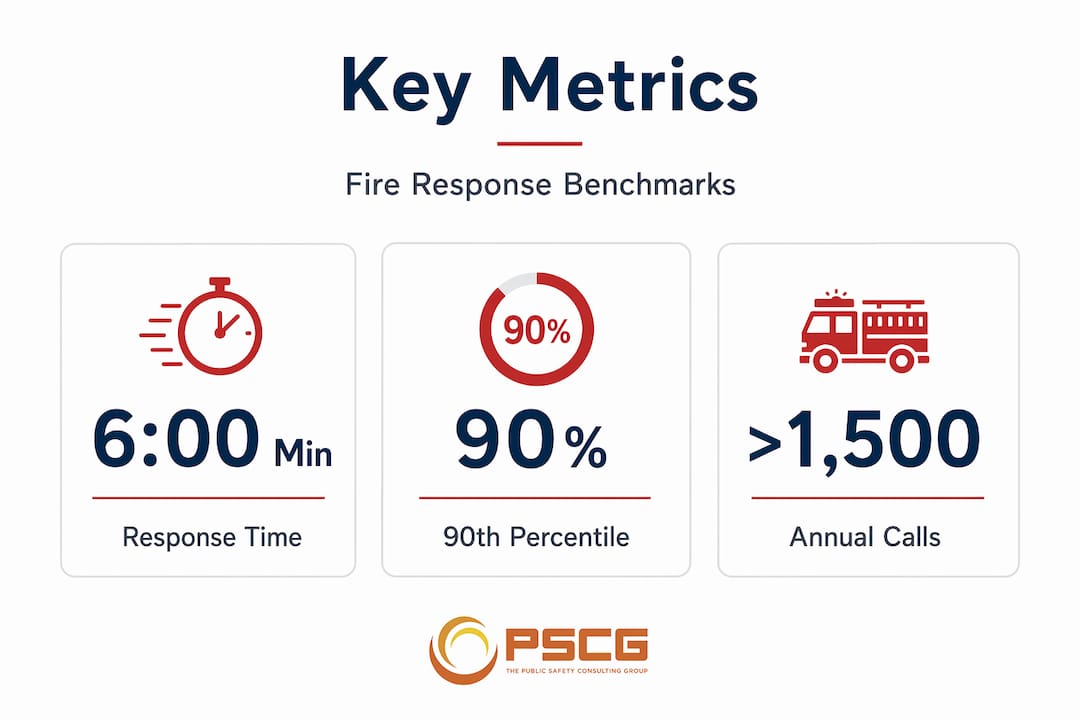
That last phrase, “at the 90th percentile,” is where many municipal leaders underestimate the complexity. An average response time of 6 minutes might look acceptable on a quarterly dashboard. But if 20 percent of your incidents are exceeding 10 minutes, averaging hides a serious coverage problem. Percentile-based reporting tied to standards of cover goals, rather than simple averages, reveals exactly where the system is failing.
The comparison table below illustrates why the choice of measurement approach matters:
| Measurement approach | What it shows | What it hides |
|---|---|---|
| Average response time | General system-wide trend | Outlier incidents with very long delays |
| 90th percentile (NFPA 1710) | Performance level for 90% of calls | Top 10% of longest responses |
| Disaggregated by phase | Which phase (dispatch/turnout/travel) is slow | Nothing; this is the most transparent method |
How to set and apply response time standards effectively:
- Adopt percentile-based reporting. Replace simple averages in your monthly and quarterly reports with 80th and 90th percentile calculations. This aligns your reporting with how national standards measure performance and makes comparisons to NFPA 1710 valid.
- Disaggregate each phase. Separately track dispatch time, turnout time, and travel time for every incident. This is the only way to isolate whether a gap is a dispatch center issue, a station response culture issue, or a deployment location problem. Our EMS response time analysis methodology applies this same phase-based approach to both fire and EMS systems.
- Run geographic analysis. Map your incidents and response times by geographic zone. Identify specific areas where standards are not being met. This geographic disaggregation transforms a system-wide statistic into an actionable finding about where to reposition resources or add coverage.
- Compare turnout to travel separately by unit. Variation between stations often indicates training, culture, or equipment differences rather than geographic limitations. Addressing those differences requires different solutions than adjusting deployment.
- Review trends over rolling 12-month periods. Single-month snapshots are misleading. A 12-month rolling analysis controls for seasonal variation and shows genuine performance trajectories.
Pro Tip: When presenting response time data to your governing body or budget committee, always include both the average and the 90th percentile side by side. The gap between those two numbers tells a story that averages alone cannot, and it helps justify resource requests in a way that resonates with fiscal decision-makers.
The practical value of understanding EMS response time impact on patient and community outcomes gives these standards their real weight. Response time standards are not bureaucratic targets; they represent thresholds below which the probability of a survivable outcome begins to decline.
Capturing outcome and efficiency: Beyond response times
Once standards are set and your data is being examined properly, broader outcomes and operational factors must be considered to complete the picture.
Response time is a process metric. It measures what happened during the response phase. But what you ultimately need to know is whether the response produced a good result. Two incidents with identical response times can have dramatically different outcomes depending on fire behavior, building construction, occupant vulnerability, and crew effectiveness. This is why outcome metrics must sit alongside response time data in every performance review.
Key outcome metrics to track:
- Civilian fatalities and injuries per 1,000 incidents
- Firefighter injuries per incident
- Percentage of structure fires confined to room or floor of origin
- Cardiac arrest survival to hospital discharge rates
- Dollar loss per incident relative to property value at risk
Key efficiency and resource utilization indicators:
- Unit Hour Utilization (UHU): the proportion of time a unit is actively deployed on a call versus available. Values between 0.30 and 0.45 generally indicate healthy utilization without burnout risk for EMS-heavy departments.
- Simultaneous incident rate: the frequency with which multiple incidents overlap, straining available resources
- Apparatus out-of-service rate: the percentage of scheduled unit hours where apparatus is unavailable due to maintenance or mechanical failure
- Cost per unit hour and cost per call
Readiness variables are not edge cases; they are core operating conditions. When evaluating response models, you must incorporate factors like apparatus out-of-service rates and unit availability and assignment effects, because they directly change realized response times and can cascade into poorer outcomes across your entire coverage area.
This is a point that cannot be overstated for municipal administrators. A department may have excellent paper response times when all units are available. But if apparatus out-of-service rates are high, those performance numbers are theoretical. The real-world response time distribution will be worse than your data suggests, and incident outcomes will reflect that gap.
Applying EMS best practices for response means building readiness tracking directly into your performance management system, not treating it as a separate fleet management issue. We also recommend that departments follow structured system assessment steps to ensure that readiness variables are formally integrated into every evaluation cycle.
Pro Tip: Calculate your “effective response time” by factoring in your apparatus out-of-service rate. If 15 percent of your unit hours are unavailable, your real coverage is meaningfully lower than your dispatch records suggest. That calculation often changes the conversation about fleet investment significantly.
Validating your model: External and internal benchmarks
Having measured all components thoroughly, the final step is validation and local adaptation to ensure your conclusions are both accurate and actionable.
Internal data analysis tells you how your department is performing. External benchmarking tells you whether that performance is adequate relative to established standards and comparable jurisdictions. Using both together strengthens the credibility of your findings and supports defensible decision-making.
Steps for validating your response model:
- Apply the ISO Public Protection Classification (PPC) review. The ISO PPC process evaluates fire department capabilities across receiving and handling fire alarms, fire department staffing and equipment, and water supply. It is a widely recognized external lens that many insurers and bond rating agencies reference. Departments rated Class 1 to 3 generally demonstrate strong operational capability.
- Cross-reference your NFPA 1710 compliance rate with ISO PPC findings. Departments that are strong in one framework but weak in the other often have specific operational blind spots that warrant targeted review.
- Use FSRS data (Fire Suppression Rating Schedule). ISO’s detailed scoring rubric examines over 100 individual factors. Walking through the FSRS components with your leadership team can reveal investment priorities that internal data alone may not surface.
- Adapt your goals to local risk. A one-size-fits-all standard is not always appropriate. Some jurisdictions explicitly modify response-time goals based on local risk assessment realities, such as rural coverage zones, demographic factors, or high-rise building concentrations. Risk-based standard modification requires documented justification but produces a more defensible and realistic operational framework.
- Establish a formal annual validation cycle. Validation is not a one-time event. Departments change, communities grow, and risk profiles shift. Annual structured reviews that include both internal performance data and external benchmarking keep your model calibrated to current conditions.
Statistic to note: Departments that achieve ISO PPC Class 1 status typically demonstrate response capability scores above 90 out of a possible 100 within the FSRS framework, reflecting strong alignment across staffing, equipment, training, and deployment. This represents a level of documented operational readiness that significantly strengthens a municipality’s position in contract negotiations, budget justifications, and community reporting.
Consulting a detailed fire department assessment guide ensures your validation process is structured rather than ad hoc, and that findings are documented in a way that supports accountability over time. When selecting or modifying your response model, EMS deployment model guidance provides essential context for understanding how staffing and positioning decisions interact with the broader response framework.
Rethinking fire department evaluation: Beyond metrics for real impact
We have spent years working alongside municipal leaders and fire department administrators who are doing their best with the data they have. The most common pattern we see is not dishonesty or indifference; it is a well-intentioned but narrow reliance on a single number, most often average response time, as the primary measure of system health.
The danger is real. Averages mask geographic inequity. A city with a 6-minute average might have one district consistently running 9-minute responses while another runs 3 minutes. The average looks fine. The district at 9 minutes is experiencing a structural coverage failure. When a fatal fire occurs there, the data that should have triggered action was never examined in a way that would reveal the problem.
Readiness variables are where this challenge becomes most acute. Apparatus availability, unit assignment logic, and simultaneous incident management are operational realities that determine whether theoretical deployment models translate into actual performance. Avoid single-metric evaluation by interpreting response time alongside outcome and efficiency measures, and by validating against readiness data. This is not a best practice suggestion; it is the difference between a model that works on paper and one that works on scene.
Our position is straightforward: the best evaluation frameworks are built to be uncomfortable. They surface problems that are politically inconvenient. They reveal that budget decisions made five years ago are producing coverage gaps today. They require leaders to act on findings rather than file reports. That discomfort is exactly the point.
The path forward is iteration, not perfection. Set your baseline, measure rigorously, validate externally, adapt to local risk, and repeat the cycle every year. Over time, this process builds an institutional knowledge of your system that no consultant can fully replicate from the outside. We work alongside your team to build that capacity. Exploring resources on optimizing EMS response models provides a practical extension of these principles into the EMS dimension of your public safety system.
Enhance your municipal response model with expert support
Translating these evaluation principles into operational change requires structured support, and that is exactly where we focus our work. At the Public Safety Consulting Group, we bring specialized experience in fire and EMS system design, performance gap analysis, and response model optimization directly to your leadership team.

Whether you are conducting your first formal fire department operational assessment or refining an existing model after identifying coverage gaps, we provide the analytical rigor and practical guidance to move from data to decisions. Our process integrates response time analysis, outcome benchmarking, readiness evaluation, and external validation into a single, coherent framework tailored to your community’s risk profile and resource realities. Contact us today to start the conversation and build a response model your community can rely on.
Frequently asked questions
What are the most important metrics for evaluating fire department response models?
The three key metrics are response time, outcomes such as lives saved and fire containment, and efficiency and resource utilization; together, these linked components provide a complete picture of system performance that no single metric can deliver alone.
Why use percentile-based response-time standards instead of averages?
Percentile-based standards expose the range of performance across all incidents, revealing areas where response goals are not being met; disaggregating turnout and travel adds another layer of precision that averages completely obscure.
What role does the ISO PPC rating play in fire department evaluation?
The ISO PPC process provides an external benchmark that evaluates fire department readiness across staffing, equipment, and water supply, serving as a valuable cross-check against internally generated performance data, though it should not be used as the sole measure of operational effectiveness.
How can readiness factors like apparatus availability affect response model results?
When apparatus is frequently out of service or units are unavailable due to assignment conflicts, realized response times worsen beyond what dispatch records indicate, and that cascading effect can directly contribute to poorer outcomes in time-sensitive incidents.