


TL;DR:
- A well-designed 911 dispatch center improves operator performance, system reliability, and safety by incorporating ergonomics, redundancy, and security features. Careful planning and continuous verification ensure the facility adapts to evolving technology, maintains environmental quality, and prevents costly mistakes, ultimately saving lives. Engaging expert consultants early in the process creates operational systems that optimize public safety and community outcomes.
A poorly designed 911 dispatch center does not just create operational headaches; it puts lives at risk. When consoles fail to support operator ergonomics, when redundant systems are absent, or when acoustic environments overwhelm staff with noise, the result is increased error rates, faster burnout, and slower response times. Emergency management professionals and municipal leaders who invest in thoughtful, systematic design get a measurable return: better operator performance, greater system reliability, and a facility capable of scaling as technology evolves. This guide walks through the critical steps to get that design right, from initial requirements to continuous performance verification.
Table of Contents
- Clarifying requirements: Essential features for modern 911 centers
- Preparing your space: Physical layout and environmental controls
- Workstations and consoles: Ergonomic and technology integration essentials
- Avoiding mistakes: Common design pitfalls and how to prevent them
- Verification and optimization: Assessing dispatch center performance
- Why conventional wisdom misses the mark on dispatch center design
- Connect with experts for next-level 911 dispatch center outcomes
- Frequently asked questions
Key Takeaways
| Point | Details |
|---|---|
| Plan for adaptability | Design your dispatch center with flexibility for evolving technology and operational needs. |
| Prioritize ergonomics | Ergonomic workstations significantly reduce fatigue and operational errors among staff. |
| Build in redundancies | Redundant electrical and data pathways ensure your center stays operational during disruptions. |
| Control environment | Lighting and acoustic controls are crucial for minimizing stress and maximizing performance. |
| Verify and improve | Regular assessment drives continuous improvement and sustained public safety outcomes. |
Clarifying requirements: Essential features for modern 911 centers
Before a single piece of equipment is ordered or a floor plan is sketched, your team must define the non-negotiable requirements that will drive every subsequent decision. Skipping this step is one of the most expensive mistakes a municipality can make. Design changes mid-project cost far more than thorough upfront planning.
Modern emergency communications centers (ECCs) must be built around four foundational pillars:
- Adaptability for evolving technology: Next Generation 911 (NG911), CAD integration, real-time data feeds, and AI-assisted call triaging are already reshaping the operational landscape. Your facility must accommodate technology that does not yet exist. This means flexible conduit runs, modular infrastructure, and power systems that can scale.
- Redundant electrical and data pathways: A single point of failure in a 911 center is unacceptable. Redundant UPS systems, generator backups, and separate fiber runs protect operations during outages. As modern ECC design confirms, adaptability, redundant electrical and data pathways, hardened zones, and ergonomic considerations are key for modern emergency communications centers.
- Hardened security zones: Physical security is as important as cybersecurity. Access-controlled entry points, segmented zones for different staff levels, and surveillance integration prevent unauthorized access and protect sensitive infrastructure.
- Operator wellbeing features: Ergonomics, acoustics, and lighting are not soft amenities. They are performance determinants. A fatigued dispatcher makes more errors. Period.
| Feature | Why it matters | Design implication |
|---|---|---|
| Tech adaptability | NG911 and AI tools require infrastructure flexibility | Modular cabling and scalable power |
| Electrical redundancy | Prevents total center failure during outages | Dual UPS, backup generators |
| Hardened security zones | Protects personnel and critical systems | Access control, CCTV, mantrap entries |
| Ergonomic environment | Reduces fatigue and error rates | Height-adjustable consoles, lighting zones |
Working with dispatch center consulting professionals early in the requirements phase helps municipalities avoid costly scope changes and ensures that all technical and operational specifications are captured before construction begins. Similarly, engaging 911 communications consulting expertise ensures that communications infrastructure requirements align with both current standards and future operational models.
Preparing your space: Physical layout and environmental controls
Once requirements are defined, the physical layout becomes the foundation of operational effectiveness. A room that looks functional on a floor plan can still fail operators if sightlines, acoustic treatments, and environmental controls are not engineered carefully.
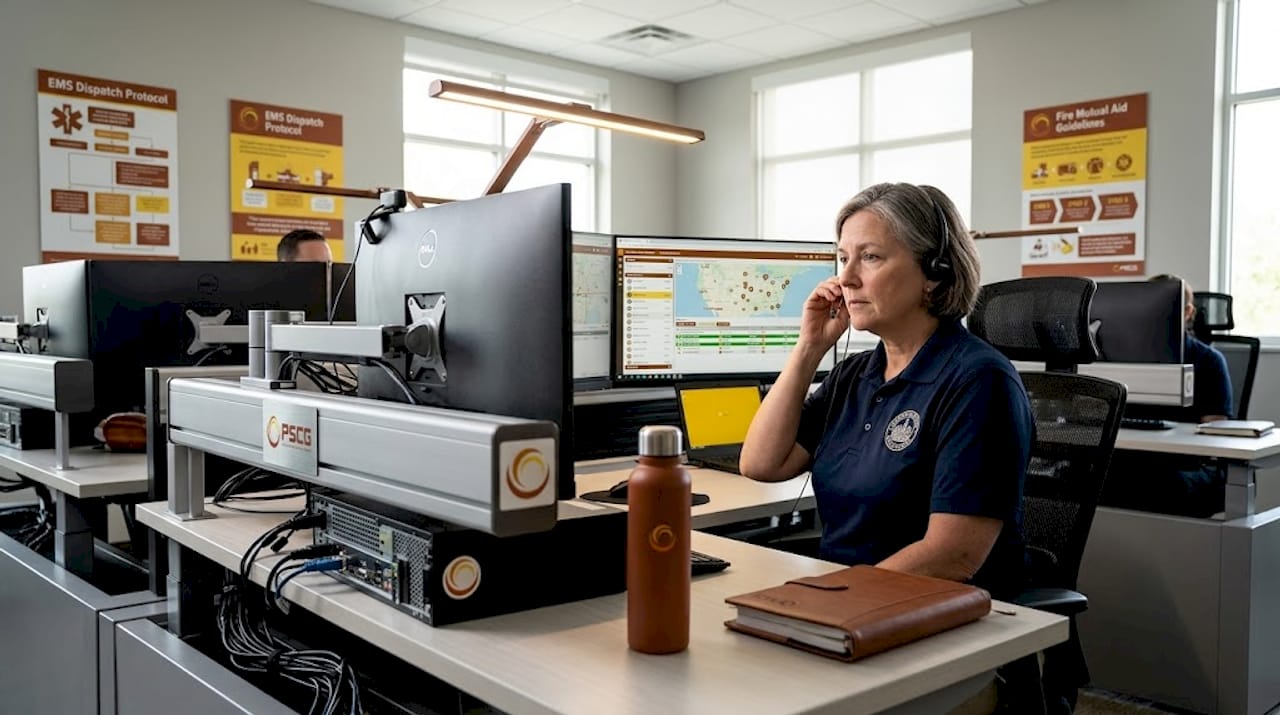
Room and console placement should prioritize supervisor visibility across the entire floor. Supervisors need unobstructed sightlines to all operator positions. Console rows are typically arranged in a slight arc or tiered configuration to support both visibility and communication among dispatchers. Avoid placing consoles directly adjacent to high-traffic corridors, which introduces noise and distraction.
Lighting controls require a layered approach. Overhead ambient lighting, task lighting at each console, and screen glare management each serve different functions. Adjustable color temperature lighting allows the center to shift from bright white light during busy daytime hours to warmer tones during overnight shifts, reducing eye strain over long shifts. Glare from windows is a persistent problem in poorly designed centers; blackout shading and strategic monitor placement mitigate this risk significantly.
Acoustic treatments represent one of the most underinvested elements in dispatch center design. Sound-absorbing ceiling tiles, wall panels, and carpet or rubber flooring materials reduce ambient noise levels that accumulate when dozens of simultaneous radio transmissions, phone calls, and keyboard inputs compete for auditory space. Environmental controls like lighting, acoustics, and room configuration are engineered to support staff wellbeing and minimize ambient noise, which directly reduces the likelihood of miscommunication during high-call-volume events.
“The acoustic environment of a 911 center is not a comfort feature. It is a safety feature. When a dispatcher cannot clearly hear a caller because of ambient noise bleed, the error potential increases exponentially.”
Redundant cabling infrastructure should be planned from the beginning. A single conduit run carrying both power and data to a console cluster creates a single point of failure. Best practice calls for physically separated conduit paths for primary and redundant data connections, with clearly labeled cable management panels at each termination point. Well-planned dispatch center infrastructure includes these details in the initial build phase, not as an afterthought.
| Environmental factor | Recommended standard | Common mistake |
|---|---|---|
| Lighting (foot-candles) | 30-50 FC at console level, adjustable | Fixed overhead fluorescent lighting only |
| Ambient noise floor | Below 45 dB(A) in operational areas | No acoustic treatment, bare concrete |
| Console spacing | Minimum 6 feet between adjacent operators | Crowded layouts that restrict movement |
| Cable management | Labeled, separated primary and redundant | Single conduit runs, unlabeled terminations |
Pro Tip: Commission an acoustic assessment from a qualified engineer before finalizing your construction documents. Retrofitting sound treatment into a completed center costs three to five times more than building it in from the start.
Workstations and consoles: Ergonomic and technology integration essentials
With the space mapped, the focus narrows to individual operator positions. The workstation is where technology meets the human operator, and poor design at this level erodes all the gains made in space planning and environmental control.
The following sequential steps provide a structured approach to console and workstation selection and configuration:
- Assess shift duration and operator profile. Dispatchers often work 10 to 12 hour shifts. Console designs must accommodate operators of varying heights, weights, and physical needs. This means motorized height adjustment is a baseline requirement, not an upgrade.
- Select modular, scalable console platforms. Fixed consoles become obsolete quickly. Modular console design allows technology components to be updated or replaced without full console replacement. Adjustable ergonomic consoles, monitor placement, acoustic and noise control, and modularity are mission-critical for PSAP (Public Safety Answering Point) dispatch floors.
- Configure monitor placement for ergonomic sightlines. Primary monitors should sit at or slightly below eye level to reduce neck strain. Secondary screens for mapping or CAD data should be positioned within a 30-degree arc of the primary viewing field. Avoid stacking monitors directly on top of each other without proper ergonomic arm mounting.
- Integrate cable and power management from day one. Every console should have dedicated power circuits with surge suppression and UPS backup. Cable management channels should route data and power cables separately to reduce interference and simplify maintenance.
- Plan for future technology integration. Reserve conduit space and power capacity for systems that may be added within five years. This might include body camera review stations, drone feeds, or real-time translation services.
- Test every position before final acceptance. Walk each console position with an actual dispatcher. Have them simulate a typical shift posture and verify that monitor heights, keyboard positions, and control panel reach zones are within ergonomic tolerances.
Optimizing communications technology at the workstation level requires coordination between your IT team, console vendors, and communications architects. An emergency communications assessment conducted before final procurement can identify mismatches between planned and actual technology requirements before contracts are signed.
Pro Tip: Require vendors to provide a full-scale mock-up of the proposed console configuration before purchase. Sitting in the actual console for 30 minutes reveals ergonomic issues that no specification sheet will show you.

Avoiding mistakes: Common design pitfalls and how to prevent them
Even well-funded dispatch center projects can undermine themselves through predictable, preventable errors. Knowing where these mistakes occur is the first step toward avoiding them.
“Operator fatigue and error risk are directly tied to workspace ergonomics, acoustics, and lighting controls.”
The most common design pitfalls include:
- Failing to plan for technology upgrades. Centers built without conduit capacity or scalable power infrastructure face expensive retrofit costs within five to seven years. Technology investment cycles in 911 are accelerating, not slowing. Every design decision should assume that major technology changes will occur within a decade.
- Ignoring acoustic and lighting environments. These are frequently treated as aesthetic decisions rather than operational ones. Centers with poor acoustic control see higher rates of dispatcher miscommunication and elevated stress levels. Centers with fixed, harsh lighting contribute to faster fatigue onset during overnight shifts.
- Overlooking operator ergonomic needs. Selecting fixed-height consoles to reduce upfront costs is a false economy. The cost of a workers’ compensation claim, short-term disability, or dispatcher turnover attributable to poor ergonomics far exceeds the cost difference between a fixed and motorized console.
- Insufficient electrical and data redundancy. Single-circuit configurations and single-path data connections are design failures. A fiber cut or breaker trip should never bring down an entire 911 center.
- Excluding dispatchers from the design process. The people who will work in the facility every day have critical operational knowledge that architects and engineers may not possess. Their input on console height preferences, sightline requirements, and workflow patterns directly improves design quality.
Reviewing 911 center best practices alongside the design process gives teams a structured framework for catching errors before they are built into the facility.
Verification and optimization: Assessing dispatch center performance
Design and construction are completed, but the work does not stop there. A well-designed center requires ongoing performance verification to ensure that it continues to meet operational standards as technology, staffing, and call volume evolve.
Follow these steps to build a structured performance review process:
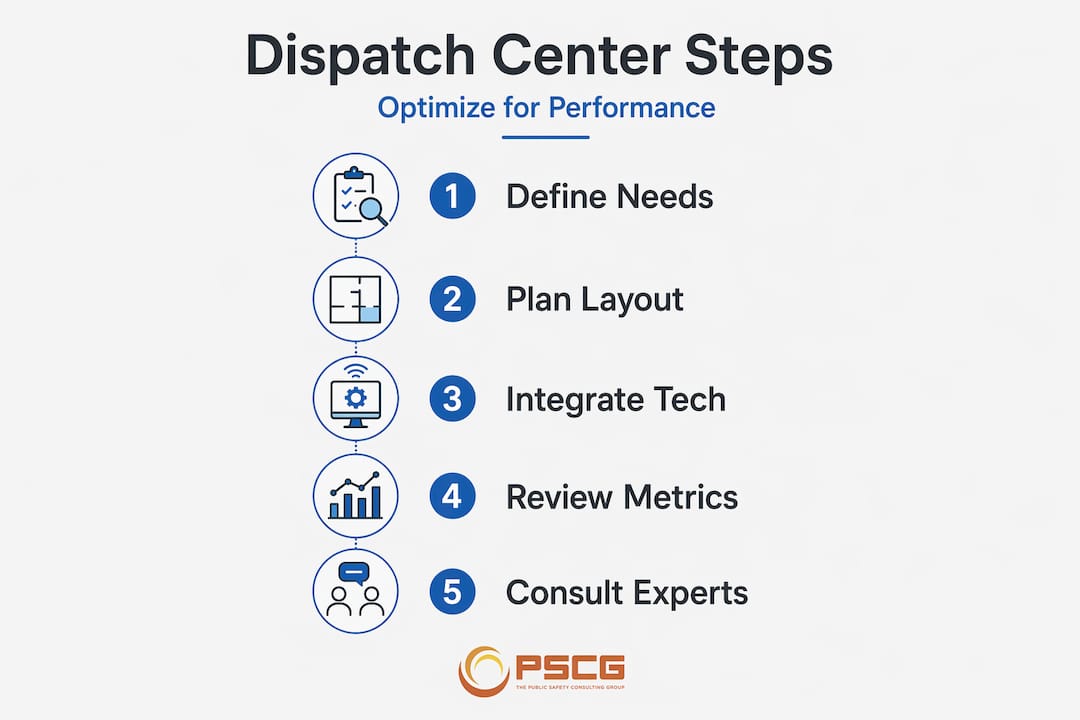
- Establish baseline operational metrics at launch. Document average call handling times, dispatch times, operator error rates, and absenteeism data from the first quarter of full operations. These baselines become the benchmarks against which future performance is measured.
- Conduct quarterly environmental assessments. Measure ambient noise levels, lighting levels at console positions, and HVAC performance at regular intervals. Environmental conditions drift over time as equipment is added, ceilings are modified, or occupancy patterns change.
- Survey dispatcher wellbeing and ergonomic satisfaction. An annual structured survey of dispatcher staff on ergonomic comfort, noise levels, and overall work environment provides qualitative data that complements operational metrics. Staff who feel heard are more likely to flag emerging issues before they become serious problems.
- Review technology integration performance. Assess whether current CAD, radio, and telephony systems are meeting response time benchmarks. Technology that was state-of-the-art at launch may be creating bottlenecks within three years.
- Implement structured continuous improvement protocols. Ongoing assessment and modernization are key for meeting public safety challenges and supporting operator wellbeing. Build a formal annual review cycle that evaluates both the physical environment and technology stack, with a defined budget for incremental improvements.
| Assessment area | Frequency | Success indicator |
|---|---|---|
| Operational metrics review | Monthly | Stable or improving dispatch times |
| Environmental measurement | Quarterly | Noise and lighting within spec |
| Dispatcher wellbeing survey | Annually | High satisfaction, low complaint volume |
| Technology performance audit | Annually | Systems meeting response benchmarks |
| Full facility review | Every 3-5 years | All systems current, infrastructure scalable |
Partnering with EMS consulting services during the verification phase provides an objective, external perspective that internal teams may not be positioned to offer.
Why conventional wisdom misses the mark on dispatch center design
Most design guides for 911 centers focus heavily on compliance checklists. Meet NFPA 1221 requirements. Pass CALEA accreditation standards. Check the boxes. We would argue that this compliance-first mindset, while necessary, is deeply insufficient for achieving genuine operational excellence.
The facilities that truly perform under pressure are not the ones that barely met a standard; they are the ones where someone asked a harder question: does this design make our dispatchers better at their jobs? That question forces a shift from minimum compliance to intentional performance design.
Human factors are the most undervalued element in most 911 center projects. The expert discussion of work environment design treats ergonomics, acoustics, and lighting as performance-and-safety factors tied to operator fatigue and error risk, yet we still see municipalities selecting fixed consoles because they cost 15% less, or skipping acoustic treatment because it was not explicitly required by a standard.
The uncomfortable truth is that a dispatch center can be fully compliant and still be a poor working environment that degrades operator performance over time. True operational excellence requires integrating human factors, technology infrastructure, and environmental design into a unified strategy from the first day of planning. That integration does not happen by accident; it happens when the right expertise is engaged early and the right questions are asked throughout the process. Our work through dispatch center consulting consistently confirms that the municipalities achieving the best outcomes are those treating their 911 centers as living operational systems, not construction projects with a completion date.
Connect with experts for next-level 911 dispatch center outcomes
Designing or redesigning a 911 dispatch center is one of the highest-stakes infrastructure decisions a municipality will make. The gap between a compliant facility and a high-performance one is real, and it is measurable in operator retention, response times, and community safety outcomes.
At PSCG, we work alongside emergency management professionals and municipal leaders to close that gap. Whether you are starting from a blank floor plan or modernizing an aging facility, our team brings the operational expertise to guide every phase. Our municipal EMS strategy guide offers a strong starting point for aligning communications and EMS infrastructure goals. For direct project support, our dispatch center consulting and EMS design consulting services deliver tailored strategies that address your specific operational, technological, and environmental needs. Let’s build something that performs.
Frequently asked questions
What are the most important features for a 911 dispatch center design?
Adaptability, redundant systems, and ergonomic considerations are key for modern emergency communications centers, along with hardened security zones and scalable data infrastructure.
How does ergonomic design impact dispatch center operations?
Ergonomic design lowers fatigue and error risk, directly improving safety and performance; operator fatigue and error risk are tied to workspace ergonomics, acoustics, and lighting controls in ways that affect every shift.
How should electrical and data redundancy be implemented?
Redundant cabling and protected data pathways should be physically separated from primary runs, ensuring that a single failure event does not interrupt 911 operations; redundant electrical systems and protected data pathways are highlights of modern dispatch center design.
What are best practices for optimizing dispatch center lighting?
Lighting should be managed with adjustable color temperature and brightness controls to reduce eye strain across varying shift conditions; lighting management is critical to support staff wellbeing and minimize the performance degradation associated with poor visual environments.
How often should dispatch center performance be reviewed?
Performance metrics should be reviewed monthly for operational data and quarterly for environmental conditions, with full facility audits every three to five years; ongoing assessment and modernization are key for meeting public safety challenges and supporting operator wellbeing over the long term.