



TL;DR:
- Building a third service EMS system gives local governments direct control over response time, staffing, and quality. Successfully launching requires navigating strict licensing, ensuring operational readiness, and establishing transparent performance metrics for accountability. Thoughtful planning and continuous oversight are essential to create sustainable, high-quality emergency medical services.
Municipalities that rely entirely on contracted or fire-based EMS delivery often discover that performance accountability is difficult to enforce and that service gaps are slow to surface until a crisis makes them impossible to ignore. Building a third service EMS system, a municipally owned and operated model separate from fire and police, gives local government direct control over response time benchmarks, staffing standards, clinical oversight, and financial performance. This guide walks you through every major phase, from state licensing requirements and Certificate of Need approvals to operational readiness checklists and post-launch performance verification, so your team can move forward with clarity and confidence.
Table of Contents
- Understanding third service EMS systems
- Licensing, permits, and regulatory requirements
- Building operational readiness: equipment, staffing, and compliance
- Designing for accountability and performance
- Launch steps and post-activation verification
- What most guides miss about starting third service EMS
- Connect with expert support for municipal EMS system success
- Frequently asked questions
Key Takeaways
| Point | Details |
|---|---|
| Regulatory readiness | Municipal leaders must secure state and local permits, demonstrate need, and assign a medical director before launching EMS. |
| Operational compliance | Continuous staffing, equipment, medication control, and robust QAPI are critical for passing compliance surveys. |
| Smart staffing strategy | Tiered response models using clinical and dispatch data drive efficient, cost-effective EMS coverage. |
| Performance accountability | Transparent measurement and reporting across all pathways prevents equity and performance gaps. |
| Consultative support | Expert guidance and proven system design help municipalities optimize their EMS launch and ongoing success. |
Understanding third service EMS systems
A third service EMS system is a stand-alone municipal agency dedicated exclusively to emergency medical services. Unlike fire-based EMS, where medics carry dual roles and budgets compete with suppression needs, or contracted private EMS, where the municipality purchases service from an outside vendor, the third service model places full operational, clinical, and financial authority in the hands of local government.
The structural differences matter enormously when you are trying to hold a system accountable. Reviewing EMS deployment models before committing to a service structure helps your team compare the trade-offs honestly. Third service systems are most common in mid-to-large cities that have experienced chronic response time failures, unresolved billing disputes with private contractors, or a community demand for higher clinical standards.
Key advantages of the third service model include:
- Direct municipal control over staffing ratios and scheduling
- Local accountability for response time performance and clinical quality
- Ability to establish dedicated billing and reimbursement infrastructure
- Freedom to negotiate or modify coverage zones without contractor approval
- Greater alignment with community health priorities and long-term planning
The regulatory implications of starting fresh are real. As outlined in Connecticut’s state EMS licensing requirements, launching a new EMS provider depends on state licensing and permit processes, and often state or local need or convenience approvals before any operations can begin. That regulatory layer is not optional, and it shapes your timeline from the first planning meeting forward.
| Feature | Third service EMS | Contracted/private EMS | Fire-based EMS |
|---|---|---|---|
| Municipal control | Full | Limited | Shared |
| Dedicated EMS budget | Yes | Contracted cost | Combined with fire |
| Clinical accountability | Direct | Vendor-managed | Fire command |
| Response flexibility | High | Contract-bound | Operationally constrained |
| Reimbursement control | Municipal | Vendor retains | Varies by model |
Understanding these distinctions, along with the EMS start-up considerations around interoperability, helps leadership build a realistic picture of what you are committing to before the first application is filed.
Licensing, permits, and regulatory requirements
No municipality can begin operating a third service EMS system without first navigating state and local regulatory approval. The process varies by state, but the fundamental steps follow a consistent framework. State EMS licensing processes require new providers to demonstrate community need, submit detailed applications, and designate qualified leadership before they receive authority to operate.
The Certificate of Public Convenience and Necessity, commonly called a COPCN, is one of the most significant approval hurdles. Florida, Nevada, and many other states require counties or municipalities to prove that existing services are insufficient before granting a new license. In states like Connecticut, need determinations are reviewed at the state EMS office level with input from regional councils. These reviews examine call volume data, response time performance, geographic coverage, and projected demand.
The major regulatory steps for launching a third service EMS system:
- Conduct a formal EMS needs assessment using local call volume, demographics, and response time data
- Identify your state’s licensing authority and review all applicable statutes and regulations
- Prepare and submit the COPCN or equivalent need-demonstration application
- Appoint a physician medical director who meets your state’s qualifications and endorses your protocols
- Draft operational policies and procedures aligned with state protocol requirements
- Submit provider licensing application with required documentation (organizational structure, staffing plan, equipment inventory)
- Schedule and pass the pre-operational compliance survey
- Receive formal approval and establish a go-live date
Understanding how state-specific timelines affect your smart EMS growth strategy is important. Rushing the regulatory phase leads to incomplete applications and costly delays. A well-structured EMS strategic planning process establishes realistic milestones from the start.
| State | Approval mechanism | Key contact agency | Typical review timeline |
|---|---|---|---|
| Florida | COPCN through county | County Emergency Management | 3 to 6 months |
| Nevada | CON through SHPDA | State Health Planning | 4 to 8 months |
| Connecticut | EMS License via DPH | DPH EMS Program Office | 2 to 5 months |
| Texas | EMS Provider License | DSHS EMS/Trauma | 2 to 4 months |
Pro Tip: Begin stakeholder engagement before you file a single document. Local hospital administrators, fire chiefs, regional EMS councils, and even incumbent providers will shape the political climate around your application. Early conversations reduce opposition and often produce data-sharing agreements that strengthen your need-demonstration filing.
Building operational readiness: equipment, staffing, and compliance
Receiving regulatory approval is only meaningful if your agency is ready to operate when surveyors arrive. Operational readiness for new EMS providers must include compliance-ready equipment and medication control, a staffing plan for continuous coverage, communications capability, and a quality assurance and performance improvement (QAPI) program that can withstand initial surveys and ongoing reviews.

This is where many start-up efforts stumble. Municipalities sometimes secure approval on paper but fall short during the actual compliance inspection because equipment procurement was delayed, controlled substance procedures were incomplete, or the QAPI program existed only as a written document with no live infrastructure behind it.
Operational readiness checklist:
- Fully stocked and inspected ambulances meeting state specifications
- Controlled substance accountability system with licensed medical director oversight
- State-approved drug formulary and equipment manifest on every unit
- Certified personnel (EMT-B, AEMT, Paramedic) meeting minimum staffing ratios per unit
- 24/7 scheduling framework with backup coverage provisions for unplanned absences
- Dispatch and communications infrastructure compatible with county or regional PSAP
- Medical director-approved treatment protocols covering all call types
- QAPI program with defined metrics, review cycles, and corrective action procedures
- Written policies for patient care documentation, billing, and infection control
Building strong EMS quality assurance infrastructure from day one creates a foundation that supports both compliance and continuous improvement. Accountability frameworks matter just as much as equipment. Reviewing EMS accountability strategies before your launch helps you design review structures that hold the organization to real clinical and operational standards.
Continuous coverage is not optional. State regulators will examine your scheduling model and backup plans. If your staffing plan cannot demonstrate uninterrupted service, your application will stall or your post-survey corrective action period will be longer and more costly.
Early investment in EMS compliance audits before your inspection date reduces risk significantly. An internal pre-survey audit that mirrors the state compliance checklist allows your team to identify and resolve deficiencies before a regulator finds them.
Pro Tip: Design your QAPI program around outcome metrics that mean something, not just minimums. Track cardiac arrest survival to discharge, stroke protocol compliance, scene time on high-acuity calls, and patient safety event rates. These data points serve you in compliance reviews, budget presentations, and community reporting equally well.
Designing for accountability and performance
Operational readiness gets you licensed. System design determines whether your third service EMS actually performs at the level your community deserves. The design choices you make before going live, around response configurations, reporting architecture, triage pathways, and staffing ratios, define what accountability will look like for years.
One of the most underappreciated risks in new EMS system design involves performance blind spots. As documented in an analysis of Seattle’s 911 ambulance service gaps, contracts and reporting rules can create equity and performance blind spots when alternative access points or diversion pathways are used, where response time standards are waived or excluded from reporting entirely. Your start-up planning must define measurement coverage and accountability for every patient access pathway, not just traditional 911 transport.
Steps for building transparent performance measurement:
- Map every patient access pathway your system will serve, including 911, nurse navigation lines, and low-acuity alternative response pathways
- Define response time benchmarks and clinical outcome standards for each pathway
- Build reporting systems that capture performance data across all pathways without exemptions
- Establish equity review cycles that examine performance variation by geography, demographic group, and call type
- Use dispatch triage data and clinical outcomes to regularly validate staffing configurations
Staffing decisions deserve special rigor. Evidence-based staffing configurations, as detailed in NAEMT’s workforce guidance, should be justified using acuity data, clinical outcomes, and dispatch triage performance, not the assumption that more ALS units everywhere improves results. Tiered response models that match resource type to call acuity can improve unit-hour utilization and reduce unnecessary costs while preserving clinical quality.
Investing in EMS quality improvement consulting during the design phase helps municipalities avoid the costly mistake of building a system that is well-resourced on paper but blind to its own performance gaps. Thoughtful mutual aid in EMS agreements also protect system performance during high-demand periods without requiring you to overstaff every day of the year.
Pro Tip: Do not assume your dispatch triage categories reflect actual patient acuity. Audit a representative sample of calls early and compare dispatch determinants to actual clinical findings. That data will tell you where to concentrate ALS resources and where BLS coverage is appropriate and cost-effective.
Launch steps and post-activation verification
Getting approval and building readiness leads to a specific sequence of actions that takes your system from ready on paper to operational in the field. Post-activation verification is just as important as the launch itself, because the first 90 days of operation will reveal gaps that planning could not anticipate.
Third service EMS launch and verification steps:
- Confirm all equipment, medications, and personnel certifications are current and documented
- Conduct a full internal compliance review using your state’s survey checklist
- Brief all staff on protocols, reporting expectations, and escalation procedures
- Coordinate with dispatch on unit identifiers, call routing, and backup activation procedures
- Notify regional hospitals, fire agencies, and mutual aid partners of your go-live date
- Begin operations and activate real-time CAD reporting for all responses
- Conduct a 30-day performance review comparing actual response times to benchmarks
- Schedule a 90-day compliance self-audit using the same framework as your state survey checklist
- Present findings to municipal leadership with corrective action recommendations
Strong EMS training practices for your staff before and after go-live reduce clinical errors and support faster team cohesion during the vulnerable early months of operation.
| Phase | Key action | Success indicator |
|---|---|---|
| Pre-launch | Internal compliance audit | Zero critical deficiencies |
| Go-live | Activate CAD reporting | All responses captured |
| 30-day review | Response time analysis | Meets benchmark targets |
| 90-day audit | Full compliance self-review | Corrective actions documented |
| 6-month review | Clinical outcome report | QAPI data supports continuity |
| Annual review | Full performance audit | Stakeholder-ready report |
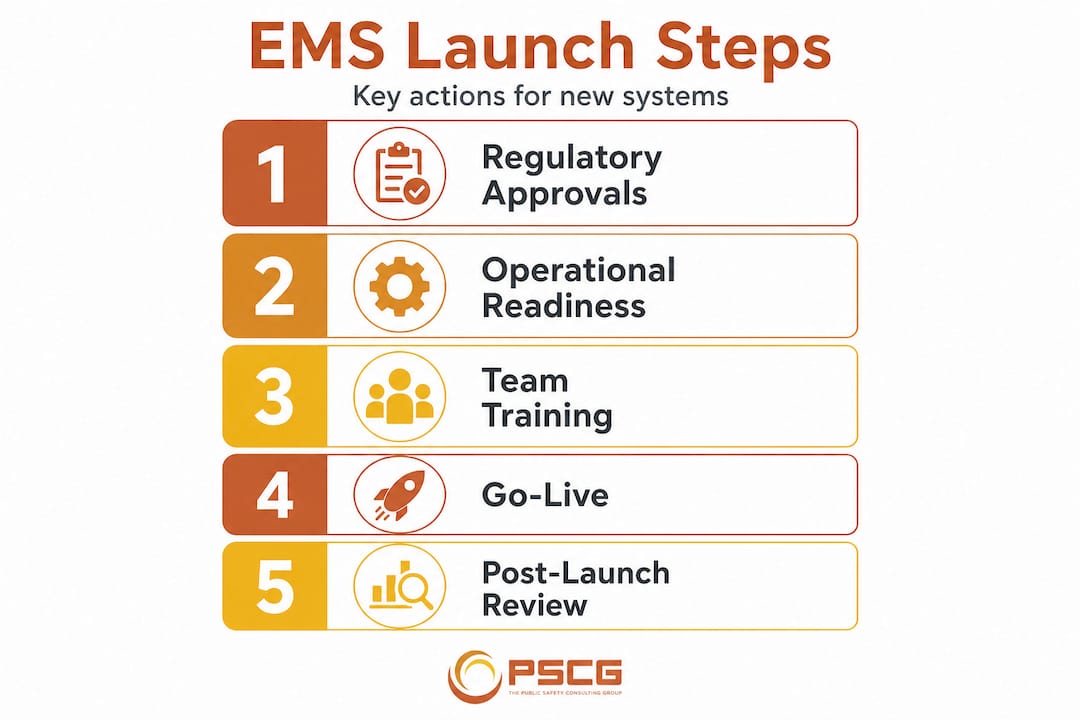
Stakeholder communication should be structured and consistent throughout the launch period. Monthly briefings to municipal leadership and quarterly reports to the public build the trust that sustains political and financial support for your system over time.
What most guides miss about starting third service EMS
Most planning guides focus heavily on the paperwork and equipment lists. Those things matter, but we have seen well-documented applications collapse during operations because the municipality never confronted two harder questions: what are you actually willing to measure, and who will be held responsible when numbers fall short?
The instinct to “add more coverage” is understandable but can be genuinely counterproductive. A municipality that deploys too many ALS units without evidence to justify them will struggle to sustain the budget, face union pressure to maintain the expanded staffing floor, and ultimately be no more accountable than the contractor they replaced. Smart EMS growth insights consistently point to the same lesson: resource decisions grounded in local data produce better outcomes than resource decisions driven by political pressure or peer community comparisons.
Financial sustainability deserves honest planning from the first budget conversation. Reimbursement rates, collection ratios, and uncompensated care levels must be modeled against realistic call volumes and cost structures before your system launches. We have worked with municipalities that were surprised to find their new system cost significantly more per transport than their previous contract, not because of waste, but because they had underestimated the true cost of direct service delivery.
The most durable third service systems are built by leaders who commit to transparent metrics, share results publicly even when they are uncomfortable, and treat corrective action as a routine management function rather than a crisis response. That culture does not develop automatically. It requires intentional design during the planning phase and consistent leadership reinforcement after launch.
Connect with expert support for municipal EMS system success
Launching a third service EMS system is one of the most significant decisions a municipal government can make, and the planning, regulatory, and operational steps involved require both technical expertise and field-tested judgment.

At The Public Safety Consulting Group, we work alongside municipal leaders at every stage of the process, from initial feasibility analysis and regulatory strategy to compliance preparation and performance measurement design. Our municipal EMS strategy guide provides a strong starting framework, and our work with communities across the country has produced EMS system design examples that demonstrate what successful launches look like in practice. If you are ready to build smarter EMS systems that deliver real accountability and sustainable performance, contact us today and let’s build a plan that fits your community.
Frequently asked questions
What are the first steps for getting approval for a third service EMS system?
You must demonstrate community need, apply for state and local permits, and appoint a qualified physician medical director before operations can begin. As noted in state EMS licensing requirements, new providers must navigate state licensing and often local need-approval processes before any service begins.
How can municipalities ensure their EMS meets compliance from day one?
They must have compliant equipment, controlled substance systems, certified staff, 24/7 coverage plans, and a functioning QAPI program ready to pass the initial survey. The Texas EMS compliance survey checklist is a useful benchmark regardless of your state.
Why do some EMS systems miss reporting on certain response pathways?
Alternative access points like nurse navigation lines or low-acuity diversion pathways can be excluded from contracts or performance measurement, creating accountability gaps. An analysis of Seattle’s ambulance service gaps illustrates how these blind spots develop when start-up planning fails to define measurement coverage for every pathway.
What is the most common staffing mistake for new EMS systems?
Deploying maximum ALS resources without local evidence to justify the configuration wastes budget and is difficult to sustain. NAEMT’s staffing guidance recommends that staffing decisions be based on acuity data, dispatch triage performance, and clinical outcomes rather than assumptions about universal ALS coverage.
How quickly can a municipality launch a third service EMS system?
Expect a realistic timeline of several months to a year, depending on state requirements, the complexity of your need-demonstration, and how quickly you achieve operational readiness. As Connecticut’s EMS plan documentation reflects, the licensing and approval process alone adds significant lead time before any unit can respond to a call.