


TL;DR:
- Incident Field Training (IFT) is a vital, practice-focused approach that enhances responder proficiency through realistic scenarios and real-time coaching. Its benefits extend to improved team communication, decision-making, and organizational resilience, making it a crucial element of comprehensive public safety training. Leaders should prioritize sustained investment in well-designed IFT programs to reduce errors, lower liabilities, and ensure operational readiness during emergencies.
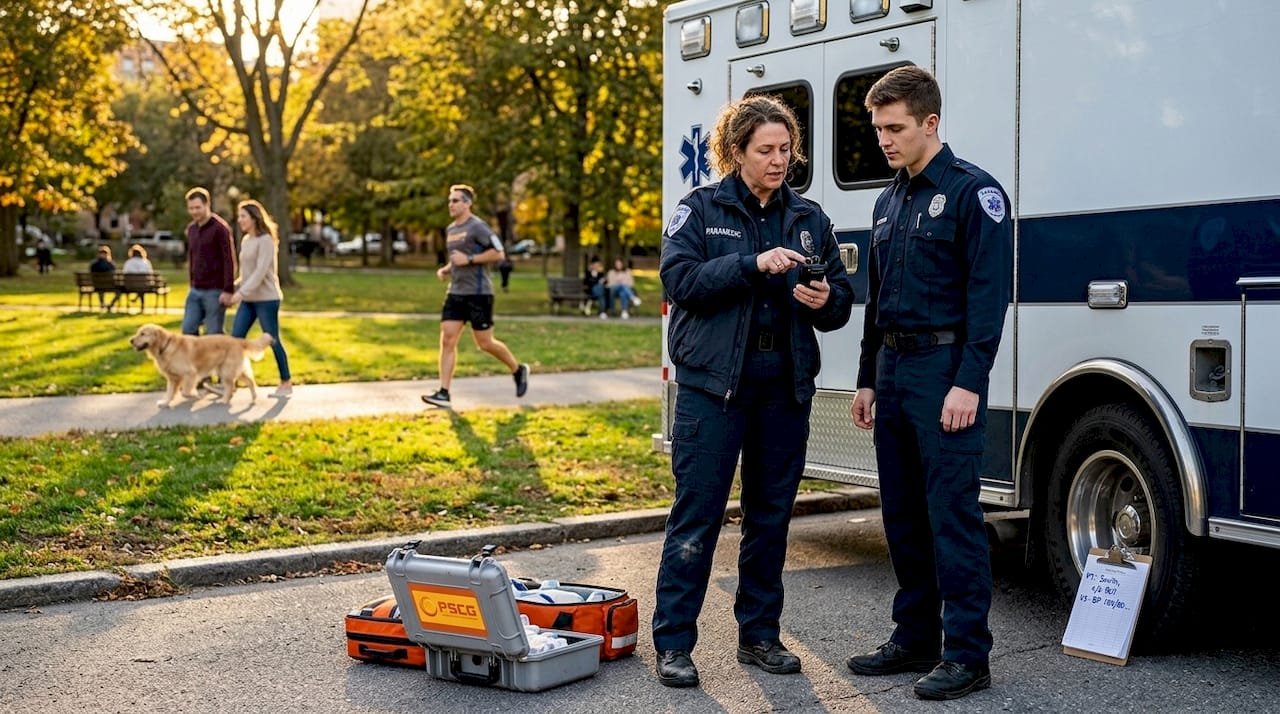
Incident Field Training, known as IFT, is one of the most operationally significant training approaches in public safety today, yet it remains underutilized in many municipal systems. While the acronym shows up across industries from food science to physical therapy, in the emergency services context, IFT means something specific and consequential. It refers to structured, field-based training programs that develop responder proficiency through simulated incidents, on-scene coaching, and real-time performance evaluation. For public safety professionals and municipal leaders, understanding what IFT programs deliver and how to build them well is the difference between a prepared response force and one that learns its lessons at the scene of an actual emergency.
Table of Contents
- Key takeaways
- What IFT means for emergency services
- Why IFT benefits the whole organization
- Designing an effective IFT program
- How IFT compares to other training methods
- Measuring success in IFT programs
- My take on why IFT deserves more serious investment
- How Thepscgroup helps you build programs that work
- FAQ
Key takeaways
| Point | Details |
|---|---|
| IFT builds field-ready responders | Scenario-based training and on-scene coaching develop skills that classroom instruction cannot replicate. |
| Benefits extend beyond individual skill | Effective IFT programs reduce on-scene errors and improve communication across the entire response team. |
| Program design requires deliberate planning | Aligning scenarios with agency priorities and engaging skilled trainers produces the most measurable impact. |
| IFT complements other training methods | When integrated with classroom learning and tabletop exercises, IFT creates a complete training ecosystem. |
| Continuous measurement sustains quality | After-action reviews and multi-source feedback are what separate programs that improve from programs that stagnate. |
What IFT means for emergency services
Incident Field Training is not a procedural drill or a compliance checkbox. IFT programs incorporate scenario-based training, on-scene coaching, and performance evaluation to build responder proficiency at every level of the organization. The distinction matters because many agencies run training that looks like IFT on paper but lacks the structured feedback and escalating complexity that actually change responder behavior under pressure.
At its core, an IFT program serves three primary objectives:
- Skills development: Responders practice psychomotor and cognitive skills in conditions that mirror real emergencies, not sanitized classroom environments.
- Situational awareness: Field trainers guide participants through the process of reading a scene, anticipating hazard escalation, and identifying what they do not yet know.
- Decision-making under pressure: Simulated high-stakes incidents force responders to make calls with incomplete information, which is exactly what they will face in the field.
The key program components that distinguish IFT from other formats include live scenario deployment, immediate and constructive feedback from experienced field trainers, structured debriefs, and documented performance evaluations. Unlike tabletop exercises, which emphasize planning and coordination, or online learning modules, which prioritize knowledge delivery, IFT is built around skill execution in conditions close to operational reality. That distinction gives it a unique and irreplaceable role in any public safety training portfolio.
Why IFT benefits the whole organization
The benefits of a well-designed IFT program extend well beyond individual responder skill. Organizations reported reduced errors and improved communication across teams after implementing IFT, which reflects how field-based learning changes not just what people know but how they work together.
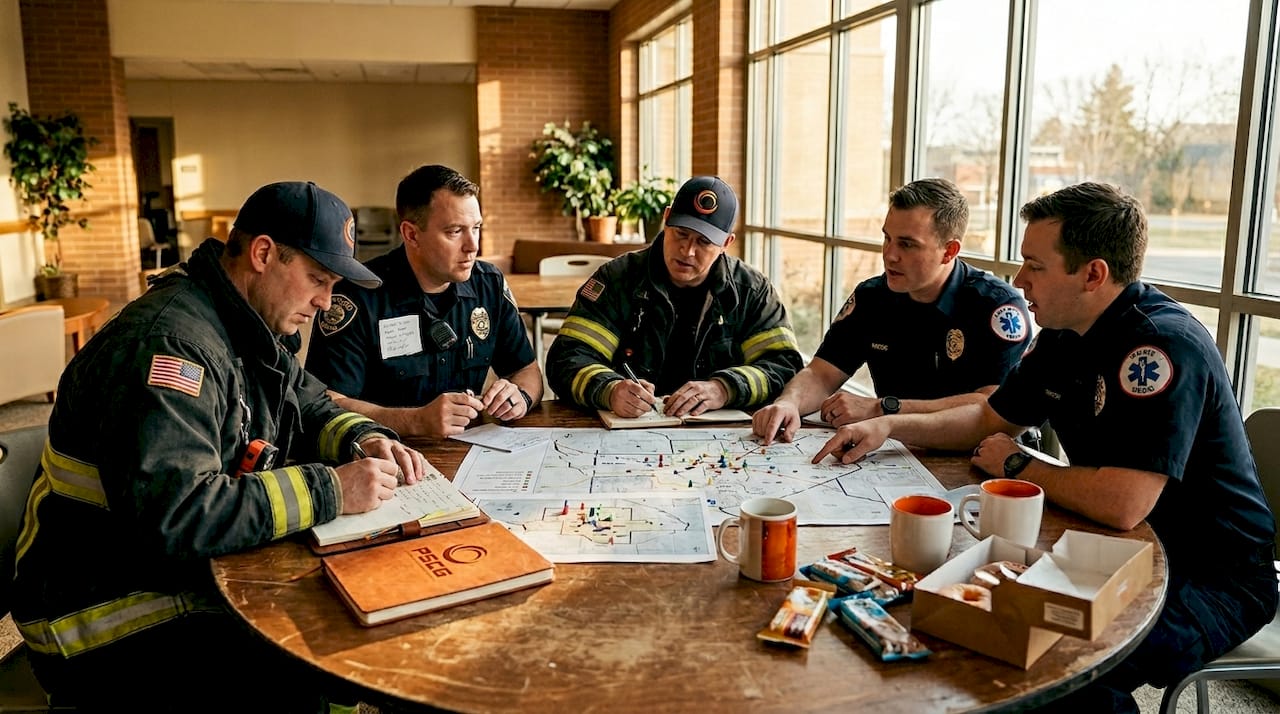
Consider what actually happens during a complex emergency. Responders are managing physical tasks, communicating across radio channels, coordinating with other agencies, and making time-sensitive clinical or tactical decisions simultaneously. Classroom instruction can explain all of those demands. Only IFT gives responders practice executing them together, under a qualified observer who can intervene, correct, and coach in real time.
The organizational benefits include:
- Improved decision-making: Repeated exposure to high-pressure scenarios builds cognitive patterns that transfer directly to actual incidents.
- Stronger team communication: IFT exercises surface communication gaps before they become on-scene failures.
- Increased responder confidence: Structured field practice reduces hesitation, which is one of the primary contributors to on-scene errors.
- Leadership development: Senior responders serving as field trainers develop coaching and accountability skills that improve the entire unit’s performance.
- Organizational resilience: Agencies with active IFT programs adapt more quickly to unusual or multi-agency incidents because their teams have practiced structured problem-solving under realistic conditions.
Pro Tip: Don’t reserve IFT only for new hires. Veteran responders who serve as field trainers often report their own skills and situational awareness sharpening significantly through the teaching process. Build that into your program’s value proposition when requesting resources from municipal leadership.
For municipal leaders, the case for IFT investment is not just operational. It is fiscal. Reduced on-scene errors translate to fewer liability exposures, fewer adverse patient outcomes, and lower long-term costs associated with retraining or incident investigation. Understanding the operational ROI of IFT is what allows you to make the case confidently to budget stakeholders.
Designing an effective IFT program
Building an IFT program that actually improves outcomes requires more than scheduling field exercises. Best practices include stakeholder engagement, alignment with operational priorities, and continuous feedback loops. Here is how that translates into a practical implementation path:
- Conduct a needs assessment. Review incident data, after-action reports, and performance gap analyses to identify where your agency’s response weaknesses are concentrated. Design your initial scenarios around those gaps, not around what is easiest to simulate.
- Develop a scenario library. Create a set of high-fidelity scenarios that reflect the incident types your responders are most likely to encounter, including low-frequency, high-consequence events that carry the greatest risk. Realistic high-pressure scenarios increase training transfer to actual emergencies.
- Select and prepare field trainers. Your trainers determine whether IFT produces results or just activity. Look for experienced responders with strong communication skills and the ability to provide immediate, constructive feedback without demoralizing participants. Trainer preparation is not optional.
- Schedule with operational reality in mind. Shift rotations, call volume, and seasonal demand all affect scheduling. Build IFT into the operational calendar rather than treating it as an add-on, and designate backfill resources so training is not sacrificed during busy periods.
- Establish a feedback and documentation system. Every IFT session should generate documented performance data. That record supports individual development conversations, informs curriculum updates, and provides the evidence base for leadership when you request continued program investment.
- Plan for resistance. Some responders view additional training requirements as a burden rather than a benefit. Address that directly through transparent communication about the program’s goals, visible leadership participation, and early showcasing of the results experienced participants report.
Pro Tip: The single most common reason IFT programs lose momentum is leadership disengagement after launch. If your fire chief or EMS director visibly participates in program reviews and acts on feedback data, participation rates and trainee buy-in stay high. If leadership goes quiet, so does the program.
How IFT compares to other training methods
Every training method has a role. The question is not whether to use IFT but how it fits within a broader training strategy. IFT offers live field realism unlike classroom or purely digital approaches, and that distinction shapes when and how to deploy each method.
| Training method | Environment | Realism level | Feedback timing | Best use case |
|---|---|---|---|---|
| Classroom instruction | Indoor, controlled | Low | Delayed | Knowledge delivery, protocols, regulations |
| Online learning modules | Self-directed, remote | Very low | Automated | Foundational content, recertification |
| Tabletop exercises | Facilitated discussion | Moderate | During debrief | Multi-agency coordination, planning |
| Simulation labs | Controlled, mannequin-based | Moderate to high | Immediate | Clinical skills, procedural practice |
| Incident Field Training (IFT) | Live field environment | High | Immediate, on-scene | Skill execution, decision-making, leadership |
Each method offers genuine value. Classroom instruction delivers the foundational knowledge base that IFT then puts into practice. Tabletop exercises strengthen command coordination in ways that field training cannot always replicate at scale. Online learning creates accessible, consistent content delivery for agencies with distributed staffing. IFT works best when it is positioned as the applied layer that validates and reinforces what those other methods teach. Agencies that treat IFT as a standalone solution miss the integration benefits, just as agencies that skip IFT in favor of purely academic training produce responders who know the right answer but struggle to execute it under pressure.
Measuring success in IFT programs
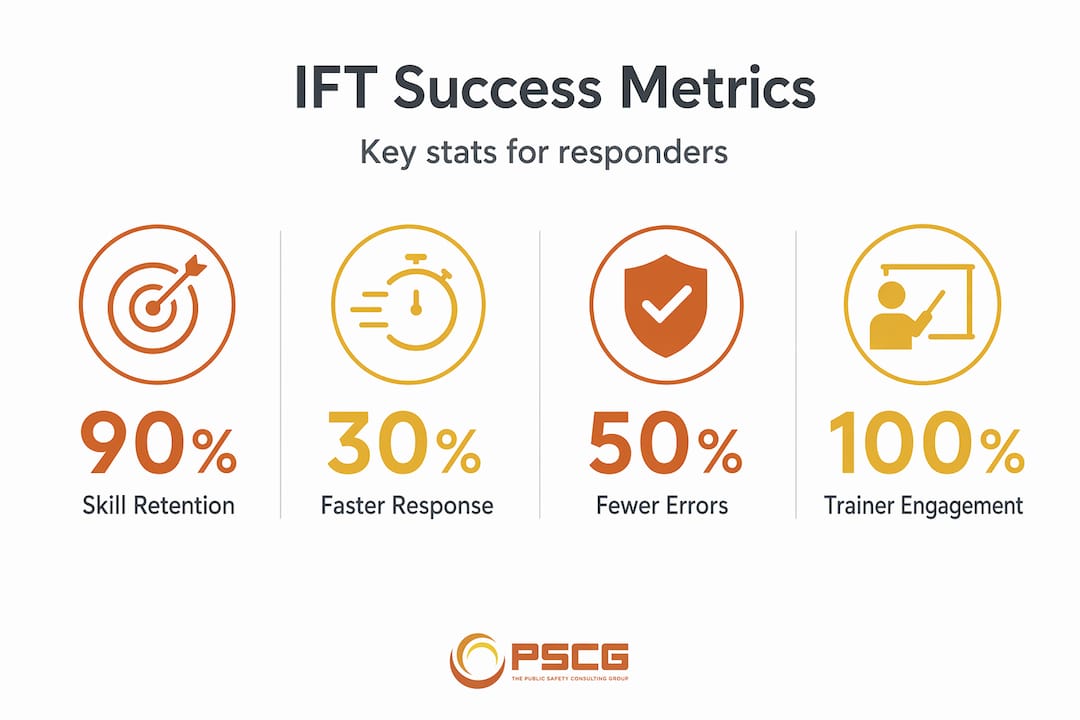
A well-run IFT program without a measurement strategy is a missed opportunity. Continuous improvement cycles enhance training relevance and impact over time, but only if your agency is actively collecting and acting on performance data.
The metrics that matter most include:
- Response time benchmarks before and after training cycles: If IFT is working, you should see measurable improvement in scene management times and coordination efficiency.
- Incident outcome data: Track adverse events, protocol deviations, and near-miss reports as a proxy for on-scene decision quality.
- Participant performance evaluations: Field trainer assessments should follow a standardized rubric so comparisons across cohorts are valid.
- After-action review findings: Structure your debriefs around specific learning objectives and track recurring themes that indicate curriculum gaps.
- Multi-source feedback: Evaluation should incorporate peer review, supervisor observation, and self-assessment to produce a complete performance picture.
Technology can accelerate this process significantly. Digital field training platforms, body-worn camera review, and learning management systems allow agencies to move from paper-based evaluations to real-time performance tracking. That data becomes the foundation for justifying continued investment, making curriculum adjustments, and identifying high-potential responders for leadership development pathways.
My take on why IFT deserves more serious investment
I’ve spent a significant amount of time working alongside municipal public safety teams, and one pattern I keep seeing is this: IFT gets treated as a budget line that flexes when finances get tight. Training is often the first cost that gets deferred and the last thing that gets restored after a lean fiscal year. That approach produces a compounding deficit.
What I’ve learned is that strong leadership involvement is the single variable that separates IFT programs that sustain momentum from those that fade after the initial enthusiasm. When the fire chief sits in on a debrief, when the EMS director reviews performance data monthly and asks hard questions, that signals to every responder in the system that this training is real and consequential. That signal changes behavior far more than any policy document can.
I’ve also seen the other side. I’ve reviewed after-action reports from communities where multi-agency response failures traced directly back to training gaps that a functioning IFT program would have addressed. The lesson isn’t abstract. It shows up in incident reports, liability claims, and community outcomes. The communities that invest thoughtfully in IFT before an incident challenges their readiness are the ones that perform when it actually counts.
My honest advice to any municipal leader reading this: don’t wait for a significant incident to motivate the investment. The ROI of a well-designed IFT program is measurable, and the cost of not having one is real. Make IFT a permanent line in your operational strategy, not a pilot program that depends on whoever champions it this year.
— Mike
How Thepscgroup helps you build programs that work

At Thepscgroup, we work directly with municipal leaders and public safety agencies to design, evaluate, and strengthen training programs that produce measurable operational results. Our approach connects EMS system design directly to training program architecture, so your IFT curriculum reflects the actual demands your responders face in the field.
We bring deep experience in performance gap analysis, scenario development, field trainer preparation, and program evaluation. Whether you are building an IFT program from the ground up or assessing why an existing one isn’t producing the results you expected, we work alongside your team to develop a strategy that fits your agency’s resources and goals.
Explore our municipal EMS strategy resources or contact us directly at thepscgroup.net to start a conversation about your agency’s training needs.
FAQ
What does IFT stand for in public safety?
IFT stands for Incident Field Training. It refers to structured, field-based training programs designed to develop emergency responder proficiency through scenario-based practice, on-scene coaching, and documented performance evaluation.
How does IFT differ from classroom training?
IFT focuses on skill execution in live, realistic field environments with immediate feedback, while classroom training prioritizes knowledge delivery in a controlled setting. Both methods serve important and complementary roles in a complete training strategy.
What are the most important components of an IFT program?
The core components of an effective IFT program include high-fidelity scenario design, experienced and prepared field trainers, structured debriefs, and a performance documentation system that supports continuous improvement.
How do you measure whether an IFT program is working?
Key indicators include improvements in response time benchmarks, reductions in on-scene errors, standardized field trainer evaluations, and after-action review findings. Multi-source feedback combining supervisor observation, peer review, and self-assessment produces the most reliable picture of program effectiveness.
How can municipal leaders justify the budget for IFT?
The operational ROI of IFT includes reduced adverse incident rates, lower liability exposure, and stronger agency readiness for complex or multi-agency events. Framing IFT as a risk management investment rather than a training expense makes the budget case more compelling to finance and elected officials.