



TL;DR:
- Less than 5% of US law enforcement agencies are nationally accredited, highlighting the process’s difficulty. Accreditation involves five key phases: application, self-assessment, on-site review, commission decision, and ongoing maintenance. Successful accreditation requires thorough preparation, leadership commitment, continuous compliance efforts, and strategic use of self-assessment to improve operations.
Less than 5% of approximately 18,000 US law enforcement agencies are nationally accredited, which tells you something important: the process is challenging enough that most agencies either avoid it or struggle to complete it. That gap represents a significant opportunity for the agencies willing to invest in the work. This guide breaks down public safety accreditation preparation into a clear, sequential path, covering the phases you will navigate, the prerequisites you need in place, the execution steps that matter most, and the strategies that keep your agency compliant long after the certificate arrives.
Table of Contents
- Understanding the accreditation process: phases and standards
- Preparation essentials: What you need before you start
- Step-by-step: Executing the accreditation process
- Common challenges and solutions in accreditation preparation
- Measuring success: Sustaining accreditation and continuous improvement
- Rethinking accreditation: What most agencies miss
- Streamline your path to accreditation with expert support
- Frequently asked questions
Key Takeaways
| Point | Details |
|---|---|
| Phased approach | Accreditation relies on a five-phase process that ensures comprehensive assessment and improvement. |
| Preparation is critical | Having proper documentation, resources, and leadership buy-in sets the foundation for success. |
| Common mistakes | Resource challenges, documentation errors, and unclear roles often undermine accreditation efforts. |
| Continuous improvement | Maintaining accreditation and benchmarking progress is an ongoing process that pays operational dividends. |
| Strategic value | True organizational benefit comes from using accreditation as a lever for cultural and strategic advancement, not just compliance. |
Understanding the accreditation process: phases and standards
After outlining the challenge, let’s define the path forward by understanding the accreditation process itself.
Public safety accreditation typically involves five key phases: application, self-assessment, on-site assessment, commission review, and maintenance or reaccreditation. Each phase builds on the last, and skipping steps or rushing through them is one of the most reliable ways to create problems downstream. Understanding what each phase demands helps you allocate staff time, budget, and attention appropriately.
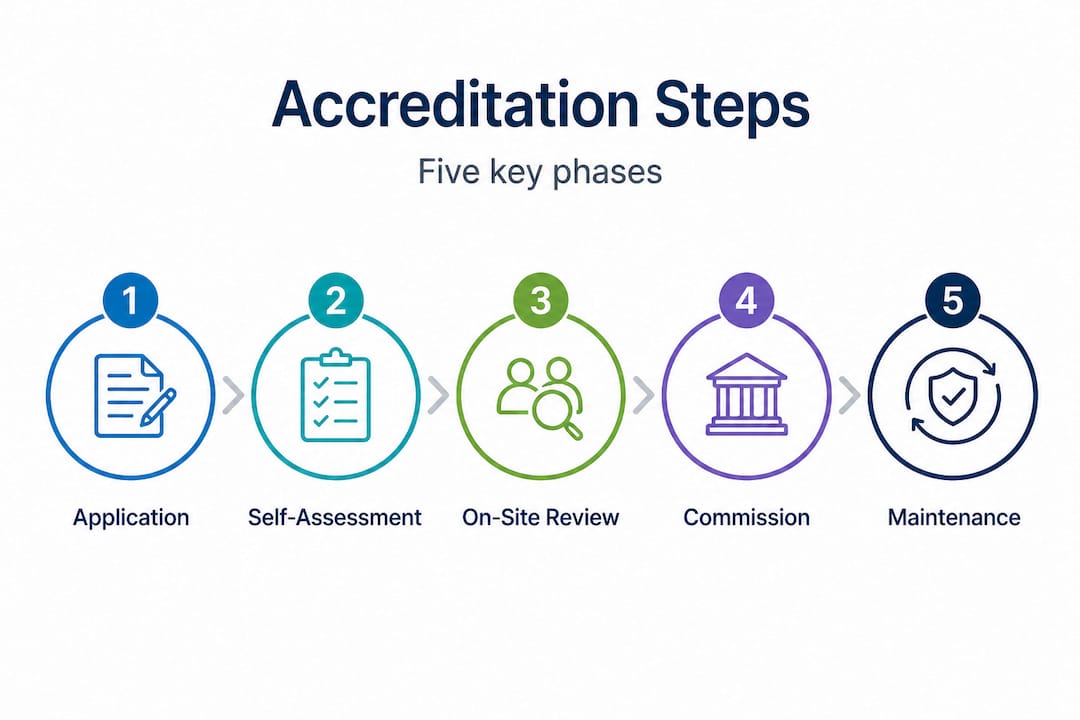
The five phases at a glance:
| Phase | Primary activity | Key output |
|---|---|---|
| Application | Eligibility confirmation, fee submission | Accepted application |
| Self-assessment | Internal standards review and gap analysis | Compliance documentation file |
| On-site assessment | External assessor review of operations and records | Assessment report |
| Commission review | Governing body evaluates assessor findings | Accreditation decision |
| Maintenance/reaccreditation | Ongoing compliance, periodic audits | Continued accredited status |
The standards themselves vary by program, but the New York State model provides a useful reference. Its 112 standards are divided across 52 administrative, 12 training, and 48 operational categories, with specific standards designated as critical for high-liability areas such as use of force, evidence handling, and emergency response. Failure on a critical standard typically triggers a more intensive review and can delay or deny accreditation.
Accreditation under that program lasts five years, with compliance audits required for reaccreditation. That five-year window sounds generous, but agencies that treat it as a vacation period rather than a continuous compliance cycle often find themselves scrambling in year four.
Strong public safety leadership strategies are foundational at every phase. Without leadership alignment from the start, the self-assessment becomes a documentation exercise rather than a genuine operational review.
Preparation essentials: What you need before you start
Once you understand the journey, ensure you have the key resources in place for a smooth start.

Preparation is where accreditation is won or lost. Agencies that arrive at the self-assessment phase without the right documentation systems, personnel assignments, and leadership buy-in consistently underperform. The preparation phase is not administrative busywork. It is the structural foundation that determines how efficiently you move through every subsequent phase.
Core preparation requirements:
- A centralized documentation management system, whether digital or physical, capable of organizing policies, training records, incident reports, and compliance evidence by standard number
- Assigned accreditation manager or coordinator with dedicated time and authority to collect, verify, and update compliance files
- Department-wide policy review to identify gaps before the formal self-assessment begins
- Leadership briefings that establish accreditation as an organizational priority, not a side project
- A realistic budget that accounts for application fees, staff time, potential policy rewrites, and external support if needed
One of the most useful early decisions is whether to pursue accreditation with internal resources only or to bring in external expertise. Both paths are viable, but they carry different risk profiles.
| Approach | Advantages | Limitations |
|---|---|---|
| In-house only | Lower direct cost, builds internal capacity | Risk of blind spots, slower timeline, staff overload |
| External support | Faster gap identification, experienced guidance | Higher upfront cost, requires good vendor selection |
| Hybrid model | Balances cost and expertise, builds capacity | Requires clear role definition between internal and external teams |
Some programs allow waivers for non-compliance during self-assessment or provide expedited paths when an agency demonstrates high readiness. Knowing these edge cases before you begin lets you plan more strategically rather than reacting to problems after they surface.
Pro Tip: Assign a dedicated accreditation coordinator before you submit your application, not after. Agencies that treat coordination as a shared responsibility across multiple staff members consistently produce inconsistent documentation and miss compliance deadlines.
For agencies operating fire or law enforcement functions, specialized support can accelerate preparation significantly. Fire department accreditation support and police department accreditation support address the specific operational standards those disciplines face, which differ meaningfully from general public safety requirements.
Step-by-step: Executing the accreditation process
Now that you’re set up, here’s how to move through the process efficiently, step by step.
Execution is where preparation meets reality. The five phases described earlier each require specific actions, and the sequence matters. Moving too quickly through self-assessment or treating the on-site assessment as a surprise inspection rather than a structured review are two of the most common execution errors we see.
Step-by-step execution guide:
- Submit your application with complete eligibility documentation and payment. Confirm your assigned program contact and timeline expectations in writing.
- Launch your self-assessment by mapping every standard to existing policies, procedures, and records. Use a compliance matrix spreadsheet to track status, responsible party, and evidence location for each standard.
- Conduct an internal gap analysis to identify standards where your agency is non-compliant or only partially compliant. Prioritize critical standards immediately, as these carry the highest risk of derailing your accreditation.
- Remediate gaps by updating policies, creating missing procedures, delivering required training, and generating documentation that demonstrates compliance. Allow adequate time for this step. Agencies frequently underestimate the effort required.
- Prepare for the on-site assessment by conducting a mock assessment with internal staff acting as assessors. Review your documentation file for completeness, consistency, and accessibility.
- Host the on-site assessment professionally. Assign a point of contact for assessors, provide workspace and access to records, and respond to requests promptly. Avoid defensiveness when assessors identify concerns.
- Respond to the assessment report by addressing any findings or recommendations before the commission review. A well-prepared response demonstrates organizational maturity and can influence the commission’s decision.
- Maintain compliance from day one of accredited status. Do not wait for the reaccreditation cycle to begin before reviewing your files.
“Accreditation is not a destination. It is a continuous process of organizational improvement that happens to produce a certificate along the way.”
The accountability benefits in accreditation extend well beyond the formal assessment. Agencies that build accountability structures during the accreditation process tend to sustain better operational performance across the board.
Pro Tip: During your self-assessment, flag every critical standard for a secondary review by a supervisor or external reviewer. A second set of eyes on high-liability standards catches errors that internal familiarity tends to mask.
Accreditation processes are structured to reward preparation and penalize reactive approaches. The agencies that perform best during on-site assessments are those that have been living their policies, not just documenting them.
Common challenges and solutions in accreditation preparation
Even the best-prepared organizations face hurdles, which are addressed in this section.
The barriers to accreditation are real and well-documented. Proponents highlight reduced liability, better operational practices, and improved public trust, while critics point to high costs, the absence of conclusive performance data, and the voluntary nature of most programs as reasons for low adoption. Understanding both sides of that debate helps you make a more informed strategic decision about which program to pursue and how to justify the investment to municipal leadership.
The most common challenges agencies face:
- Resource constraints: Accreditation preparation requires staff time that is often not budgeted. Small and mid-size agencies frequently struggle to balance daily operations with documentation demands.
- Documentation gaps: Policies that exist in practice but have never been written down are one of the most common compliance failures. Assessors cannot credit what they cannot verify.
- Standards interpretation: Some standards are written broadly enough to create genuine uncertainty about what constitutes compliance. Without guidance, agencies sometimes over-engineer solutions or miss the intent entirely.
- Leadership turnover: When a police chief, fire chief, or EMS director changes mid-process, accreditation efforts often lose momentum or institutional knowledge.
- Program selection confusion: Choosing between state and national programs without a clear strategic rationale leads to misaligned effort and, in some cases, redundant work.
Practical solutions that work:
- Use technology to your advantage. Document management platforms, compliance tracking software, and shared digital workspaces reduce the administrative burden significantly.
- Build accreditation tasks into existing workflows rather than treating them as separate projects. Policy reviews, training records, and incident documentation should feed your compliance file automatically.
- Engage 911 communications consulting strategies early if your communications center is part of the accreditation scope. Communications operations carry their own standards and timelines.
- When resources are genuinely tight, consider a phased approach. Some programs allow agencies to demonstrate readiness incrementally rather than requiring full compliance at a single point in time.
Pro Tip: Before selecting a program, map your agency’s strategic priorities against the standards each program emphasizes. Agencies that choose programs aligned with their operational goals sustain compliance more naturally because the standards reinforce what they already want to achieve.
Measuring success: Sustaining accreditation and continuous improvement
Preparation doesn’t end with accreditation; maintaining your edge is vital for lasting improvements.
Earning accreditation is a significant achievement. Keeping it requires a different kind of discipline. The reaccreditation cycle is not a formality. It is a structured opportunity to assess whether your agency has continued to operate at the standard it committed to when it first sought accreditation.
Accreditation lasts five years under programs like New York State’s, with compliance audits required for reaccreditation. That timeline creates a natural rhythm for continuous improvement if you use it intentionally.
Sustaining compliance between cycles:
- Schedule quarterly internal compliance reviews rather than waiting for annual audits
- Update policies within 30 days of any operational change, legal development, or incident that affects standard compliance
- Maintain training records in real time, not as a batch process at reaccreditation
- Benchmark your performance against peer agencies using available data on response times, incident outcomes, and community feedback
- Assign a standing accreditation committee that meets regularly and reports to agency leadership
Ohio reports over 70% of agencies committed to standards, with 477 recertified in Group 1, which demonstrates that sustained compliance is achievable at scale when organizational commitment is genuine.
| Maintenance activity | Recommended frequency | Responsible party |
|---|---|---|
| Policy review and update | Quarterly or as needed | Accreditation coordinator |
| Training record audit | Monthly | Training officer |
| Internal compliance check | Semi-annually | Accreditation committee |
| Peer benchmarking review | Annually | Agency leadership |
| Pre-reaccreditation mock assessment | 12 months before renewal | Accreditation coordinator and external reviewer |
Building public safety leadership capacity within your agency is the single most reliable predictor of sustained accreditation success. Leaders who understand the standards, believe in their value, and hold their teams accountable create the culture that makes compliance a natural outcome rather than a periodic effort.
Rethinking accreditation: What most agencies miss
Beyond the steps and challenges lies an overlooked dimension: the strategic value of accreditation.
Most agencies approach accreditation as a compliance exercise. They ask: “What do we need to do to pass?” That framing is understandable, but it misses the deeper value of the process. The agencies that extract the most from accreditation treat it as a strategic diagnostic tool, not a certification goal.
When you work through a rigorous self-assessment, you are generating a detailed picture of your agency’s operational strengths and weaknesses. That picture is valuable regardless of what the accrediting body decides. Agencies that use self-assessment findings to drive policy reform, training investment, and resource allocation decisions see operational improvements that outlast any five-year accreditation cycle.
The choice between state and national programs is another dimension that deserves more strategic thought than it typically receives. Some agencies have withdrawn from state programs in favor of CALEA, viewing the national program as more strategically aligned with their goals and more recognized by peer agencies, courts, and the public. That is not a decision driven purely by standards content. It is a leadership decision about organizational identity and long-term positioning.
We also see agencies that pursue accreditation without genuine leadership commitment, treating it as a project assigned to a coordinator rather than an organizational priority. Those agencies tend to achieve accreditation once and then struggle to maintain it, because the underlying culture never aligned with the standards they committed to. The certificate reflects a moment in time. The culture determines whether that moment becomes a baseline or a high-water mark.
Our perspective at The Public Safety Consulting Group is that accreditation is most valuable when it is treated as a leadership development process for the entire organization, not a documentation project for a single coordinator. The agencies that get this right use accreditation to build the habits, accountability structures, and performance orientation that define excellent public safety operations.
Streamline your path to accreditation with expert support
If you want the most reliable path to successful accreditation, expert guidance reduces complexity and accelerates results.
Navigating the accreditation process is demanding, and the margin for error is narrow when community safety and municipal liability are on the line. The Public Safety Consulting Group works alongside public safety agencies to design systems, close compliance gaps, and build the organizational capacity needed to achieve and sustain accreditation. Whether you are starting your first application or preparing for reaccreditation, we bring the operational expertise and strategic clarity your team needs.
Our municipal EMS strategy guide and public safety strategic planning services are built specifically for the challenges municipal leaders face. We also offer EMS system design examples that demonstrate how operational structure and accreditation readiness reinforce each other. Contact us today to discuss where your agency stands and how we can help you move forward with confidence.
Frequently asked questions
What are the main phases of the public safety accreditation process?
The process includes application, self-assessment, on-site assessment, commission review, and ongoing maintenance or reaccreditation, with each phase building directly on the previous one.
How long does public safety accreditation last?
Most programs, including New York State’s, last five years with scheduled compliance audits required before reaccreditation is granted.
What if my agency can’t meet every accreditation standard?
Some programs allow waivers for non-compliance during self-assessment or provide expedited paths when an agency demonstrates sufficiently high readiness across other standards.
Why do so few agencies pursue national accreditation?
The voluntary nature, high costs, and absence of definitive performance outcome data all contribute to the low national adoption rate among eligible agencies.
What is the difference between state and national accreditation programs?
National programs like CALEA are widely viewed as the gold standard for accreditation, offering broader recognition, while state programs often carry more localized relevance and may be less resource-intensive to achieve.
Recommended
- Ensuring excellence in EMS: 5 benefits of accountability | The Public Safety Consulting Group
- Public safety advocacy steps for Connecticut leaders – The Public Safety Consulting Group
- How to Build Public Safety Leadership for EMS Success
- Public Safety System Assessment Steps for Optimal EMS Results
- Compliance and Standards – IT Start