



TL;DR:
- EMS liability risks include ambulance collisions and patient care negligence.
- Proactive system design, training, and oversight are essential for risk mitigation.
- Effective strategies involve protocol standardization, continuous review, and medical oversight integration.
EMS operations carry liability exposure that most municipal leaders and legal counsel significantly underestimate. While the public focuses on clinical outcomes, the legal and financial risks are just as consequential. Ambulance collisions and patient care negligence account for the majority of EMS liability cases, with 92% of patient plaintiffs citing inadequate assessment or treatment as the basis for their claims. For municipal leaders and healthcare administrators managing EMS systems, understanding this liability landscape is not optional. It is the foundation of sound operational and legal governance.
Table of Contents
- Understanding EMS liability risks
- How liability impacts municipal EMS operations
- Key strategies for liability mitigation and consulting
- Lessons learned from EMS liability case studies
- What most EMS leaders miss about liability risk
- Connect with expert EMS liability consulting
- Frequently asked questions
Key Takeaways
| Point | Details |
|---|---|
| Major liability risks | Ambulance collisions and patient care negligence are the most frequent and costly EMS exposures. |
| Consulting mitigates claims | Expert EMS liability consulting helps municipalities reduce risk through best practices and systematic oversight. |
| Cost of inaction | High-value settlements demonstrate that even rare cases can impact municipal budgets substantially. |
| Proactive improvement | Continuous review and staff training are essential to manage liability and improve EMS performance. |
Understanding EMS liability risks
Building upon the introduction’s stark liability statistics, let’s examine the types of exposures that drive risk for EMS systems. EMS liability is not a single, easily defined category of risk. It encompasses a wide spectrum of exposures, each with its own causes, frequencies, and potential financial consequences. For municipal governments and healthcare administrators, failing to map these exposures is like managing a budget without understanding where the expenditures originate.
The two dominant categories of EMS liability are ambulance collisions and patient care negligence. According to historical litigation data, ambulance collisions represent roughly 50% of all EMS liability cases. This is a striking finding because many municipal leaders and even legal counsel assume patient care errors are the primary driver. In reality, operational risks on the road are equally, if not more, prevalent in litigation.
Patient care negligence cases typically involve one or more of the following failure points:
- Arrival and transport delays, where extended response times contribute to patient deterioration
- Inadequate initial assessment, including failure to recognize life-threatening conditions
- Treatment errors in the field, from medication administration to airway management
- Improper patient transport decisions, including choosing an inappropriate receiving facility
Our operational risk reduction work consistently shows that these failure points are rarely isolated incidents. They are symptoms of systemic gaps in training, oversight, and protocol adherence.
EMS liability risk overview
| Risk category | Approximate frequency | Common outcomes |
|---|---|---|
| Ambulance collisions | ~50% of cases | Injury claims, property damage, bodily injury suits |
| Patient care negligence | Majority of patient claims | Wrongful death, malpractice settlements |
| Arrival/transport delays | Frequently cited | Negligence claims, civil suits |
| Inadequate assessment or treatment | 92% of patient plaintiff claims | High settlement amounts, verdicts |
“The frequency and distribution of EMS liability cases reveal that risk is not confined to the clinical domain. Operational failures on the road and systemic gaps in patient assessment are equally central to the liability landscape. Municipalities that treat EMS risk as purely a medical issue are leaving major exposures unaddressed.” — EMS liability research perspective
The data makes one thing clear: EMS quality assurance must address both operational safety and clinical performance. A siloed approach to one without the other leaves significant risk on the table. Municipal leaders who invest in quality assurance frameworks that monitor both vehicle operations and clinical benchmarks are far better positioned to defend against litigation and, more importantly, to prevent incidents from occurring in the first place.
How liability impacts municipal EMS operations
Having outlined key risk categories, it is essential to understand how these risks translate into real-world consequences for municipal EMS systems. Liability does not end with a settlement check. Its effects ripple outward, affecting budgets, staffing, community trust, and the long-term sustainability of EMS services.

Understanding the full chain of consequences is critical for legal counsel advising municipal governments and for healthcare administrators overseeing EMS contracts and operations. Here is how a single liability incident typically unfolds from initiation to resolution.
The liability chain: from incident to litigation
- Incident occurs (collision, delayed response, patient care error)
- Internal reporting and documentation (or failure to document, which worsens exposure)
- Patient or third-party complaint filed with the municipality or EMS agency
- Legal review and investigation initiated by municipal legal counsel
- Discovery phase where records, protocols, and training documentation are examined
- Mediation or trial with potential for settlement or jury verdict
- Financial settlement or judgment rendered, along with operational remediation requirements
- Post-incident review and corrective action, often mandated by the court or insurer
Each step in this chain consumes financial resources and administrative bandwidth. It also creates reputational exposure for the municipality and can affect staff morale, retention, and recruitment. When litigation becomes public, community confidence in EMS operational impact and overall public safety capacity can erode significantly.
Legal vs. operational consequences compared
| Consequence type | Legal exposure | Operational exposure |
|---|---|---|
| Financial | Settlements, legal fees, increased premiums | Overtime costs, staffing gaps, equipment replacement |
| Reputational | Public records, media coverage, council scrutiny | Reduced community trust, political pressure |
| Systemic | Mandated protocol revisions, consent decrees | Forced operational restructuring, oversight mandates |
| Human capital | Depositions, staff testimony burdens | Staff burnout, turnover, recruitment challenges |
Research shows that 40.8% of EMS cases close without payment. However, that statistic can create a dangerous false sense of security. When cases do settle, the amounts can be substantial, and the non-financial costs of defending litigation are significant regardless of outcome. Strong medical oversight strategies are among the most effective tools for interrupting this liability chain before it reaches step three.
Pro Tip: Build a culture of accountability before you need it. Municipalities that establish routine internal audits, clear incident reporting procedures, and leadership transparency are far more likely to identify problems early and resolve them before they become litigation.
Key strategies for liability mitigation and consulting
To counteract these risks, expert consulting offers structured strategies that help municipal leaders and healthcare administrators minimize exposure. The core principle behind effective EMS liability mitigation is not reactive defense. It is proactive system design and continuous operational improvement.
The fact that 92% of patient plaintiffs cite inadequate assessment or treatment tells us that clinical protocol gaps are a primary driver of litigation. This statistic should anchor every liability mitigation strategy your organization pursues. When assessment errors are this prevalent in plaintiff claims, the answer is systematic protocol development, continuous training, and robust medical oversight.
Our EMS consulting strategies address liability mitigation through the following structured approaches.
Municipal liability mitigation checklist
- Protocol standardization: Ensure all clinical and operational protocols are current, written, and regularly reviewed by your medical director and legal counsel
- Response time benchmarking: Establish, monitor, and report response time performance against nationally recognized benchmarks to demonstrate due diligence
- Driver training and certification: Implement emergency vehicle operator courses (EVOC) with regular refresher training and documented completion records
- Medical oversight integration: Formalize the role of your EMS medical director in reviewing incidents, approving protocols, and participating in quality assurance meetings
- Documentation quality audits: Conduct routine review of patient care reports (PCRs) to ensure complete, accurate, and legally defensible documentation
- Incident review processes: Establish structured case review committees that examine adverse events without punitive framing, focusing instead on systemic correction
- Legal defensibility planning: Work with legal counsel to ensure that operational records, training logs, and protocol documents are consistently maintained and accessible
- Staffing and competency verification: Implement credentialing and recertification tracking to ensure all field personnel meet qualification requirements at all times
The quality improvement consulting process we use begins with a performance gap analysis. This means comparing your system’s current practices against established benchmarks and identifying the specific areas where exposure is highest. From that analysis, we build a prioritized corrective action plan that addresses the most urgent vulnerabilities first.
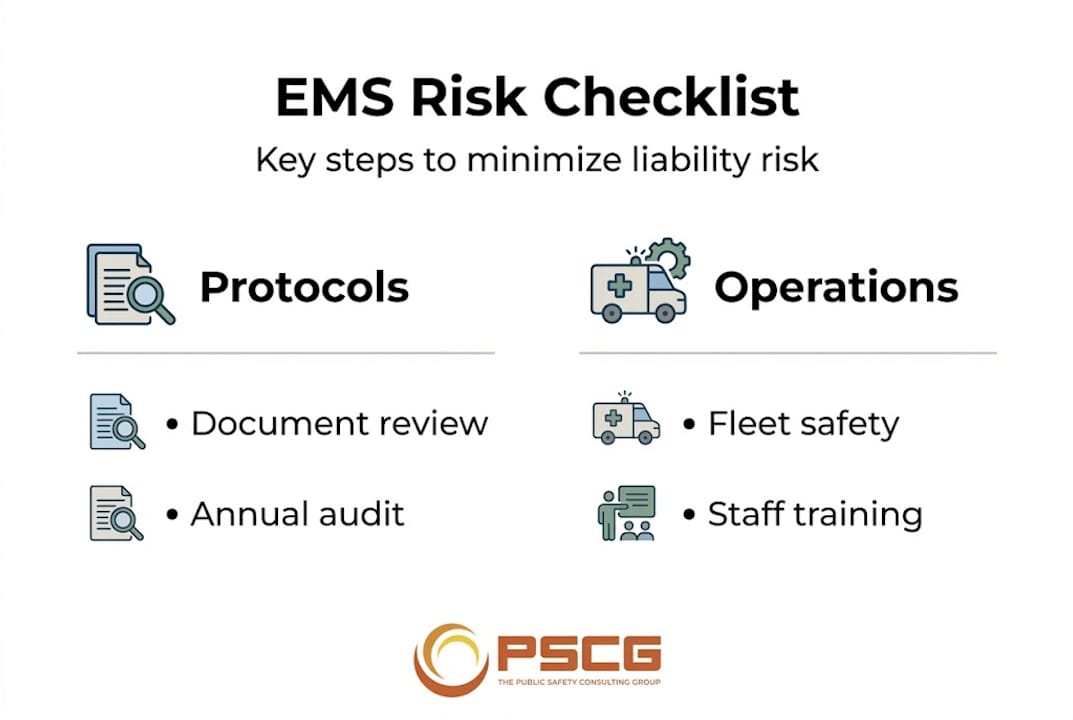
Pro Tip: Do not wait for an adverse event to standardize your protocols. Systems that conduct annual protocol reviews and integrate legal defensibility language from the outset are significantly less vulnerable when claims arise. A protocol that cannot be defended in court is effectively no protocol at all.
Effective liability mitigation also requires attention to ambulance operations, not just clinical care. Fleet safety programs, vehicle inspection checklists, and intersection safety protocols all reduce collision risk. These are not glamorous interventions, but they address the 50% of liability cases that originate behind the wheel.
Lessons learned from EMS liability case studies
With strategies established, reviewing real liability cases brings clarity about the practical risks and how consulting addresses them. Examining the patterns within EMS litigation history reveals a consistent set of preventable errors that appear across incidents, regardless of system size or geography.
Historically, five EMS liability cases resulted in settlements exceeding $1 million, demonstrating the significant financial stakes involved when liability is not proactively managed. These are not anomalies. They are the predictable outcome of systemic failures that consulting could have identified and corrected.
“A single EMS liability settlement exceeding $1 million does not just affect a municipal budget. It reshapes how that community funds, governs, and perceives its public safety infrastructure for years to come. The real cost is never just the settlement amount.”
Common preventable errors found in EMS liability cases
- Failure to document: Incomplete or absent patient care reports that leave providers unable to defend clinical decisions
- Protocol non-adherence: Field personnel deviating from established protocols without documented clinical justification
- Delayed recognition of critical conditions: Failure to identify time-sensitive emergencies such as stroke, STEMI, or sepsis during initial assessment
- Communication breakdowns: Inadequate handoff communication between field crews and receiving hospitals leading to treatment gaps
- Unsafe ambulance operations: Collisions at intersections, failure to yield, and excessive speed in non-emergency situations
- Inadequate supervisor oversight: Supervisors failing to identify and correct repeated protocol deviations before an adverse event occurs
Consider a common scenario: a patient calls 911 with chest pain. The crew arrives within response time benchmarks but fails to perform a 12-lead ECG in the field. The patient deteriorates during transport and suffers a significant cardiac event. The hospital receives no advance notification. The patient outcomes are poor. In litigation, the plaintiff’s attorney points to three specific protocol failures, none of which required extraordinary clinical skill to avoid. They required adherence to written protocols and accountability at the supervisory level.
Consulting work from the public safety consulting insights framework we apply consistently shows that these scenarios are preventable. When systems invest in structured case review, supervisory accountability, and reimbursement consultants who understand the documentation requirements that support both billing and legal defense, outcomes improve measurably.
Action steps drawn from these case studies include conducting retrospective chart reviews of all high-acuity calls, implementing real-time supervisory ride-along programs, and creating feedback loops between medical oversight and field staff. Each of these steps directly interrupts the patterns that lead to liability exposure.
What most EMS leaders miss about liability risk
Most EMS leaders approach liability management as a compliance exercise. They update their protocols when regulations change, deliver mandatory training on an annual schedule, and respond to adverse events with corrective action plans. These steps are necessary, but they are not sufficient. Compliance sets a floor, not a ceiling, for liability management.
The deeper issue is that EMS systems are dynamic, and their liability exposure shifts continuously. Staffing changes, new equipment, updated drug formularies, and changes in call volume patterns all alter the risk profile of a system. A one-time compliance review captures a snapshot of risk at a single point in time. What systems need is continuous monitoring and a feedback mechanism that surfaces emerging gaps before they become incidents.
We have observed that agencies with the lowest liability exposure share a common cultural characteristic: leadership treats near-misses with the same analytical seriousness as adverse events. These agencies review the calls that almost went wrong with the same rigor they apply to the ones that did. That discipline is not a regulatory requirement. It is a leadership choice.
Our EMS consulting expertise focuses on building these continuous improvement systems because we know that the single most expensive EMS liability event is always the one that could have been prevented. Invest in ongoing review processes, not one-off fixes. The return on that investment is measured in claims that never get filed.
Connect with expert EMS liability consulting
For municipalities and healthcare leaders seeking actionable support, the next step is connecting with consulting partners who specialize in EMS liability and risk management.

At The Public Safety Consulting Group, we work alongside municipal leaders, legal counsel, and healthcare administrators to build EMS systems that are operationally strong and legally defensible. From reviewing your EMS strategy guide to evaluating system design examples and analyzing your EMS deployment models, we bring the expertise to help you reduce exposure and strengthen services. Contact us today to start building a more resilient, accountable EMS system for your community.
Frequently asked questions
What are the most common EMS liability exposures for municipalities?
The most common EMS liability exposures are ambulance collisions and patient care negligence, including delays in arrival and inadequate assessment or treatment, which 92% of patient plaintiffs cite in their claims.
How can EMS consulting reduce liability risk?
Consulting provides structured frameworks for risk assessment, protocol standardization, staff training, and medical oversight that directly address the systemic gaps most responsible for EMS liability claims.
Are EMS liability claims expensive for municipalities?
While many cases close without payment, some settlements exceed $1 million, and the non-financial costs of litigation, including staff time, reputational harm, and operational disruption, are significant regardless of outcome.
What is the role of medical oversight in EMS liability management?
Medical oversight establishes clinical protocols, monitors field performance, and identifies systemic weaknesses in assessment and treatment practices that are the most frequently cited sources of EMS liability exposure.