



TL;DR:
- EMS operational blind spots stem from incomplete data and stakeholder input, risking poor decision-making.
- A structured review involves validating data, comparing metrics, conducting interviews, and setting actionable recommendations.
- Multivariable analysis and dynamic benchmarking are essential for accurate performance assessment and ongoing improvement.
Operational blind spots are one of the most persistent risks Connecticut municipalities face in managing EMS systems. When performance data is incomplete, response-time benchmarks are miscalculated, or stakeholder input goes uncollected, leaders end up making high-stakes decisions on unreliable information. A structured EMS operational review addresses exactly these gaps, giving you a clear, evidence-based picture of where your system performs well and where it falls short. This guide walks municipal leaders and public safety administrators through every stage of an operational review: what you need, how to execute it, what can go wrong, and how to verify lasting improvement.
Table of Contents
- What you need for a successful EMS operational review
- Step-by-step process for conducting an operational review
- Common pitfalls and how to avoid them
- Verifying results and tracking ongoing improvements
- A smarter way to approach EMS operational reviews
- Take your review further: Tools and consulting for Connecticut EMS leaders
- Frequently asked questions
Key Takeaways
| Point | Details |
|---|---|
| Plan with CT EMS standards | Align your operational review process with Connecticut’s OEMS and EMS Plan guidelines for performance and evaluation. |
| Treat documentation as QA | Ensure ePCR completeness and quality to avoid biased metrics and support reliable operational decisions. |
| Embrace analytics complexity | Use multivariable models and frequent audits to accurately track and improve response times and outcomes. |
| Benchmark and update regularly | Compare against state/national standards and repeat reviews to drive continuous improvement. |
What you need for a successful EMS operational review
Having set expectations, let’s clarify what you’ll need upfront before starting your operational review. Preparation is not a formality. It directly determines the accuracy and credibility of everything your review produces.
Connecticut’s regulatory framework sets the foundation. The State EMS Plan 2023–2028 reflects that Connecticut’s Office of Emergency Medical Services (OEMS) requires and publishes a statewide EMS Plan on a five-year cycle, with specific goals, timelines, cost data, alternative funding sources, and performance standards for evaluation. This document is not background reading. It is the governing benchmark against which your local system should be measured.
Your review will only be as good as the data you bring into it. Below is a checklist of the core documentation and tools required:
- Current ePCR (electronic patient care report) exports from the past 12 to 36 months
- Prior operational audit reports and any corrective action records
- Compliance metrics and certification status for personnel
- Mutual aid agreements and resource sharing documentation
- Budget records, funding allocations, and any alternative funding sources
- Call volume data segmented by time of day, geography, and call type
- Prior quality improvement committee meeting minutes
Alongside your documentation, you need to identify the right stakeholders before you begin. This includes EMS medical directors, department supervisors, municipal finance officers, dispatch center managers, and union representatives where applicable. Overlooking any of these voices early can create gaps in your qualitative data later.
| Preparation element | Why it matters |
|---|---|
| ePCR data (validated) | Drives all quantitative performance metrics |
| Prior audit reports | Reveals unresolved issues and trend patterns |
| Compliance records | Flags certification and regulatory gaps |
| Stakeholder map | Ensures all operational perspectives are captured |
| CT OEMS benchmarks | Provides the external standard for comparison |
Understanding the system assessment steps relevant to your community type is also essential. Rural municipalities face different resource constraints than urban systems, and your preparation should account for that distinction from the start.
Pro Tip: Don’t wait until the review kicks off to request ePCR data. Place that request with your vendor at least 30 days in advance, because formatting, filtering, and validation often take longer than expected and can delay your entire timeline.
A structured operational auditing guide can also help your team align on scope and methodology before the first meeting, particularly if this is your municipality’s first formal review in several years.
Step-by-step process for conducting an operational review
With the materials and context in place, here’s how to execute a thorough operational review step-by-step. Structure matters here. A disorganized review often produces findings that are difficult to defend or act on.
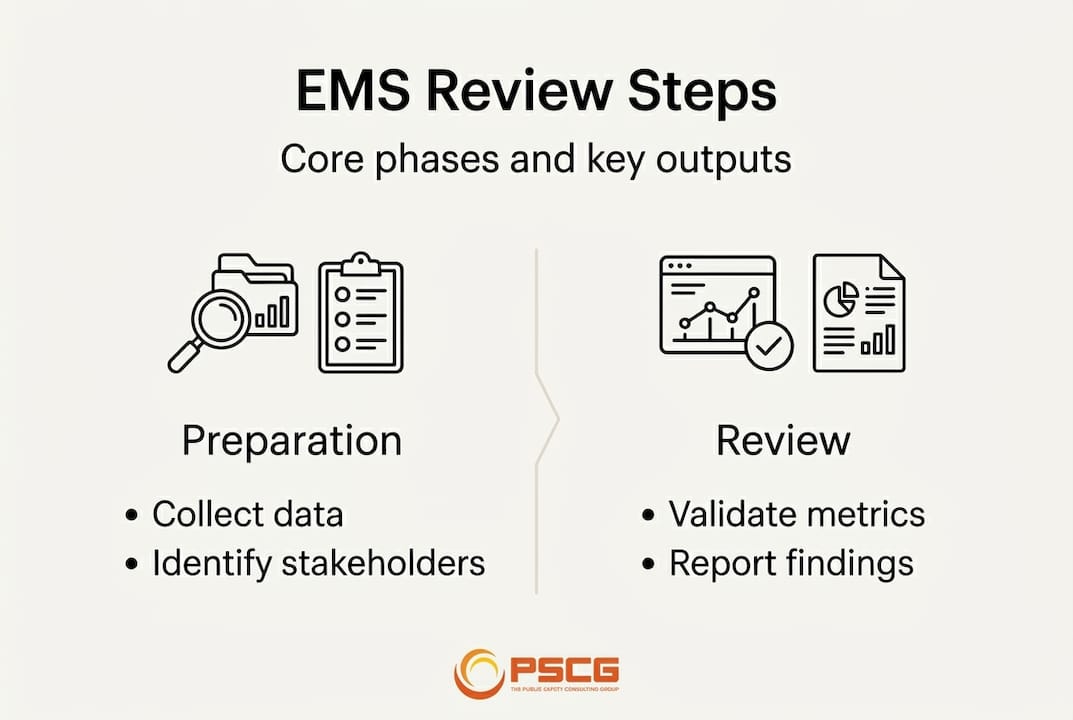
Validate your ePCR data first. Before any analysis begins, run your ePCR dataset through completeness and consistency checks. According to Connecticut’s framework, the 2024 OEMS Annual Report confirms that Connecticut uses statewide ePCR data with built-in validation rules for completeness and provides performance measurement including response-time metrics and unit and town characteristics. If your data has high rates of missing fields, those gaps need to be flagged before you build any performance tables.
Review prior performance standards and compare current metrics. Pull your response-time data, unit hour utilization rates, cardiac arrest survival rates, and call-to-treatment intervals. Compare them against your previous review cycle, the state benchmarks from the OEMS annual report, and any applicable national standards from organizations such as NAEMSP or ACEP.
Conduct structured qualitative interviews with EMS personnel. Surveys alone rarely surface the operational friction that experienced responders notice every shift. Schedule structured, confidential interviews with field crews, supervisors, and dispatch staff. Ask open-ended questions about equipment reliability, protocol clarity, staffing challenges, and communication breakdowns.
Benchmark against state and national performance standards. Use the OEMS report data to position your system relative to statewide averages. Where your metrics fall below state benchmarks, document the gap precisely and note contributing variables such as geography, staffing levels, or dispatch protocols.
Document all findings in a structured report with prioritized recommendations. Each finding should include the metric or observation, the evidence source, the magnitude of the gap, and a recommended corrective action with a suggested timeline.
| Review phase | Primary output |
|---|---|
| Data validation | Cleaned, complete ePCR dataset |
| Metric comparison | Performance gap analysis table |
| Qualitative interviews | Summary of field-level operational insights |
| Benchmarking | Variance report vs. state and national standards |
| Recommendations | Prioritized corrective action plan |
Reviewing our operational audit guide before drafting your findings report can help you structure recommendations in a way that municipal decision-makers will find actionable and credible. Strong recommendations are specific, measurable, and tied directly to the evidence your review produced.

Pro Tip: Align your review’s reporting timeline with your municipality’s budget cycle. Recommendations that arrive after budget decisions are made will likely wait a full year to get funded, which delays improvement and frustrates your EMS team.
Connecting your review to a broader strategic planning process ensures that findings don’t sit in a binder but instead feed directly into your municipality’s operational priorities and resource allocations.
Common pitfalls and how to avoid them
Even the most prepared teams can make missteps. Here’s how to steer clear of the most common problems that can quietly compromise the quality and credibility of your operational review.
Incomplete ePCR documentation is the most damaging pitfall. The 2024 OEMS Annual Report explicitly ties all statewide reporting to what was documented in ePCRs and uses validation rules as an initial QA step. When field crews leave required fields blank or enter inconsistent data, the resulting metrics are distorted at the source. You cannot identify a performance gap if the data generating that metric is unreliable.
Common pitfalls to watch for and correct:
- Biased response-time calculations from inconsistencies in how dispatch timestamps are recorded across shifts or units
- Vendor reporting differences that make comparing ePCR data across system changes or software migrations misleading
- Failure to cross-reference QA validation outputs before drawing conclusions from summary statistics
- Stakeholder exclusion, particularly frontline crew members, who often have the most direct knowledge of operational dysfunction
- Treating process audits and data audits as separate activities, when in reality they must be integrated to produce valid findings
“Treat ePCR and electronic documentation quality as part of the performance measurement system itself. Incomplete documentation does not just reflect poor charting habits. It actively distorts your operational metrics and the decisions that follow.”
Coordinating with a quality improvement consulting partner can help your team build a documentation quality audit into the review process from the start, rather than discovering data problems after weeks of analysis.
Reviewing EMS best practices from peer municipalities also helps your team recognize which performance gaps are common and addressable versus which ones signal deeper structural problems requiring more significant intervention.
Pro Tip: Create a standardized ePCR completeness report that your QA officer runs monthly, not just at review time. Catching documentation gaps in real time is far less costly than discovering them during a formal review when the damage to your dataset is already done.
Another frequently overlooked pitfall is scope creep. Reviews that begin with clear parameters often expand as new issues surface. Expanding scope mid-review is not inherently wrong, but it must be formalized with revised timelines and additional stakeholder sign-off to avoid confusion about what the final report actually covers.
Verifying results and tracking ongoing improvements
After addressing pitfalls, it’s time to confirm your review’s impact and lay the groundwork for lasting improvement.
A completed operational review is not the end of the process. It is the beginning of a performance improvement cycle. Verification means confirming that your recommendations are actually producing measurable change, not simply that they were implemented on paper.
Start with multivariable analysis of your performance data. A 2025 Stockholm EMS analysis confirms that EMS response-time improvement is analytically complex, with large datasets and multivariable modeling approaches needed to understand response-time drivers and their interrelationships. Relying on a single metric, such as average response time, to declare success is analytically insufficient. You need to understand which variables shifted and how they interacted.
Steps for verifying review outcomes:
- Re-run your baseline metrics 90 days after implementing recommendations. Compare the new results directly against your pre-review baseline to measure movement.
- Disaggregate data by unit, geography, and time of day. System-wide averages can mask poor performance in specific zones or shifts.
- Hold a structured debrief with EMS supervisors and QA staff. Ask whether the recommended changes are functioning as intended in daily operations, not just on paper.
- Adjust your corrective action plan based on what the data shows. Rigid adherence to an original plan, even when results suggest course correction is needed, is a common and costly mistake.
- Schedule the next review cycle. Verification is most meaningful when it feeds directly into planning your next formal operational review.
For ongoing tracking, consider building a performance dashboard that monitors the following in near real-time:
- ePCR completion rates by unit
- Response-time compliance by geographic zone
- Unit hour utilization against staffing benchmarks
- Cardiac arrest outcomes and protocol adherence rates
- Call volume trends segmented by call type
Statistic callout: Research confirms that multivariable modeling of EMS response-time data is necessary to understand the true drivers of performance variation, because single-factor explanations regularly fail to account for dispatch delays, geographic complexity, and concurrent call load simultaneously.
Building analytics for public safety into your ongoing operations, rather than reserving data analysis only for formal review cycles, is increasingly becoming the standard expectation for well-managed municipal EMS systems.
Understanding EMS response time statistics and their clinical implications will also help your leadership team communicate the human stakes of performance improvement to elected officials and the public.
A smarter way to approach EMS operational reviews
Let’s pause for a practical rethink, based on what the research and real experience have shown.
One of the most persistent mistakes we see in municipal EMS reviews is the over-reliance on a single performance metric, usually average response time, as a proxy for overall system health. It’s understandable. Response time is visible, quantifiable, and politically legible. But it is also deeply misleading when used in isolation.
The 2025 Stockholm EMS analysis demonstrates that response-time performance depends on many interacting factors, including dispatch protocols, geography, weather conditions, and concurrent call volume, which argues strongly for multivariable analysis rather than single-metric conclusions.
What this means practically is that two Connecticut municipalities can report identical average response times and have entirely different underlying performance realities. One system may be performing efficiently across all zones. The other may be masking severe delays in rural corridors with strong urban performance pulling the average up. Only multivariable analysis will surface that distinction.
The same logic applies to benchmarking. Static benchmarks that don’t evolve alongside your system’s changing call volume, geography, or staffing model will gradually become irrelevant. Effective EMS strategy consulting incorporates dynamic benchmarking, adjusting performance expectations as system conditions change. Data integrity, analytical flexibility, and benchmarks that evolve with your system are not optional features. They are the foundation of a review process that actually improves public safety rather than just producing documentation.
Take your review further: Tools and consulting for Connecticut EMS leaders
If you’re ready for bigger impact, specialized support can accelerate your progress. Operational reviews are demanding, and having the right expertise alongside your team makes the difference between a report that sits on a shelf and one that drives real change.

At PSCG, we work directly with Connecticut municipalities to design, execute, and follow through on EMS operational reviews that produce defensible findings and actionable results. Whether you need a complete EMS system design consulting engagement or targeted EMS quality improvement consulting to address specific gaps, we tailor our approach to your system’s realities. Start with our municipal EMS strategy guide to map your priorities, then contact us to build a plan that fits your timeline and budget.
Frequently asked questions
What core data sources should Connecticut EMS operational reviews use?
The State EMS Plan 2023–2028 and OEMS annual reports, including validated ePCR datasets and response-time metrics, are the essential foundation for any Connecticut EMS operational review.
How does ePCR quality affect EMS operational review outcomes?
Incomplete or inconsistent ePCR data distorts key performance metrics and can lead to flawed operational decisions, which is why the 2024 OEMS Annual Report identifies ePCR validation as a first-round quality assurance step.
What analytical models are recommended for EMS operational reviews?
Multivariable modeling, including regression and other advanced approaches, is recommended because multivariable approaches are needed to understand the complex interrelationships driving EMS response-time performance.
How often should Connecticut municipalities conduct operational reviews?
Formal reviews should align with the Connecticut OEMS five-year planning cycle, though targeted annual reviews are advisable whenever performance metrics shift significantly or major operational changes occur.
What’s one easy improvement step for EMS review quality?
Implement a monthly ePCR completeness audit so that documentation gaps are caught in real time, because the 2024 OEMS Annual Report confirms that OEMS uses validation rules to highlight incomplete fields as a first-round quality assurance step.