

TL;DR:
- Dispatch consulting helps improve operational efficiency by aligning people, processes, governance, and technology.
- Strategies include AI-assisted call taking, consolidation, virtual dispatch, and hybrid models tailored to community needs.
- Effective engagement involves structured assessment, stakeholder input, pilot testing, and ongoing performance monitoring.
Dispatch center consulting for stronger public safety outcomes
Many municipalities pour significant resources into dispatch center upgrades, from next-generation CAD systems to AI-assisted call taking, only to find that response times plateau and staff turnover climbs. The gap is rarely about the technology itself. It is about how people, processes, governance, and data work together underneath the surface. Dispatch center consulting exists precisely to close that gap, giving municipal leaders and emergency management officials a structured, evidence-based path from operational uncertainty to measurable performance improvement. This guide breaks down what consulting actually involves, which strategies work and when, and how your leadership team can evaluate and apply these approaches with confidence.
Table of Contents
- What is dispatch center consulting and why does it matter?
- Core strategies and models consultants use
- How consultants assess and improve dispatch center operations
- Pitfalls to avoid and questions municipal leaders should ask
- What most dispatch center consulting guides miss
- Expert guidance for every phase of dispatch center optimization
- Frequently asked questions
Key Takeaways
| Point | Details |
|---|---|
| Consulting unlocks efficiency | Engaging experts in dispatch center operations leads to cost savings, reliability, and enhanced public safety outcomes. |
| Model choice matters | Selecting the right approach—AI, consolidation, or virtual PSAP—impacts both success and risk profiles. |
| Assessment is ongoing | Continuous measurement and follow-through are critical for sustainable improvement in dispatch services. |
| Ask strategic questions | Municipal leaders should vet consulting partners with targeted questions to avoid common project pitfalls. |
What is dispatch center consulting and why does it matter?
Dispatch center consulting is a specialized service that helps municipalities evaluate, redesign, and improve the operational systems that power their Public Safety Answering Points (PSAPs). A PSAP is the facility that receives 911 calls and coordinates emergency response. Consulting engagements in this space typically cover technology assessment, staffing models, protocol compliance, interoperability, governance structures, and long-term performance benchmarking.
It is worth being direct about what consulting is not. It is not a product sale. A qualified consultant does not arrive with a predetermined solution. Instead, they conduct a structured performance gap analysis, identify the root causes of operational inefficiency, and build a roadmap tailored to your municipality’s call volume, geography, budget, and workforce capacity.
Why does this matter to municipal leaders? Because every second of delay in a dispatch center has a measurable outcome in the community. Cardiac arrest survival rates drop approximately 10 percent for every minute without defibrillation. Structure fires double in size roughly every minute. Dispatch center efficiency is not an administrative detail. It is a public safety imperative.
Here is what effective consulting addresses:
- Technology integration: Ensuring CAD systems, radio interoperability, and emerging tools like AI-assisted call taking are properly deployed and staff-supported
- Staffing models: Analyzing turnover drivers, scheduling structures, and workload distribution to reduce fatigue and improve retention
- Governance clarity: Clarifying who owns operational decisions across agencies sharing a dispatch center
- Data-driven improvement: Establishing baseline metrics and ongoing monitoring so improvements are visible and sustainable
- Protocol compliance: Verifying that dispatchers follow nationally recognized protocols such as MPDS (Medical Priority Dispatch System) consistently
One common misconception is that consulting is only viable for large urban PSAPs. In reality, EMS consulting strategies are highly scalable. Smaller municipalities often benefit even more because proportional improvements in efficiency translate directly to community outcomes without requiring large capital investments.
Another misconception is that consulting is prohibitively expensive. The key consulting advantages typically include reimbursement optimization and cost-reduction recommendations that offset the consulting investment within the first engagement cycle.
Pro Tip: Before engaging a consultant, document your three most pressing operational pain points in specific, measurable terms. Vague concerns like “things feel chaotic” make scoping harder and extend timelines. Specific statements like “our average call-to-dispatch time exceeds 90 seconds for Priority 1 medical calls” give consultants an immediate foothold.
As AI call-taking tools are explored by departments like Vail Police, the pattern is consistent: technology alleviates staffing pressure but introduces new risks around reliability and dispatcher fatigue if not implemented within a carefully structured operational framework.
Core strategies and models consultants use
Once you understand why consulting matters, the next question is what strategies consultants actually deploy. The landscape has evolved considerably, and no single model works universally. The right approach depends on your municipality’s size, call volume, budget, existing infrastructure, and inter-agency relationships.
Here are the primary models in use today:
- AI-assisted call taking: Artificial intelligence tools that handle initial call intake, gather caller information, and route the call to a dispatcher with contextual data pre-populated. This approach reduces time-to-dispatch and eases cognitive load on staff.
- Consolidation: Merging two or more PSAPs into a single regional center to reduce operating costs, share staffing resources, and standardize protocols.
- Virtual PSAP: A model where dispatchers work remotely or across distributed locations using cloud-based platforms, offering flexibility during surges and staff shortages.
- Hybrid models: Combining elements of the above, such as AI triage plus partial consolidation, to address specific local constraints.
Each approach carries meaningful tradeoffs, as consolidation and virtual dispatch both offer cost advantages but introduce governance complexity and monitoring challenges that require careful planning.
| Strategy | Strengths | Risks | Best fit |
|---|---|---|---|
| AI call taking | Faster dispatch, reduced staff burden | Technology reliability, staff resistance | High call volume PSAPs with tech infrastructure |
| Consolidation | Cost savings, protocol standardization | Governance disputes, community resistance | Adjacent municipalities with aligned leadership |
| Virtual PSAP | Staffing flexibility, surge capacity | Supervision difficulty, connectivity risks | Areas with chronic staffing shortfalls |
| Hybrid model | Customized to local needs | Complexity in implementation | Multi-agency environments with mixed challenges |
“The question is never which technology is best in isolation. The question is which strategy, or combination of strategies, fits the operational and political reality of your municipality right now.”
A useful illustration: a mid-sized Connecticut municipality facing a 22 percent dispatcher vacancy rate explored full consolidation with a neighboring town. After a C-MED dispatch center review and governance assessment, consultants recommended a phased approach: AI-assisted triage first to stabilize current operations, followed by a shared services agreement that preserved each municipality’s dispatching identity while reducing duplicate infrastructure costs. This avoided a contentious consolidation vote while still delivering 18 percent cost reduction in year two.
For leaders evaluating public safety communication systems, the critical variable is not the technology catalog available. It is the sequencing of changes and the degree to which each step is tested before the next is layered on. Consultants who push for rapid, large-scale transformation without piloting create as many problems as they solve.
Interoperability is another dimension that is frequently underestimated. An interoperability analysis ensures that dispatch systems can share real-time information with fire, EMS, and law enforcement across jurisdictional lines, which is essential for mutual aid and mass casualty events.
How consultants assess and improve dispatch center operations
Understanding consulting models is valuable, but knowing how the engagement actually unfolds is what allows municipal leaders to set realistic expectations and contribute productively to the process.
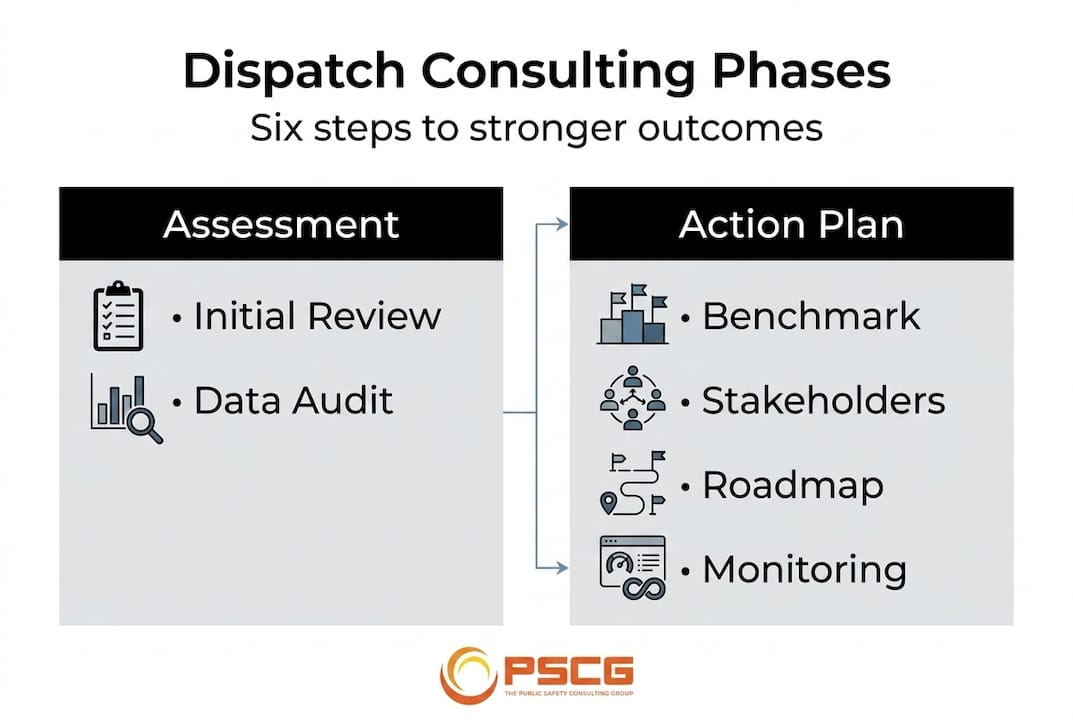
A well-structured consulting engagement follows a defined workflow:
Phase 1: Initial review and scoping. Consultants conduct structured interviews with dispatch supervisors, department heads, and IT staff. They review existing policy documents, CAD configuration, staffing records, and any available performance data.

Phase 2: Data collection and audit. This is where the work gets granular. Consultants pull call logs, response time records, quality assurance reports, and equipment uptime data. They observe live operations, usually across multiple shifts and call volume periods.
Phase 3: Performance benchmarking. Collected data is measured against national standards, peer municipality comparisons, and the municipality’s own stated service goals.
Here is a sample of the metrics typically tracked during an assessment:
| Metric | What it measures | National benchmark |
|---|---|---|
| Time to answer | Speed of initial call pickup | Under 10 seconds for 95% of calls |
| Call processing time | Dispatch interval for Priority 1 calls | Under 60 seconds |
| Technology uptime | CAD and radio system availability | 99.9% or higher |
| Staff turnover rate | Annual dispatcher attrition | Under 15% |
| Protocol compliance | Adherence to approved dispatch protocols | Above 95% |
| Callback rate | Calls requiring follow-up from confusion | Under 3% |
Phase 4: Stakeholder engagement. Findings are presented to dispatchers, supervisors, IT staff, and municipal leadership separately before being synthesized. Front-line dispatcher input is especially critical. Dispatchers often identify process gaps that data alone cannot reveal.
Pro Tip: Do not skip the front-line engagement step. Dispatchers who feel excluded from the consulting process frequently resist implementation. Including them early transforms potential obstacles into problem-solving partners.
Phase 5: Roadmap development. Consultants produce a prioritized action plan with specific timelines, resource requirements, and accountability assignments. This is not a generic report. It is a governance-ready document your leadership can act on directly.
Phase 6: Implementation support and monitoring. The best consulting engagements do not end at the report stage. Consultants remain involved through training delivery, technology configuration support, and regular performance reviews. EMS quality consulting at this level ensures improvements are sustained, not just initiated.
A common error that EMS consulting myths consistently debunk is the belief that a single technology upgrade replaces the need for ongoing process review. It does not. Data from AI-assisted dispatch pilots shows that without workflow redesign alongside technology deployment, performance gains are often temporary and staff burnout risk increases.
Pitfalls to avoid and questions municipal leaders should ask
Even well-intentioned consulting engagements fail when leaders are not equipped to ask the right questions or recognize early warning signs. Having reviewed numerous dispatch center improvement initiatives, we see the same mistakes emerge repeatedly.
Common pitfalls in dispatch center consulting:
- Over-promising technology: Vendors and consultants who lead with technology features before completing an operational assessment are reversing the correct sequence. Technology should solve a defined problem, not search for one.
- Ignoring governance complexity: When multiple agencies share a dispatch center, decision-making authority must be clearly assigned. Consultants who do not address governance upfront create implementation deadlocks.
- Underestimating staff fatigue: Dispatcher burnout and exhaustion are documented risks in high-volume PSAPs, and any consulting plan that does not account for workforce wellbeing will underperform.
- Neglecting scalability: Solutions designed for today’s call volume may be inadequate in three years. Consultants must build growth assumptions into every recommendation.
- Skipping the pilot phase: Large-scale rollouts without structured pilots carry enormous risk. Pilots reveal integration failures, staff training gaps, and unanticipated workflow disruptions before they affect the full operation.
Questions every municipal leader should ask before signing an engagement:
- What municipalities of similar size and call volume have you worked with, and what were the measurable outcomes?
- How do you approach governance when multiple agencies are involved?
- What does your implementation support look like after the final report is delivered?
- How do you account for dispatcher wellbeing in your recommendations?
- What metrics will we use to define success, and at what intervals will they be reviewed?
- How do you handle recommendations that require policy or legislative changes?
- What is your process for managing stakeholder resistance at the front-line level?
Positive indicators when evaluating a consulting partner include a willingness to interview dispatchers directly, a clear track record with fire department consulting and EMS integration, and a methodology that separates assessment from solution delivery.
Red flags include consultants who arrive with a technology preference before completing any assessment, those who cannot name specific outcome metrics from prior engagements, and those who minimize the governance or cultural complexity of your situation.
Pro Tip: Before full-scale rollout of any new dispatch protocol or technology, run a four-to-six week pilot on one shift or one call category. Document everything. Use what you learn to refine the implementation plan before it becomes the standard.
What most dispatch center consulting guides miss
Most articles on dispatch center consulting treat the challenge as primarily technical. Get the right software, adopt the right protocol, hit the right benchmarks. In our experience working alongside public safety leaders across New England and beyond, the most persistent barriers to lasting improvement are cultural, not technical.
Front-line dispatchers often operate under significant stress with limited agency over their working conditions. When leadership rolls out a new system without genuine buy-in, the result is passive resistance: workarounds, underutilization of new tools, and accelerated turnover. We have seen six-figure technology investments underperform because the implementation skipped two weeks of structured staff engagement.
Leaders also frequently underestimate the gap between their strategic vision and what dispatchers experience shift to shift. A governance restructuring that makes sense on an org chart can translate into confusion and conflict on the floor if not communicated clearly and incrementally.
The proven public safety consulting strategies that deliver lasting results share one common trait: they treat technology and process as enablers, not solutions. Incremental, well-communicated change with consistent feedback loops outperforms any large-scale transformation initiative that prioritizes speed over sustainability. Balance innovation with operational reality, and never underestimate the value of a dispatcher who feels respected and heard.
Expert guidance for every phase of dispatch center optimization
Navigating dispatch center improvement requires more than good intentions. It requires structured expertise, field-tested frameworks, and a consulting partner who understands both the operational demands and the political realities of municipal public safety.
At The Public Safety Consulting Group, we work alongside municipal leaders and emergency management officials to build dispatch center strategies that are realistic, measurable, and sustainable. Whether you are exploring a municipal EMS strategy guide for the first time or ready to act on a specific performance gap, we bring the structured methodology and real-world experience your operation needs. Explore our EMS system design examples and strategic public safety planning resources to see how municipalities like yours have moved from uncertainty to measurable, lasting improvement.
Frequently asked questions
What is the main benefit of dispatch center consulting for small municipalities?
Dispatch center consulting provides tailored strategies that improve response time and efficiency, even for small municipalities with limited resources, by focusing on the specific operational gaps that have the greatest impact on community safety.
Does dispatch center consulting only focus on technology upgrades?
No, consulting also covers staff training, operational processes, governance, and resource allocation, ensuring that technology investments are supported by the organizational and human infrastructure needed to make them work.
How can municipalities evaluate the success of dispatch center consulting?
Success is measured through improved response times, fewer critical errors, and increased staff satisfaction post-engagement, using baseline metrics established at the start of the consulting process to track progress objectively.
What questions should leaders ask when considering a consulting firm?
Leaders should ask about the firm’s experience with similar municipalities, what measurable outcomes prior clients achieved, and what implementation support looks like after the final report is delivered.