



TL;DR:
- True interoperability requires comprehensive progress across governance, procedures, technology, training, and usage.
- Readiness assessments, including technology inventories and standards compliance, are essential before system upgrades.
- Sustained leadership, policy discipline, and ongoing training are critical for long-term interoperability success.
When two agencies respond to the same structure fire and their radios cannot reach each other, lives hang in the balance. That is not a hypothetical. It is a recurring operational failure that costs response time, creates command confusion, and in the worst cases, costs lives. For municipal leaders and emergency management professionals, closing that gap is not optional. This guide walks you through the SAFECOM Interoperability Continuum framework, readiness assessment, a proven implementation roadmap, and sustainability strategies so your jurisdiction can achieve genuine, measurable interoperability across EMS and public safety systems.
Table of Contents
- Understanding the interoperability continuum and why it matters
- Assessing readiness: What you need before starting
- Step-by-step: How to enhance public safety interoperability
- Troubleshooting, sustainability, and funding for ongoing success
- The uncomfortable truth most leaders miss about interoperability
- Get expert guidance to drive interoperability success
- Frequently asked questions
Key Takeaways
| Point | Details |
|---|---|
| Start with the continuum | Assess your agency using the SAFECOM Interoperability Continuum to identify the biggest gaps and priority actions. |
| Be readiness-focused | Strong governance, SOPs, and technology standards set the stage for successful interoperability projects. |
| Execution is stepwise | Follow proven steps—governance, SOPs, technology deployment, training, and ongoing assessments—for best results. |
| Plan for long-term sustainment | Anticipate funding needs, legacy system challenges, and persistent training to keep your improvements resilient. |
| Technology isn’t everything | Lasting interoperability depends as much on people, policy, and practice as on new radios or software. |
Understanding the interoperability continuum and why it matters
Before you can fix a problem, you need a shared language to describe it. The SAFECOM Interoperability Continuum, maintained by the Cybersecurity and Infrastructure Security Agency (CISA), gives public safety leaders exactly that. It organizes interoperability progress across five defined lanes: Governance, Standard Operating Procedures (SOPs), Technology, Training and Exercises, and Usage. Each lane represents a dimension where your jurisdiction either advances or stalls.
Governance covers the formal agreements, leadership structures, and policy frameworks that authorize cross-agency communication. SOPs define the specific procedures personnel follow when those communications occur. Technology addresses the hardware, software, and network infrastructure that make communication physically possible. Training and Exercises ensure personnel can actually execute the SOPs under real conditions. Usage measures how consistently and effectively all of the above is applied during daily operations and incidents.
What makes the continuum so valuable is that it forces leaders to assess all five lanes simultaneously. Many agencies invest heavily in technology while neglecting governance or training, which is precisely why expensive radio upgrades often fail to produce measurable improvement. When you are overcoming interoperability barriers, the continuum gives you a structured baseline to identify where the real gaps are.
On a practical scoring level, a benchmark score of 3.74 out of 5.0 was recorded in Texas assessments, reflecting mid-level interoperability maturity. That number matters because federal grant programs increasingly require agencies to demonstrate continuum-aligned progress to qualify for funding. Scoring below 3.0 in any lane signals a systemic gap that grant reviewers will flag.
True interoperability, as defined by SAFECOM, means:
- Seamless voice and data communication across agencies and jurisdictions
- Multi-agency coordination without manual workarounds or patch solutions
- Multi-vendor equipment compatibility using open standards like P25
- Consistent performance during both planned events and unplanned emergencies
- Documented, exercised, and regularly updated SOPs
If your current system requires a dispatcher to physically relay information between two agencies because their systems cannot talk, you are not interoperable. You are compensating.
For agencies working on optimizing communication systems, the continuum also provides a credible, defensible framework for presenting improvement plans to elected officials and budget committees.
Pro Tip: Formally designate an Interoperability Coordinator within your agency and engage your State Interoperability Coordinator (SWIC), the National Council of Statewide Interoperability Coordinators (NCSWIC), and your Regional Emergency Communications Coordination Working Group (RECCWG) before you spend a single dollar on technology upgrades.
| Continuum lane | What it measures | Common gap |
|---|---|---|
| Governance | Formal agreements and authority | Missing MOUs between agencies |
| SOPs | Documented communication procedures | Outdated or untested protocols |
| Technology | Equipment and network compatibility | Legacy systems, vendor lock-in |
| Training and exercises | Personnel readiness | Infrequent drills, low participation |
| Usage | Daily operational application | Inconsistent field adoption |
Assessing readiness: What you need before starting
Understanding the continuum is step one. Next, ensure your agency is actually prepared to start improving. Readiness assessment is not a formality. It is the difference between a well-targeted investment and a costly misalignment.
Start with a technology inventory. Know exactly what radio systems, dispatch platforms, and data networks you are operating. Identify every vendor, every contract expiration date, and every system that uses proprietary rather than open standards. Vendor lock-in is one of the most common obstacles we see in municipal assessments, and it rarely surfaces until a procurement decision is already made.
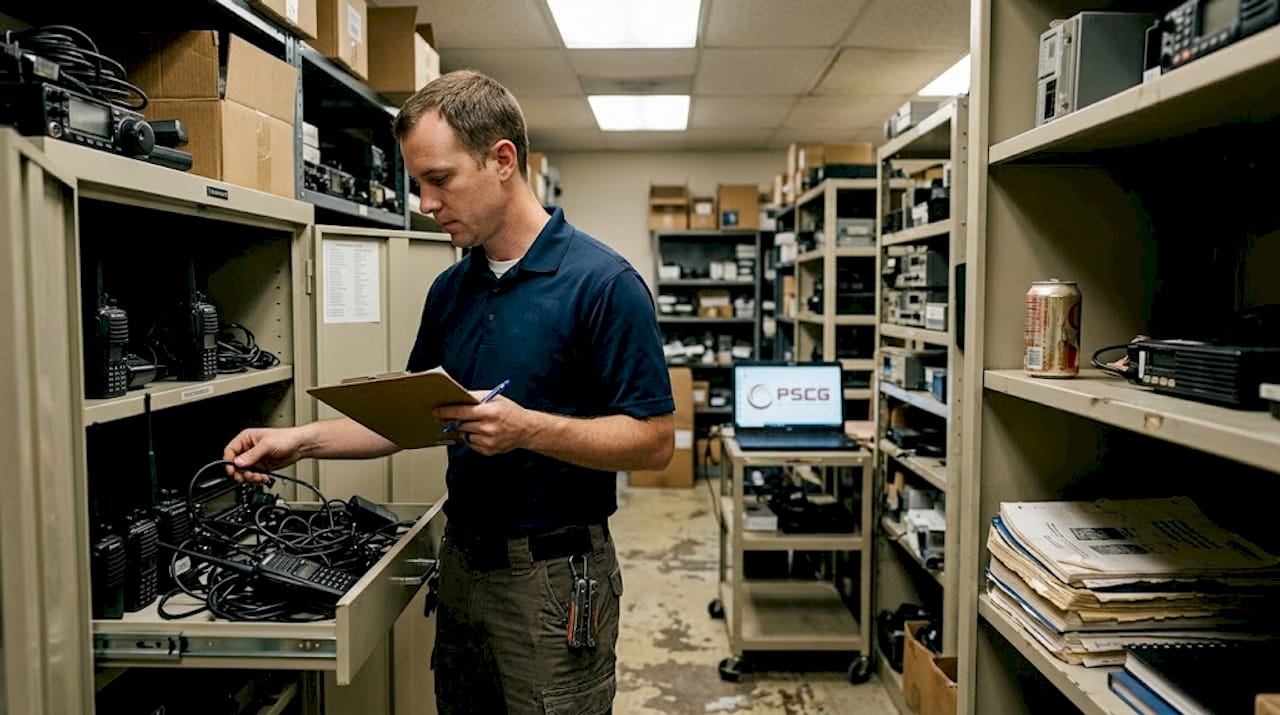
Connecticut’s P25 trunked system offers a strong readiness reference point. The state’s adoption of the P25 open standard enabled multi-agency, multi-vendor interoperability across diverse terrain and jurisdictions, including during active wildfire response. That outcome required deliberate readiness work before the technology was deployed, not after.
For leaders exploring core EMS and public safety definitions, readiness also means confirming compliance with key standards: NENA i3 for Next Generation 911 (NG911) architecture, P25 templates for radio system design, FCC licensing requirements, NFPA communication standards, and HIPAA for any data systems that carry patient information.
Use this checklist to validate your starting position:
- Technology inventory: All radio systems, CAD platforms, and data networks documented
- SOP review: Existing communication protocols reviewed and dated within the last 24 months
- Training records: Personnel training levels verified against current SOP requirements
- Grant eligibility: SAFECOM continuum score documented and SWIC engaged
- Vendor assessment: Proprietary vs. open-standard systems identified and flagged
- Compliance check: NENA i3, P25, FCC, NFPA, and HIPAA requirements confirmed
The benefits of system integration only materialize when this groundwork is solid. Skipping the readiness phase is the single fastest way to waste grant funding.
| Readiness dimension | Basic agency | Advanced agency |
|---|---|---|
| People | Limited designated roles | Trained interoperability coordinator |
| SOPs | Informal or outdated | Documented, exercised, current |
| Technology | Legacy, proprietary systems | P25 compliant, open standards |
| Coordination | Ad hoc, reactive | Active SWIC and RECCWG engagement |
Step-by-step: How to enhance public safety interoperability
With your baseline set, follow this proven path to real, measurable progress. These steps reflect core methodologies drawn from SAFECOM grant guidance and field-tested implementation experience.
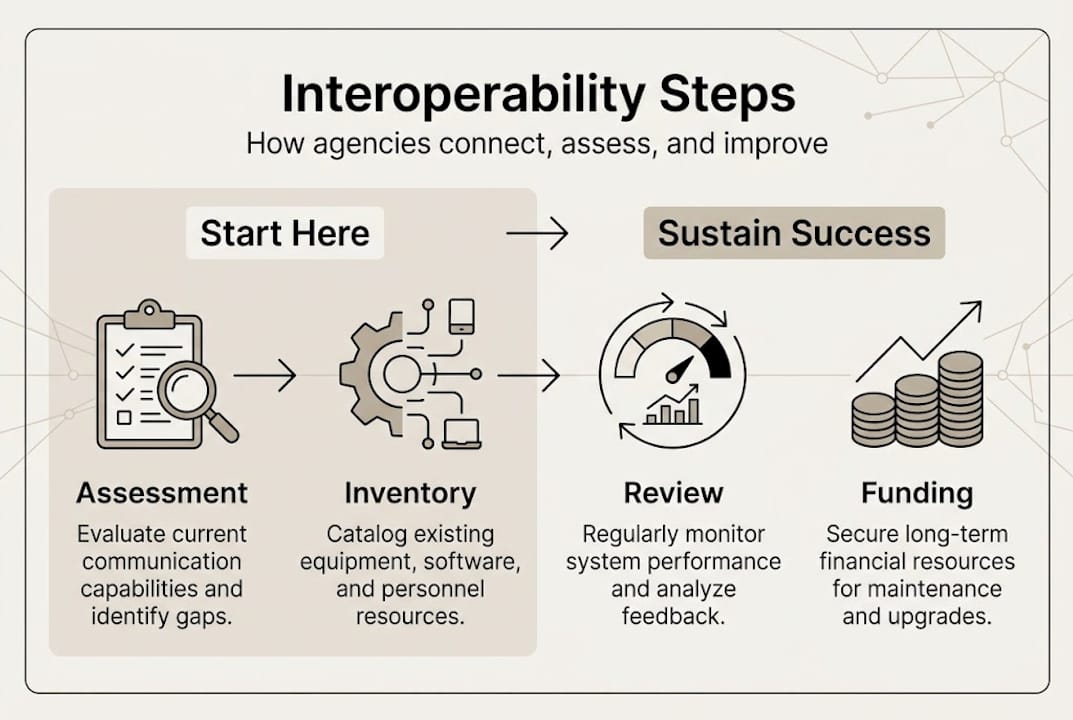
Establish governance first. Formalize Memoranda of Understanding (MOUs) between all participating agencies. Designate your Interoperability Coordinator and define the decision-making authority for cross-agency communication. Without this, every subsequent step lacks enforcement.
Draft and validate SOPs. Develop written communication procedures that cover daily operations, mutual aid activations, and major incident response. Involve field personnel in drafting. SOPs written only by administrators rarely survive first contact with an actual incident.
Upgrade technology using open standards. Prioritize P25-compliant radio systems and NENA i3-aligned NG911 architecture. Avoid proprietary solutions that create future lock-in. Reference key terminology for EMS communications to ensure procurement language is precise and enforceable.
Conduct structured training and exercises. Schedule tabletop exercises and full-scale drills that test your SOPs under realistic conditions. Document participation, identify failures, and revise SOPs accordingly. Training is not a one-time event.
Monitor usage and measure outcomes. Track how consistently personnel use approved channels and procedures during actual incidents. Compare against your continuum baseline score quarterly. Use that data to drive continuous improvement and support future grant applications.
Pro Tip: Always include both technical staff and field personnel in every testing phase. Technical teams identify system failures. Field personnel identify procedural failures. You need both perspectives to produce a reliable after-action report.
CISA guidance note: Agencies transitioning from legacy gateway systems to NG911 architecture should conduct a cybersecurity risk assessment before cutover. Legacy Time Division Multiplexing (TDM) gateways can introduce logical vulnerabilities when bridged to IP-based NG911 networks. Treat the transition period as a high-risk window requiring additional monitoring and documented contingency procedures. See official SAFECOM guidance for current templates.
Troubleshooting, sustainability, and funding for ongoing success
Improvements mean little without ongoing rigor and resourcefulness. Here is how to make success last beyond the initial implementation phase.
The most common mistakes we see agencies make after a successful upgrade include:
- Overlooking legacy system integration: New systems deployed alongside old ones without a formal bridge or sunset plan create shadow communication channels that bypass interoperable infrastructure.
- Ignoring field feedback: When field personnel report that a procedure does not work in practice, those reports must be captured and acted on. Dismissing them produces workarounds that undermine the entire system.
- Missing cybersecurity audits: Key challenges like legacy TDM integration and NG911 cyber exposure require scheduled audits, not reactive responses.
- Undertraining staff on updated systems: Every technology upgrade must be paired with a training update. Assuming personnel will self-adapt is a documented path to degraded performance.
Route diversity reminder: Physical and logical route diversity in NG911 systems is not optional. A single point of failure in a 911 network can take an entire jurisdiction offline. Agencies should document primary and backup routing for every critical communication pathway and test those backups on a defined schedule.
For strategic tips on municipal sustainability, funding alignment is equally critical. Federal programs such as the Homeland Security Grant Program (HSGP) and Emergency Management Performance Grant (EMPG) favor agencies that demonstrate SAFECOM continuum alignment, active SWIC coordination, and documented training records. Agencies that cannot produce those records consistently leave grant funding on the table.
To maintain a continuum score above 3.5 out of 5.0 post-implementation, build a formal annual review cycle. Reassess all five continuum lanes each year. Update SOPs when personnel, technology, or jurisdictional agreements change. Engage your SWIC and RECCWG regularly, not just at grant application time. For troubleshooting interoperability challenges that persist after implementation, a structured gap analysis against the continuum almost always surfaces the root cause.
The uncomfortable truth most leaders miss about interoperability
After working with municipalities across the country, we have observed a consistent pattern. Leaders who invest in technology upgrades and then declare victory are the same leaders who call us two years later wondering why their interoperability scores have not improved.
The hard truth is that technology is the easiest part. Radios, software platforms, and network upgrades are procurable. Governance discipline, SOP adherence, and a training culture that sustains itself without external pressure are not. Connecticut’s P25 success was built on consistent governance and sustained training commitment, not just equipment investment.
Real interoperability requires leaders who are willing to confront cultural inertia inside their own organizations. That means enforcing SOP compliance when it is inconvenient, funding training when budgets are tight, and holding governance partners accountable when MOUs are not honored. The system integration wisdom that produces lasting results lives in daily practice, not in procurement documents. If you are not prepared to lead that culture, no technology investment will close the gap.
Get expert guidance to drive interoperability success
Ready to operationalize change? The right support ensures you move from assessment to action with precision and accountability.
At PSCG, we work alongside municipal leaders and emergency management professionals to build interoperability strategies that hold up under real operational pressure. From initial continuum assessments to full municipal EMS strategy development, we bring field-tested methodology and a deep understanding of federal funding alignment to every engagement. Whether you are starting from scratch or refining an existing system, our EMS system design experience and strategic planning capabilities are built to deliver measurable results. Contact us today to schedule a tailored consultation.
Frequently asked questions
What is public safety interoperability?
It is the ability of emergency systems and personnel to communicate and work together seamlessly across agencies and jurisdictions using compatible procedures and technologies, as defined by the SAFECOM framework.
What’s the first step for improving interoperability in my city?
Complete a SAFECOM Interoperability Continuum assessment and consult with your state SWIC and relevant working groups to identify current gaps; SAFECOM assessment and SWIC engagement are the recognized starting points.
How do federal grants align with interoperability projects?
Federal grants favor agencies that align projects with the SAFECOM Continuum, NENA i3 standards, and stakeholder coordination; grants prioritize compliance with these frameworks and collaborative best practices.
What is the biggest barrier to full interoperability?
Most often, the primary obstacles are governance gaps, inconsistent training, and unsustainable funding structures, not technology shortfalls; major barriers consistently trace back to human and policy factors.
What cybersecurity risks affect public safety interoperability?
Newer systems like NG911 can introduce cyber vulnerabilities through IP-based architecture; regular audits of physical and logical route diversity are considered best practice by CISA.