


TL;DR:
- EMS quality improvement consulting offers objective system assessments, strategic planning, and operational audits.
- Success depends on thorough preparation, clear SMART goals, and continuous local adaptation.
- Sustained improvement requires leadership follow-through, regular reviews, and a culture of non-punitive learning.
Municipal EMS leaders know the frustration well: years of investment, revised protocols, and staff training, yet response time benchmarks and clinical outcome targets remain just out of reach. EMS quality improvement consulting uses a structured, strategic process to address complex challenges and boost system performance in ways that internal efforts alone rarely achieve. This article walks you through how to prepare, execute, and verify lasting EMS improvements using proven consulting frameworks, national benchmarks, and practical strategies built for the realities of municipal public safety operations.
Table of Contents
- Understanding EMS quality improvement consulting: The foundation
- Preparation: Assessing your EMS system and defining goals
- Execution: Deploying consulting frameworks and best practices
- Troubleshooting & verification: Lessons learned, monitoring, and sustaining progress
- A fresh perspective: Why EMS quality improvement consulting needs local nuance and relentless follow-through
- Take your EMS quality improvement to the next level
- Frequently asked questions
Key Takeaways
| Point | Details |
|---|---|
| Structured consulting adds value | Using expert consulting creates objective improvement frameworks and delivers measurable results for municipal EMS systems. |
| Data-driven assessment matters | Benchmarking current performance against standardized metrics is essential for setting realistic goals and tracking progress. |
| Continuous review sustains gains | Quarterly audits, stakeholder engagement, and adaptable strategies keep improvements from stalling or reversing. |
| Local context drives success | Customization to community factors—like urban/rural differences and local regulations—determines how well EMS consulting translates into real-world impact. |
Understanding EMS quality improvement consulting: The foundation
EMS quality improvement (QI) consulting is the practice of engaging external experts to assess, plan, and guide systematic improvements to an emergency medical services system. Unlike routine internal reviews, consulting brings objectivity, specialized diagnostic tools, and access to national performance data that most municipal teams simply do not have on hand.
The core service categories include:
- System assessments: A structured review of your agency’s operations, staffing models, response zones, and clinical protocols.
- Strategic planning: Long-range roadmaps aligned to community growth, budget realities, and regulatory requirements.
- Operational audits: Detailed compliance reviews that surface gaps in documentation, billing, and clinical standards.
- Compliance improvement: Targeted interventions to bring agencies into alignment with state and federal requirements.
The difference between consultant-led and internal-only QI is significant. Internal teams are close to the work, which creates blind spots. Consultants bring structured benchmarking tools, cross-agency comparisons, and the credibility to deliver findings that internal leaders sometimes cannot.
| Factor | Consultant-led QI | Internal-only QI |
|---|---|---|
| Objectivity | High | Limited |
| Access to benchmarks | National/regional data | Local data only |
| Specialized tools | Yes | Rarely |
| Stakeholder credibility | Strong | Variable |
| Speed to diagnosis | Faster | Slower |
Established firms offering consulting services overview bring structured methodologies that internal teams cannot replicate without significant investment. As noted by system assessments and planning at firms like Fitch & Associates, expert consulting includes risk mitigation and strategic planning tailored specifically for municipal EMS agencies. Understanding the advantages of EMS consulting begins with recognizing that outside expertise accelerates the path from problem identification to measurable results.
Preparation: Assessing your EMS system and defining goals
Before any improvement plan can succeed, you need an honest, data-driven picture of where your system stands today. Preparation is not a formality. It is the foundation that determines whether your improvement effort produces real results or just paperwork.

Start with a thorough EMS assessment strategies review using standardized performance measures. The National EMS Quality Alliance (NEMSQA) and the National EMS Information System (NEMSIS) provide the benchmarks most widely accepted across the industry. Quality improvement begins with strategic assessment using KPIs like response times, clinical outcomes, and service reliability, with NEMSQA and NEMSIS measures serving as the benchmarking standard.
Here is a structured preparation sequence:
- Pull baseline data. Extract at least 12 months of run data from your CAD and ePCR systems.
- Compare against national benchmarks. Use the NEMSIS state dashboard to compare your agency’s performance against state and national peers.
- Identify priority gaps. Focus on response time compliance, cardiac arrest outcomes, STEMI protocol adherence, and documentation accuracy.
- Engage all stakeholders. Medical directors, field supervisors, municipal administrators, and community representatives each hold critical information.
- Set SMART goals. Every objective must be Specific, Measurable, Achievable, Relevant, and Time-bound to be actionable.
Tools that support this phase include data dashboards, structured run reviews, and RACI matrices (Responsible, Accountable, Consulted, Informed) to clarify who owns each improvement task.
Pro Tip: Do not skip the community representative step. Residents and local officials often surface service gaps that data alone will not show, especially in underserved or geographically isolated areas.
A solid EMS needs assessment at this stage prevents costly mid-course corrections later. The time invested in preparation directly determines the quality of your improvement plan.
Execution: Deploying consulting frameworks and best practices
With clear objectives in place, the work shifts to deploying proven frameworks that drive measurable change. This is where structured methodology separates effective consulting engagements from efforts that stall after the initial report.
The most widely used improvement model in EMS is the PDSA cycle: Plan, Do, Study, Act. Each cycle tests a targeted change, measures its effect, and either scales it or adjusts based on findings. Combined with NEMSQA benchmarking measures and NEMSIS dashboards as outlined in EMS Agenda 2050, PDSA cycles create a disciplined, repeatable path to improvement.
A practical execution sequence looks like this:
- Launch a baseline clinical review. Identify the top three clinical performance gaps from your preparation phase.
- Design targeted interventions. Match each gap to a specific protocol change, training module, or process adjustment.
- Implement and track in real time. Use live dashboards to monitor compliance rates as changes roll out.
- Conduct quarterly reviews. Structured reviews every 90 days keep leadership accountable and surface emerging issues before they compound.
- Adapt to local context. Urban density, call volume patterns, and volunteer versus career staffing all require customized approaches.
“Empirical benchmarks confirm that urban ALS systems achieving response under 8 minutes and STEMI EMS-to-balloon times under 90 minutes, combined with Resuscitation Academy-style training, produce measurable cardiac arrest survival gains.”
Pro Tip: Quarterly clinical reviews consistently yield measurable outcomes. Agencies that commit to structured 90-day review cycles have documented clinical error reductions of up to 30% within the first year.
Review EMS best practices alongside your consulting team to identify which interventions fit your agency’s scale and resources. Structured quality improvement frameworks provide the scaffolding, but your team’s commitment to the process determines the outcome. A well-designed EMS strategic planning process ties each intervention back to your SMART goals, keeping the entire effort coherent and measurable.
Troubleshooting & verification: Lessons learned, monitoring, and sustaining progress
Implementation is not the finish line. The agencies that sustain improvement are the ones that build verification and troubleshooting into their regular operations, not just their consulting engagements.
Verification tools include:
- Real-time dashboards tracking response times, clinical compliance rates, and documentation accuracy.
- Audit checklists reviewed monthly by supervisors and medical directors.
- Structured feedback loops that give field providers a voice in identifying protocol barriers.
- Peer review panels that examine outlier cases without assigning blame.
Common pitfalls that derail sustained improvement include:
- Insufficient stakeholder buy-in. Research published in AHA Journals confirms that stakeholder buy-in is critical and that QI programs must foster non-punitive reporting cultures to succeed. Agencies that punish errors instead of learning from them suppress the data they need to improve.
- Overemphasis on response times. Response time is one metric among many. Focusing on it exclusively at the expense of clinical outcome measures produces a distorted picture of system health.
- Failing to adapt for urban versus rural contexts. Regionalization strategies, volunteer workforce dynamics, and geographic coverage challenges require fundamentally different approaches.
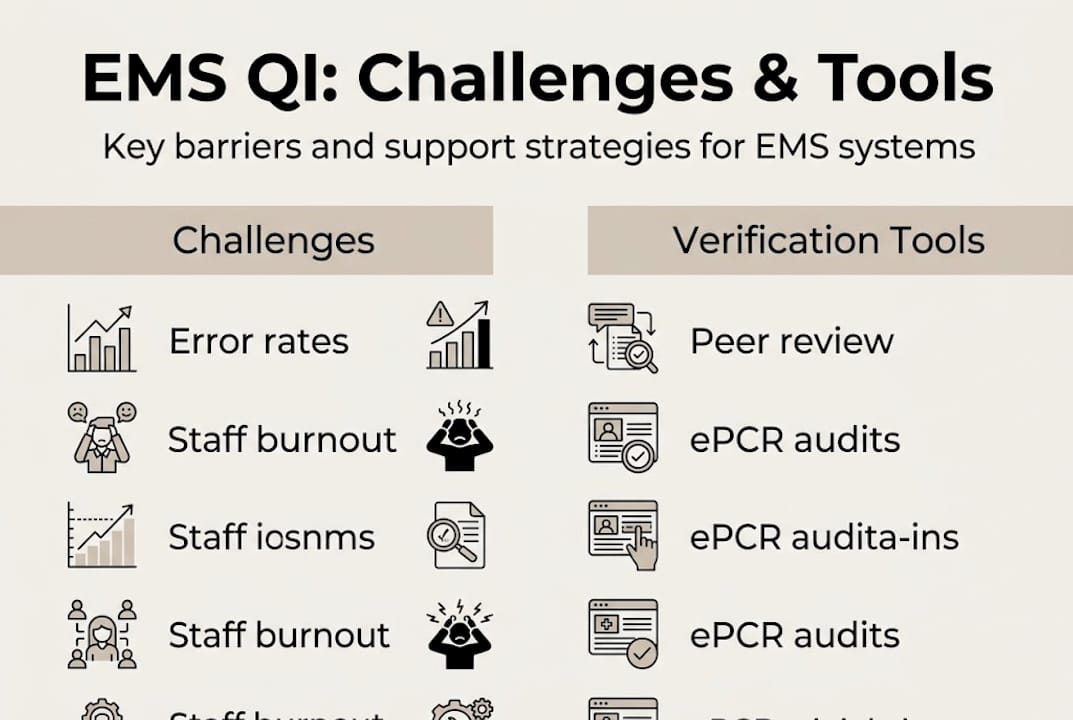
| Challenge | Verification tool | Sustaining strategy |
|---|---|---|
| Clinical error rates | Peer review, ePCR audits | Quarterly retraining |
| Response time gaps | CAD dashboard | Deployment model review |
| Compliance lapses | Audit checklists | Policy refresh cycles |
| Stakeholder disengagement | Feedback surveys | Regular briefings |
For low-performing agencies, intensive retraining using Resuscitation Academy approaches should be prioritized before broader system changes are attempted. A thorough EMS quality assurance guide and structured operational audits give leadership the visibility needed to catch regression early and respond decisively.
A fresh perspective: Why EMS quality improvement consulting needs local nuance and relentless follow-through
Here is something national frameworks will not tell you directly: the gap between a well-designed improvement plan and actual sustained results almost always comes down to local fit and leadership follow-through, not the sophistication of the methodology.
We have seen agencies implement textbook PDSA cycles and NEMSQA benchmarking, then plateau within 18 months because leadership treated the consulting engagement as a project with an end date rather than a permanent operating discipline. Real improvement does not conclude with a final report. It continues through quarterly reviews, ongoing training aligned to community realities, and leadership that holds the line on accountability.
National benchmarks are a starting point. A rural volunteer agency and a high-volume urban ALS system face fundamentally different constraints. As strategy guide insights make clear, prioritizing consultants with NEMSQA and NEMSIS expertise alongside local regulatory knowledge, starting with a needs assessment tailored to community context, is the approach that produces durable results. Never chase a one-size-fits-all solution. The agencies that improve and stay improved are the ones that treat consulting as a partnership, not a purchase.
Take your EMS quality improvement to the next level
If your agency is ready to move from persistent performance gaps to measurable, sustained results, we are ready to work alongside your team. PSCG brings the structured methodology, national benchmarking expertise, and local regulatory knowledge that municipal EMS leaders need to drive real change.
Explore our strategy guide for EMS to build a clear roadmap for your system. Connect with our team through system design consulting to align your operations with best practices. And use our compliance audits to identify gaps before they become liabilities. Let’s build a stronger, more resilient EMS system together.
Frequently asked questions
What is the first step in EMS quality improvement consulting?
Begin with a needs assessment using national performance measures and local stakeholder input to establish a clear baseline and identify priority improvement areas.
How do consultants measure EMS performance?
Consultants use data dashboards, NEMSQA and NEMSIS benchmarks, and regular audits to track response times, clinical outcomes, and compliance rates against national standards.
What are common mistakes in EMS quality improvement?
Failing to engage all stakeholders, focusing only on response times, and neglecting ongoing review cycles are the most frequent pitfalls, with non-punitive reporting being especially critical to sustain a culture of learning.
What improvement results should municipal leaders expect?
Leaders who implement consulting recommendations consistently see measurable clinical gains, including reduced error rates, improved cardiac arrest survival, and stronger compliance outcomes within the first year.