


TL;DR:
- Hardware upgrades alone rarely fix 911 performance gaps; workflows and training are critical.
- External consulting provides objective assessments, structured strategies, and ongoing performance monitoring.
- Successful system improvements require organizational change, culture shifts, and leadership commitment.
Many municipal leaders assume the fastest path to better 911 performance runs through a capital equipment budget. New consoles, upgraded CAD systems, next-generation radio infrastructure — these investments feel decisive and visible. But the most persistent performance gaps in emergency communications rarely trace back to hardware. They trace back to workflows, training deficits, interoperability failures, and organizational blind spots that no new device can fix on its own. Specialized 911 communications consulting addresses those root causes directly, often delivering measurable gains in response speed and accuracy without requiring major capital outlays. This guide explains what consulting actually involves and how to use it strategically.
Table of Contents
- What is 911 communications consulting?
- Key challenges facing municipal 911 systems
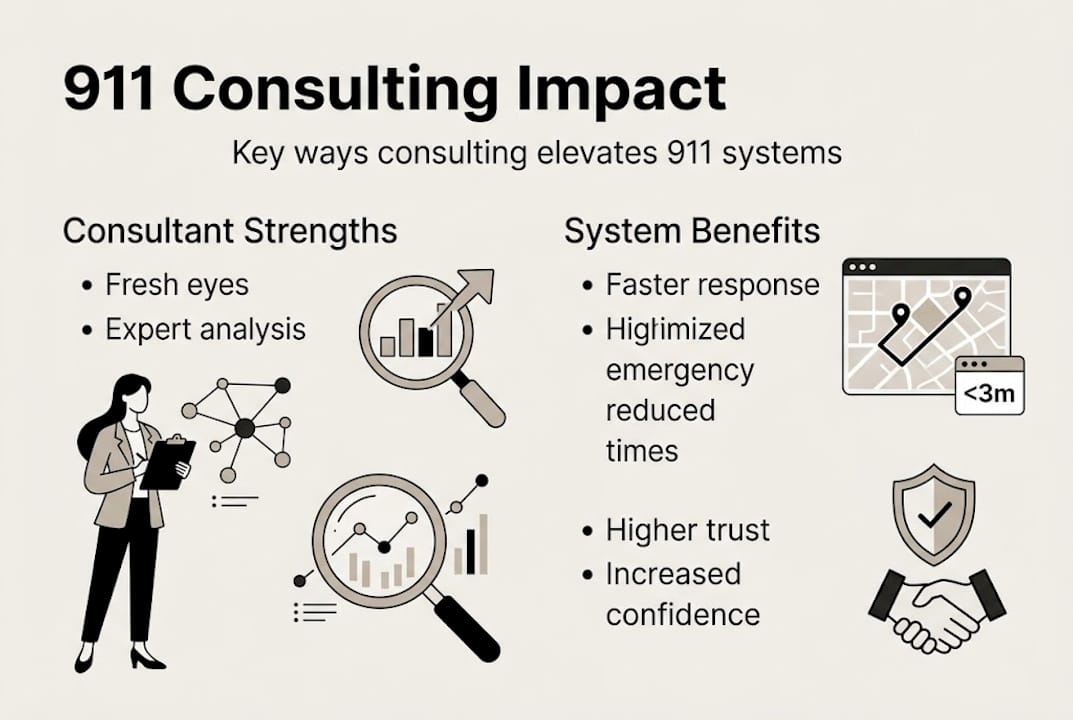
- How consulting transforms 911 communications
- Selecting the right 911 communications consultant
- Key steps for municipal leaders to get started
- A fresh look: What most leaders miss in 911 communications upgrades
- Partner with experts for lasting 911 transformation
- Frequently asked questions
Key Takeaways
| Point | Details |
|---|---|
| Consulting defined | 911 communications consulting brings objective assessments and strategic improvement to public safety systems. |
| Biggest challenges | Common issues include outdated technology, insufficient training, and lack of interoperability among agencies. |
| How consulting helps | Consultants enable faster emergency response times, better resource use, and effective cross-agency collaboration. |
| Selecting a partner | Evaluate a consultant’s experience, municipal expertise, and ability to offer customized solutions before engaging. |
| Leaders’ next steps | Assess your system, engage stakeholders, and prioritize smart strategy over expensive gadgets. |
What is 911 communications consulting?
At its core, 911 communications consulting is a professional advisory service focused on improving the performance, reliability, and interoperability of emergency communication systems. It is not the same as purchasing equipment from a vendor or contracting IT staff to upgrade software. A vendor’s objective is to sell a product. A consultant’s objective is to solve a problem, regardless of what product, process, or organizational change that solution requires.
As EMS consulting overview affirms, 911 consulting goes beyond technology procurement. The discipline spans a wide range of professional services that work together to strengthen every layer of your communications operation:
- Needs assessments and gap analysis: Identifying where current systems fall short of performance benchmarks
- Strategic planning: Building multi-year roadmaps aligned with budget cycles and public safety goals
- Interoperability coordination: Ensuring seamless communication across agencies, jurisdictions, and platforms
- Workflow optimization: Redesigning dispatch processes and call handling protocols to reduce delays
- Training program development: Equipping dispatchers, supervisors, and field units with consistent, current procedures
- Performance monitoring: Establishing metrics and reporting systems that sustain improvement over time
“The most valuable thing an outside consultant brings is not expertise alone — it is an unfiltered view of what your team has stopped seeing because they see it every day.”
That external perspective is genuinely difficult to replicate internally. Staff who have worked within the same system for years develop institutional assumptions that can make even obvious inefficiencies invisible. Consultants who optimize communication systems bring fresh eyes, structured methodology, and cross-jurisdictional benchmarks that internal teams simply cannot generate on their own.
Key challenges facing municipal 911 systems
Before exploring how consulting delivers results, it is worth naming the specific pain points that hold most municipal 911 systems back. These are not theoretical problems. They are the operational realities your dispatch center and field units navigate every shift.
- Aging infrastructure: Many PSAPs (Public Safety Answering Points) still operate on legacy systems that were not designed for modern call volumes or data integration
- Limited interoperability: When agencies cannot communicate across jurisdictions in real time, multi-unit responses become dangerously fragmented — a well-documented problem in interoperability challenges that consulting can help address
- Staffing shortages and turnover: High attrition rates in dispatch roles mean institutional knowledge drains continuously, leaving gaps in protocol adherence and situational awareness
- Call volume growth: Increasing 911 call volume, compounded by non-emergency misuse, creates data overload that degrades dispatcher performance without proper triage systems
- Budget pressure: Most municipalities are being asked to improve outcomes while holding or reducing operational costs, making resource allocation decisions increasingly difficult
- Insufficient analytics: Without structured data review, supervisors cannot identify patterns, predict peak periods, or target training where it matters most
Statistic callout: Data analytics can cut EMS response times by as much as 12%, a result that requires no hardware purchase — only the disciplined application of data your system is already generating.
Pro Tip: Before engaging a consultant, ask your dispatch supervisor to pull the last 90 days of call-to-dispatch interval data. That single metric often reveals more about system performance than any technology audit.
These challenges tend to compound each other. Staffing gaps reduce the capacity for ongoing training. Aging systems produce unreliable 911 data insights that make analytics difficult. Budget constraints delay infrastructure updates. A consultant’s role is to cut through that interconnected complexity and identify the highest-leverage intervention points.
How consulting transforms 911 communications
The consulting process follows a structured path from diagnosis to sustained improvement. Understanding that sequence helps leaders set realistic expectations and allocate internal resources appropriately.
In-house upgrades vs. consultant-led projects
| Factor | In-house upgrade | Consultant-led project |
|---|---|---|
| Perspective | Internal, familiar | External, objective |
| Gap identification | Often incomplete | Structured and systematic |
| Interoperability focus | Limited | Cross-jurisdictional |
| Training integration | Ad hoc | Protocol-driven |
| Measurable outcomes | Inconsistent | Benchmarked and tracked |
Consultant-led needs assessments identify critical gaps that internal teams frequently miss because of proximity bias — the tendency to normalize existing conditions rather than evaluate them against objective standards.
Here is a typical consulting engagement sequence:
- System assessment: Consultants review call data, dispatch protocols, technology infrastructure, and staffing models to build an accurate baseline
- Gap analysis: Performance is measured against recognized EMS best practices and regional benchmarks to identify specific deficiencies
- Recommendations report: A prioritized action plan is delivered with clear rationale, estimated impact, and resource requirements for each recommendation
- Implementation support: Consultants work alongside department leadership to execute changes, adjust protocols, and coordinate multi-agency alignment
- Performance monitoring: Metrics are tracked post-implementation to confirm that improvements are holding and to identify any new optimization opportunities
Pro Tip: Request a real-world consulting success case study from any consultant you consider. Concrete examples from similar municipal environments reveal far more about a firm’s capabilities than any proposal document.
This process is fundamentally iterative. The most effective consulting relationships do not end at the delivery of a report. They continue through implementation and into the monitoring phase, ensuring that recommendations translate into lasting operational change rather than a binder that sits on a shelf.
Selecting the right 911 communications consultant
Not all consulting firms are equally equipped to serve municipal 911 operations. Selecting the wrong partner can mean wasted budget, disrupted operations, and recommendations that do not account for your specific regulatory environment or community context.
Consultant comparison by firm type
| Firm type | Strengths | Limitations |
|---|---|---|
| Local/regional firm | Community familiarity, regulatory knowledge | Narrower cross-jurisdictional data |
| National firm | Broad benchmarking data, large team | Less local context, higher cost |
| Specialized EMS/public safety firm | Deep domain expertise, proven frameworks | May have narrower service scope |
Experienced consultants offer frameworks tailored to municipal needs, which means they are not applying generic business consulting principles to a public safety context. They understand dispatch protocols, NENA (National Emergency Number Association) standards, mutual aid agreements, and the political dynamics of multi-agency coordination.
Key qualifications to verify before signing an engagement:
- Documented public safety and EMS operational experience, not just consulting credentials
- Familiarity with your state’s 911 funding and governance structure
- A clear methodology for performance measurement and post-project follow-up
- References from municipalities of comparable size and complexity
- Transparent conflict-of-interest disclosures, particularly if the firm has vendor relationships
Common red flags include vague deliverable descriptions, proposals heavy on technology recommendations before a needs assessment is complete, and firms that cannot provide consultant attributes in action through real examples of protocol improvements or training program results. Ongoing partnership — not a single engagement — is the model that produces the most durable outcomes. Prioritize firms that build long-term advisory relationships over those that deliver a report and exit.
Key steps for municipal leaders to get started
Moving from intention to action requires a structured approach. Here is a practical sequence for initiating a 911 consulting engagement that maximizes early momentum and stakeholder alignment.
- Conduct a self-assessment: Review current call-to-dispatch intervals, dispatcher staffing ratios, training completion rates, and inter-agency communication logs. Document what you know and what you cannot currently measure
- Engage key stakeholders: Bring dispatch supervisors, field commanders, IT leadership, and finance staff into the conversation early. Their input shapes realistic objectives and prevents implementation resistance later
- Define clear project objectives: Specify what success looks like before any consultant is hired. Objectives might include reducing call handling time by a defined percentage, achieving specific interoperability standards, or reaching compliance with updated NENA guidelines
- Explore funding sources: Federal grants, state 911 funds, and FEMA preparedness programs may offset consulting costs. A qualified consultant can often help identify and navigate these funding streams
- Issue structured inquiries: Send a clear scope-of-work request to candidate firms rather than an open-ended RFP. Structured inquiries produce more comparable, actionable proposals
- Complete a readiness worksheet: Identify internal champions, confirm available data sets, and document current vendor contracts before the first consultant meeting
As the public safety strategic planning guide makes clear, strategic planning is essential for municipal EMS improvement, and the same principle applies to 911 communications. Leaders who invest time in upfront planning dramatically reduce project delays and cost overruns.
Pro Tip: Designate one internal project manager — ideally someone with operational dispatch experience — to serve as the primary liaison throughout the consulting engagement. Distributed ownership of the project is one of the most common reasons implementation stalls.
A fresh look: What most leaders miss in 911 communications upgrades
After working across municipal public safety operations, we have observed a consistent pattern: communities that invest heavily in new technology without addressing organizational culture and workflow design rarely see the performance gains they expect. A new CAD system installed in a dispatch center with fragmented protocols and inadequate supervisor oversight will underperform every time.
The truth is that EMS myths and realities around technology are pervasive in public safety leadership circles. Decision-makers are conditioned to equate visible investment with progress. But some of the most significant breakthroughs we have seen came from zero-capital interventions: restructuring shift briefings, revising mutual aid activation thresholds, or redesigning call triage scripts. These changes required leadership commitment and careful communication management, not procurement authority.
Consulting’s highest value is not in the technical recommendations. It is in creating the conditions — trust, shared language, clear accountability — under which people change how they work. That is harder, slower, and more important than any technology selection. Leaders who understand this distinction will consistently outperform those who do not.
Partner with experts for lasting 911 transformation
The insights in this guide reflect the kind of structured, outcomes-focused thinking that defines effective 911 consulting engagements. Municipalities that act on these principles do not just improve a metric — they build systems that protect communities more reliably, shift by shift.
At PSCG, we work alongside municipal leaders to assess current performance, identify the highest-impact opportunities, and support full implementation from protocol redesign to staff training. Whether you are starting with a readiness review or ready to move forward on a specific project, our EMS strategy guide and system design consulting services are built for your operational context. Contact us today to schedule a tailored system assessment and take the first concrete step toward stronger emergency communications.
Frequently asked questions
How do 911 communications consultants improve emergency response times?
Consultants redesign dispatch workflows and apply data-driven strategies that produce measurable reductions in call handling and unit deployment intervals, often without requiring new equipment purchases.
What is the difference between a 911 system vendor and a consulting firm?
Vendors sell and install equipment with a direct commercial interest in product selection, while consulting addresses comprehensive needs beyond product sales, including unbiased strategic advice, process improvement, and training support.
How long does a typical 911 consulting engagement take?
Most projects range from a few weeks for focused assessments to several months for full system redesign, depending on project scope, stakeholder complexity, and the municipality’s implementation capacity.
Is 911 communications consulting only for large cities?
No. Frameworks can be customized for municipalities of all sizes, and smaller communities often see proportionally greater improvements because their systems have fewer redundancies to absorb operational inefficiency.
Recommended
- Optimize public safety communication systems in 2026 – The Public Safety Consulting Group
- Interoperability Without Surrender | The Public Safety Consulting Group
- Expert EMS Consulting & Public Safety Services | PSCG
- The crucial connection: Field providers and legislative engagement | The Public Safety Consulting Group
- Blue Light Services Case Study | Web Design | AMW Media