

TL;DR:
- Modern fire department consulting uses data-driven assessments and standardized benchmarks for operational improvement.
- Tailored strategies prioritize community risks, response times, and ongoing performance monitoring.
- Effective partnerships require experienced, transparent consultants committed to long-term support and organizational capacity building.
Many U.S. fire departments assume that performance gaps trace back to staffing shortages or outdated equipment. The more accurate culprit is often misaligned assessment processes and reactive planning frameworks that fail to account for evolving community risk. Fire department consulting changes that equation by applying rigorous data analysis, standardized benchmarking, and locally tailored strategies that move departments from guesswork to precision. In this article, we cover the core consulting frameworks driving operational improvement, how those frameworks translate into action, the compliance and accreditation landscape, and what to look for when selecting a consulting partner.
Table of Contents
- Understanding modern fire department consulting frameworks
- From data to action: Implementing tailored strategies
- Addressing compliance, accreditation, and emerging risks
- Selecting and maximizing your fire department consulting partner
- Why most fire department consulting misses the mark—and what truly drives results
- Enhance municipal fire safety with expert consulting
- Frequently asked questions
Key Takeaways
| Point | Details |
|---|---|
| Data-driven improvement | Consulting uses local and national data to shape effective fire department strategies. |
| Standards and compliance | Expert guidance helps departments consistently meet NFPA, CFAI, and new safety benchmarks. |
| Managing emerging risks | Consultants address unique municipal threats, from old buildings to new technologies and overtime challenges. |
| Customized solutions | No one-size-fits-all plans; consulting adapts frameworks for each community’s specific needs. |
| Continuous process | Success depends on treating risk analyses and strategy documents as evolving tools—not one-time reports. |
Understanding modern fire department consulting frameworks
With the growing urgency to align with national benchmarks and optimize response, it is crucial to understand the science behind fire department consulting frameworks. At the foundation of any credible consulting engagement are two core methodologies: Community Risk Assessment (CRA) and Standards of Cover (SOC). These are not one-time reports. They function as living documents updated annually, continuously refined using computer-aided dispatch (CAD) data, records management system (RMS) outputs, GIS risk profiles, and historical incident analysis spanning three to five years.
The CRA/SOC process maps your community’s risk landscape with precision. GIS tools layer population density, building stock, infrastructure vulnerability, and hazard locations into a visual risk model. That model then becomes the basis for resource deployment decisions, station placement analysis, and response time benchmarking. Without this level of detail, departments risk over-deploying resources in low-risk corridors while leaving high-risk zones underserved.
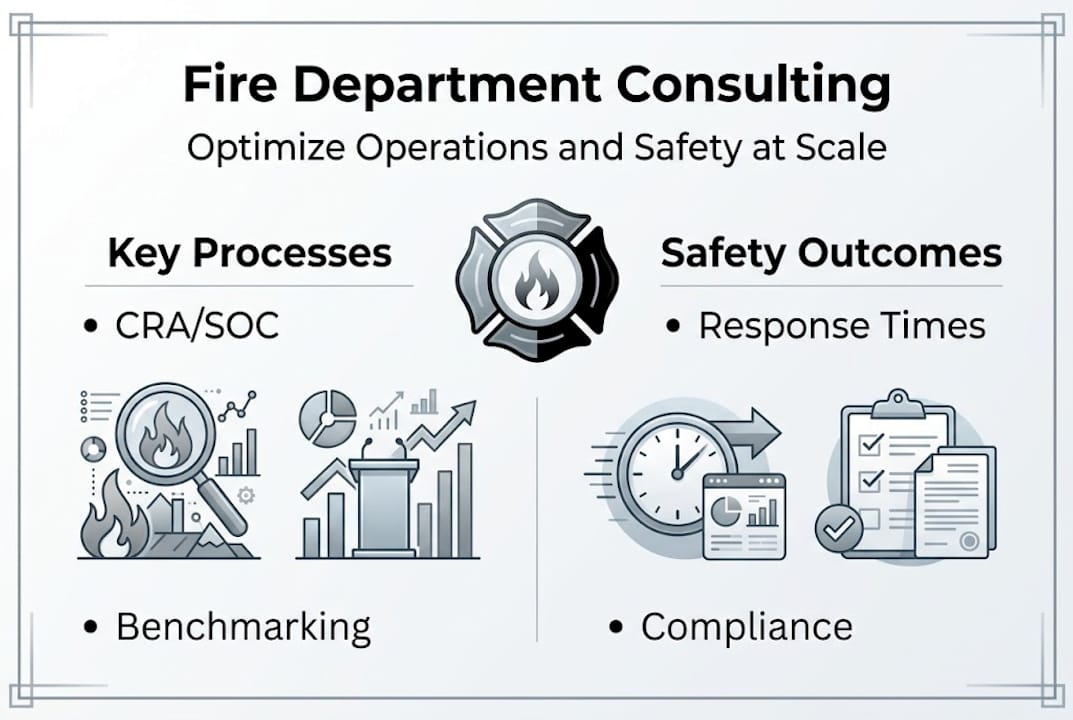
Benchmarking is where abstract data becomes actionable. NFPA 1710 sets response time standards for career departments, including a 240-second total response time for the first unit and full effective firefighting force arrival within 480 seconds for structure fires. NFPA 1720 applies comparable expectations to volunteer or combination departments with different staffing thresholds. Consulting professionals use these benchmarks to measure current performance and identify specific gaps, supporting public safety risk reduction across your jurisdiction.
This framework also supports accreditation through the Commission on Fire Accreditation International (CFAI) under the Center for Public Safety Excellence (CPSE). Departments seeking CFAI status must demonstrate objective assessment against performance standards, and a well-constructed CRA/SOC is central to that case. It also strengthens budget justifications and grant applications by providing documented performance data.
| Data component | Description | Review cycle |
|---|---|---|
| CAD/RMS incident logs | Response times, call types, unit utilization | Annual |
| GIS risk profiles | Building hazards, occupancy types, infrastructure | Annual |
| Population and growth data | Density shifts, new developments | Annual |
| Historical trend analysis | 3-5 year performance patterns | Every 3-5 years |
| NFPA benchmark comparison | Travel time and staffing gap analysis | Annual |
“A system-based, tailored approach that integrates local data, unique risk factors, and performance benchmarks consistently outperforms one-size-fits-all formulas. No two communities face the same risk profile, and consulting frameworks must reflect that reality.”
For departments also assessing EMS needs alongside fire suppression capacity, integrating EMS performance data into the CRA/SOC produces a more complete picture. And for those exploring broader system planning, reviewing EMS consulting strategies helps connect fire and EMS planning into a unified operational model.
From data to action: Implementing tailored strategies
Once decision-makers understand the frameworks, the next step is translating that knowledge into practical strategies adapted for their community. A non-prescriptive, locally tailored approach integrating unique risks and benchmarks is what separates effective consulting from generic recommendations. Implementation follows a disciplined sequence that prevents critical gaps from slipping through.
Step-by-step implementation process:
- Hazard and risk prioritization. Rank identified risks by probability and consequence, drawing directly from the CRA findings.
- Deployment optimization. Align unit positioning, staffing levels, and apparatus assignments with the risk map rather than historical habit.
- Response time gap closure. Model alternative station placements or mutual aid configurations to close NFPA benchmark gaps.
- Training alignment. Match training curricula to the highest-priority risk categories identified in the CRA.
- Performance monitoring. Establish quarterly metrics reviews to track progress and flag emerging deviations.
Local factors shape every step. A coastal community with seasonal population surges faces different hazard concentrations than a mid-sized inland city with aging industrial infrastructure. Consulting that ignores these variables will produce a plan that looks complete on paper but fails in execution. Effective emergency management consulting accounts for population density shifts, transportation corridors, and evolving threats like wildland-urban interface fires.
| Factor | Traditional gap analysis | Data-driven CRA/SOC strategy |
|---|---|---|
| Risk identification | Generalized hazard categories | GIS-mapped, incident-specific risk layers |
| Deployment decisions | Based on coverage area formulas | Based on modeled response time data |
| Performance review | Annual or ad hoc | Quarterly monitoring with real-time adjustment |
| Benchmark alignment | NFPA referenced loosely | NFPA 1710/1720 integrated into targets |
| Community-specific factors | Rarely incorporated | Central to the planning model |
Pro Tip: Resist the temptation to shortcut the analytical steps, especially risk prioritization. Departments that skip this phase in favor of faster deliverables regularly discover missed vulnerabilities during accreditation reviews or after significant incidents. Reviewing EMS best practices alongside fire consulting data strengthens your department’s full-service readiness profile.
Addressing compliance, accreditation, and emerging risks
Having grounded operational strategies in strong analytics, attention must turn to regulatory compliance and emerging risk adaptation. Consultants guide departments through the requirements of NFPA, CFAI/CPSE accreditation processes, and evolving best practices that go well beyond standard checklists. CRA/SOC supports CFAI accreditation by providing objective assessment against established standards, which is precisely what accreditation reviewers look for.

Compliance nuances add complexity. Historic structures require specialized evaluation systems because their construction materials, compartmentalization, and egress configurations differ fundamentally from modern buildings. Consulting teams must understand these distinctions and build them into risk classification frameworks. Similarly, the rapid proliferation of lithium-ion battery systems, in electric vehicles, commercial storage units, and residential devices, has created a new category of high-heat, fast-escalating fire risk that standard suppression protocols were not designed to address.
Common emerging threats requiring tailored consulting responses:
- Lithium-ion battery fires (residential, commercial, and transit applications)
- Wildland-urban interface expansion in previously low-risk zones
- Aging water infrastructure limiting suppression capacity
- Civil unrest events requiring coordinated fire and law enforcement response
- Climate-related incident volume increases, including flooding and extreme heat responses
Fatigue and overtime management deserve direct attention. Fire-rescue overtime trends show that unmanaged overtime creates measurable safety risks, including reduced cognitive performance during critical decisions and increased injury rates. Consultants help departments build staffing models that reduce chronic overtime reliance without sacrificing operational readiness.
Civil unrest response is an area where many departments lack structured frameworks. Consulting engagements informed by USFA study findings help departments define staging protocols, communication chains with law enforcement, and resource pre-positioning strategies that protect both personnel and communities during elevated-tension events. Reviewing your department’s system assessment steps ensures these scenarios are incorporated before an activation is required.
Selecting and maximizing your fire department consulting partner
The right consulting frameworks and compliance strategy will only bear fruit with an effective partnership. Here is how to choose and maximize yours. A credible consulting partner functions as an ongoing guide who helps living documents adapt as city needs evolve, not as a vendor who delivers a binder and disappears.
What to look for when choosing a fire department consultant:
- Relevant operational experience. Look for consultants with direct fire service leadership backgrounds, not only academic credentials.
- Methodological transparency. Your consultant should clearly explain every analytical step and share the underlying data, not just conclusions.
- Accreditation track record. Confirmed experience supporting CFAI/CPSE processes signals familiarity with high-stakes documentation requirements.
- Data-centered approach. Insist on CAD/RMS integration and GIS-based risk modeling as baseline deliverables, not optional add-ons.
- Ongoing support commitment. The relationship should extend beyond the initial engagement to include performance monitoring and annual document updates.
Building an internal team to work alongside external consultants multiplies the value of the engagement. Assign a project lead with direct access to operational data and authority to facilitate cross-departmental coordination. This person bridges the consultant’s analytical work with the day-to-day realities your team faces.
Pro Tip: Insist on proactive data sharing throughout the engagement. Consultants who provide interim findings, draft benchmarks, and educational materials during the process build your team’s internal capacity, which means the gains persist after the contract concludes.
Sustaining improvement after engagement requires deliberate structure. Schedule quarterly performance reviews, assign ownership of annual CRA/SOC updates to a specific role, and connect your planning cycle to budget timelines so that consulting findings translate directly into resource requests. Building public safety partnerships with neighboring jurisdictions further strengthens mutual aid frameworks identified during consulting work.
Why most fire department consulting misses the mark—and what truly drives results
We have seen consulting engagements that produced impressive documentation and very little operational change. The pattern is consistent: the engagement focuses on compliance outputs rather than on building the internal capacity to sustain improvement. Consultants arrive, conduct assessments, and deliver reports. Departments file those reports and wait for the next review cycle.
The most effective departments we have worked with treat CRA/SOC not as binders but as living processes revisited quarterly, even informally. Their leadership teams challenge the data, ask what changed since last quarter, and hold themselves accountable to specific response time targets rather than documentation milestones.
Results-driven consulting demands something more than frameworks. It demands a leadership mindset willing to engage in uncomfortable conversations about resource allocation, station staffing models, and training gaps. Compliance is a floor, not a ceiling. Municipal leaders should measure consulting value by improved operational readiness, stronger accreditation positioning, and measurable response time gains, not by the thickness of the final report.
Enhance municipal fire safety with expert consulting
The gap between a well-documented fire department and a genuinely high-performing one comes down to how consistently leadership applies, updates, and acts on consulting findings. Data-driven frameworks only deliver results when they are paired with expert guidance and organizational commitment.
We work alongside municipal leaders to build that connection. Whether you are starting your first CRA/SOC process or looking to strengthen an existing compliance strategy, explore our EMS system design examples and review our approach to strategic planning for readiness. For a full overview of how we support fire and EMS operations, our EMS strategy guide is an excellent starting point. Contact The Public Safety Consulting Group today to discuss a custom engagement tailored to your community’s needs.
Frequently asked questions
What is a Community Risk Assessment (CRA) in fire department consulting?
A CRA is a data-driven analysis that identifies and prioritizes local risks using GIS mapping, historical incidents, and hazard profiling, guiding departments to allocate resources where they are needed most.
How does fire department consulting help with NFPA compliance?
Consultants benchmark your department against NFPA 1710/1720 standards for response times and staffing, then develop targeted improvement plans to close the gaps between current performance and required thresholds.
What are common emerging risks consulting can address?
Consultants address risks including lithium-ion battery fires, aging infrastructure, civil unrest scenarios, and overtime fatigue trends, all of which require solutions specific to each department’s operational context.
How often should fire department performance and risk data be reviewed?
Best practice calls for annual CRA/SOC updates at minimum, but departments that conduct quarterly informal reviews adapt faster to community changes and catch performance drift before it becomes a compliance issue.
What should municipal leaders look for in a consulting partner?
Leaders should prioritize data-focused relationships built on operational experience, transparent methodology, confirmed accreditation history, and a genuine commitment to ongoing support beyond the initial deliverable.