



TL;DR:
- Effective EMS systems depend on well-designed, interconnected layers that address dispatch, response, and hospital integration. Modern deployment models use data analytics and tiered responses to optimize response times and resource utilization. Continuous quality improvement, cross-system collaboration, and system-wide redesign are essential for sustained high performance.
Even well-funded EMS systems can fail patients when their design doesn’t adapt to real-world demand. Research consistently shows that structural factors like flexible deployment, tiered response protocols, and seamless hospital hand-offs drive better outcomes than simply adding more ambulances or increasing budgets. Municipal leaders who focus only on resource counts miss the deeper levers that separate high-performing systems from those that struggle with response time benchmarks and clinical quality. This guide breaks down the four core layers of EMS system design, explores modern deployment strategies, and provides actionable frameworks for benchmarking, dispatch prioritization, and regional coordination.
Table of Contents
- Understanding the four layers of EMS system design
- Deploying resources: From static coverage to dynamic deployment
- Making sense of EMS dispatch triage and prioritization
- Benchmarks and continuous quality improvement in EMS
- Regionalization, bypass, and destination: Optimizing patient flow
- Real deployment lessons: Why most EMS systems underperform until leaders rethink the whole
- Partner for performance: Next steps in evolving your EMS system
- Frequently asked questions
Key Takeaways
| Point | Details |
|---|---|
| Integrated system layers | Effective EMS depends on seamless coordination between dispatch, first response, ambulance care, and hospital hand-off. |
| Dynamic resource deployment | Moving from static stationing to dynamic deployment strategies cuts response times and optimizes resource use. |
| Data-driven dispatch | Regularly reviewing triage accuracy reduces overtriage and undertriage to improve patient outcomes. |
| Continuous benchmarking | Applying national EMS quality measures enables objective assessment and ongoing improvement. |
| Cross-agency collaboration | Strong partnerships with hospitals and other providers ensure patients get timely, appropriate care. |
Understanding the four layers of EMS system design
To structure an effective EMS system, municipal leaders must address how its different components fit and work together. Let’s start by mapping out these foundational layers.
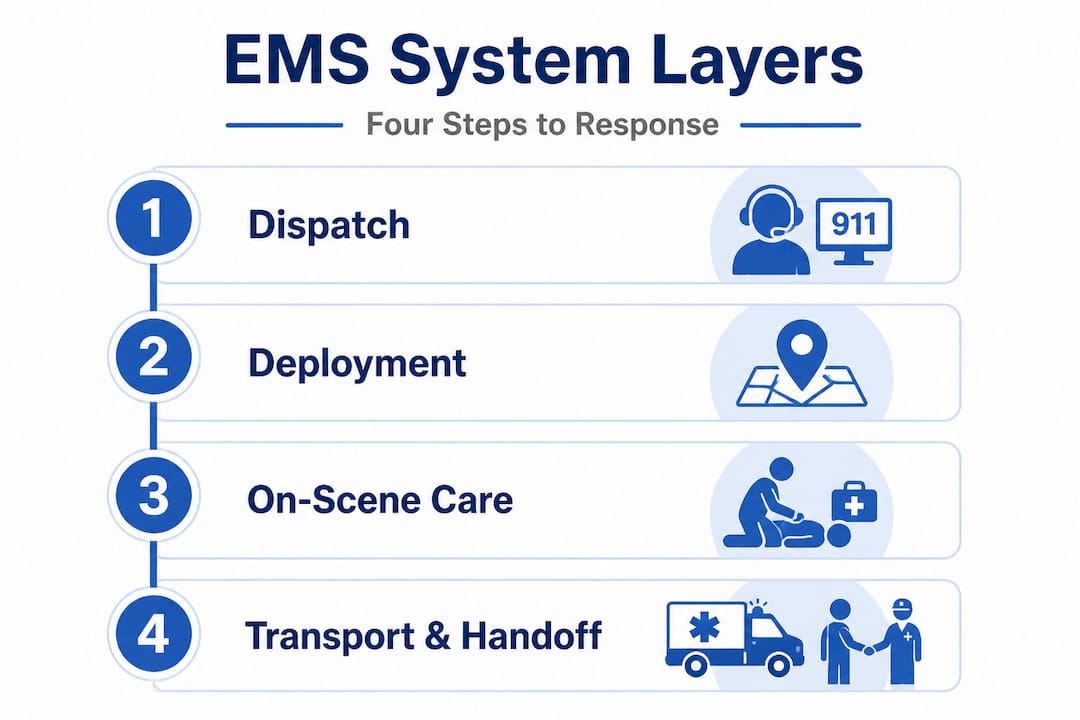
Every EMS system operates across four distinct but interconnected layers, and friction at any transition point can erode the entire system’s performance. According to prehospital emergency care research, effective municipal EMS design must explicitly connect these four layers: dispatch triage and activation, first response (fire, EMR, or BLS units), advanced care and ambulance response under medical direction, and receiving-facility integration including prenotification and hand-off. When these layers are designed in isolation, gaps form and patients pay the price.
Consider a common scenario: a municipality invests in new cardiac monitors and highly trained paramedics, but the dispatch center uses an outdated prioritization script that delays activation by two minutes. That two-minute delay can translate directly into reduced survival rates for cardiac arrest patients, where every minute without defibrillation decreases survival probability by approximately 10%. The investment in advanced care is undermined by a failure at layer one.
Here is a breakdown of each layer and the key decisions that shape performance:
- Layer 1: Dispatch triage and activation. This layer determines who gets called and how fast. Decisions here include protocol selection, call categorization, and Medical Priority Dispatch System (MPDS) implementation. Errors at this stage cascade through every layer below.
- Layer 2: First response. Fire departments, EMRs, and BLS units typically arrive before the ambulance. Their role, training level, and integration with ALS units determine whether the patient receives timely intervention or simply waits for the ambulance.
- Layer 3: Advanced care and ambulance response. This is where ALS paramedics and transport vehicles operate under medical direction. Decisions about unit staffing, vehicle positioning, and clinical protocols live here.
- Layer 4: Receiving-facility integration. Prenotification, bypass protocols, and structured hand-offs determine whether the gains made in the field are preserved or lost in the transition to hospital care.
| Layer | Key decision points | Common failure modes |
|---|---|---|
| Dispatch triage | Protocol selection, call categorization | Overtriage, undertriage, delayed activation |
| First response | Unit type, training level, dispatch criteria | Redundant responses, undertrained first responders |
| Advanced care | Staffing model, deployment zones, medical oversight | Poor positioning, ALS-BLS misalignment |
| Facility integration | Prenotification, bypass policies, hand-off structure | Communication gaps, delayed ED acceptance |
Pro Tip: Conduct a layer-by-layer gap analysis before making any capital investment. You may find that a protocol change at dispatch produces faster results than purchasing additional units. Our EMS design consulting approach always starts with this diagnostic step.
If you want to see how these layers play out in practice, reviewing EMS system design examples from comparable municipalities can accelerate your planning process significantly.
Deploying resources: From static coverage to dynamic deployment
Once the system’s structure is understood, the next step is ensuring resources are in the right place at the right time. This task has evolved considerably with advances in data analytics and geographic information systems.
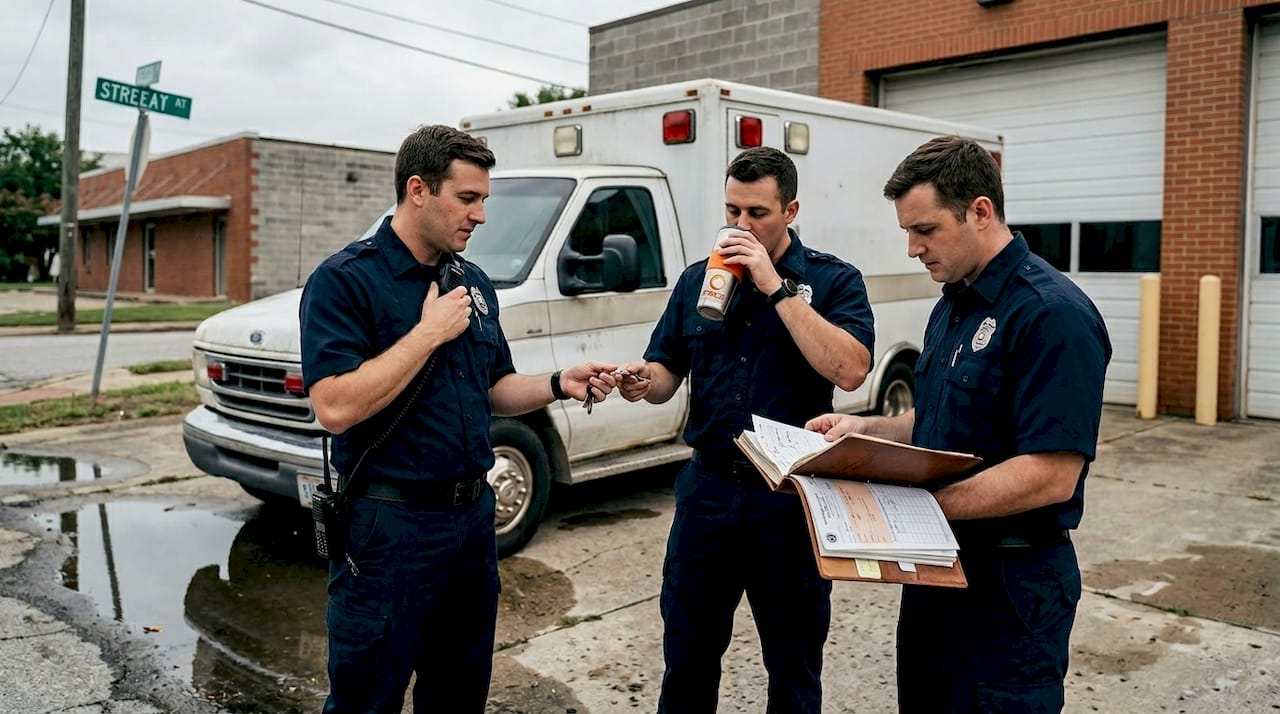
Static deployment, the traditional model where ambulances are stationed at fixed locations regardless of demand patterns, made sense in an era before data-driven planning. Today, it represents a significant missed opportunity. High-performance EMS systems use flexible production and dynamic resource management rather than static coverage alone. These systems reposition units throughout a shift based on real-time demand, historical call patterns, and predictive modeling, which reduces the average distance between an available unit and the next call.
The transition from all-ALS to tiered ALS/BLS deployment is equally important. When every call receives an ALS response regardless of acuity, you’re burning paramedic hours on low-acuity calls that a BLS crew could handle effectively. Tiered systems, when properly linked to dispatch triage, direct ALS resources to the patients who genuinely need them while maintaining appropriate coverage for the broader call volume.
Here is what effective dynamic deployment looks like in practice:
- Demand forecasting: Analyze historical call data by time of day, day of week, season, and geographic zone. Most systems have 12 to 18 months of usable data that can reveal predictable demand spikes.
- Post positioning: Designate dynamic posting locations based on demand analysis, not just proximity to the station. A busy commercial corridor at noon may need coverage that a residential neighborhood needs at 2 a.m.
- Unit readiness standards: Define minimum staffing thresholds and unit availability targets. When coverage drops below a defined threshold, automatic redeployment protocols activate.
- Tiered response integration: Align BLS and ALS dispatch criteria with your medical director’s protocols so that each call receives the right level of care without over-resourcing low-acuity incidents.
| Deployment model | Response time performance | Resource utilization | Staffing flexibility |
|---|---|---|---|
| Static stationing | Moderate | Low | Limited |
| Dynamic deployment | High | High | High |
| Tiered ALS/BLS with dynamic posting | Highest | Highest | Highest |
Municipalities that have adopted dynamic strategies consistently report measurable reductions in response times and improved unit hour utilization, which is the ratio of time units spend on calls versus available time. Understanding the full range of deployment models for municipalities is essential before committing to a structural change, since the right model depends on geography, call volume, and existing resources.
Pro Tip: Review your deployment zones and shift schedules at least quarterly. Communities change, call patterns shift, and a deployment plan built on two-year-old data may no longer reflect current demand. System Status Management provides a formal framework for this ongoing adjustment process.
Making sense of EMS dispatch triage and prioritization
Planning and resource deployment only matter if the right help is dispatched at the right time. That relies on smart prioritization at the dispatch center.
Dispatch triage is where every EMS response begins, and its accuracy directly determines whether patients receive appropriate care. Dispatch prioritization systems can be evaluated using sensitivity and specificity measures, along with undertriage and overtriage rates. Performance varies significantly depending on how call categories are classified, which means a system that looks adequate on paper may have hidden accuracy problems when you examine individual call types.
Overtriage sends ALS resources to low-acuity calls, wasting capacity and increasing response times for true emergencies. Undertriage fails to dispatch sufficient resources to high-acuity calls, directly endangering patients. Both are costly, but they require different corrective actions.
A stepwise approach to evaluating and improving dispatch prioritization:
- Audit your current call categorization. Pull a sample of calls across all priority levels and review whether the assigned category matched the actual patient acuity on arrival.
- Calculate overtriage and undertriage rates. Establish baseline rates for each priority category. National benchmarks vary by protocol, but most quality programs target undertriage rates below 5%.
- Identify ambiguous mid-priority categories. Many systems have a “moderate” or “alpha/bravo” category that functions as a catch-all. These categories frequently distort performance metrics because they absorb calls that should be classified higher or lower.
- Adjust protocols and retrain dispatchers. Protocol changes alone are insufficient without dispatcher training and quality assurance feedback loops.
- Measure again. Repeat the audit cycle at 90 days to assess whether changes produced the intended improvement.
“Dispatch prioritization systems can be evaluated using sensitivity and specificity measures, along with undertriage and overtriage analysis. Performance may vary depending on how call categories are classified, making periodic review of categorization schemes essential for maintaining accuracy.”
The advantages of EMS consulting become especially clear in dispatch analysis, where an outside perspective can identify categorization problems that internal teams have normalized over time.
Benchmarks and continuous quality improvement in EMS
How can leaders know if their system really delivers? That’s where objective benchmarks and continuous measurement come in.
Benchmarking transforms subjective assessments into objective comparisons. Rather than relying on anecdotal feedback or internal satisfaction surveys, municipal leaders can measure their systems against nationally recognized standards. EMS quality measurement frameworks used nationally include both process and outcome measures that are suitable for benchmarking system performance across jurisdictions of varying size and complexity.
Process measures track whether the right things are being done, such as response time compliance, appropriate medication administration, and structured hand-off completion rates. Outcome measures track whether those actions produce results, including cardiac arrest survival to discharge, stroke recognition accuracy, and trauma mortality rates. Both types of data are necessary for a complete picture.
Key metrics worth tracking in any municipal EMS quality improvement program:
- Response time compliance: Percentage of priority calls met within your defined response time standard
- Cardiac arrest return of spontaneous circulation (ROSC): Measures resuscitation effectiveness
- Stroke recognition and prenotification rate: Tracks time-sensitive neurological emergency handling
- Hospital hand-off time: Time from ambulance arrival at ED to unit availability
- Crew training compliance: Percentage of personnel current on required certifications and continuing education
| Measure type | Example metric | Why it matters |
|---|---|---|
| Process | Response time compliance | Tracks operational efficiency |
| Process | Prenotification completion rate | Measures hospital integration |
| Outcome | Cardiac arrest survival to discharge | Reflects clinical effectiveness |
| Outcome | Stroke door-to-needle time (via EMS) | Captures time-sensitive care quality |
Effective EMS quality improvement programs institutionalize this feedback loop so that data collection, analysis, and protocol adjustment become routine rather than reactive. What gets measured consistently gets managed consistently.
Regionalization, bypass, and destination: Optimizing patient flow
Beyond municipal boundaries, EMS outcomes depend on where and how patients are transported, requiring protocols that cut across organizational and geographic lines.
Regionalization is the practice of directing patients to facilities best equipped to treat their specific condition, rather than simply transporting to the nearest emergency department. For stroke, STEMI, trauma, and pediatric emergencies, the difference between a capable regional center and a community ED can determine whether a patient survives or sustains permanent disability. Regionalization and bypass decisions require protocols and cooperation across the healthcare system and should be treated as continuous quality improvement, not one-time policy decisions.
Municipal leaders often underestimate how much influence they have over these protocols. Engaging hospital systems, regional EMS medical directors, and state EMS offices in protocol development creates alignment that benefits patients across the entire region.
Key principles for effective regionalization and destination policy:
- Condition-specific destination protocols: Develop separate protocols for cardiac, stroke, trauma, and pediatric emergencies that direct patients to the most appropriate facility based on capability, not just proximity.
- Regular protocol review cycles: Destination protocols should be reviewed at least annually and updated when hospital capabilities change, new facilities open, or outcome data reveals gaps.
- Bypass policy transparency: All providers must understand bypass criteria and how to apply them in real time. Confusion at the scene delays transport and undermines the protocol’s purpose.
- Outcome data sharing: Hospitals and EMS agencies should share outcome data to evaluate whether destination decisions are producing the intended clinical results.
“Regionalization, bypass, and destination decisions require protocols and cooperation across the entire healthcare system. These decisions are most effective when treated as continuous quality improvement rather than fixed policy.”
Building these cross-agency relationships mirrors strategies for successful public sector partnerships, where shared goals and clear accountability structures determine whether collaboration actually produces results.
Real deployment lessons: Why most EMS systems underperform until leaders rethink the whole
After breaking down each element, one thing becomes clear: incremental fixes rarely move the needle in a meaningful or sustained way. So, what separates top-performing EMS systems from those that are always lagging?
In our experience working with municipalities across the country, the most common pattern we see is this: a leader identifies a visible problem, implements a targeted fix, and sees modest short-term improvement before performance plateaus again. The reason is almost always the same. The fix addressed a symptom in one layer without resolving the friction between layers. Buying more ambulances doesn’t help if dispatch is misclassifying calls. Retraining dispatchers doesn’t help if BLS and ALS units aren’t integrated effectively in the field.
Data consistently reveals that hospital hand-off delays and BLS-ALS integration failures can undermine even the best-deployed fleets. A unit that responds in six minutes but spends 25 minutes at the ED before clearing is effectively unavailable for the next call. That’s a layer four problem that no amount of layer three investment will solve.
True improvement requires simultaneous changes in structure, workflow, measurement, and partnership. This is not a comfortable message for leaders who want a quick win, but it reflects how high-performing systems actually achieve their results. The municipalities that have successfully optimized their municipal EMS operations share one common trait: they approached the challenge as a system-wide redesign, not a series of isolated upgrades.
Pro Tip: Launch a cross-functional task force that includes dispatch supervisors, field crew representatives, hospital ED liaisons, and municipal administrators. Map every hand-off point in your system, identify where delays consistently occur, and assign ownership for closing each gap. This process alone often reveals the highest-leverage improvement opportunities in the entire system.
Partner for performance: Next steps in evolving your EMS system
When municipalities are ready to advance, expert guidance and proven resources can accelerate safe and measurable results.
The frameworks in this article represent the building blocks of high-performance EMS, but applying them to your specific community requires local knowledge, political context, and operational expertise working together. At PSCG, we work alongside municipal leaders to translate evidence-based design insights into practical action plans.
Whether you need a focused assessment of your current system’s performance gaps, guidance on high-impact EMS system design, or ongoing support through a quality improvement consulting engagement, we bring the technical depth and municipal experience to move your system forward. Our municipal EMS strategy guide is a strong starting point for leaders who want a structured overview of where to begin. Contact us today to discuss a scoped assessment tailored to your community’s needs and goals.
Frequently asked questions
What is the advantage of dynamic EMS deployment over static stationing?
Dynamic deployment strategically positions ambulances based on predicted demand, improving response times compared to fixed stationing models. High-performance EMS systems use flexible production and dynamic resource management rather than static coverage alone.
How do municipalities know if their EMS system is performing well?
Municipalities can benchmark performance using national EMS quality measures that track process and outcome metrics, such as response times and patient care outcomes. Nationally recognized frameworks provide the measurement structure needed for objective comparison.
Why do some EMS calls receive different levels of response?
Dispatch triage systems tailor the response based on call acuity, sending ALS or BLS units according to urgency. High-performance systems transition to tiered ALS/BLS deployment and reserve Medical First Response for higher-acuity calls.
What role does hospital cooperation play in EMS system success?
Collaborative hospital protocols for patient destination and bypass are vital to ensure patients receive the right care quickly, particularly for serious conditions. Regionalization decisions require cross-system cooperation and should be treated as continuous quality improvement.
How can EMS leaders address overtriage or undertriage in dispatch?
Review ambiguous dispatch categories and regularly analyze sensitivity and specificity to minimize both overtriage and undertriage. Dispatch prioritization accuracy depends heavily on how call categories are classified, making periodic protocol review essential.
Recommended
- Optimize EMS Response Models For Better Public Safety
- EMS System Design Examples To Improve Public Safety In 2026
- EMS Deployment Models For Municipalities: Choosing The Right Fit
- EMS System Design Consulting For Safer, Smarter Cities
- Executive guide to incident response: advanced strategies
- Field Service Scheduling Guide for Efficient Technician Deployment