


TL;DR:
- Emergency vehicle operations involve training, protocols, and legal standards to ensure safe and effective emergency response. Properly trained operators reduce liability, improve responses, and ensure safety for both responders and the public. Continuous training, documentation, and system integration are crucial for operational excellence and risk management.
Emergency vehicle operations (EVO) is defined as the comprehensive system of training, protocols, and legal frameworks that govern how public safety personnel drive and manage emergency vehicles in high-stakes situations. The industry standard term is Emergency Vehicle Operations, with the Emergency Vehicle Operator Course (EVOC) serving as the most widely recognized training framework in the United States. For public safety professionals, emergency responders, and municipal leaders, understanding EVO is not optional. It directly determines whether your agency reduces liability, improves response outcomes, and keeps both operators and the public safe.
What is emergency vehicle operations and why does it matter?
Emergency vehicle operations covers far more than knowing how to drive fast with lights and sirens. It is a structured discipline that combines vehicle dynamics, legal accountability, mental performance, and institutional coordination into a single operational framework. Agencies that treat EVO as a checkbox miss the point entirely.
The stakes are high on every level. Emergency vehicle operators face both civil and criminal liability when incidents occur on the road. Training explicitly addresses these risks by covering physical forces, intersection navigation, hazard avoidance, and the legal frameworks that govern emergency vehicle use. That combination of technical and legal knowledge is what separates a prepared operator from a liability waiting to happen.
Municipal leaders carry institutional risk as well. When an agency lacks documented, standardized EVO training, any collision involving an emergency vehicle becomes a legal exposure for the organization. The goal of EVO is not just safety. It is defensible, documented competence at every level of the organization.
What core skills does emergency vehicle training like EVOC teach?
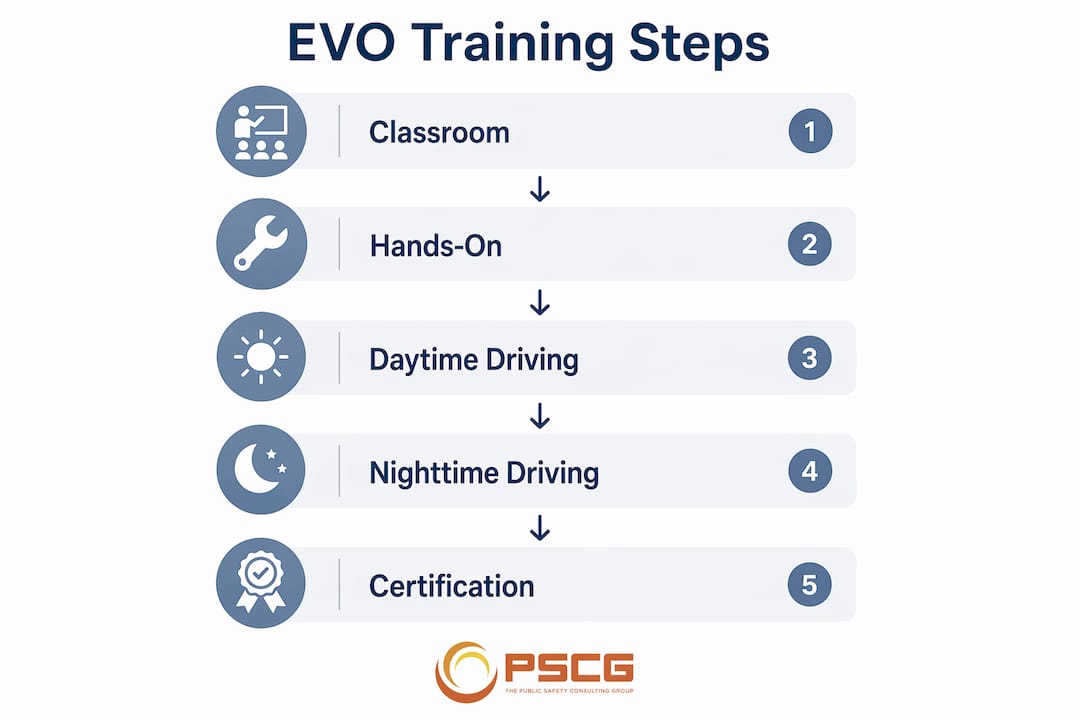
EVOC training programs range from 8 to 40 hours, combining classroom instruction with hands-on driving exercises. That range reflects the difference between a foundational certification and an advanced tactical course. The variation matters because not every responder operates the same vehicle type or faces the same response environment.
Standard EVOC curricula cover the following core modules:
- Vehicle dynamics: Understanding how weight transfer, braking distance, and center of gravity change at speed
- Defensive driving: Anticipating hazards before they require emergency reaction
- Intersection safety: Protocols for clearing intersections legally and safely, including communication with other units
- Hazard avoidance: Recognizing and responding to road conditions, pedestrians, and other vehicles
- Adverse condition driving: Operating on wet, icy, or unpaved surfaces where vehicle behavior changes significantly
Advanced courses go further. Modern EVO training incorporates daytime and nighttime driving on both paved and unpaved roads, with high-speed evasive maneuvers and skid control exercises conducted over 3–5 day intensives. That level of immersion prepares operators for the conditions they will actually face, not just the conditions that are easy to simulate.
EVOC certification typically includes 8 hours of classroom instruction and 8 hours of hands-on driving assessment. Certifications are valid for four years, which means agencies must build refresher cycles into their training calendars, not treat initial certification as a permanent credential.
Pro Tip: Schedule EVOC refreshers at the three-year mark rather than waiting for the four-year expiration. Operators who refresh early consistently perform better on assessments and report higher confidence in adverse conditions.
How do legal requirements and liability shape emergency vehicle protocols?
Legal accountability in emergency vehicle operations runs in two directions: toward the individual operator and toward the agency. Both exposures are real, and both require active management through documented training and operational standards.
The legal framework for emergency vehicle use varies by state, but common elements include:
- Operator certification requirements: Most states mandate documented training before an operator can legally drive under lights and sirens.
- Pre-shift vehicle inspections: Agencies require detailed pre-shift inspections to document equipment security. Loose equipment becomes a projectile during emergency maneuvers, and that is treated as a legal risk factor, not just a maintenance issue.
- Training record maintenance: Agencies must retain documentation of all training completed, including refreshers, to defend against liability claims.
- Risk management integration: TEEX emphasizes that EVO training reduces agency liability by standardizing responses to the most common emergency incident types, with risk management personnel directly influencing curriculum design.
“The goal of standardized emergency vehicle training is not just to improve driving skills. It is to create a documented, defensible record that the agency took every reasonable step to prepare its operators.” — Thepscgroup operational risk perspective
Agencies that integrate operational risk reduction into their EVO programs build a legal buffer that generic driving instruction cannot provide. The difference between a training program and a liability management tool is documentation, standardization, and periodic review.
What driving tactics and decision-making skills matter most in high-stakes operations?
Technical driving skill and mental performance are equally important in emergency vehicle operations. Most training programs spend significant time on mechanics. The best programs spend equal time on the mental side.
Key tactical skills for high-stakes emergency driving include:
- Braking and cornering at speed: Understanding threshold braking and how cornering forces affect vehicle control prevents the overcorrection errors that cause rollovers
- Intersection navigation: Intersections represent a significant risk, especially during non-emergency return trips when operator vigilance drops. Spotters, hand signals, and radio communication with dispatch reduce that risk substantially
- Situational awareness: Scanning well ahead of the vehicle, not just the immediate road surface, gives operators time to make decisions rather than reactions
- Stress and adrenaline management: The mental aspects of managing physiological stress and avoiding tunnel vision are among the least taught but most critical skills in EVO. Experienced responders treat adrenaline management as a core competency, not a soft skill
Post-call vigilance is a separate and underappreciated risk period. Operator complacency after a call is a known contributor to collisions. The lights are off, the urgency is gone, and the operator’s guard drops. Training programs that include post-response decompression modules address this gap directly.
Pro Tip: After every lights-and-siren response, build a 60-second mental reset into your standard operating procedure before resuming normal driving. That brief pause resets physiological arousal and reduces the complacency window.
State fire academies are now shifting EVO training from purely mechanical driving skills to mental and physical decision-making under stress. That shift reflects what field experience has long confirmed: the operator’s mind fails before the vehicle does.
How does EVO fit into broader emergency response systems?
Emergency vehicle operations does not function in isolation. It is one component of a larger operational architecture that includes Incident Command Systems (ICS), multi-agency coordination, and protocol-driven response frameworks. Tactical emergency driving must integrate with ICS and multi-agency coordination to optimize response in complex incidents.
The table below compares how EVO training and integration requirements differ across common public safety vehicle types:
| Vehicle type | Primary EVO focus | Integration requirement |
|---|---|---|
| Ambulance / EMS | Patient safety, smooth braking, intersection protocols | EMS clinical protocols, hospital coordination |
| Fire apparatus | Large vehicle dynamics, aerial positioning, scene approach | ICS, mutual aid coordination |
| Law enforcement | High-speed pursuit tactics, evasive maneuvers | Dispatch coordination, pursuit policy compliance |
| Hazmat / specialty | Low-speed precision, load stability, site access | Multi-agency command, environmental protocols |
Municipal EMS and fire agencies benefit most when EVO training is customized to the specific vehicle types their operators drive. A paramedic who trains exclusively in a light-duty vehicle and then operates a Type I ambulance faces a significant gap in vehicle dynamics knowledge. Customization is not a luxury. It is a safety requirement.
For municipal leaders, integrating EVO standards into broader municipal EMS best practices creates consistency across the fleet and reduces the performance variability that leads to incidents. Agencies that align their vehicle operations training with their overall response system design see measurable improvements in both safety records and response time benchmarks.
Key Takeaways
Effective emergency vehicle operations requires documented training, legal accountability, mental performance skills, and system-level integration to protect operators, agencies, and the public.
| Point | Details |
|---|---|
| EVO is a legal and operational discipline | Training addresses both driving mechanics and civil or criminal liability for operators and agencies. |
| EVOC ranges from 8 to 40 hours | Course length reflects role complexity; advanced courses include night driving, skid control, and evasive maneuvers. |
| Mental performance is a core skill | Managing adrenaline and avoiding tunnel vision prevents more collisions than mechanical driving skill alone. |
| Post-call vigilance is a known risk period | Operator complacency after a response is a documented collision risk; training must address it explicitly. |
| System integration multiplies EVO effectiveness | Aligning vehicle operations with ICS, multi-agency protocols, and clinical standards produces better outcomes than standalone training. |
What I’ve learned about EVO that most training programs still miss
After working alongside public safety agencies across Connecticut and beyond, I have seen a consistent pattern: agencies invest in initial EVOC certification and then treat the job as done. That approach leaves the most dangerous gaps unaddressed.
The mechanical skills taught in EVOC are necessary. They are not sufficient. The operators I have seen involved in post-response incidents were not undertrained on braking or cornering. They were caught in the complacency window after a call, when the adrenaline drops and the mind shifts out of active mode. That is the period that kills people, and most training programs spend almost no time on it.
The other gap I see consistently is documentation. Agencies that cannot produce training records, vehicle inspection logs, and refresher schedules are exposed in ways they do not fully appreciate until a claim is filed. Pre-trip inspections are not a maintenance formality. They are legal risk management documentation, and they need to be treated that way from day one.
The agencies that get EVO right treat it as an ongoing operational standard, not a one-time certification event. They build refresher cycles into their calendars, they customize training to their specific vehicle types, and they integrate vehicle operations into their broader public safety training framework. That is the standard worth building toward.
— Mike
How Thepscgroup supports emergency vehicle operations improvement

Thepscgroup works directly with municipal leaders and public safety agencies to close the gap between minimum compliance and genuine operational excellence. Our consulting services cover EMS system design, operational risk reduction, and training alignment, giving your agency a clear path from current performance to documented, defensible best practice.
If your agency is reviewing its EVO protocols, updating training cycles, or building a liability risk management framework, we can help you structure that work effectively. Explore our EMS system design resources or connect with our team directly at thepscgroup.net to discuss where your agency stands and what a stronger operational foundation looks like in practice.
FAQ
What is emergency vehicle operations (EVO)?
Emergency vehicle operations is the structured system of training, protocols, and legal standards that govern how public safety personnel operate emergency vehicles safely and legally. It covers vehicle dynamics, intersection safety, legal liability, and mental performance under stress.
How long does EVOC certification take?
EVOC certification typically requires 8 hours of classroom instruction and 8 hours of hands-on driving, with certifications valid for four years. Advanced tactical courses can run 40 hours or more over 3–5 days.
What are the biggest legal risks in emergency vehicle operations?
The primary legal risks include undocumented training, missing pre-shift vehicle inspection records, and operator actions that fall outside established protocols. Agencies that standardize training and maintain complete documentation significantly reduce their civil and criminal exposure.
Why is post-call vigilance important in emergency driving?
Operator complacency after a lights-and-siren response is a documented collision risk because physiological arousal drops and mental alertness decreases. Training programs that include post-response decompression protocols directly address this gap.
How does EVO training differ by vehicle type?
EVO training should be customized to the specific vehicle an operator drives. Ambulance operators focus on smooth braking and patient safety, fire apparatus operators train on large vehicle dynamics and aerial positioning, and law enforcement operators emphasize high-speed pursuit tactics and evasive maneuvers.
Recommended
- Fire Department Operational Assessment Guide For Safer Communities
- Municipal EMS Best Practices: Optimize Response And Impact
- Best Practices for EMS Instructors: Shaping the Future of Emergency Medical Services Education | The Public Safety Consulting Group
- CP In The Field: What Every EMS Responder Must Know