



TL;DR:
- Effective EMS response planning involves eight core components that ensure preparedness and coordination during emergencies. It must be continuously tested, revised, and include strong multi-agency cooperation to build operational reliability and mitigate response failures.
EMS response planning is the structured framework that defines how emergency medical services prepare for, coordinate, and execute medical response during incidents. In the industry, this process is formally called Emergency Response Planning (ERP), and it goes well beyond a simple checklist. A complete ERP addresses coordination, communication, resource management, training, and interoperability with partner agencies. Public safety leaders who master these principles build systems that perform under pressure, not just on paper. This guide covers the eight core components recognized in 2026 best practices, multi-agency coordination, training standards, and the most common planning failures.
What is EMS response planning and why does it matter?
EMS response planning is a living process, not a static document. It defines who does what, when, and with what resources when an emergency occurs. The distinction between an Emergency Action Plan (EAP) and a full Emergency Response Plan matters here. OSHA 29 CFR 1910.38 sets minimum EAP requirements covering evacuation and critical shutdown. An ERP goes further, adding detailed response procedures, training requirements, and formal review cycles. That difference is significant for any agency serious about operational readiness.
Effective emergency management planning requires leaders to treat the plan as a system, not a binder on a shelf. When an incident occurs, responders rely on pre-built muscle memory and clear protocols. Plans that are written but never exercised create a false sense of security. The goal is a document that drives behavior, not one that simply satisfies a compliance requirement.
What are the essential components of EMS response planning?
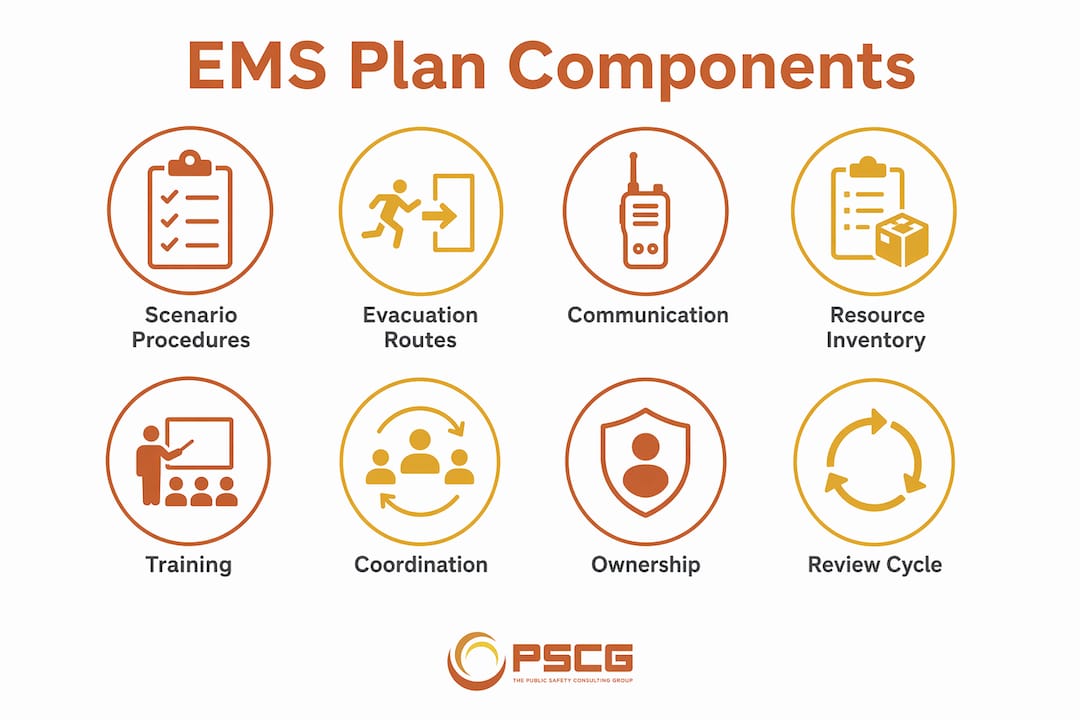
Eight core components form the foundation of every credible ERP. Each component serves a distinct function, and gaps in any one of them create vulnerabilities during an actual response.
| Component | Function |
|---|---|
| Scenario-specific procedures | Define step-by-step actions for fire, medical, hazmat, and mass casualty events |
| Evacuation routes and assembly points | Provide mapped egress paths and designated gathering locations |
| Communication protocols | Establish notification chains, radio channels, and backup systems |
| Roles and responsibilities | Assign clear ownership of tasks to specific positions, not individuals |
| Emergency contact lists | Maintain current contacts for personnel, mutual aid partners, and agencies |
| Resource inventories | Catalog available equipment, vehicles, medications, and supplies |
| Training and drill schedules | Set recurring dates and formats for exercises at all levels |
| Plan review and update cycles | Require formal reassessment after incidents, exercises, or regulatory changes |
Scenario-specific procedures deserve particular attention. A plan that addresses only “general emergencies” fails when a hazardous materials release requires different staging, personal protective equipment, and decontamination protocols than a structural fire. Each scenario type needs its own procedure set.
Pro Tip: Assign plan ownership to a position title, such as “EMS Operations Supervisor,” rather than a person’s name. Personnel change; the role does not. This prevents critical gaps when staff turn over.
Resource inventories are often underdeveloped. Agencies frequently list vehicles but omit medication quantities, equipment calibration dates, or mutual aid resource availability. A complete inventory includes condition, location, and replenishment lead time for every critical item.
How do EMS agencies coordinate with other public safety entities?
Multi-agency coordination is where most EMS plans show their weakest points. Pre-incident coordination and formalized mutual aid agreements are the foundation of effective disaster response. Agencies that plan in isolation consistently underperform when incidents require shared resources and unified command.
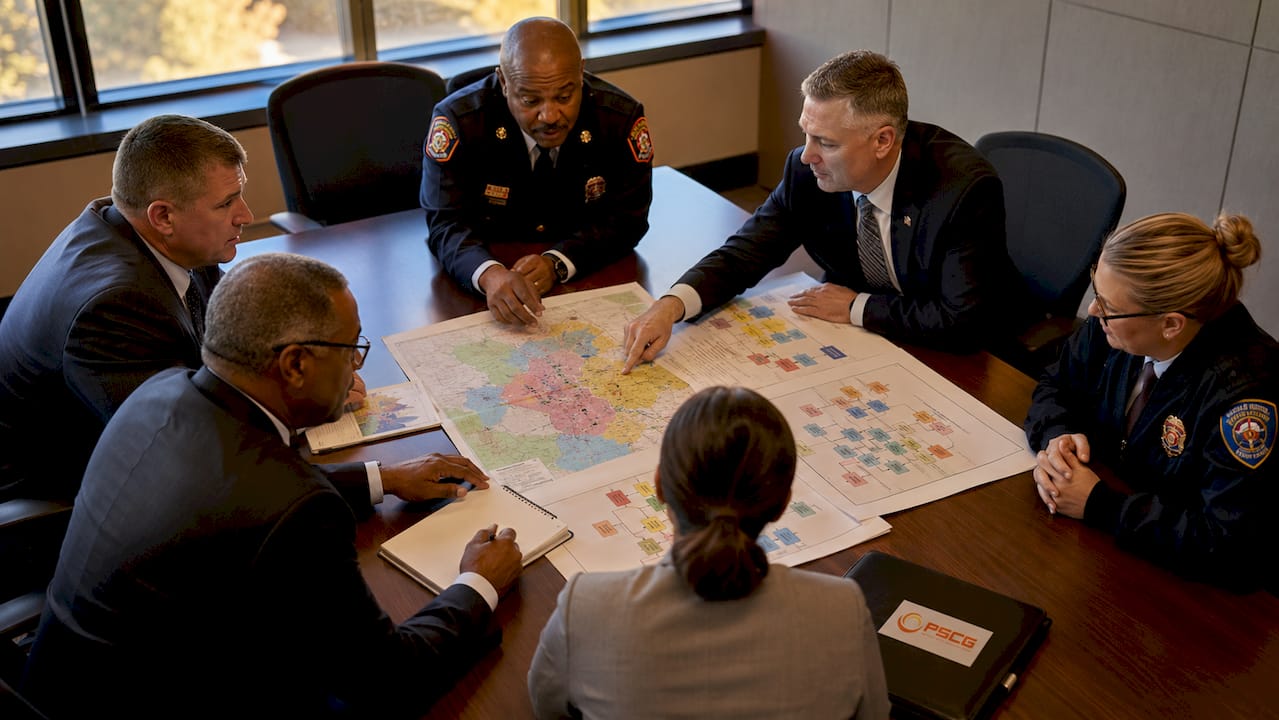
The Standard Response Protocol (SRP) addresses one of the most persistent coordination failures. Standardized action-based language reduces confusion under high stress in multi-agency responses. When a fire department, law enforcement, and EMS use different terminology for the same action, critical seconds are lost. The SRP provides a common vocabulary that all agencies can adopt without replacing their existing operational frameworks.
Mutual aid agreements require more than a signature page. Licensure reciprocity and liability protection must be addressed proactively before a disaster, not during one. A paramedic deployed from a neighboring jurisdiction needs clear legal authority to practice and clear liability coverage. Medical directors carry responsibility for ensuring these administrative details are resolved in advance.
Physical coordination presents its own challenges. Shared staging areas, radio channels, and access control must be explicitly planned to prevent safety hazards and evidence contamination at complex scenes. Law enforcement and EMS often have competing priorities at crime scenes or mass casualty events. Pre-incident planning that includes worst-case coordination scenarios with law enforcement protects both responders and the integrity of the response.
Pro Tip: Conduct a joint tabletop exercise with your law enforcement and fire partners at least once a year. Tabletops cost almost nothing and reveal coordination gaps that no written plan will expose.
- Establish shared radio channels and test them before an incident
- Designate unified staging areas in your mutual aid agreements
- Confirm licensure reciprocity language in every out-of-jurisdiction deployment agreement
- Include law enforcement in EMS mass casualty planning sessions
What are the recommended training and drill practices for EMS readiness?
Training frequency is not a matter of preference. EMS drills follow specific recommended frequencies: medical scenario drills quarterly, fire drills semiannually, and full-scale multi-agency exercises annually. Quarterly drills run 20–45 minutes. Annual multi-agency exercises span 2–4 hours. These benchmarks exist because skill degradation is real and measurable.
- Quarterly medical drills. Run 20–45 minute scenario-based exercises focused on patient assessment, treatment protocols, and equipment operation. Rotate scenarios to cover cardiac arrest, trauma, and pediatric emergencies across the year.
- Semiannual fire drills. Practice evacuation procedures, communication chains, and accountability systems. Include scenarios that test responders under reduced visibility or access constraints.
- Annual full-scale exercises. Conduct 2–4 hour multi-agency exercises that activate mutual aid agreements, test unified command structures, and simulate mass casualty or disaster conditions.
- Tabletop exercises. Use these for leadership teams to work through decision-making under simulated pressure without the cost of a live deployment. Tabletops are particularly effective for testing communication protocols and resource allocation decisions.
- After-action reviews. Document every drill with a formal debrief. Record what worked, what failed, and what changes the plan requires. Feed those findings directly into the next plan revision cycle.
The planning “P” cycle formalizes this approach. Continuous evaluation and revision through exercises builds the response muscle memory that makes plans reliable. Agencies that skip after-action reviews lose the most valuable data their drills produce.
Pro Tip: Build a feedback loop into your drill documentation. Assign one person to track every corrective action identified in after-action reviews and report on resolution status at the next drill. Unresolved findings from past drills are a leading indicator of plan failure.
For EMS training excellence, instructors need structured frameworks that connect drill outcomes to plan revisions. Training that does not feed back into the plan is training that does not improve readiness.
What common pitfalls undermine EMS response planning?
The most damaging mistake in EMS planning is treating the plan as a finished product. Plans that are never drilled are failures waiting to happen. A document that sits in a filing cabinet does not build response capacity. Only repeated exercise builds the automatic behaviors that hold up under stress.
“Effective disaster response relies on formalized mutual-aid agreements and shared communication frameworks established before incidents occur.” — FEMA Comprehensive Preparedness Guide
Isolated agency planning is the second most common failure. Planning in isolation produces plans that work perfectly until a second agency arrives on scene. At that point, incompatible protocols, unfamiliar terminology, and undefined command relationships create confusion at the worst possible moment.
- Static planning. Plans must be revised after every significant incident, exercise, or regulatory change. Annual reviews are a minimum, not a ceiling.
- Communication gaps. Agencies that skip communication standardization pay for it during multi-agency responses. Adopt a shared protocol like the Standard Response Protocol before an incident forces improvisation.
- Logistical blind spots. Staging areas, access routes, and equipment positioning must be pre-planned. Discovering that two agencies planned to use the same staging area during an active incident is a preventable failure.
- Workforce administration gaps. Temporary licensure, liability coverage, and credentialing for deployed personnel must be resolved in advance. These are not paperwork issues. They are legal and operational barriers that stop responders from functioning.
EMS physicians and administrators carry a technical leadership role that extends well beyond patient care during disasters. Policy decisions, workforce planning, and interagency coordination fall within their scope. Agencies that limit medical director involvement to clinical oversight miss the full value of that expertise.
Key Takeaways
Effective EMS response planning requires eight defined components, pre-incident multi-agency coordination, structured drill cycles, and a continuous revision process to remain operationally reliable.
| Point | Details |
|---|---|
| Eight core components | Every credible ERP includes scenario procedures, communication protocols, roles, resources, and a formal review cycle. |
| Pre-incident coordination | Mutual aid agreements, licensure reciprocity, and shared communication frameworks must be established before an incident occurs. |
| Drill frequency benchmarks | Medical drills quarterly, fire drills semiannually, and full-scale multi-agency exercises annually build reliable response capacity. |
| Plans are living documents | Revise after every incident, exercise, or regulatory change. Static plans degrade readiness over time. |
| Communication standardization | Adopting a shared protocol like the Standard Response Protocol reduces confusion and improves multi-agency performance. |
What I’ve learned about EMS planning that most guides won’t tell you
The plans that fail are almost never the ones with missing sections. They are the ones that were written by one agency, approved by leadership, and never tested with the partners who would actually show up on scene. I have worked alongside EMS systems across Connecticut and seen this pattern repeat itself. A well-formatted plan gives leaders confidence. That confidence is the problem when the plan has never been stress-tested.
The other thing I have seen consistently is that EMS medical directors are underutilized in the planning process. Their role in disaster response leadership extends into policy, workforce administration, and interagency coordination. When medical directors are brought in only for clinical sign-off, agencies lose the technical leadership that makes plans operationally sound.
The agencies that perform best in real incidents are the ones that treat planning as an ongoing operational function, not an annual compliance task. They run drills, document findings, revise the plan, and do it again. That cycle is not glamorous. It is exactly what works.
— Mike
How Thepscgroup supports EMS response planning
Public safety leaders who want to move from compliance-level planning to genuinely operational readiness need more than a template. Thepscgroup works directly with EMS agencies and municipal leaders to build plans that hold up under real conditions.

Our team specializes in EMS system design and municipal EMS strategy, helping agencies close the gap between written plans and operational performance. Whether you are building a new ERP from the ground up or revising an existing system, we work alongside your team to identify gaps, align mutual aid frameworks, and structure training cycles that produce measurable results. Contact us at thepscgroup.net to discuss your agency’s planning needs.
FAQ
What is EMS response planning?
EMS response planning is the structured process by which emergency medical services agencies define procedures, assign roles, establish communication protocols, and coordinate resources to respond effectively to medical emergencies and disasters.
How many components does a complete EMS response plan include?
A complete ERP includes eight core components: scenario-specific procedures, evacuation routes, communication protocols, roles and responsibilities, emergency contacts, resource inventories, training schedules, and a formal review cycle.
How often should EMS agencies conduct response drills?
Medical scenario drills are recommended quarterly at 20–45 minutes each, fire drills semiannually, and full-scale multi-agency exercises annually at 2–4 hours.
What is the difference between an EAP and an ERP?
An Emergency Action Plan (EAP) meets OSHA 29 CFR 1910.38 minimums and covers evacuation and critical shutdown. An Emergency Response Plan (ERP) includes those elements plus detailed response procedures, training requirements, and ongoing revision cycles.
Why do multi-agency EMS responses fail?
Multi-agency responses most often fail due to incompatible communication protocols, undefined command structures, and unresolved logistical conflicts like shared staging areas. Pre-incident coordination and adoption of standardized language like the Standard Response Protocol directly reduce these failures.