



TL;DR:
- Effective emergency response plans require cross-functional collaboration, explicit activation criteria, and continuous reviews.
- Implementation success depends on regular drills, clear role training, and maintaining a living, well-updated document.
An emergency response plan is a documented set of clear, actionable procedures that organizations use to protect people and property during a crisis. Known formally as an Emergency Response Plan (ERP), this document defines who does what, when, and how the moment an incident occurs. Without one, even experienced teams hesitate, communication breaks down, and outcomes worsen. With one, your organization moves from reaction to coordinated action in seconds.
Public safety officials and organizational leaders who understand how to create emergency response plans give their teams a measurable advantage. The emergency management principles behind effective ERPs are well established, and the process is repeatable. This article walks you through every step.
What are the essential steps to create an emergency response plan?
Developing an effective ERP follows an 8 to 11-step process that covers threat assessment, role assignment, protective actions, and regular drills. Each step builds on the last, so skipping one creates gaps that surface at the worst possible moment.
1. Build a cross-functional planning team.
Assemble representatives from operations, HR, security, IT, and facilities. Cross-functional collaboration with external public safety agencies is required for a complete risk picture. No single department holds all the information needed to plan for every scenario.

2. Conduct a comprehensive hazard and risk assessment.
Identify every credible threat to your facility or community, from natural disasters to active threats to infrastructure failures. Map each hazard to its likelihood and potential impact. This step determines which scenarios your plan must address first.
3. Define activation triggers.
Specify exactly when each protective action kicks in. Clear activation triggers eliminate hesitation by telling personnel precisely when to raise an alarm, evacuate, shelter in place, or call for outside help. Vague criteria cause dangerous delays.
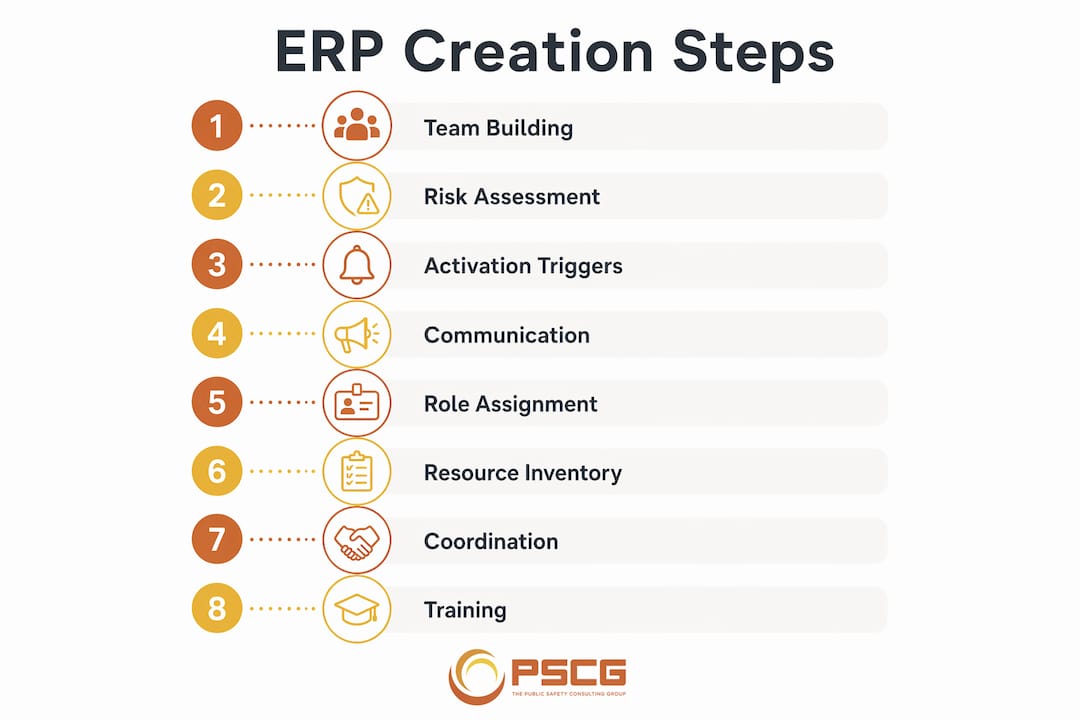
4. Develop communication protocols.
Establish how information flows internally to staff and externally to first responders, media, and the public. Assign primary and backup communication leads. Document every contact number, radio channel, and notification system in one accessible location.
5. Assign roles and responsibilities.
Every function in the plan needs a named primary person and a backup. Evacuation wardens, first aid leads, and incident commanders must know their duties before an emergency occurs. Ambiguity in roles is one of the most common failure points in real activations.
6. Document resource inventories.
List the location and quantity of first aid kits, AEDs, fire extinguishers, backup power, and any specialized safety equipment. Personnel cannot use resources they cannot find under pressure.
7. Coordinate with local public safety agencies.
Share your plan with your local fire department, EMS provider, and law enforcement. Their feedback will identify gaps you cannot see from inside your organization. This coordination also speeds up response when agencies arrive on scene.
8. Schedule training and review cycles.
Plans require annual review at minimum, with additional reviews triggered by significant facility or organizational changes. Build the review date into the plan document itself so it does not get skipped.
Pro Tip: Assign a single plan owner who is accountable for keeping the document current. Shared ownership almost always means no ownership.
What tools and formats best support effective emergency response plans?
The format of your ERP determines whether personnel can actually use it under stress. Overly complex plans fail because they require too much cognitive load at exactly the moment cognitive load is highest. Simple, action-oriented language is not a shortcut. It is a design requirement.
The following elements belong in every professionally developed ERP:
- Site maps and evacuation routes with clearly marked assembly points and alternate exits
- Contact lists for internal team leads, external responders, utilities, and public information officers
- Resource inventory tables showing the location of AEDs, first aid kits, fire suppression equipment, and backup power
- Scenario-specific action checklists written in plain language, organized by role
- Version control notation showing the date of the last review and the name of the plan owner
Templates from Ready.gov and WorkSafeBC provide consistent structure and reduce the time needed to build a plan from scratch. A basic emergency plan can be drafted in approximately 20 minutes using a structured template. That figure applies to household plans, but the principle holds for organizations: a clear template removes the blank-page barrier and focuses the team on content rather than format.
The table below shows how to match document format to use case:
| Use Case | Recommended Format | Key Feature |
|---|---|---|
| Rapid field reference | Laminated one-page checklist | Role-specific, no narrative |
| Full plan documentation | Digital PDF with version control | Searchable, linked appendices |
| Training and onboarding | Slide deck or video walkthrough | Scenario-based examples |
| Drill debrief | Structured after-action report | Gap identification fields |
Pro Tip: Store the full plan digitally with offline access. Cloud-only storage fails when the network goes down during the exact emergency you planned for.
How to implement, train, and maintain your emergency response plan effectively
A written plan that no one has practiced is not a plan. It is a document. The gap between those two things shows up in every real activation. FEMA’s CPG 101 guide confirms that successful emergency planning requires whole-community engagement and shared understanding of roles to produce synchronized crisis response.
Effective implementation follows these practices:
- Conduct drills at least annually. Use tabletop exercises for leadership and full-scale drills for operational staff. Each drill tests a different scenario to build broad competency.
- Train all personnel on their specific roles. Evacuation wardens, first aiders, and incident commanders need role-specific training, not just a general overview of the plan.
- Document attendance and competency. Keep records of who trained, when, and what they demonstrated. This documentation protects your organization and identifies personnel who need additional support.
- Debrief after every drill. The debrief is where the plan improves. Capture every gap, near-miss, and suggestion before the team disperses.
- Collaborate with external agencies for realistic exercises. Inviting your local fire department or EMS provider to participate in a drill produces feedback no internal team can replicate. Guidance on effective public safety partnerships shows how these relationships improve outcomes across the board.
- Update the plan after every significant event. An ERP is a living document that requires mandatory recurring reviews after drills, incidents, or organizational changes. Treating it as static guarantees it will be wrong when you need it most.
Pro Tip: Run your first drill as a no-fault exercise. Tell staff in advance that the goal is to find problems, not to perform perfectly. You will get more honest feedback and identify more gaps.
What are common mistakes when developing emergency response plans?
The most preventable failures in emergency response planning share a common cause: the plan was built for the shelf, not for the field. Outcome-driven emergency plans focus resources on the vulnerabilities that pose the greatest risk, which requires leaders to define what success looks like before, during, and after an incident.
Several specific mistakes appear repeatedly across organizations of all sizes.
Bureaucratic language. Plans written in passive voice with multi-clause sentences slow down decision-making when seconds matter. Every sentence in an operational checklist should begin with a verb.
Vague activation criteria. If your plan says “when conditions warrant,” your team will hesitate. Define the exact threshold: a confirmed fire alarm, a specific weather warning level, or a direct threat communication. Explicit criteria produce faster, more consistent responses.
Siloed planning. Plans developed by a single department without input from operations, HR, security, or external agencies contain blind spots. The interoperability between organizations and public safety agencies is not optional. It is the mechanism that makes coordinated response possible.
Failure to update after changes. A plan written before a facility expansion, a staffing restructure, or a new hazard is a plan for a building that no longer exists. Schedule reviews as a recurring calendar event, not a good intention.
“The plan that sits in a binder on a shelf is not an emergency response plan. It is a liability document.”
The consequences of poor planning are not abstract. Organizations that lack clear activation criteria, trained personnel, and updated contact lists experience longer response times, greater property damage, and higher rates of preventable injury. The investment in getting the plan right is small compared to the cost of getting it wrong.
Key Takeaways
Effective emergency response plans require cross-functional collaboration, explicit activation criteria, and continuous review to remain reliable when an incident occurs.
| Point | Details |
|---|---|
| Build a cross-functional team | Include operations, HR, security, IT, and external public safety agencies from the start. |
| Define activation triggers | Explicit criteria eliminate hesitation and produce faster, more consistent protective actions. |
| Use simple, action-oriented language | Plans written for high-stress execution must be clear and direct, not bureaucratic. |
| Treat the plan as a living document | Review after every drill, incident, or organizational change to maintain accuracy. |
| Train and drill regularly | Annual drills with documented debrief findings are the minimum standard for operational readiness. |
Why most emergency plans fail before the first alarm sounds
I have worked alongside public safety teams long enough to recognize a pattern. The organizations that struggle most during real emergencies are rarely the ones that lacked resources. They are the ones that built a plan in isolation and never tested it.
The most common failure I see is not a missing section or a wrong phone number. It is the absence of leadership commitment to the process. When senior leaders treat emergency planning as a compliance checkbox, the plan reflects that. It gets filed, not practiced. It gets reviewed when an auditor asks, not when the facility changes. The people who need to execute it have never held it in their hands.
What actually works is treating the ERP as an operational tool, the same way you treat a response time benchmark or a staffing matrix. It needs an owner, a review schedule, and a culture that takes drills seriously. The EMS training best practices that apply to clinical education apply here too: repetition builds competency, and competency builds confidence under pressure.
The organizations I have seen perform well during real incidents share one trait. Their people knew the plan because they had practiced it. Not because they had read it once.
— Mike
How Thepscgroup supports your emergency response planning
Public safety leaders who want to move from a paper plan to an operational system need more than a template. They need a structured process, experienced partners, and a framework built for real-world conditions.

Thepscgroup works directly with municipal leaders, EMS directors, and organizational safety officers to design response systems that hold up under pressure. Our EMS system design consulting provides the structural foundation that effective emergency plans depend on, from hazard assessment to resource deployment modeling. We also offer municipal EMS strategy guidance that integrates your emergency response planning with broader public safety operations. Contact us at thepscgroup.net to start the conversation.
FAQ
What is an emergency response plan?
An emergency response plan is a documented set of procedures that defines how an organization protects people and property during a crisis. It includes activation triggers, role assignments, communication protocols, and resource inventories.
What are the core emergency response plan steps?
The core steps include forming a cross-functional team, conducting a hazard assessment, defining activation triggers, establishing communication protocols, assigning roles, documenting resources, coordinating with public safety agencies, and scheduling annual reviews.
How often should an emergency response plan be reviewed?
Plans require review at least annually, with additional reviews triggered by drills, incidents, or significant organizational or facility changes.
What should be included in an emergency response plan?
Every ERP should include site maps, evacuation routes, assembly points, contact lists, resource inventories, scenario-specific checklists, and version control notation showing the last review date.
Why do emergency response plans fail?
Plans most often fail because of vague activation criteria, siloed development, lack of training, and failure to update after organizational changes. Outcome-driven planning that defines measurable objectives before an incident is the most reliable counter to these failures.