



TL;DR:
- Municipal EMS strategy workflows involve aligning resources, stakeholders, and processes to ensure effective emergency response. Success depends on leadership ownership, staff engagement, and choosing a system design that matches community needs, with ongoing review and adaptation. Implementing a strategic plan grounded in data and clear mission principles promotes sustainability and operational excellence.
A municipal EMS strategy workflow is the systematic process municipal leaders use to align emergency medical services resources, processes, and stakeholders for optimized response and long-term sustainability. In the industry, this is often called EMS strategic planning, and it covers everything from mission definition to deployment model selection to funding mechanisms. Without a deliberate workflow, municipalities default to reactive decision-making, which costs more and delivers less. Thepscgroup works alongside municipal leaders every day to build these frameworks, and the difference between agencies that thrive and those that struggle almost always comes down to whether a real strategy exists.
What are the core components of a municipal EMS strategy workflow?
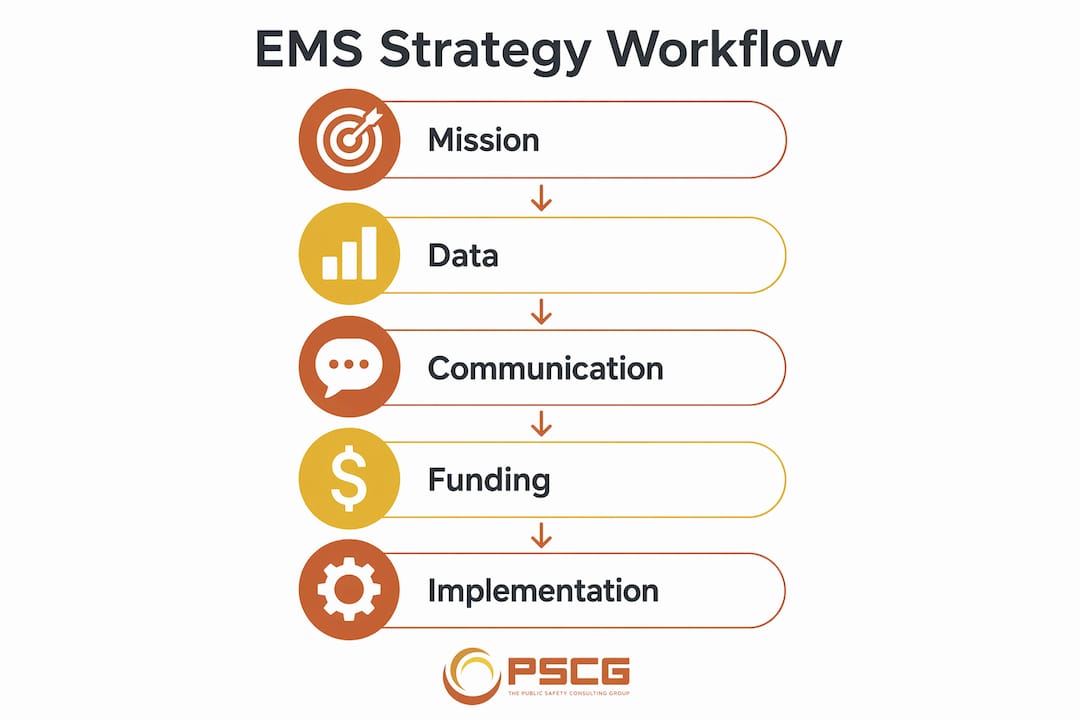
A municipal EMS strategy workflow rests on five core components: mission clarity, data systems, communication networks, staffing models, and deployment frameworks. Each component must connect to the others. A strong mission statement, for example, acts as a decision filter that guides resource allocation and prevents mission dilution when competing priorities arise.
Data systems are the operational backbone. Call volume analysis, response time benchmarks, and unit hour utilization reports give leaders the evidence they need to justify staffing decisions and budget requests. Without reliable data, resource allocation becomes guesswork.
Communication networks tie the workflow together. This means both internal communication between leadership and field staff and external coordination with hospitals, dispatch centers, and municipal government. Agencies that invest in System Status Management platforms and integrated CAD systems consistently outperform those relying on paper-based or siloed processes.
Funding mechanisms are a frequently underestimated component. Value-based care models like Treat without Transport (TIP) and Transport to Alternative Destination (TAD) generate per-encounter fees based on insurer savings, offering a revenue stream that traditional fee-for-service billing misses entirely. Incorporating these models into your EMS strategy development plan can close funding gaps that would otherwise force service cuts.
| Workflow Component | Common Tools | Municipal Application |
|---|---|---|
| Mission Clarity | Strategic planning frameworks, mission statements | Filters decisions on partnerships and resource use |
| Data Systems | CAD integration, unit hour utilization reports | Supports staffing and deployment decisions |
| Communication Networks | System Status Management, integrated dispatch | Coordinates field, hospital, and municipal stakeholders |
| Staffing Models | Deployment modeling software, scheduling platforms | Matches unit availability to call demand patterns |
| Funding Mechanisms | TIP/TAD models, consolidation analysis, tax mechanisms | Closes revenue gaps and supports service sustainability |
Pro Tip: Before selecting any tool or platform, map your current workflow gaps first. The best municipal EMS strategy tools are the ones that solve your specific constraints, not the ones with the most features.
How can municipal leaders develop and implement an EMS strategy workflow?
Strategic planning in EMS is a deliberate leadership act, not an administrative task. It requires the chief, medical director, and municipal leadership to agree on purpose before they agree on tactics. That sequence matters. Agencies that skip mission alignment and jump straight to operational changes often find themselves rebuilding the same problems a year later.

Staff involvement is not optional. Staff input highlights capacity constraints and practical realities that leadership may not see from the top. It also transforms a leadership document into an organizational commitment. When field providers understand how their daily work connects to the agency’s larger goals, performance improves.
Here is a practical sequence for developing and implementing your EMS strategic planning process:
- Define your mission and core priorities. Write a mission statement short enough to memorize and specific enough to guide decisions. Avoid vague language like “serve the community.” Instead, name your service area, your population, and your performance standard.
- Conduct a needs assessment. Analyze call volume trends, response time data, geographic coverage gaps, and demographic shifts. Use this data to identify where your current workflow falls short.
- Evaluate capacity and resources. Assess staffing levels, unit availability, equipment condition, and budget constraints against your identified needs. This step reveals the gap between aspiration and reality.
- Engage stakeholders. Include field staff, dispatch, hospital partners, municipal finance officers, and elected officials. Each group holds information the others need.
- Design the workflow. Map the process from call receipt to patient handoff, identifying decision points, resource triggers, and escalation protocols.
- Build a sustainability plan. Address funding, succession planning, and performance review cycles. A workflow without a sustainability plan is a project, not a strategy.
- Communicate continuously. EMS strategic planning is ongoing, requiring regular reinforcement to embed strategy into organizational culture. Schedule quarterly reviews and share progress with your entire team.
Pro Tip: Use your mission statement as a filter for every major decision. If a proposed partnership, program, or expenditure does not advance your stated mission, it deserves serious scrutiny before approval.
What are common challenges in municipal EMS strategy workflows?
The most common failure in municipal emergency strategy is not a lack of resources. It is a lack of leadership ownership. When the chief delegates the strategic plan to a committee and never references it again, the plan becomes a document rather than a direction. That gap between document and direction is where mission drift begins.
The following challenges appear repeatedly across municipal EMS agencies:
- Insufficient staff involvement: Plans developed without field input often contain unrealistic assumptions about capacity, scheduling, and call complexity.
- Reactive planning cycles: Agencies that only revisit their strategy after a crisis are always behind. Effective EMS workflow optimization requires scheduled, proactive reviews.
- Resource constraints mismanaged: Budget pressure is real, but cutting resources without a strategic framework often creates larger costs downstream, including overtime, turnover, and liability exposure.
- Siloed communication: When dispatch, field crews, and hospital partners operate without shared protocols, response quality suffers and data collection becomes unreliable.
- Misaligned performance metrics: Measuring only response times ignores patient outcomes, staff retention, and financial sustainability, all of which are critical indicators of workflow health.
Caution: Leadership cannot delegate ownership of the strategic plan. When the plan lives only in a binder on a shelf, the organization operates without direction. The chief and municipal leadership must reference the strategy in budget discussions, hiring decisions, and partnership negotiations. Ownership is not a one-time act. It is a daily practice.
The remedies are straightforward. Schedule a formal plan review every six months. Create a one-page summary of the strategy and post it where staff can see it. Use performance gap analysis to identify where the workflow is breaking down, and address those gaps with data before they become crises. Thepscgroup’s emergency management consulting practice is built around exactly this kind of structured, ongoing support.
How do EMS system design models affect municipal strategy workflows?
The structure of your EMS system shapes every other element of your workflow. Municipal leaders who choose a system design model without evaluating its workflow implications often find themselves locked into operational patterns that do not match their community’s needs.
Three primary models define most municipal EMS systems:
Third-service municipal EMS places the agency directly under municipal government, separate from fire and police. This model gives leaders direct control over staffing, deployment, and budget. It works well in communities with high call volumes and stable municipal funding, but it requires strong internal management capacity.
Consolidated regional agencies combine multiple smaller services under a single administrative structure. County-level consolidation can realize administrative cost reductions and operational gains, particularly for agencies handling fewer than 1,000 calls per year. The tradeoff is reduced local control and the political complexity of multi-jurisdictional governance.
Private partnership models contract EMS delivery to a private provider. This model transfers operational risk and reduces direct municipal management burden. It works best when contract terms include strong performance standards, response time benchmarks, and community accountability provisions.
| System Model | Workflow Strengths | Workflow Challenges | Best Fit |
|---|---|---|---|
| Third-Service Municipal | Direct control, mission alignment | Requires strong internal management | High call volume, stable funding |
| Consolidated Regional | Cost efficiency, shared resources | Reduced local control, political complexity | Rural or low-volume agencies |
| Private Partnership | Reduced management burden | Contract dependency, accountability gaps | Communities with limited admin capacity |
Choosing the right model requires honest assessment of call volume, geography, funding stability, and local political context. Consolidation combined with revenue mechanisms yields the largest funding impact but may still leave residual gaps requiring additional sources. No model eliminates the need for strategic planning. It simply changes who does it and how.
Pro Tip: When evaluating system design models, factor in your five-year call volume projections and technology integration needs. A model that works today may not scale with your community’s growth or with evolving EMS delivery standards.
For a deeper look at how these models play out in practice, Thepscgroup’s EMS system design consulting resources offer detailed frameworks for municipal leaders.
Key takeaways
A sustainable municipal EMS strategy workflow requires leadership ownership, staff engagement, and a system design model aligned to your community’s specific needs and resources.
| Point | Details |
|---|---|
| Mission clarity drives decisions | A concise mission statement filters resource allocation and prevents mission drift over time. |
| Staff input strengthens plans | Field staff involvement reveals capacity constraints and builds organizational commitment to the strategy. |
| System design shapes workflow | The choice between third-service, consolidated, and private models determines your operational flexibility and cost structure. |
| Funding mechanisms matter | TIP, TAD, and consolidation models can close revenue gaps that traditional fee-for-service billing leaves open. |
| Strategy requires ongoing communication | Embedding strategy into culture means referencing the plan in daily decisions, not just annual reviews. |
What i’ve learned building EMS strategies that actually hold
I have worked with enough municipal EMS agencies to know that the hardest part of strategic planning is not writing the plan. It is keeping it alive after the retreat ends and the binders get distributed.
The agencies that sustain strong workflows share one trait: their leaders treat the strategy as a living document, not a finished product. They reference it in budget meetings. They use it to push back on unfunded mandates. They share it with new hires on day one. That consistent reinforcement is what separates a plan that guides an organization from one that collects dust.
The other thing I have seen repeatedly is the cost of skipping staff engagement. Leadership teams that build strategy in isolation often produce plans that are technically sound but operationally disconnected. Field providers know things about call patterns, equipment limitations, and community dynamics that do not show up in any dashboard. Leaving that knowledge out of the planning process is a real loss.
My honest advice to any municipal leader reading this: start with your mission, involve your people, and commit to reviewing the plan on a schedule. The EMS strategic planning process does not need to be complicated. It needs to be owned.
— Mike
How Thepscgroup helps municipal leaders build stronger EMS workflows
Thepscgroup is a Connecticut-based public safety consulting firm with deep expertise in EMS system design, municipal EMS strategy, and operational risk reduction. We work alongside municipal leaders to build workflows that are grounded in data, aligned to mission, and built to last.
Whether you are starting from scratch or rebuilding a system that has drifted from its original purpose, our team brings the experience and structure you need. Explore our municipal EMS strategy guide for a comprehensive look at how we approach EMS planning for municipalities of every size. You can also review EMS system design examples to see how other public safety leaders have applied these frameworks in real communities. Contact us at thepscgroup.net to start the conversation.
FAQ
What is a municipal EMS strategy workflow?
A municipal EMS strategy workflow is the coordinated process a municipality uses to align EMS resources, staffing, funding, and stakeholder communication for effective emergency response. It covers everything from mission definition to deployment model selection and performance review.
How does staff involvement improve EMS strategic planning?
Staff input reveals capacity constraints and operational realities that leadership may not see, and it transforms a leadership document into an organizational commitment. Agencies that include field providers in planning consistently produce more realistic and durable strategies.
What EMS funding models work best for municipalities?
Consolidation combined with revenue mechanisms like sales tax and Highway User Tax Funds yields the largest funding impact, though residual gaps may still require additional sources. Value-based care models like TIP and TAD also generate per-encounter fees that traditional billing misses.
How often should a municipal EMS strategy be reviewed?
EMS strategic plans require ongoing communication and reinforcement to remain effective, with formal reviews recommended at least every six months. Regular reviews allow leaders to adjust resource allocation and priorities based on current performance data.
Which EMS system design model is right for my municipality?
The right model depends on your call volume, geography, funding stability, and administrative capacity. Third-service municipal EMS suits high-volume communities with stable budgets, while consolidated regional models benefit smaller agencies seeking cost efficiency.