



TL;DR:
- Municipal EMS evaluation assesses system effectiveness, compliance, and service quality through structured steps and data collection. Engaging stakeholders early and reviewing emergency plans are critical to producing credible, actionable findings. Ongoing evaluation and a continuous quality improvement program ensure sustained emergency response system improvements.
Municipal EMS evaluation is the systematic process of assessing a local emergency medical services system’s operational effectiveness, regulatory compliance, and service quality. Following structured municipal EMS evaluation steps gives public safety administrators a clear path to identify performance gaps, meet standards set by bodies like NAEMSP, ACEP, and NFPA, and make defensible decisions about resource allocation. A 2026 audit revealed that only 9% of municipalities maintained valid, up-to-date emergency plans. That number alone tells you how much ground most systems have to cover before they can call themselves evaluation-ready.
What are the foundational prerequisites for municipal EMS evaluation steps?
Before any formal assessment begins, you need the right data sources, the right people at the table, and a clear picture of your current policy standing. Skipping this preparation phase produces findings that are incomplete, contested, or impossible to act on.

Data sources to gather first
Effective EMS evaluations use diverse data sources including ambulance ride-alongs, dispatch call monitoring, and patient surveys. Each source captures a different layer of system performance. Dispatch data reveals call volume patterns and response time trends. Clinical care reports show protocol adherence and patient outcome quality. Patient surveys surface service experience gaps that operational data alone will miss.
The core data sources to compile before starting your evaluation include:
- Full fiscal year 911 call records, including call answer times and dispatch intervals
- Clinical care reports and patient care documentation
- Certification and credentialing records for all EMS personnel
- Equipment maintenance and readiness logs
- Patient satisfaction surveys and complaint records
- Current mutual aid agreements and operational policies
Stakeholder identification and engagement
Identifying your stakeholders early is not a courtesy step. It is a prerequisite for getting accurate data. Municipal EMS systems typically involve fire departments, dedicated EMS agencies, volunteer squads, hospital partners, and elected officials. Each group holds a piece of the operational picture. Leaving any one of them out creates blind spots in your findings.
Identifying key legislative stakeholders early in the process also helps you anticipate political friction before it disrupts data collection. Map every agency and individual who contributes to or depends on EMS service delivery. Assign a point of contact for each group and establish clear expectations for data sharing before the evaluation formally launches.
Policy and plan review
Only about 11% of municipalities had emergency plans approved within the mandatory 3-year period, and only 5% tested their plans regularly. Those figures reflect a systemic failure in plan maintenance, not just isolated oversights. Before your evaluation begins, confirm whether your current emergency operations plan is within its validity window and whether it has been tested through drills or tabletop exercises.
Pro Tip: Pull your plan’s last approval date and last exercise date before your first stakeholder meeting. If either is more than three years old, flag it as a prerequisite finding before the formal evaluation even starts.
| Prerequisite Item | Why It Matters |
|---|---|
| 911 dispatch data (full fiscal year) | Establishes baseline call volume and response time trends |
| Clinical care reports | Reveals protocol adherence and documentation quality |
| Personnel certification records | Confirms compliance with state and NFPA credentialing standards |
| Emergency plan validity | Confirms regulatory compliance before benchmarking begins |
| Stakeholder contact map | Prevents data gaps caused by missing agency input |
What are the core steps to conduct a municipal EMS system audit?
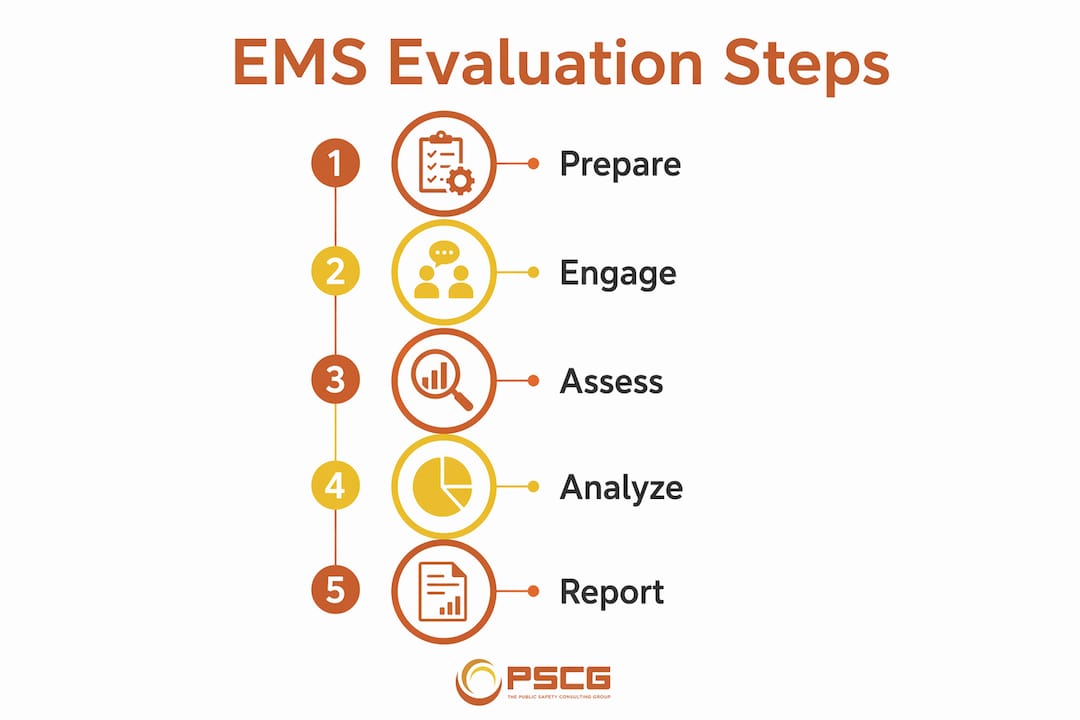
A structured EMS assessment procedure follows a logical sequence. Each step builds on the last. Jumping ahead or skipping steps produces findings that won’t hold up to scrutiny from elected officials, legal counsel, or the public.
Benchmark current performance against recognized standards. Compare your system’s response times, call answer times, and clinical outcomes against NFPA standards, NAEMSP guidelines, and ACEP position statements. This step establishes the gap between where you are and where you need to be. Benchmarking against regional and national standards is the anchor for every finding that follows.
Collect and analyze operational data. Pull your full fiscal year 911 call data and review it against regulatory requirements. In states like California, this means adherence to Title 22. Your state will have its own equivalent. Analyze call volume by time of day, day of week, and geographic zone to identify demand patterns that staffing models may not currently address.
Observe field and dispatch operations directly. Conduct structured ride-alongs with field crews and monitor dispatch operations in real time. Written records tell you what happened. Direct observation tells you why. Look for workflow gaps, communication breakdowns, and equipment issues that don’t appear in documentation.
Conduct surveys and structured interviews. Survey patients, field providers, and dispatch personnel using standardized instruments. Interview agency leaders and medical directors separately to capture candid assessments. Structured interviews with fire department leadership and EMS squad supervisors often surface tensions that surveys alone won’t reveal.
Identify performance gaps and system strengths. Cross-reference your benchmarking data, operational data, observation notes, and survey results. Gaps are where current performance falls below standard. Strengths are where performance meets or exceeds benchmarks. Both matter. Documenting strengths gives you a foundation to build from and protects against the perception that evaluation is purely punitive.
Compile findings and produce a formal report. Organize findings by category: response performance, clinical quality, workforce readiness, equipment status, and policy compliance. Each finding should include the data source, the applicable standard, the current performance level, and a recommended corrective action. The report is the deliverable that drives budget requests, policy changes, and staffing decisions.
The EMS operational audit process at Thepscgroup follows this same sequential structure, with particular attention to the compliance gap between documented policy and actual field practice.
Pro Tip: Assign a single project lead to own the evaluation timeline and data collection log. Evaluations that distribute ownership across multiple departments routinely stall at the data collection phase.
Key assessment criteria to track throughout each step:
- Ambulance response times by call priority and geographic zone
- Dispatch answer times and pre-arrival instruction delivery
- Certification currency for all licensed personnel
- Equipment readiness rates and maintenance compliance
- Documentation completeness in patient care reports
- Protocol adherence rates by call type
How can municipal leaders handle political and operational barriers during evaluation?
Political friction is the most common reason EMS evaluations produce incomplete findings. Fire departments, EMS squads, and volunteer organizations each have institutional interests that don’t always align with a transparent system review. Acknowledging that reality upfront is more productive than pretending the evaluation is purely technical.
Early stakeholder engagement is not just a consensus-building exercise. It is a critical enabler of accurate EMS program evaluation. When agencies feel excluded from the process, they withhold data, challenge findings, and resist implementation. When they are brought in early, they become co-owners of the outcome.
Consultants report that 67% of queried agencies responded during one municipal EMS review, but managing tensions among providers was essential to producing accurate data. That finding reflects a pattern seen across municipal systems nationwide. Partial participation produces partial findings.
Practical steps for managing barriers during the evaluation process:
- Hold a pre-evaluation briefing with all agency heads before data collection begins
- Establish a written data-sharing agreement that defines what information each party will provide
- Use a neutral third-party facilitator for interviews when inter-agency tensions are high
- Communicate findings to stakeholders before the report is finalized to allow factual corrections
- Frame the evaluation as a system improvement process, not an accountability investigation
When data is limited or policies are outdated, document the gap explicitly rather than working around it. An evaluation that acknowledges its own data limitations is more credible than one that overstates confidence in incomplete records. Reviewing EMS deployment models can also help frame staffing conversations in objective terms, reducing the perception that any single agency is being targeted.
Which performance metrics are essential for assessing EMS effectiveness?
Key EMS performance metrics include response times, call answer times, patient assessment accuracy, and certification tracking. NFPA standards and Continuous Quality Improvement models guide how these indicators are selected and measured. No single metric tells the full story. A system with fast response times but poor documentation compliance is not a high-performing system.
Continuous Quality Improvement programs that incorporate personnel, documentation, clinical care, and patient outcomes are the standard framework for ongoing EMS performance monitoring. Local EMS quality improvement teams collect data, monitor indicators, and evaluate results on a regular cycle. The evaluation process you conduct now should feed directly into that ongoing CQI structure.
| Performance Metric | Target Benchmark | Standard Reference |
|---|---|---|
| Ambulance response time (Priority 1) | 8 minutes or less (90th percentile) | NFPA 1710 |
| 911 call answer time | 15 seconds or less | NFPA 1221 |
| Certification currency rate | 100% of active personnel | State EMS licensing requirements |
| Patient care report completion | 100% of transports | State and local protocol |
| Equipment readiness rate | 100% pre-shift inspection compliance | Agency policy and NFPA standards |
| Patient satisfaction score | Agency-defined threshold, reviewed quarterly | CQI program benchmarks |
Beyond the numbers, qualitative indicators matter. Field provider morale, supervisor span of control, and medical director engagement all affect system performance in ways that data tables don’t fully capture. A complete municipal emergency response assessment accounts for both dimensions.
The public safety system assessment steps framework used by Thepscgroup integrates quantitative metrics with structured qualitative review, producing a more complete picture of system health than metrics alone can provide.
Key Takeaways
A structured municipal EMS evaluation requires benchmarking against NFPA and NAEMSP standards, multi-source data collection, direct field observation, and early stakeholder engagement to produce findings that are accurate, credible, and ready to act on.
| Point | Details |
|---|---|
| Benchmark before you assess | Compare current performance to NFPA, NAEMSP, and ACEP standards before drawing any conclusions. |
| Use multiple data sources | Combine 911 data, clinical reports, ride-alongs, and patient surveys for a complete operational picture. |
| Engage stakeholders early | Bring fire, EMS, and volunteer leaders into the process before data collection begins to prevent gaps. |
| Track the right metrics | Monitor response times, certification currency, documentation rates, and patient satisfaction on a defined cycle. |
| Feed findings into CQI | Connect evaluation outcomes to a Continuous Quality Improvement program to sustain performance gains over time. |
What I’ve learned from watching evaluations succeed and fail
I’ve seen municipal EMS evaluations that produced genuinely transformative results, and I’ve seen evaluations that generated a polished report nobody acted on. The difference almost never came down to the quality of the data. It came down to whether the right people were invested in the outcome before the first data point was collected.
The evaluations that worked treated stakeholder engagement as a technical requirement, not a political formality. When fire department chiefs, EMS medical directors, and volunteer squad leaders understood why the evaluation was happening and what would be done with the findings, they provided better data and accepted harder conclusions. When they felt ambushed by the process, they found ways to slow it down or discredit the results.
The other pattern I’ve observed is the tendency to treat evaluation as a one-time event rather than a cycle. A system that conducts a thorough assessment and then waits five years to look again has not built a quality improvement culture. It has conducted an audit. The municipal EMS best practices that produce durable results are the ones that connect evaluation findings to an ongoing CQI program with defined review intervals and accountable owners.
My honest recommendation: start with your emergency plan validity date and your last certification audit. If either is out of compliance, you already have your first two findings before the formal evaluation begins.
— Mike
How Thepscgroup supports municipal EMS system evaluation
Municipal leaders who want to move from evaluation findings to real system improvement need more than a checklist. They need a structured process, experienced facilitation, and a clear path from data to decision.

Thepscgroup works directly with municipal administrators and public safety leaders to design and execute EMS system evaluations that produce findings you can act on. From benchmarking and data collection to stakeholder facilitation and final reporting, we work alongside your team at every stage. Our step-by-step EMS system design guide gives leaders a practical framework for translating evaluation outcomes into system improvements. For a broader view of service delivery strategy, the municipal EMS strategy guide covers the full range of operational and policy decisions that follow a completed evaluation. Reach us directly at thepscgroup.net.
FAQ
What are the first steps in a municipal EMS evaluation?
The first steps are confirming emergency plan validity, identifying all stakeholder agencies, and compiling a full fiscal year of 911 dispatch data. These prerequisites establish the foundation for accurate benchmarking and gap analysis.
How do NFPA standards apply to EMS performance evaluation?
NFPA 1710 and NFPA 1221 set response time and call answer time benchmarks that serve as the primary quantitative targets in most municipal EMS assessments. Measuring current performance against these standards identifies the most critical gaps.
Why does stakeholder engagement affect evaluation accuracy?
When agencies feel excluded from the evaluation process, they withhold data and challenge findings. Early engagement converts potential opponents into co-owners of the outcome, producing more complete and credible results.
What is a Continuous Quality Improvement program in EMS?
A CQI program is an ongoing monitoring structure that tracks personnel performance, documentation quality, clinical care delivery, and patient outcomes on a defined review cycle. It converts one-time evaluation findings into sustained system improvement.
How often should a municipal EMS system be formally evaluated?
Most quality improvement frameworks recommend a formal system review every two to three years, with ongoing metric monitoring conducted quarterly. Emergency plan validity requirements in most states also mandate review within a three-year window.