



TL;DR:
- EMS compliance involves adhering to federal laws, operational standards, and documentation requirements that govern emergency services. It is essential for EMS agencies to meet these standards to avoid enforcement actions, penalties, and staffing disruptions that impact patient care.
EMS compliance is defined as the adherence to federal and state laws, operational standards, and documentation requirements that govern how Emergency Medical Services agencies deliver care, manage medications, and protect patient information. For EMS personnel and emergency managers, understanding EMS compliance requirements is not optional. Agencies that fall short face DEA enforcement actions, OSHA citations, HIPAA penalties, and staffing disruptions that directly affect patient outcomes. The regulatory landscape shifted significantly in 2026 with the Protecting Patient Access to Emergency Medications Act (PPAEMA) final rule, making this the right moment to build a clear, working compliance program.
What is EMS compliance and why does it matter?
EMS compliance means meeting the specific legal and operational obligations set by federal agencies including the Drug Enforcement Administration (DEA), the Occupational Safety and Health Administration (OSHA), and the Department of Health and Human Services through the Health Insurance Portability and Accountability Act (HIPAA). Each of these frameworks governs a distinct part of EMS operations, and all three apply simultaneously.
HIPAA protects patient health information. EMS agencies must train all staff who handle patient records, enforce access controls, and retain compliance documentation for six years. That retention period is longer than most EMS leaders expect, and gaps in older records surface during audits.
OSHA’s bloodborne pathogen standard protects field crews from exposure to infectious disease. It requires annual training, exposure control plans, and hepatitis B vaccination offered at no cost to patient-facing personnel within 10 working days of their initial assignment. OSHA training records must be retained for three years.
The DEA’s Controlled Substances Act governs every narcotic carried on an EMS unit. The 2026 PPAEMA final rule added new registration, storage, and recordkeeping requirements that affect nearly every agency in the country. Together, these three frameworks define what EMS compliance means in practice.
What are the core federal regulations governing EMS compliance?
Three federal frameworks form the foundation of EMS compliance requirements. Each carries its own enforcement authority, documentation standards, and training mandates.
- HIPAA: Agencies must train all workforce members who access protected health information. Training must be role-specific, documented, and repeated when policies change. Records are retained for six years from the date of creation or last effective date, whichever is later.
- OSHA Bloodborne Pathogen Standard (29 CFR 1910.1030): Annual training is mandatory for all employees with occupational exposure. The standard requires a written exposure control plan, access to personal protective equipment, and post-exposure follow-up protocols. Training records are retained for three years.
- DEA Controlled Substances Act: EMS agencies must register with the DEA, maintain accurate inventory records, and document every controlled substance transaction. The 2026 PPAEMA rule expanded these requirements substantially.
The format of training matters as much as the content. Live trainer interaction is required for both OSHA bloodborne pathogen and HIPAA training. Self-paced digital modules without an accessible trainer are commonly cited as non-compliant. That distinction catches many agencies off guard, particularly those that adopted fully automated learning management systems during the pandemic.
Pro Tip: Assign a compliance officer with authority to review training records quarterly. Waiting for an audit to find gaps is the most expensive way to discover them.
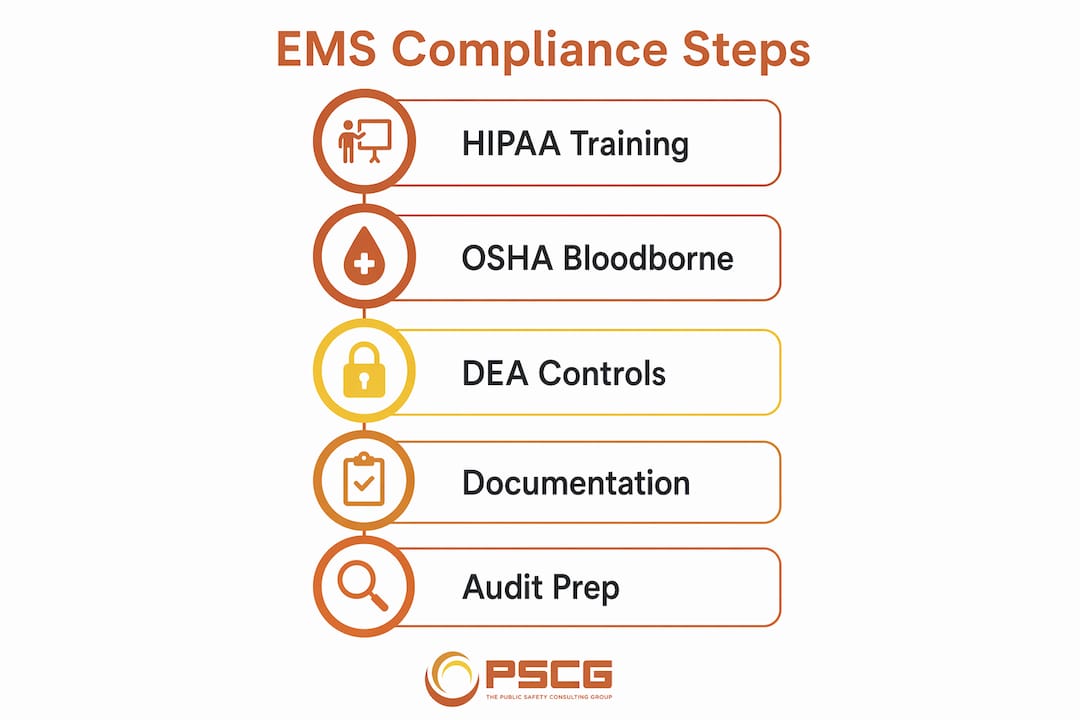
Agencies that treat these three frameworks as separate checklists miss the point. HIPAA, OSHA, and DEA requirements overlap in daily operations. A single patient encounter can trigger documentation obligations under all three.

How does the 2026 PPAEMA DEA rule affect EMS agencies?
The PPAEMA final rule, effective in 2026, is the most significant change to EMS controlled substance regulation in decades. It requires agencies to restructure how they store, access, and document narcotics at every level of their operation.
- State-based DEA registration: EMS agencies must now register in each state where they operate, not just their home state. Multi-county or regional services face the largest administrative burden from this change.
- Secure storage in vehicles and facilities: Controlled substances must be stored in DEA-compliant locked compartments. Vehicles require power-independent locking systems that maintain security even when the unit is shut down.
- Individual access accountability: Shared PINs or blanket access to controlled substance storage is non-compliant under the 2026 rule. Every access event must be tied to a specific, credentialed individual.
- Complete chain-of-custody documentation: Agencies must document every dose administered, including drug name, dosage form, date, patient identifier, administering clinician, authorizing provider, and disposal details with witness initials where applicable. Records must be retained for a minimum of two years.
- Audit-ready digital records: DEA auditors expect agencies to produce complete, searchable access logs within minutes of a request. Paper binders and manual reconciliation are treated as indicators of non-compliance, not just inconvenience.
The most common DEA violations in EMS are not intentional diversion. Incomplete recordkeeping and missed biennial inventories are the violations auditors find most often. That means the gap between a compliant agency and a cited one is often a documentation process, not a conduct problem.
Pro Tip: Invest in a digital controlled substance management system that generates exportable audit reports. When a DEA auditor arrives, you want to hand them a complete log in under five minutes, not spend the morning searching file cabinets.
Penalties for PPAEMA non-compliance include registration suspension, civil fines, and in serious cases, criminal referral. Proactive compliance is the only defensible position.
What are the essential documentation and training compliance requirements in EMS?
Documentation and training compliance in EMS is role-specific. A one-size-fits-all training program does not satisfy HIPAA, OSHA, or DEA requirements. Agencies must map training obligations to each job function.
| Role | Required Training | Retention Period |
|---|---|---|
| Field crews (EMTs, paramedics) | HIPAA, bloodborne pathogens, EVOC, controlled substances | 3–6 years depending on regulation |
| Drivers | Emergency Vehicle Operator Course (EVOC) | Per state requirement, minimum 3 years |
| Billing staff | HIPAA privacy and security | 6 years |
| Dispatch | HIPAA, patient abuse and neglect (where required) | 6 years |
| All staff | Annual bloodborne pathogen refresher | 3 years |
The Emergency Vehicle Operator Course (EVOC) is a frequently overlooked compliance requirement. Many states mandate documented EVOC completion before a provider operates an emergency vehicle. Agencies that skip this documentation face liability exposure in the event of a collision, regardless of the driver’s actual skill level.
Certification tracking is equally critical. An agency that allows a paramedic’s National Registry certification to lapse faces an immediate staffing gap. Managing certifications proactively prevents service interruptions that affect response capacity and patient care. A compliance calendar tied to each employee’s credential expiration dates is the most direct solution.
Patient abuse and neglect training is required in a growing number of states. Agencies operating under state EMS licensure should verify whether this training is mandated in their jurisdiction and document completion accordingly.
Pro Tip: Build your compliance calendar into your scheduling software. When a certification expires, the system should flag it 90 days out, not the morning of the shift.
The best practices for EMS instructors include maintaining training logs that are searchable by employee, date, and topic. That structure makes audit preparation a routine task rather than an emergency.
How does EMS compliance support patient safety and operational effectiveness?
EMS compliance is a proactive foundation for patient safety, not a bureaucratic burden layered on top of clinical work. Agencies that treat compliance as a core operational value deliver more consistent care and face fewer legal and financial risks.
Compliance is not the ceiling of what an EMS agency should do. It is the floor. Agencies that build their culture around meeting minimum standards will always be one audit away from a crisis. Agencies that build their culture around patient safety will find compliance follows naturally.
The benefits of EMS compliance extend well beyond avoiding penalties:
- Reduced legal exposure: Precise medication documentation and regulated storage reduce the risk of diversion allegations and civil liability.
- Staffing stability: Tracking certifications and training deadlines prevents the sudden discovery that a crew member cannot legally work a shift.
- Public trust: Demonstrated accountability through documented training and auditable records builds community confidence in the agency.
- Operational continuity: Agencies with complete records and trained staff recover faster from inspections, accreditation reviews, and incident investigations.
EMS operational audits consistently show that agencies with structured compliance programs outperform those without them on response time benchmarks, documentation accuracy, and staff retention. Compliance and performance are not competing priorities. They reinforce each other.
Common compliance pitfalls include expired certifications discovered during scheduling, HIPAA training records that cannot be located for departed employees, and controlled substance logs with missing witness signatures. Each of these is preventable with a structured compliance management process.
Compliance is a leadership decision, not a paperwork problem
I have worked with EMS agencies across a range of sizes and service models, and the pattern is consistent. Agencies that struggle with compliance do not struggle because their people are careless. They struggle because leadership has not made compliance a visible, funded priority.
The 2026 PPAEMA rule is a clear example. The individual accountability requirement for controlled substance access is not technically difficult to implement. It requires a policy decision, a technology investment, and a training rollout. Agencies that waited for the rule to take effect before acting are now scrambling. Agencies that treated the rulemaking process as a planning signal had months to prepare.
The same logic applies to HIPAA and OSHA. Appointing a dedicated compliance officer, maintaining current standard operating procedures, and scheduling regular internal audits are leadership decisions. They cost money and time. They cost far less than a DEA enforcement action or an OSHA citation.
Compliance also shapes culture. When an agency invests in EMS medical oversight and treats documentation as a clinical skill rather than an administrative chore, providers internalize safety as a value. That shift is the difference between an agency that passes audits and one that earns them.
The agencies I respect most are the ones that do not wait to be told what the rules require. They read the rulemaking, they consult with experts, and they build systems that hold up under scrutiny. That is what compliance leadership looks like.
— Mike
How Thepscgroup supports EMS compliance and system design
Thepscgroup works alongside EMS agencies and public safety leaders to address the full scope of compliance complexity, from controlled substance management and training documentation to system-wide operational design.
Whether your agency is preparing for a DEA audit, restructuring after a compliance gap, or building a new EMS system from the ground up, Thepscgroup brings the expertise to move from assessment to implementation. Our EMS system design consulting integrates compliance requirements directly into operational structure, so regulations become part of how your system runs rather than a separate burden to manage. For agencies ready to build smarter, visit thepscgroup.net or review our EMS system design examples to see how compliance-centered design works in practice.
Key Takeaways
EMS compliance requires simultaneous adherence to HIPAA, OSHA bloodborne pathogen standards, and DEA controlled substance regulations, with documentation retention periods ranging from two to six years depending on the framework.
| Point | Details |
|---|---|
| Three frameworks govern EMS compliance | HIPAA, OSHA, and DEA each impose distinct training, documentation, and retention requirements. |
| Live training is required | Self-paced modules without accessible trainers violate OSHA and HIPAA training standards. |
| PPAEMA demands individual accountability | Shared PINs or keys for controlled substance access are non-compliant under the 2026 DEA rule. |
| Digital records are audit-critical | DEA auditors expect searchable access logs produced within minutes, not paper binders. |
| Compliance protects staffing and operations | Tracking certifications and training deadlines prevents service disruptions and legal exposure. |
FAQ
What does EMS compliance mean?
EMS compliance means meeting all federal and state legal requirements governing how an EMS agency trains its staff, manages controlled substances, protects patient information, and documents its operations. The three primary federal frameworks are HIPAA, OSHA, and the DEA Controlled Substances Act.
How long must EMS agencies retain compliance records?
HIPAA documentation must be retained for six years, OSHA bloodborne pathogen training records for three years, and controlled substance medication records for a minimum of two years under DEA requirements.
What changed for EMS agencies under the 2026 PPAEMA rule?
The 2026 PPAEMA final rule requires individual accountability for every controlled substance access event, state-based DEA registration for multi-state operators, power-independent secure storage in vehicles, and complete chain-of-custody documentation for every dose administered.
Is self-paced online training sufficient for HIPAA and OSHA compliance?
Self-paced digital training without an accessible live trainer does not meet OSHA or HIPAA training requirements. Both standards require that employees have the ability to interact with a qualified trainer during the training session.
What are the most common EMS compliance violations?
Incomplete recordkeeping and failure to conduct required biennial controlled substance inventories are the most frequent DEA compliance violations found in EMS agencies. Most violations result from documentation gaps, not intentional misconduct.