



TL;DR:
- Municipal EMS contracting involves acquiring emergency medical services through a process that ensures reliability, compliance, and cost effectiveness.
- A well-structured contract includes clinical credentials, insurance, cybersecurity, response benchmarks, and accountability clauses to prevent operational failures.
Municipal EMS contracting is the process by which local government leaders procure emergency medical services to secure reliable, compliant, and cost-effective community response. This municipal EMS contracting guide addresses the full procurement lifecycle, from drafting a Request for Proposal (RFP) to managing vendor performance after award. The industry term for this discipline is EMS service procurement, and it sits at the intersection of public health law, operational risk management, and fiscal accountability. Municipal leaders who treat EMS contracting as a routine purchasing exercise routinely face service gaps, regulatory penalties, and community harm. The stakes are too high for that approach.
What essential components should a municipal EMS contract include?
A well-structured EMS contract defines the legal, clinical, and operational obligations of every party before a single ambulance rolls. Successful emergency service bids require comprehensive documentation including verified professional licenses, registration equivalents, and insurance coverage. That requirement exists because clinical governance failures at the contract stage become operational failures in the field.
Every EMS contract should address the following components:
- Clinical governance documentation: Verified paramedic and EMT licenses, medical director credentials, and state EMS agency certifications.
- Insurance and liability coverage: General liability, professional liability, and workers’ compensation minimums stated in dollar amounts, not percentages.
- Cybersecurity requirements: Defined Recovery Time Objectives (RTO) and Recovery Point Objectives (RPO) aligned with HIPAA standards. Business associates cause 30%–40% of all HIPAA-related data breaches, costing an average of $9.77 million per breach in 2024. That figure makes cybersecurity a non-negotiable contract clause, not an optional addendum.
- Response time benchmarks: Specific time targets by call priority level, geography, and time of day, with defined consequences for non-compliance.
- Patient outcome metrics: Cardiac arrest survival rates, stroke protocol adherence, and trauma transport times tied to contract performance reviews.
- Vendor accountability clauses: Scheduled audits, incident reporting timelines, and escalation procedures for service failures.
Pro Tip: Require vendors to submit a completed HIPAA Business Associate Agreement (BAA) before contract execution, not after. Waiting until post-award creates a compliance gap that exposes your municipality to federal liability.
You can also review municipal EMS best practices from Thepscgroup to benchmark your contract requirements against proven operational standards.

How to design an effective RFP for EMS services
RFP design is where most municipal EMS contracts succeed or fail before they begin. Poor RFP design is a leading cause of failed contracts. Successful EMS procurement requires detailed RFPs that define launch risk, schedule volatility, and accountability from the start.
The most effective approach separates the procurement into three distinct operational phases:
- Launch phase: Define mobilization requirements, staffing timelines, equipment delivery schedules, and go-live readiness criteria. This phase carries the highest risk and deserves its own performance standards.
- Ramp-up phase: Establish interim response time targets, training completion milestones, and community notification requirements. Separating launch and ramp-up requirements from steady-state operations is best practice because each phase carries different risks and performance indicators.
- Steady-state phase: Set full performance expectations, including System Status Management protocols, unit hour utilization targets, and quarterly review schedules.
Beyond phase separation, your RFP must address pricing transparency. Require vendors to itemize all cost assumptions, including fuel, labor, equipment depreciation, and overhead. Ambiguous pricing structures invite change orders and budget overruns after award.
Pro Tip: Before issuing your RFP, develop a supplier selection brief that aligns your internal stakeholders on quality, cost, risk tolerance, and scope. A structured selection brief prevents conflicting internal priorities from producing a flawed RFQ and speeds your final decision.
The table below compares two common RFP design approaches:
| RFP approach | Strengths | Risks |
|---|---|---|
| Single-phase bundled RFP | Simpler to administer initially | Merges launch and steady-state risks, reducing vendor accountability |
| Multi-phase separated RFP | Clearer performance targets per phase | Requires more upfront planning and internal alignment |
Municipal leaders who invest time in the multi-phase approach consistently report fewer contract disputes and better vendor performance over the contract term.
What are the best practices for evaluating EMS contract bids and vendor risk?
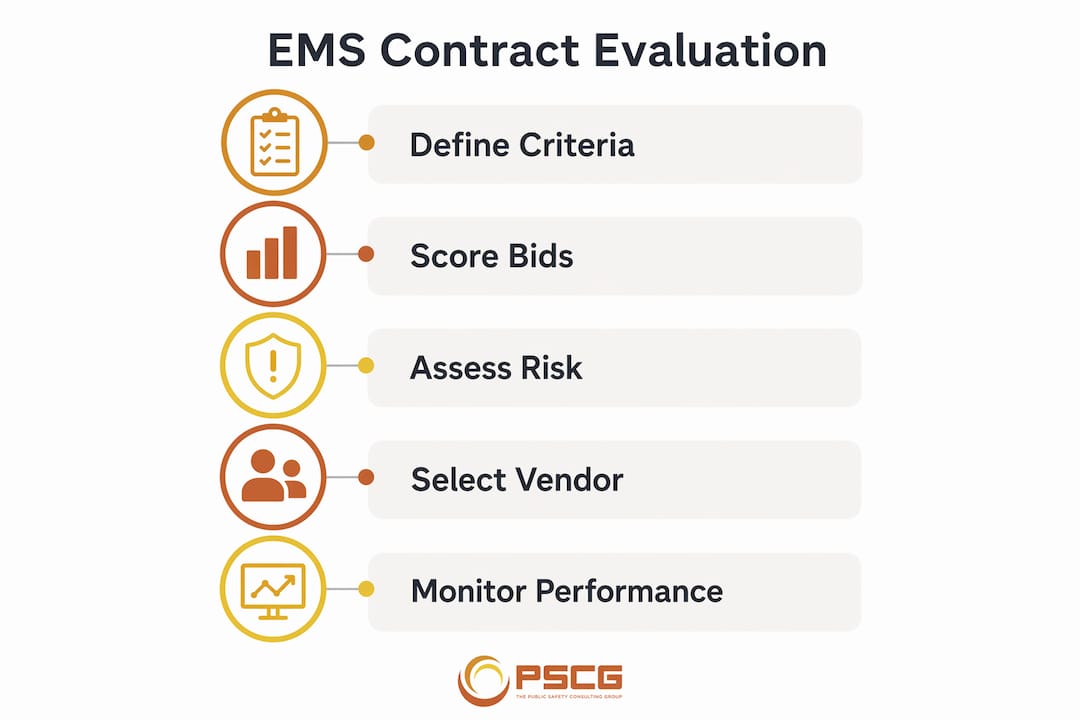
Bid evaluation is not a scoring exercise. It is a risk management decision. Comprehensive bid evaluation includes clinical readiness, operational capacity, historic performance metrics, and transparent cost structures. Comparing bids on multiple criteria reduces reliance on lowest price alone and improves service outcomes.
Use the following criteria when scoring EMS vendor bids:
- Clinical and operational readiness: Verify current staffing ratios, training records, and medical director qualifications. Ask for the last three years of response time compliance data from comparable contracts.
- Cybersecurity posture: Request the vendor’s most recent third-party security assessment, breach response plan, and documented RTO and RPO commitments. Vendors’ cybersecurity posture should be regularly monitored using automated platforms to maintain visibility and manage emerging threats.
- Cost structure transparency: Reject bids that bundle labor and overhead without itemization. Hidden costs in EMS contracts surface as budget shortfalls within 18 months of award.
- References and past performance: Contact at least two current municipal clients of similar population size. Ask specifically about response time compliance and how the vendor handled service disruptions.
- Financial stability: Request two years of audited financial statements. A vendor that cannot demonstrate fiscal health poses a continuity risk to your community.
A common evaluation pitfall is weighting price too heavily in the initial scoring matrix. The lowest bid rarely delivers the lowest total cost of ownership when you factor in performance penalties, retraining costs, and contract renegotiation expenses. Thepscgroup recommends a weighted scoring model that assigns at least 40% of total points to clinical and operational criteria, with price weighted no higher than 30%.
You can also consult the EMS deployment models resource from Thepscgroup to align your evaluation criteria with the deployment structure that fits your community’s geography and call volume.
For municipal fleets, emergency vehicle lighting standards are a practical compliance checkpoint worth including in your vendor equipment review.
How to manage the EMS contract lifecycle for sustained service quality
Awarding the contract is not the finish line. Contract lifecycle management is the discipline that determines whether your EMS system performs as promised over the full contract term.
Effective lifecycle management requires four ongoing commitments:
- Performance monitoring schedules: Conduct formal quarterly reviews using pre-agreed metrics. Response time compliance, unit hour utilization, and patient outcome data should all appear in a standardized dashboard shared with the vendor.
- Change order management: Define a written change control process before the contract launches. Verbal agreements about scope changes become disputes within 12 months without documentation.
- Incident response coordination: Require the vendor to maintain a downtime playbook with contact lists and recovery procedures. Downtime playbooks and joint drills are critical for maintaining EMS operations during service interruptions.
- Lessons-learned integration: After each contract year, conduct a structured debrief with the vendor. Document what worked, what failed, and what changes the next contract cycle should reflect.
Municipal emergency management plans require adoption and approval from regulatory directors, typically receiving approval responses within six weeks. That timeline means you need to initiate regulatory coordination well before your contract renewal date, not after.
The table below outlines a practical contract review schedule:
| Review interval | Focus area | Output |
|---|---|---|
| Monthly | Response time compliance and incident reports | Variance report shared with vendor |
| Quarterly | Full performance scorecard review | Formal written assessment with corrective action plan if needed |
| Annual | Contract terms, cost structures, and scope alignment | Amendment or renegotiation brief |
| Pre-renewal (12 months out) | Lessons learned and RFP refresh | Updated RFP or sole-source justification |
Municipalities that follow a structured review calendar reduce mid-contract disputes and enter renegotiations with documented evidence rather than anecdotal complaints.
Key takeaways
Effective municipal EMS contracting requires phase-separated RFPs, multi-criteria bid evaluation, cybersecurity compliance, and structured lifecycle management to deliver sustained service quality.
| Point | Details |
|---|---|
| Define contract components early | Include clinical governance, cybersecurity RTO/RPO, response benchmarks, and vendor accountability clauses before issuing any RFP. |
| Separate contract phases | Split launch, ramp-up, and steady-state requirements to assign the right performance standards to each operational stage. |
| Evaluate bids on multiple criteria | Weight clinical readiness and operational capacity at least as heavily as price to avoid lowest-bid service failures. |
| Monitor cybersecurity continuously | Require automated vendor risk monitoring and a current BAA to manage HIPAA exposure throughout the contract term. |
| Build a lifecycle review calendar | Conduct monthly, quarterly, and annual reviews with documented outputs to maintain vendor accountability and support renegotiation. |
What I’ve learned from watching municipal EMS contracts go wrong
After working alongside municipal leaders on EMS system design and procurement, the pattern I see most often is not malice. It is optimism. Leaders issue a single-phase RFP, award to the lowest bidder, and assume the vendor will figure out the details. Six months later, response times are slipping, the vendor is requesting change orders, and the community is asking questions at town hall.
The contracts that hold up are the ones where the municipality did the hard internal work first. That means aligning your fire chief, finance director, town counsel, and medical director on scope, risk tolerance, and performance expectations before a single vendor sees your RFP. A structured selection brief is not bureaucratic overhead. It is the document that prevents your procurement from becoming someone else’s case study in what not to do.
Cybersecurity is the issue I see most consistently underweighted in EMS contracts. Municipal leaders treat it as an IT problem. It is a public safety problem. A vendor breach that exposes patient records does not just trigger federal penalties. It erodes community trust in your entire emergency services system. Require documented RTO and RPO commitments, a current third-party security assessment, and a signed BAA before you execute any EMS service agreement.
The other shift I expect to see accelerate through 2026 is the use of operational risk reduction frameworks applied directly to vendor contracts. Municipalities that build risk reduction language into their contracts, rather than managing risk reactively after incidents, will consistently outperform those that do not. The contract is your primary risk management tool. Use it like one.
— Mike
How Thepscgroup supports municipal EMS contracting
Municipal EMS contracting is complex, and the cost of a poorly structured contract falls on your community, not on the vendor. Thepscgroup works directly with municipal leaders and public safety officials to design EMS systems, structure procurement processes, and build contracts that hold vendors accountable from day one.

Our team brings deep expertise in EMS system design, reimbursement optimization, and operational risk reduction. Whether you are approaching a first-time procurement or renegotiating an existing agreement, we work alongside your team to close the gaps before they become crises. The Municipal EMS Strategy Guide from Thepscgroup provides a practical framework for leaders ready to move from reactive contracting to proactive system management. You can also explore EMS system design consulting to see how we support municipalities at every stage of the procurement and design process. Reach us at thepscgroup.net.
FAQ
What is municipal EMS contracting?
Municipal EMS contracting is the formal process by which local governments procure emergency medical services from public or private providers through legally binding service agreements. It covers RFP design, bid evaluation, contract execution, and ongoing performance management.
What should every EMS contract include?
Every EMS contract should include verified clinical credentials, insurance minimums, HIPAA-compliant cybersecurity requirements with defined RTO and RPO, response time benchmarks by call priority, and a vendor accountability and audit schedule.
How do I evaluate competing EMS bids fairly?
Score bids on clinical readiness, operational capacity, historic performance data, cybersecurity posture, and transparent cost structures. Assign price no more than 30% of total scoring weight to avoid awarding to a vendor who cannot sustain service quality.
Why does cybersecurity matter in EMS contracts?
Business associates cause 30%–40% of all HIPAA-related data breaches, with an average breach cost of $9.77 million in 2024. EMS vendors handle protected health information daily, making cybersecurity contract language a legal and operational necessity.
How often should municipalities review EMS contract performance?
Municipalities should conduct monthly response time reviews, quarterly full performance scorecards, and annual contract alignment assessments. Beginning the renegotiation or re-bid process at least 12 months before contract expiration gives you the time to make changes from a position of strength.