



TL;DR:
- EMS data reporting standards require agencies to document patient care following the NEMSIS v3.5 standard and submit electronically within specified deadlines. Non-compliance often results from outdated coding, incomplete data, or delayed reviews, which can lead to penalties and operational issues. High-quality, timely data supports better funding, performance evaluation, and system improvement efforts.
EMS data reporting requirements establish the mandatory standards and procedures for documenting and submitting patient care and incident data to state and national health authorities. These requirements, anchored by frameworks like NEMSIS v3.5 and enforced through state regulations in Georgia, Kentucky, and Ontario, govern what data EMS agencies collect, how they format it, and when they submit it. For EMS professionals and municipal leaders, understanding these mandates is not optional. Compliance directly affects audit outcomes, funding eligibility, and the quality of patient care your system delivers.
What are the core EMS data reporting requirements and standards?
NEMSIS, the National EMS Information System, defines the national data standard that most U.S. states have adopted as their baseline for EMS reporting. Georgia, for example, mandates NEMSIS v3.5 and all future versions for every EMS agency in the state, applying to all responses without exception. That mandate means agencies cannot selectively report or use older data formats. Every call must conform to the current version of the standard.
The core data elements required under NEMSIS v3.5 fall into three broad categories:
- Demographic data: Patient age, sex, race, and insurance status
- Clinical data: Chief complaint, vital signs, procedures performed, medications administered, and patient outcome at transfer
- Operational data: Unit response times, dispatch times, scene times, and transport destination
Beyond the national baseline, specialized reporting frameworks address complex prehospital interventions. The SEMSTAR project, a consensus-driven research initiative, defined 168 standardized data elements for prehospital blood transfusion reporting, split into 86 core and 82 expanded metrics across 89 EMS systems. That level of granularity reflects where EMS data standards are heading. Agencies managing advanced resuscitation programs should anticipate similar element sets becoming mandatory.
| Data Category | Examples | Reporting Purpose |
|---|---|---|
| Demographic | Age, sex, insurance | Equity analysis, billing |
| Clinical | Vitals, procedures, medications | Quality improvement, outcomes |
| Operational | Response times, scene times | Benchmarking, resource planning |
| Incident | Dispatch reason, call type | System performance analysis |
Pro Tip: Review your agency’s data dictionary against the current NEMSIS version at least once per quarter. Agencies that fail compliance audits most often do so because their field data elements are coded to an outdated version of the standard.
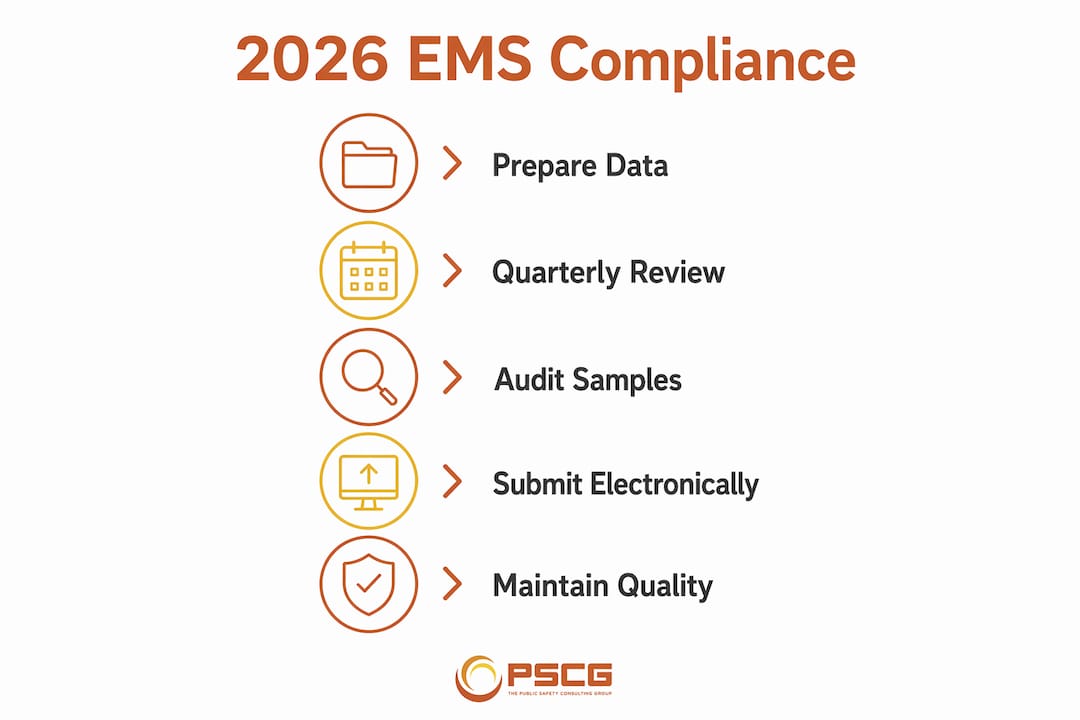
Standardized definitions matter as much as the elements themselves. A field labeled “response time” must match the jurisdictional definition exactly. Inconsistent definitions cause data rejection at the state level, which triggers compliance flags and delays reporting cycles.
What are the typical submission processes and timelines?
Submission timelines are not suggestions. They carry regulatory weight, and missing them creates documented compliance failures. Here is how the process typically works across jurisdictions:
Complete the patient care report at the scene or immediately after transport. Field providers must document all required elements before the end of their shift. Waiting until the next day creates gaps that are difficult to correct accurately.
Conduct a first-level review at shift handoff. Internal first-review protocols at shift changes reduce late corrections and support compliance with short reporting deadlines. A supervisor or charge medic should verify completeness before the crew clears.
Submit electronically through an approved platform. Ontario’s ambulance documentation standards require electronic submission within 2 business days of the incident. Fax is explicitly prohibited. Electronic platforms must meet HL7 v3 or higher standards to satisfy HIPAA and data integrity requirements.
Meet state-specific deadlines. Kentucky requires submission within 120 hours for 90% of responses. Agencies that miss that threshold face disciplinary action and financial penalties.
Monitor completeness and accuracy metrics. State agencies track submission rates and flag agencies that fall below thresholds. Compliance monitoring is ongoing, not just during formal audits.
Pro Tip: Build your internal review workflow backward from the submission deadline. If your state requires submission within 120 hours, your internal sign-off should happen no later than 72 hours post-incident. That buffer gives your data manager time to catch and correct errors before the regulatory clock runs out.
The prohibition on fax and paper submission is now widespread. Electronic reporting platforms must comply with HL7 v3 or higher and structure data according to jurisdictional data dictionaries. Agencies still relying on legacy paper workflows face both compliance risk and operational inefficiency.
How do EMS agencies ensure data quality and compliance?
Data quality is the most common failure point in EMS reporting compliance. Automated data submission fails during audits when required fields are blank or formatted incorrectly. That finding from NASEMSO guidance reflects a pattern seen across agencies of all sizes. The problem is rarely intentional. It stems from undertrained field providers, outdated software configurations, and the absence of a formal quality review process.

The three pillars of compliance are accuracy, completeness, and timeliness. Agencies that treat these as separate concerns tend to struggle. The most effective approach addresses all three simultaneously through a structured data management program.
Specific practices that produce measurable compliance improvements include:
- Automated field validation: Configure your electronic patient care record (ePCR) platform to flag incomplete or out-of-range entries before a report can be finalized. This catches errors at the source, not during a state audit.
- Standardized electronic forms: Use forms that mirror the NEMSIS data dictionary exactly. Custom fields that do not map to standard elements create reporting gaps.
- Ongoing provider training: EMS agencies often fail compliance audits due to insufficient coding for newer NEMSIS versions. Regular training on documentation standards, not just clinical skills, closes that gap.
- Privacy compliance through the minimum-necessary principle: The minimum-necessary principle guides EMS data sharing across state lines, limiting exposure of patient information to what is strictly required for the receiving agency’s purpose.
Pro Tip: Assign a designated data quality officer within your agency, even if it is a part-time role. Agencies with a named individual responsible for data integrity consistently outperform those that treat documentation as a collective responsibility with no clear owner.
Continuous auditing matters more than periodic review. Agencies that audit a sample of reports weekly catch systemic errors before they compound. Agencies that audit quarterly often discover problems only after a state compliance flag has already been issued.
What do these requirements mean for municipal leaders and EMS professionals?
EMS data reporting requirements carry direct operational and financial consequences for municipal leaders. High-quality data supports resource allocation decisions, performance benchmarking, and public safety advocacy. Agencies that report accurately and on time build a documented performance record that strengthens grant applications and budget requests.
Municipal leaders bear responsibility for the systems and policies that make compliance possible. That means:
- Investing in compliant ePCR platforms that meet current HL7 and NEMSIS version requirements. Outdated software is a compliance liability, not just an operational inconvenience.
- Coordinating with state EMS offices to understand jurisdiction-specific data dictionaries and submission portals. Requirements vary, and assuming your platform is compliant without verification is a common mistake.
- Integrating reporting standards into EMS system design from the start. Retrofitting compliance into an existing system costs more and takes longer than building it in from the beginning.
- Using data transparency to support advocacy. Standardized EMS data reporting frameworks like SEMSTAR enable benchmarking and multi-center research for advanced prehospital care. That comparability gives municipal leaders credible evidence when arguing for funding or policy changes.
EMS professionals in the field carry equal responsibility. Documentation accuracy starts with the provider who writes the patient care report. Leaders who invest in field-level training on digital documentation practices see measurable improvements in data quality within one reporting cycle.
Key Takeaways
Compliance with EMS data reporting requirements depends on three non-negotiable factors: standardized data elements aligned to NEMSIS v3.5, electronic submission within regulated timeframes, and continuous internal quality review.
| Point | Details |
|---|---|
| NEMSIS v3.5 is the national baseline | States like Georgia mandate this version for all EMS responses, with no exceptions. |
| Submission deadlines carry penalties | Kentucky requires 90% of reports within 120 hours; missed deadlines trigger disciplinary action. |
| Electronic-only submission is the standard | Fax and paper are prohibited; platforms must meet HL7 v3 or higher requirements. |
| Data quality requires a named owner | Agencies with a designated data quality officer consistently outperform those without one. |
| Accurate data drives funding and advocacy | High-quality reporting supports grant applications, resource planning, and performance benchmarking. |
Why I think most agencies are treating data reporting as the wrong kind of problem
After working with EMS agencies across multiple states, the pattern I see most often is this: leaders treat data reporting as a compliance checkbox. They focus on avoiding penalties rather than building a reporting infrastructure that actually serves the agency. That framing is the root cause of most compliance failures.
The agencies that perform best do not think about NEMSIS v3.5 as a burden. They treat their data as a strategic asset. When your reporting is accurate, complete, and timely, you have a documented performance record that no one can argue with. You can walk into a budget meeting with response time benchmarks, patient outcome data, and call volume trends. That is a fundamentally different conversation than showing up with anecdotal evidence and hoping for the best.
The shift from mere data submission to data quality focus is the defining challenge for EMS leadership in 2026. Agencies that embed compliance troubleshooting into routine operations, rather than treating it as an annual audit event, build durable systems. The ones that wait for a state flag to trigger a review spend twice the effort fixing problems that should never have accumulated. Start with your internal review workflow. If you cannot tell me who reviews each report, when they review it, and what they do when they find an error, your compliance process has a gap. Close that gap before your state does it for you.
— Mike
How Thepscgroup supports EMS reporting compliance and system design
Thepscgroup works directly with EMS agencies and municipal leaders to build reporting systems that meet current regulatory standards and hold up under audit. Our team specializes in EMS system design, data compliance strategy, and operational risk reduction, bringing field-tested experience to every engagement.
If your agency is working through NEMSIS version transitions, submission workflow gaps, or state compliance requirements, our EMS system design consulting services provide the structured support you need. We also offer municipal EMS strategy guidance for leaders who want to connect reporting compliance to broader operational performance goals. Reach us at thepscgroup.net to start the conversation.
FAQ
What is NEMSIS and why does it matter for EMS reporting?
NEMSIS, the National EMS Information System, is the national data standard that defines required data elements for EMS patient care reports. States like Georgia mandate NEMSIS v3.5 for all EMS responses to support uniform, high-quality data submission at both the state and national level.
How quickly must EMS agencies submit incident reports?
Submission deadlines vary by jurisdiction. Ontario requires electronic submission within 2 business days; Kentucky requires 90% of reports within 120 hours of the incident. Missing these deadlines can trigger disciplinary action and financial penalties.
What happens if EMS data is incomplete or incorrectly formatted?
Incomplete or incorrectly formatted data causes automated submissions to fail during audits, as documented in NASEMSO guidance. Agencies face compliance flags, potential penalties, and delayed reporting cycles when required fields are blank or coded to outdated standards.
Can EMS agencies still submit reports by fax or paper?
No. Most jurisdictions now prohibit fax and paper submission. Electronic platforms must meet HL7 v3 or higher standards to satisfy HIPAA requirements and ensure data integrity.
How does data quality affect EMS funding and resource decisions?
Accurate and complete EMS data directly supports resource allocation, performance benchmarking, and public safety advocacy. Agencies with strong reporting records use that documented performance to strengthen grant applications and budget requests with municipal governments.