

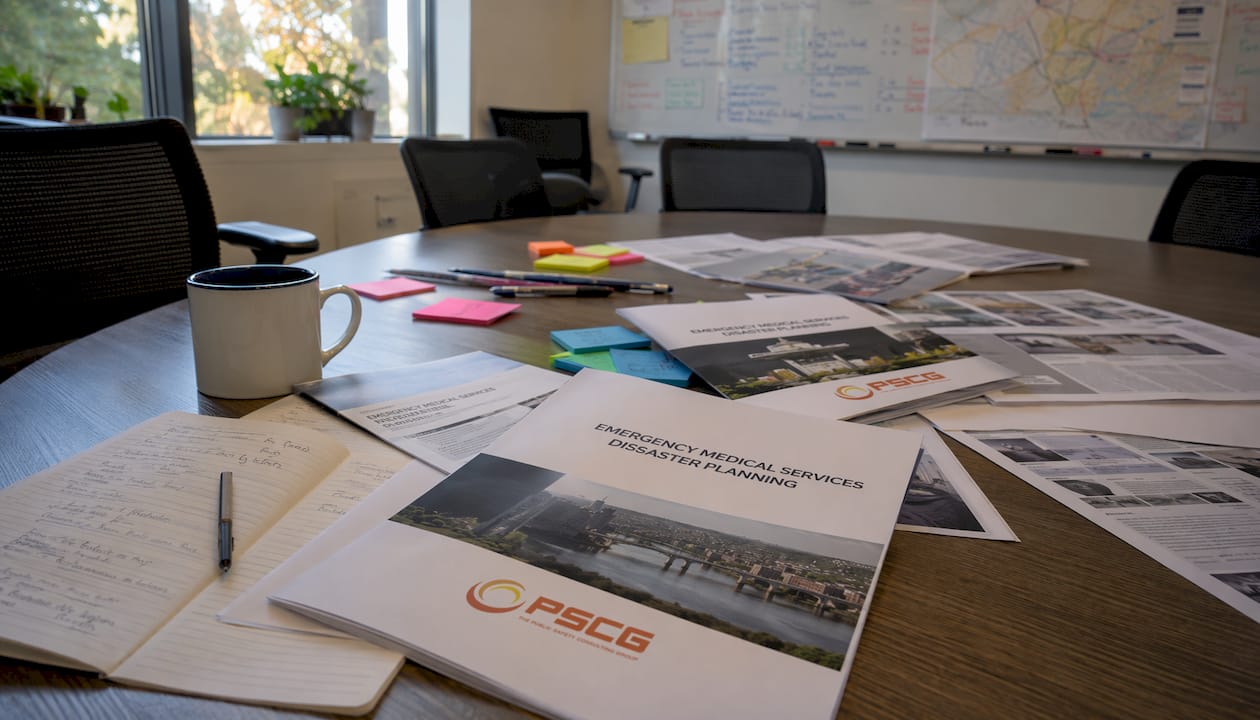
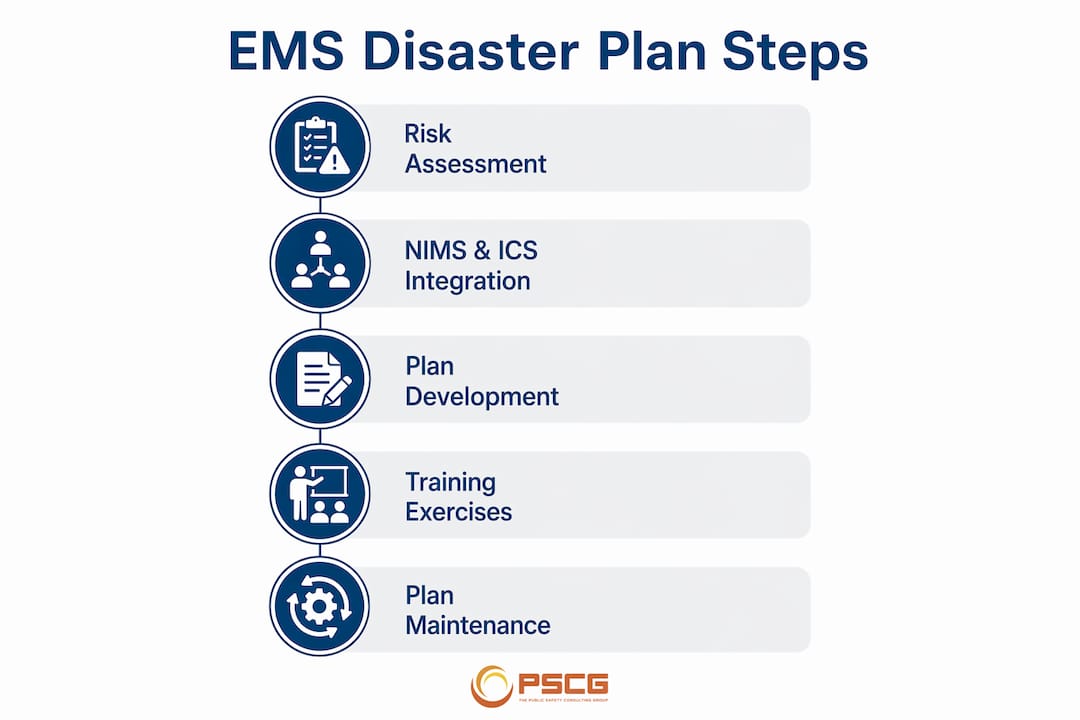
Building effective EMS disaster plans requires five structured steps: risk identification and assessment, integration of National Incident Management System (NIMS) and Incident Command System (ICS) standards, development of comprehensive plan components, rigorous training and exercise testing, and disciplined plan maintenance. These steps, grounded in FEMA’s Comprehensive Preparedness Guide (CPG 101) and federal emergency management doctrine, form the backbone of any credible EMS disaster preparedness strategy in 2026.
The critical components your plan must address from day one:
- Risk identification: Hazard vulnerability analysis (HVA) using structured models like SMAUG
- Federal framework alignment: Full compliance with NIMS and ICS principles
- Plan components: Clear activation triggers, defined roles, communication systems, mutual aid agreements, and incident-specific annexes
- Training and exercises: Tabletop, functional, full-scale simulations, and routine micro-drills
- Maintenance: Annual or biennial review cycles tied to real-world lessons and resource changes
- Legal compliance: Written mutual aid agreements, NIMS compliance mandated by FEMA, and coordination with the Assistant Secretary for Preparedness and Response (ASPR)
- Interoperability: Unified command structures connecting EMS with fire, law enforcement, public health, and hospital systems
The emergency management cycle runs through four phases: mitigation, preparedness, response, and recovery. Your disaster plan must address all four, not just the response phase that tends to dominate planning conversations. Agencies that treat preparedness as a document exercise rather than an operational discipline consistently underperform when real incidents occur. The goal is a living system, not a binder on a shelf.
1. How to conduct risk identification and assessment for EMS disaster planning
Risk identification is where every credible EMS disaster plan begins. Before you can write a single protocol, you need a clear picture of what your community actually faces, how severe those threats are, and where your operational gaps exist. Skipping this step produces plans that look thorough on paper but collapse under the specific pressures of a real event.
Starting with a hazard vulnerability analysis
A hazard vulnerability analysis (HVA) is the structured process for identifying, ranking, and prioritizing the threats most likely to affect your service area. The HVA examines both internal hazards (facility failures, staffing shortfalls, equipment breakdowns) and external ones (natural disasters, mass casualty incidents, infrastructure collapse). Geographic features deserve particular attention: dams, fault lines, flood plains, terrain that limits access to portions of your coverage area, and seasonal weather patterns that affect EMS operations all belong in your assessment.
Your HVA should also account for the local economic environment, community crime statistics, and demographic vulnerabilities. Populations with limited English proficiency, residents who depend on home medical equipment, and communities with high rates of mobility limitations require specific planning considerations that generic all-hazards templates often miss.
Using the SMAUG model to prioritize hazards
Once hazards are identified, the SMAUG model gives planners a structured, objective method for ranking them. SMAUG evaluates each hazard across five criteria:
- Seriousness: Potential impact on life, property, and financial resources
- Manageability: Your agency’s capacity to mitigate or control the hazard
- Acceptability: Whether the consequences are tolerable to the community and stakeholders
- Urgency: How immediately the hazard demands action
- Growth: The likelihood that the hazard’s probability or severity increases over time
Each hazard receives a high, medium, or low rating across all five dimensions. The combined profile drives your prioritization decisions and directly informs where you allocate planning resources.
Sample hazard ranking table
| Hazard | Seriousness | Manageability | Acceptability | Urgency | Growth | Priority |
|---|---|---|---|---|---|---|
| Mass casualty incident (MCI) | High | Medium | Low | High | Medium | High |
| Pandemic/infectious disease | High | Low | Low | High | High | High |
| Severe weather/flooding | High | Medium | Medium | Medium | High | High |
| Hazmat incident | Medium | Medium | Low | High | Low | Medium |
| Infrastructure failure | Medium | High | Medium | Low | Medium | Medium |
| Civil unrest | Medium | Medium | Medium | Medium | Low | Medium |
Pro Tip: Run your HVA with input from local emergency management, public health, hospital partners, and community representatives. A single-agency HVA routinely misses vulnerabilities that cross-sector partners identify immediately.
The resource gap analysis is the final piece of this step. Map your current personnel, equipment, facilities, and mutual aid capacity against the demands each high-priority hazard would generate. Where the gap is widest, your plan needs the most specific protocols.
2. How to integrate NIMS and ICS standards into your EMS disaster plan
NIMS and ICS are not optional frameworks for EMS agencies receiving federal preparedness funding. As of 2026, FEMA mandates that EMS agencies coordinate with fire, law enforcement, and public health under NIMS, with designated authorities assigned to activate plans. Compliance is a condition of federal grant eligibility, and more practically, it is the only way to achieve genuine interoperability when a major incident pulls multiple agencies into a unified response.
What NIMS and ICS actually do
NIMS provides the overarching framework. It is organized around five core components:
- Preparedness: Training, exercises, and credentialing standards
- Communication and information management: Common terminology and interoperable systems
- Resource management: Typed resources, mutual aid, and tracking
- Command and management: ICS, Multiagency Coordination Systems, and Public Information
- Ongoing management and maintenance: Continuous improvement and compliance
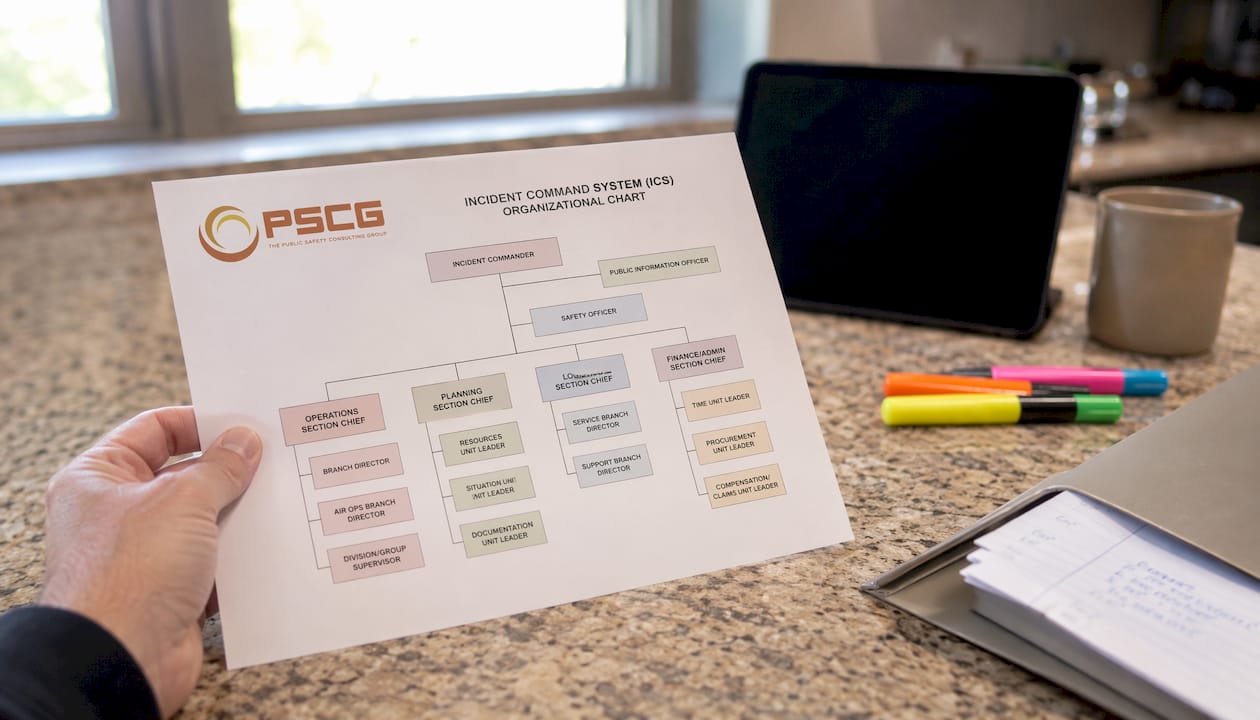
ICS operates within the command and management component. It uses a modular, top-down organizational structure that expands or contracts based on incident scale. The span of control under ICS is typically limited to 3–7 personnel per supervisor, because effective leadership becomes difficult beyond that range. Every resource, including personnel, is tracked in real time for full accountability.
ICS structure in EMS disaster response
| ICS Position | Primary Function |
|---|---|
| Incident Commander | Overall authority; sets incident objectives |
| Operations Section Chief | Tactical execution of the response |
| Planning Section Chief | Situational awareness; Incident Action Plan |
| Logistics Section Chief | Resources, supplies, transportation |
| Finance/Admin Section Chief | Cost tracking, procurement, claims |
| Safety Officer | Monitors hazards; protects responder safety |
| Liaison Officer | Coordinates with external agencies |
| Public Information Officer | Manages media and public communications |
For larger incidents, a Unified Command structure brings together agency heads from EMS, fire, law enforcement, and public health to make joint decisions while each agency retains its own operational authority. Your plan must specify exactly who holds activation authority, typically the highest-ranking staff member on duty, and how command transfers as the incident escalates.
Your EMS disaster plan should reference NIMS explicitly and incorporate ICS principles throughout. The plan’s activation criteria, role assignments, communication protocols, and resource requests all need to align with ICS terminology so that any responding agency, regardless of jurisdiction, can integrate without confusion.
3. Developing comprehensive EMS disaster plan components
A well-built emergency operations plan (EOP) is not a procedural manual. Plans that are excessively detailed or overly lengthy consistently underperform during actual operations because responders cannot locate critical information under stress. The goal is a plan that is brief enough to be used, flexible enough to adapt, and specific enough to guide decisions when conditions are chaotic.
Base plan structure
Your EOP base plan should cover:
- Mission and scope: What the plan covers and what it does not
- Activation authority: Who can activate the plan and under what criteria
- Command structure: ICS chart with named positions and alternates
- Concept of operations: The sequence from recognition through demobilization
- Resource inventory: Personnel, equipment, facilities, and external assets
- Communication plan: Primary and backup systems with designated frequencies and platforms
- Mutual aid provisions: Written agreements with partner agencies
- Vulnerable population protocols: Specific provisions for children, adults with disabilities, and non-English speakers
- Recovery transition: Criteria and process for shifting from response to recovery operations
Incident-specific annexes
Your base plan cannot anticipate every scenario in equal depth. Incident-specific annexes address the hazards your HVA ranked highest, including pandemic response, mass casualty incidents, natural disasters, hazmat events, and civil unrest. Each annex should include contingency plans and standard operating procedures tailored to that event type, without duplicating the base plan’s command structure.
Mutual aid agreements
Written mutual aid agreements are not a formality. Informal relationships degrade under the stress of a real disaster, particularly when key personnel turn over. Documented agreements define exactly what resources each partner commits, under what conditions, and who authorizes deployment. The Emergency Management Assistance Compact (EMAC) provides a national framework for interstate mutual aid, and your plan should reference it explicitly alongside local and regional agreements.
Communication technology and backup systems
Your communication plan needs primary, secondary, and tertiary options. When primary radio systems fail, which they do in major incidents, your team needs a pre-established fallback. Options to address in your plan include:
- Primary: Agency radio systems and CAD integration
- Secondary: Interoperable radio platforms (P25 systems, mutual aid channels)
- Tertiary: Cellular, satellite phones, or mesh network devices for field units
- Out-of-band: Runners, physical message boards at the command post
Surge capacity and resource allocation
Your plan must define how you will scale operations when demand exceeds normal capacity. Surge capacity planning addresses staffing (call-back protocols, mutual aid personnel), equipment (caches, vendor agreements), and facilities (alternate staging areas, field treatment sites). Define the thresholds that trigger each level of surge response so that activation decisions are criteria-based, not judgment calls made under pressure.
Psychological support and personnel resilience
Personnel resilience planning belongs in the base plan, not as an afterthought. Identify your Critical Incident Stress Management (CISM) resources, peer support contacts, and Employee Assistance Program access before an incident occurs. Specify when and how debriefings will be conducted following mass casualty events, and assign a staff member to coordinate mental health follow-up during extended operations.
For agencies looking to reduce operational vulnerabilities across their planning framework, operational risk reduction strategies provide a practical foundation for identifying and closing gaps before they become liabilities.
4. How training and exercises validate your EMS disaster plan
The planning process itself builds the shared understanding that makes a response work. Training and exercises are not supplementary activities; they are how you find out whether your plan actually functions before lives depend on it. A document that has never been tested is a hypothesis, not a plan.
Types of exercises and what each one tests
Tabletop exercises bring key personnel together to walk through a scenario in a conference room setting. They test decision-making, role clarity, and interagency coordination without the logistical demands of a field deployment. Tabletops are low-cost, high-value, and should be conducted at minimum annually with your full command staff.
Functional exercises test specific functions, such as communications, resource deployment, or medical coordination, in a more realistic setting without full field mobilization. They are particularly useful for stress-testing your backup communication systems or your mutual aid activation process.
Full-scale exercises deploy personnel and equipment in a simulated real-world scenario. They reveal interoperability gaps, equipment failures, and command structure weaknesses that tabletops cannot surface. Joint full-scale exercises with fire, law enforcement, and hospital partners are the gold standard for testing unified command.
Micro-drills are the most underused tool in EMS preparedness. Routine small-scale drills integrated into regular training maintain ICS proficiency and identify interoperability gaps more effectively than infrequent large simulations. A 20-minute mass casualty triage drill during a regular shift keeps skills current without the scheduling burden of a full exercise.
After-action reviews
Every exercise, regardless of scale, should conclude with a structured after-action review (AAR). The AAR identifies what worked, what did not, and what specific changes the plan or training program needs. Assign a responsible party and a deadline to each corrective action. An AAR without follow-through is just a conversation.
Cross-agency participation in exercises is not optional for agencies that expect to operate in a unified command. Your fire department, law enforcement, public health partners, and receiving hospitals all need to exercise alongside your EMS teams. Gaps in interoperability only become visible when the agencies that need to work together actually try to do so under simulated pressure.
For organizations operating in high-threat environments, active shooter training resources offer specialized preparation that complements standard EMS mass casualty protocols and strengthens overall responder readiness.
5. Maintaining and updating your EMS disaster plan for sustained readiness
A plan that was accurate when it was written becomes a liability if it is not updated. Personnel change, resources shift, new threats emerge, and lessons from real events reveal gaps that no planning team anticipated. The EOP is a living document, and treating it as one requires a disciplined maintenance process.
Review intervals and triggers
Plans should be reviewed annually, or at minimum every two years. Beyond scheduled reviews, specific triggers should prompt an immediate revision:
- A real-world activation that revealed plan deficiencies
- A major exercise with significant corrective actions identified
- Significant personnel changes in command positions
- Changes to mutual aid agreements or partner agency capabilities
- New or emerging threats identified in an updated HVA
- Changes to federal or state regulatory requirements
- Significant shifts in community demographics or infrastructure
Plan maintenance checklist
- Verify all contact information for command staff, mutual aid partners, and external agencies
- Confirm that mutual aid agreements are current and signed by authorized parties
- Update the resource inventory to reflect current personnel, equipment, and facility status
- Review incident-specific annexes against the most recent HVA results
- Incorporate corrective actions from the most recent AAR
- Validate that communication systems and backup platforms remain operational
- Confirm that NIMS compliance documentation is current
- Review psychological support resources and CISM contacts for accuracy
- Distribute updated plan copies to all relevant personnel and partner agencies
Integrating lessons from real events
After-action data from actual incidents is more valuable than any exercise finding, because real events surface failure modes that even the best exercise design cannot fully replicate. Build a formal process for capturing lessons from every activation, even minor ones, and route those findings directly into the plan revision cycle. Agencies that do this consistently develop plans that reflect operational reality rather than planning assumptions.
The planning cycle itself, the process of building stakeholder relationships and shared strategies, is as important as the final document. Agencies that engage their partners throughout the maintenance process, rather than distributing a revised document and calling it done, sustain the interoperability that makes coordinated response possible.
6. Leadership and community integration strategies that strengthen EMS disaster plans
The best-written plan will not perform well if the people responsible for executing it are not prepared to lead under pressure. Leadership development is a fifth component of EMS disaster readiness, sitting alongside equipment, personnel, training, and the plan itself. Agencies that invest in command-level leadership training consistently outperform those that treat ICS as a checkbox rather than a practiced discipline.
Building command-level leadership capacity
ICS proficiency at the supervisory level is not the same as command-level readiness. Your incident commanders need experience making high-stakes decisions with incomplete information, managing unified command dynamics with partner agencies, and maintaining situational awareness across a complex, evolving incident. That capability comes from deliberate leadership development, not from reading the plan.
EMS leadership development programs that focus on ICS command and decision-making skills directly improve plan execution outcomes. Agencies should identify their command-track personnel early and invest in progressive training that moves from ICS 100/200 through ICS 300/400 and into applied command exercises with real partner agencies.
Whole-community integration
Engaging local governments, community leaders, and vulnerable populations in the planning process produces more equitable and effective disaster preparedness systems. Community integration is not a public relations exercise. It is how you learn where your plan’s assumptions about resource access, communication reach, and population behavior are wrong before an incident exposes those assumptions at the worst possible moment.
Effective community integration in EMS disaster planning includes:
- Formal coordination with local emergency management agencies and the Local Emergency Planning Committee (LEPC)
- Engagement with public health departments on pandemic and mass casualty protocols
- Partnerships with hospitals and trauma centers on patient surge and diversion planning
- Outreach to community organizations serving populations with access and functional needs
- Coordination with school districts, transit authorities, and utilities on evacuation and shelter planning
- Regular participation in regional planning bodies and multi-agency coordination groups
How Thepscgroup supports EMS disaster planning
Thepscgroup works alongside EMS agency directors and municipal leaders to build disaster preparedness systems that meet 2026 federal standards and reflect the specific operational realities of each community we serve. Our consulting work spans EMS system design, leadership development, operational risk reduction, and interagency coordination, giving agencies a partner who understands both the technical requirements of NIMS/ICS compliance and the organizational dynamics that determine whether a plan actually works under pressure.
We have supported agencies through HVA development, EOP construction, exercise design, and after-action analysis, and we bring that experience directly to your planning team. You can learn more about our approach to EMS system design and how it supports disaster readiness across the full planning cycle.
Ready to build a disaster plan your agency can actually execute? Thepscgroup partners with EMS agencies across the country to develop plans grounded in NIMS/ICS standards, validated through rigorous exercises, and maintained as living operational tools. Visit us at thepscgroup.net to connect with our team.
Key Takeaways
Building EMS disaster plans requires a structured, standards-based process that integrates risk assessment, NIMS/ICS compliance, comprehensive plan components, validated training, and disciplined maintenance to produce a system that performs when it matters most.
| Point | Details |
|---|---|
| Start with risk assessment | Use the SMAUG model and HVA to rank hazards and identify resource gaps before writing any protocols. |
| Align with NIMS and ICS | Federal compliance requires NIMS integration; ICS span of control is typically limited to 3–7 personnel per supervisor. |
| Keep plans brief and flexible | Overly detailed plans reduce usability; focus on activation triggers, core roles, and ICS-based flexibility. |
| Test with micro-drills and exercises | Routine small-scale drills maintain ICS proficiency and reveal interoperability gaps more effectively than infrequent large simulations. |
| Review annually at minimum | Plans should be updated at least every two years, and immediately after any real-world activation or major exercise. |