



Adopt five evidence-based actions now: measure fatigue with validated tools, cap shifts under 24 hours, provide access to caffeine, permit strategic napping, and require fatigue education for every crew member. These recommendations come from the field’s own GRADE-reviewed guidelines, not guesswork, and they only work when leadership commits to measurement and policy alongside them. Waiting for a sentinel event to force the issue costs more than building the program does.
TL;DR:
- Regularly assess fatigue using validated surveys, focusing initially on overnight and high-call-volume shifts to identify the most fatigue-prone areas.
- Limit shifts to less than 24 hours and enforce a mandatory eight-hour rest period before returning to duty during long or extended shifts.
- Implement supervised caffeine access and designate proper rest spaces, allowing strategic naps of up to 90 minutes to support recovery on duty.
- Establish a non-punitive fatigue reporting system with clear supervisor authority to approve immediate time-outs and reassignments for exhausted crew members.
- Lead cultural change with ongoing fatigue education, annual schedule reviews, and a phased pilot program to build sustainable, evidence-based fatigue management practices.
Table of Contents
- What Are the Five EMS Fatigue Management Recommendations?
- How Do You Measure and Monitor EMS Fatigue?
- Why Do 24-Hour Shifts Increase Fatigue Risk in EMS?
- What Countermeasures Actually Reduce Fatigue on Shift?
- How Do You Build a Culture That Supports Fatigue Reporting?
- What’s a Realistic Rollout Plan for a Fatigue Program?
- Which Tools Support Fatigue Risk Management in EMS?
- A Note on Making This Stick
- How PSCG Helps Agencies Put Fatigue Policy Into Practice
- Sources
- FAQ
What Are the Five EMS Fatigue Management Recommendations?
The 2018 Evidence-Based Guidelines translate research into five concrete actions. Each one needs an operational owner, not just a policy line. Fatigue affects a significant portion of EMS personnel at some point, according to the University of Pittsburgh’s coverage of the guidelines, which is reason enough to treat this as a staffing priority rather than an individual coping problem.
- Measure and monitor fatigue using validated survey instruments, tracked on a regular cadence.
- Limit shifts to under 24 hours wherever staffing allows it.
- Provide access to caffeine as a supervised, temporary countermeasure.
- Permit strategic napping on duty, with defined space and time.
- Require fatigue education at onboarding and on a recurring schedule.
Evidence certainty varies across these five items, so tailor cadence and enforcement to your call volume, geography, and staffing model rather than copying a template built for a different agency.
How Do You Measure and Monitor EMS Fatigue?
Fatigue management EMS programs live or die on measurement, and the tools already exist. Validated self-report sleepiness scales, paired with supervisor checklists for overnight and extended shifts, give you a baseline without requiring a clinical sleep lab.
- Deploy a validated fatigue or sleepiness survey quarterly, with heavier sampling on overnight and 24-hour shifts.
- Track training completion rates as a leading indicator, not an afterthought.
- Log the percentage of shifts formally assessed for fatigue risk.
- Monitor fatigue-related incidents and near-misses as a lagging indicator of program impact.
Pro Tip: Start with the shifts you already suspect are the problem. If your overnight transfer unit or a single busy station generates most of your fatigue complaints, assess there first instead of rolling out a survey system-wide on day one.
A substantial number of EMS personnel report meaningful fatigue on the job, based on the NHTSA project report that compiled the underlying evidence. That single data point should be enough to justify a measurement budget line.
Why Do 24-Hour Shifts Increase Fatigue Risk in EMS?
Shifts of 24 hours or longer are consistently linked to worse fatigue-related outcomes, according to research on shift work in EMS. Sleep debt accumulates fast in a job with no guaranteed rest windows, and a single long shift can leave a crew member operating on the cognitive equivalent of legal intoxication by the final hours.
Where long shifts remain operationally unavoidable, especially in rural systems with thin staffing, policy has to do the work that scheduling alone cannot:
- Adopt a formal time-out policy that lets a crew member step back from duty when fatigue crosses a defined threshold.
- Cap consecutive hours worked, with a hard ceiling and at least eight hours off before returning.
- Limit holdovers and mandatory overtime that push a scheduled shift past its planned length.
Review your full schedule annually, and flag stations or units with disproportionate call volume overnight as high-risk for targeted intervention.
Pro Tip: Coordinate with receiving hospitals on low-acuity overnight transfers. Reducing that stacked overnight workload, a point the Pittsburgh guideline coverage highlights, is often cheaper than adding a unit.
What Countermeasures Actually Reduce Fatigue on Shift?
Caffeine and napping both work, but only when they’re managed as tools within a larger fatigue recovery strategy rather than treated as a substitute for sleep. Caffeine buys alertness for a few hours; it does not pay down sleep debt, and leaning on it to justify an unsafe schedule defeats the purpose.
- Provide caffeine access on every shift, with guidance on timing so it doesn’t disrupt the next sleep opportunity.
- Offer short naps of 10 to 30 minutes for a quick alertness boost between calls.
- Offer recovery naps of 60 to 90 minutes on extended or overnight shifts where operations allow it, per EMSKY’s toolkit guidance.
- Designate a real rest space, not a break room repurposed on the fly.
- Build in a buffer period after a nap before a crew member returns to high-risk tasks, to manage sleep inertia.
Supervisors need explicit authority to reassign a groggy crew member to lower-acuity duty for the first several minutes after waking, rather than sending them straight to a call.
How Do You Build a Culture That Supports Fatigue Reporting?
Training only works if the culture around it doesn’t punish honesty. Schedule fatigue education at onboarding and repeat it every two years, matching the cadence the Pittsburgh feature on the national guidelines recommends, with learning objectives that cover sleep science, warning signs, and how to use the reporting system.
- Build a non-punitive reporting channel and track how often it’s actually used.
- Give supervisors clear authority to approve a time-out without escalating through multiple layers first.
- Document a short list of mitigation options: rest, reassignment, relief crew, or safe transport home.
Pro Tip: A non-punitive system that nobody uses is not a non-punitive system. If usage stays near zero after six months, the problem is usually trust, not the policy language.
Non-punitive reporting paired with clear supervisor authority is one of the lowest-cost, highest-impact changes an agency can make, according to research on organizational safety culture.

What’s a Realistic Rollout Plan for a Fatigue Program?
Most agencies stall not because the evidence is unclear but because nobody owns the rollout. A phased approach keeps momentum without overwhelming a department already stretched thin.
- Assess current schedules, incident data, and existing fatigue complaints. Owner: operations chief, 2 to 3 weeks.
- Draft policy covering time-outs, nap permission, and caffeine access. Owner: medical director and HR, 3 to 4 weeks.
- Pilot the policy on one or two high-risk stations or shifts. Owner: shift supervisors, 30 days.
- Evaluate results against baseline incident and survey data. Owner: quality improvement lead, ongoing.
- Scale across the full system once the pilot shows measurable improvement.
Sample policy language to adapt: “Any crew member may initiate a fatigue time-out without penalty. Supervisors will document the report and select from approved mitigation options within 15 minutes.”
Quick checklist for a 30 to 90 day pilot:
- Pick one pilot station and one baseline metric.
- Draft your time-out and nap policy in plain language.
- Train the pilot crew before day one.
- Set a 90 day review date on the calendar now.
Which Tools Support Fatigue Risk Management in EMS?
The NASEMSO implementation guidebook and its companion Shift Schedule Fatigue Risk Analyzer give administrators a starting biomathematical model of how a given schedule pattern scores for fatigue risk.
- Use the Shift Schedule Fatigue Risk Analyzer to flag high-risk rotations before you finalize a new schedule.
- Treat its output as a starting point. It needs local incident and call-volume data layered on top to reflect your actual operation.
- Pull sample policy templates and supervisor checklists from the EMSKY Fatigue Toolkit rather than drafting language from scratch.
A Note on Making This Stick
Guidelines don’t implement themselves, and that’s the gap most agencies underestimate. The evidence has been sitting in a published guideline since 2018, and a majority of departments still run on ad hoc scheduling built more around coverage math than human physiology.
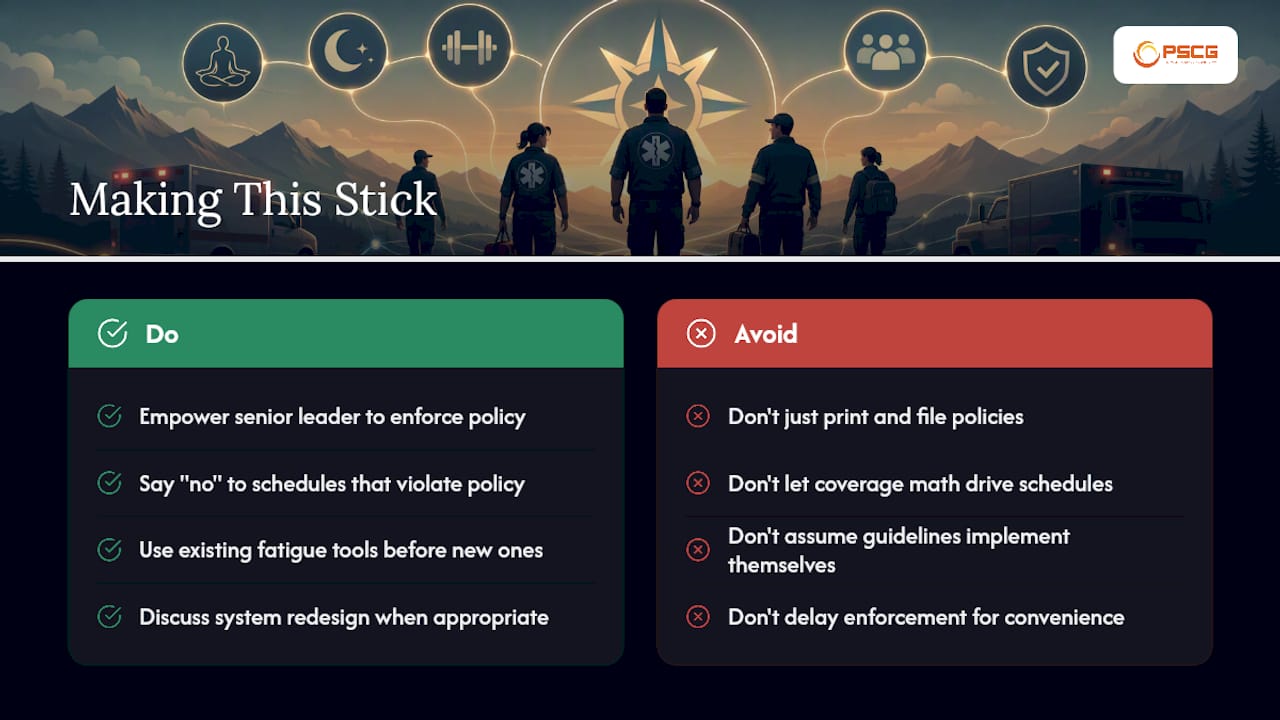
What tends to separate the agencies that actually change outcomes from the ones that print a policy and file it away is leadership follow-through: someone senior enough to say no to a schedule that violates the time-out policy, even when it’s inconvenient. We’ve seen the same pattern in operational risk reduction work across other parts of EMS systems: the fix usually isn’t a new tool, it’s someone with the authority to enforce the one you already have.
Fatigue management works the same way pilot fatigue rules do in aviation, where fatigue policy only holds up when scheduling authority backs it. If your agency is weighing a broader system redesign alongside this work, that’s worth a conversation.
— Mike
How PSCG Helps Agencies Put Fatigue Policy Into Practice
Consulting firms can give agencies a faster path from guideline to working policy than building one alone from scratch. We help departments translate the five evidence-based recommendations into a schedule review, a written time-out and nap policy, and a training rollout your supervisors can actually enforce, not just file.
Teams working in operational risk reduction navigate staffing math, reimbursement pressure, and political realities that make fatigue policy hard to prioritize in budget cycles. That’s the operational risk reduction work we do every day, alongside EMS system design projects that often surface the same scheduling patterns driving fatigue in the first place. If your agency is ready to move past the guideline document and into a working pilot, reach out to Thepscgroup to talk through a phased rollout built around your call volume and staffing model.
Sources
- Fatigue in Emergency Medical Services Systems — NHTSA (Aug 2019)
- Evidence-Based Guidelines for Fatigue Risk Management in Emergency Medical Services (Patterson et al., 2018) — PubMed
- EMS Fatigue Toolkit — EMSKY
- New national guidelines aim to combat fatigue in emergency shift workers — University of Pittsburgh (feature)
FAQ
What Are the Five Evidence-Based Recommendations for EMS Fatigue?
Use validated fatigue survey instruments, limit shifts to under 24 hours, provide caffeine access, permit strategic napping, and require fatigue education at onboarding and every two years, per the 2018 Evidence-Based Guidelines.
What Can EMS Personnel Do to Relieve Extreme Fatigue on Shift?
A short 10 to 30 minute nap or a longer 60 to 90 minute recovery nap on extended shifts, paired with supervised caffeine use, provides temporary relief. Neither replaces actual sleep, so a crew member reporting extreme fatigue should be evaluated for a time-out rather than pushed through the shift.
How Does EMS Fatigue Management Compare to Truck Driver Fatigue Rules?
Both fields rely on limiting continuous duty hours and mandating rest periods, but EMS lacks the federally mandated hours-of-service rules that govern commercial trucking, so most fatigue controls in EMS come from voluntary agency policy rather than regulation.
How Often Should EMS Agencies Reassess Fatigue Risk?
Review full shift schedules annually and reassess fatigue survey data quarterly, with closer attention to overnight and extended shifts where risk concentrates.
Can PSCG Help Design a Fatigue Management Policy for My Agency?
Yes. Thepscgroup works with EMS agencies on scheduling analysis, policy drafting, and training rollout as part of broader operational risk reduction and system design consulting.